Shopify Review Analytics Metrics That Actually Matter
Updated September 6, 2026.
Shopify review analytics is useful when it changes what a team does next. If the output only reports star rating, review count, or a sentiment chart, it is not enough. The metrics that matter are the ones that connect review evidence to search demand, indexation, and conversions from the article itself.
This article is the metrics layer for the Shopify review analytics cluster. The broader workflow and comparison pages already own the operating model and buying criteria. This page focuses on the four numbers a growth team should care about when the article is live:
- organic clicks
- indexed URL count
- qualified signups
- assisted conversions from the article URL
Why these four metrics matter
A review analytics article should not be judged only by traffic. Traffic without indexation, indexation without signups, and signups without assisted conversions are all partial wins.
| Metric | What it tells you | Why it matters |
|---|---|---|
| Organic clicks | Whether searchers found and chose the page | Measures demand capture from the target query |
| Indexed URL count | Whether the article is eligible to be discovered | Confirms the page can actually compete in search |
| Qualified signups | Whether the page attracts the right audience | Filters out low-intent visits and vanity traffic |
| Assisted conversions from the article URL | Whether the article supports the buying path | Shows whether the page contributes to downstream pipeline |
If one of those numbers is missing, the article is not doing its full job.
What to watch in the first 30 days
Start with a bounded window. For a new article, the first 30 days matter more than the first day.
| Time window | What to inspect |
|---|---|
| Days 1-7 | Indexation, title/canonical correctness, crawl visibility |
| Days 8-14 | Early clicks, query match, and whether the topic is attracting the right audience |
| Days 15-21 | Signup quality, internal-link performance, and repeat visits |
| Days 22-30 | Assisted conversions and whether the article supports the wider content path |
That window is enough to tell whether the article is becoming a useful asset or just another page in the archive.
How to interpret each metric
Organic clicks
Organic clicks tell you whether the title, meta description, and topic framing are good enough to earn the visit. For this page, the target intent is practical middle-funnel evaluation. The click should come from someone who wants a real metric stack, not a generic explanation of Shopify reviews.
Indexed URL count
Indexed URL count tells you whether the page is discoverable at all. If the article is not indexed, no amount of good writing will save it. Check the source route, canonical, and locale routes together, because indexing issues often start with publication drift rather than content quality.
Qualified signups
Qualified signups are the strongest signal that the article is attracting the right reader. For VOC.AI, a qualified signup is a visitor who is plausibly interested in review intelligence, product research, or customer-feedback workflows, not just a casual browser.
Assisted conversions from the article URL
Assisted conversions are the most important long-tail metric here. A page can look modest on last-click attribution and still help move buyers toward a trial or demo. That is especially true for metrics articles, which often shape evaluation criteria before the buyer converts.
The scorecard logic
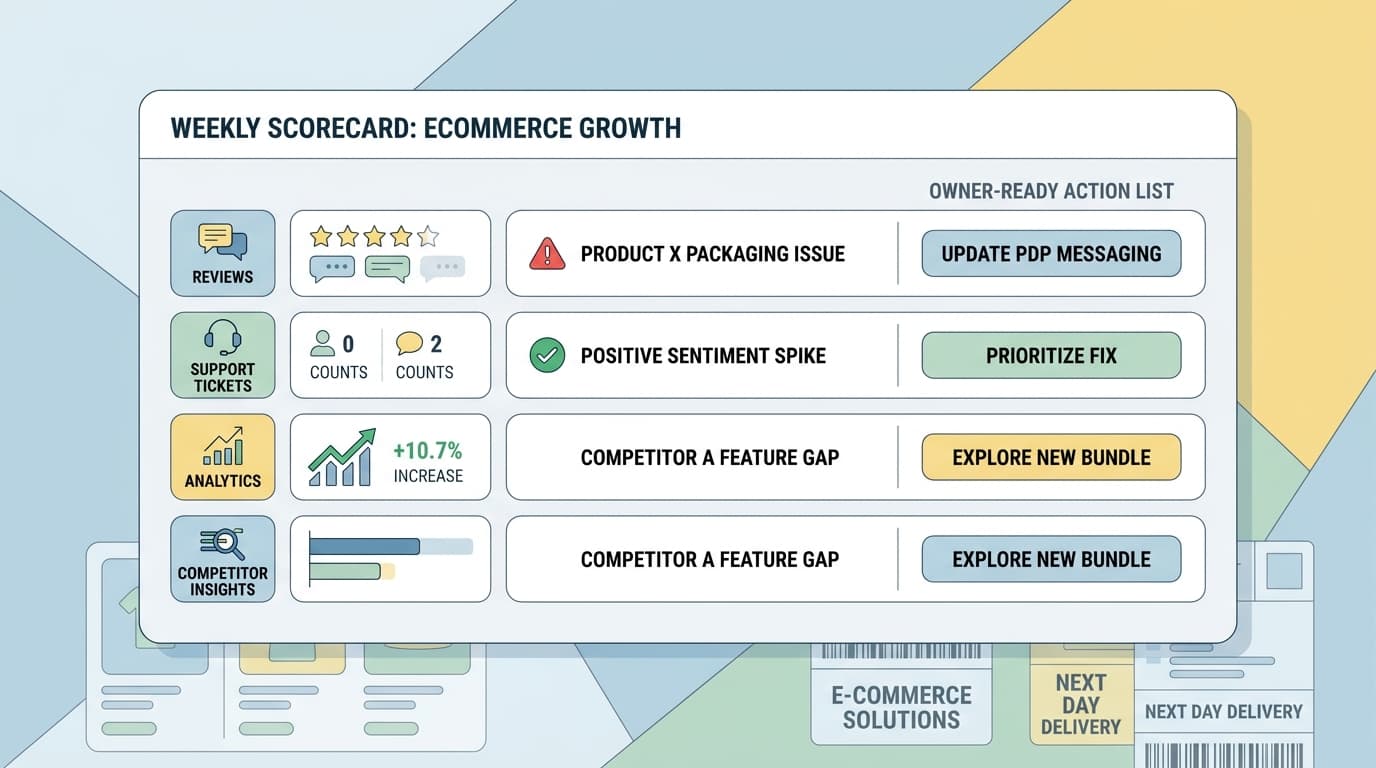
Use the article as a weekly scorecard input, not a one-time publish event.
| Question | Metric to inspect | Follow-up |
|---|---|---|
| Did searchers find the page? | Organic clicks | Rework title or meta description |
| Can the page compete in search? | Indexed URL count | Check canonical, route, and crawl status |
| Are we attracting the right reader? | Qualified signups | Tighten intent, examples, or internal links |
| Does the page support revenue? | Assisted conversions | Improve CTA path and related article links |
A page that fails one row can still be salvageable. A page that fails all four usually needs rework.
How this fits the VOC.AI cluster
This page sits under the broader Shopify review analytics cluster.
- Use Shopify Review Analytics Comparison for buyer evaluation criteria.
- Use Shopify Review Analytics: Practical Guide for Teams for the weekly operating workflow.
- Use Shopify Review Analytics Tools: Evaluation Framework when the buying question is tool selection.
This page owns the metric lens: what to count, how to read it, and how to know whether the article is doing its job.
Conclusion
If a Shopify review analytics page does not produce organic clicks, indexation, qualified signups, and assisted conversions, it is not doing enough work.
The right scorecard is simple. Count the page, not just the pageview. Count the readers who matter, not just the visits. Count the assisted conversions, not just the final click.