Churn rarely starts with the cancellation click.
It starts when a customer repeats the same workaround for the fifth time. When a promised integration fails during a critical workflow. When a pricing surprise changes the perceived value of the product. When support resolves the ticket but not the reason the ticket existed.
By the time those customers appear in a churn report, the product team is looking at an outcome rather than the events that created it.
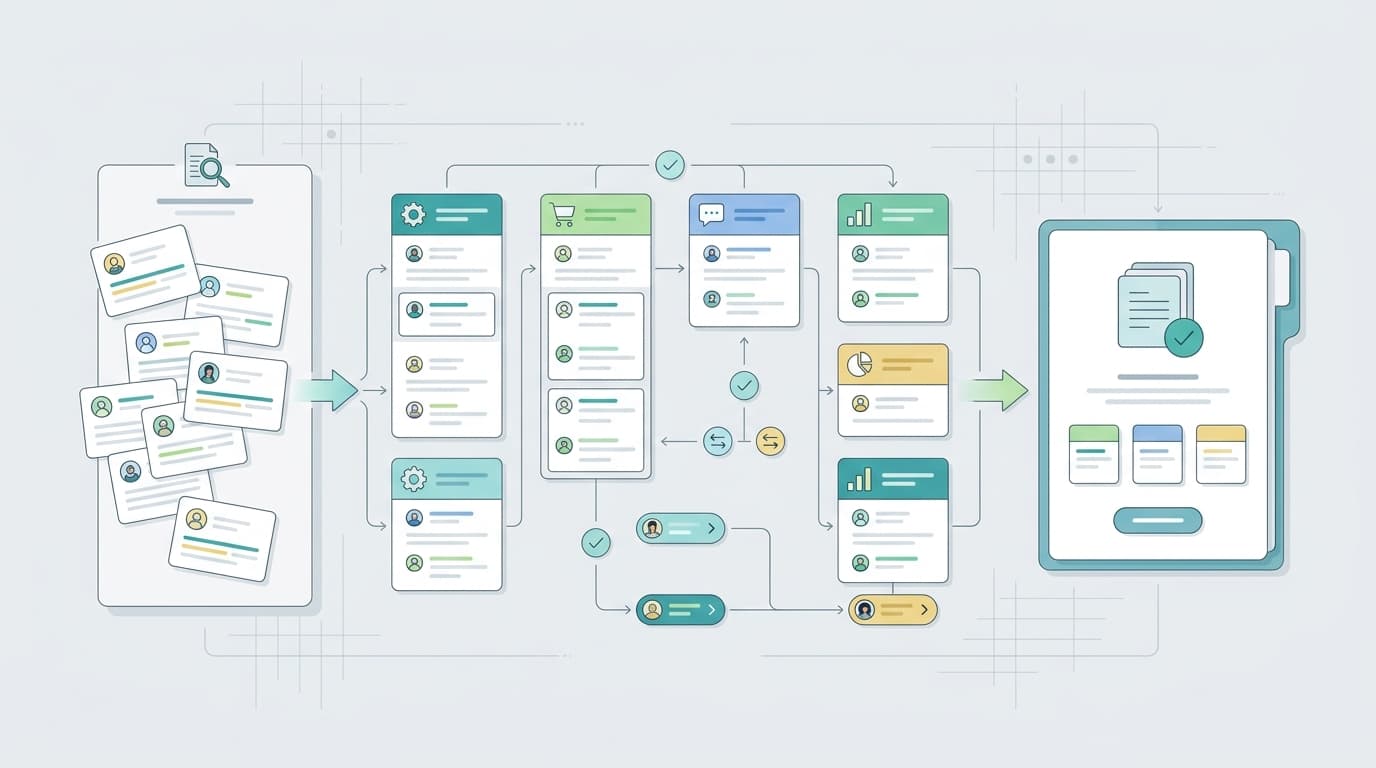
Review mining for churn analysis helps teams study those earlier events. It turns reviews, support conversations, survey comments, community posts, and cancellation notes into structured evidence about where customer confidence is weakening.
But it has an important limit: customer language is not a churn probability model. A complaint can reveal risk without proving that a customer will leave. The useful workflow is to treat qualitative feedback as an early-warning system, then corroborate it with account, product, support, and revenue data before acting.
This guide shows how.
What review mining can—and cannot—tell you about churn
Review mining is the systematic analysis of customer language to find repeated situations, expectations, breakdowns, workarounds, and outcomes.
For churn work, it can help answer questions such as:
- Which product failures repeatedly damage trust?
- What expected outcome are customers failing to achieve?
- Which workarounds make the product feel replaceable?
- Where does pricing become unfair in the customer's words?
- Which support or onboarding gaps extend time to value?
- What complaints are concentrated in a specific plan, segment, use case, or lifecycle stage?
- Which themes appear before downgrades, non-renewals, or cancellation requests?
It cannot tell you, by itself:
- the probability that an individual customer will churn;
- whether a complaint caused a cancellation;
- how representative public reviewers are of the full customer base;
- whether a product change will improve retention;
- which account should receive an automated intervention.
That distinction matters because public reviews are self-selected. Customers who post are not a random sample of everyone who uses the product. Review platforms can also contain manipulated or incentivized content; the US Federal Trade Commission's rule on fake reviews and testimonials is one reason teams should preserve source context rather than treating every review as equally reliable.
The correct claim is not “this theme predicts churn.” It is “this theme is a plausible retention risk that deserves corroboration.”
The five-part churn-risk evidence record
Sentiment labels are too broad for churn analysis. “Negative” does not explain what happened, whether the problem matters, or what a team can change.
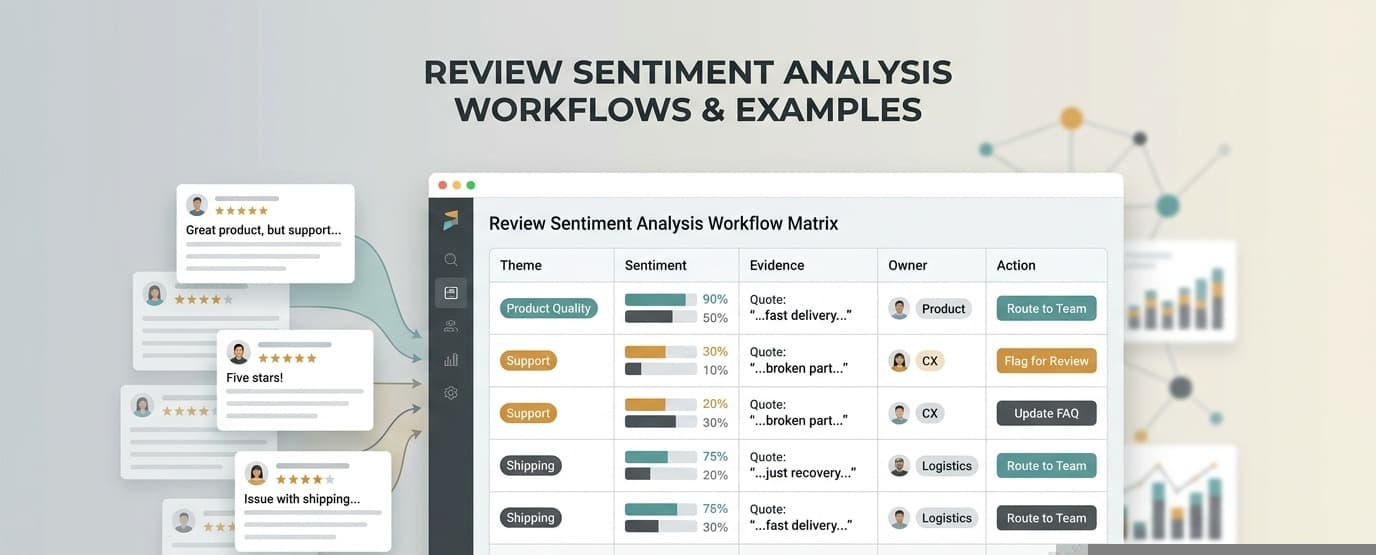
Instead, turn each useful comment into an evidence record with five fields.
| Field | Question | Example |
|---|---|---|
| Situation | What was the customer trying to do? | Prepare a weekly customer-insight report for leadership |
| Expectation | What did they believe the product would provide? | Import support feedback without manual cleanup |
| Breakdown | What failed or created friction? | Field mapping changed after every export |
| Workaround | What did the customer do instead? | Rebuilt the analysis in a spreadsheet |
| Retention consequence | How did the event affect continued use? | Product became optional rather than part of the weekly workflow |
This structure separates a vague complaint from a customer event.
Compare these two notes:
“The integration is frustrating.”
and:
“The support export changed columns again, so our PM rebuilt the report manually and stopped using the integration for the monthly review.”
The second record contains a situation, failure, workaround, and loss of workflow dependence. That is much more useful for churn investigation.
A practical review-mining workflow for churn analysis
1. Define the retention decision first
Do not begin with “find churn insights.” Begin with a decision your team may actually make.
Examples:
- Which onboarding breakdown should we investigate this sprint?
- Which recurring complaint should trigger customer interviews?
- Why are customers on one plan downgrading after three months?
- What product dependency is missing from accounts that do not renew?
- Which billing surprise should product, finance, and support resolve together?
A decision boundary prevents the analysis from becoming a long list of complaints with no owner.
It also determines the evidence window. An onboarding question may need comments from the first 30 days. A renewal question may require feedback from the months before contract review. A product-quality question may need version, release, device, or integration context.
2. Build a traceable source set
Combine feedback sources that capture different parts of the customer journey:
- public product reviews;
- support tickets and chat transcripts;
- cancellation and downgrade reasons;
- onboarding survey comments;
- NPS, CSAT, or relationship survey verbatims;
- community and social posts;
- sales loss notes;
- customer-success call summaries;
- interview transcripts.
Keep a source reference, date, channel, segment, lifecycle stage, product version, and account identifier where policy permits. Remove unnecessary personal data and restrict access to sensitive fields. The NIST Privacy Framework is a useful starting point for aligning data processing with privacy risk management.
Do not flatten the sources into one anonymous text pile. A public review from a former customer, an in-app comment from an active administrator, and a support ticket from a trial user carry different context.
If your team needs a broader research design before clustering, use the workflow in review mining for user research.
3. Normalize the language into churn-risk themes
Customers describe the same failure in different words. One person says “setup took forever,” another says “we never got the data connected,” and a third says “the trial ended before we saw anything useful.”
Normalize those comments under a precise theme such as:
Delayed time to first value because data connection fails during onboarding.
A useful churn-risk theme names:
- the customer context;
- the expected outcome;
- the breakdown;
- the consequence for continued use.
Avoid buckets such as “UX,” “pricing,” “bugs,” or “support.” They are departments, not explanations.
More diagnostic themes look like this:
- Administrators cannot complete a recurring report without manual rework, so usage shifts back to spreadsheets.
- Small teams encounter plan limits before they have demonstrated value internally, making the upgrade feel premature.
- Customers receive a technically correct support response but still cannot complete the blocked workflow.
- A core integration becomes unreliable after upstream changes, reducing trust in scheduled reporting.
- New users cannot distinguish setup work from product value, so the trial feels like implementation labor.
4. Add context before counting frequency
Twenty complaints are not automatically more important than five.
Add context that changes the meaning of a theme:
- customer segment;
- plan and contract type;
- tenure or lifecycle stage;
- primary use case;
- role and permission level;
- acquisition source;
- product version;
- integration or device;
- region and language;
- whether the customer later renewed, downgraded, or churned.
A low-frequency problem in a high-value, fast-growing segment may deserve more investigation than a common cosmetic complaint. A theme concentrated among new customers may be an onboarding issue, while the same language among mature customers may signal product regression.
Context also protects the team from universalizing the loudest feedback.
5. Score investigation priority, not predicted churn
Create a transparent prioritization score for investigation. Do not disguise it as a machine-learning probability.
One simple model is:
Investigation priority =
  evidence strength
  × workflow criticality
  × recurrence
  × segment exposure
  × strategic relevance
  × reversibility factor
Define each factor explicitly.
| Factor | High score means |
|---|---|
| Evidence strength | Multiple traceable records describe the same event |
| Workflow criticality | The failure blocks a job the customer hired the product to do |
| Recurrence | The theme appears repeatedly across time or sources |
| Segment exposure | The affected segment is material to the retention question |
| Strategic relevance | The issue touches the product's intended differentiation |
| Reversibility factor | The team can test a plausible intervention without excessive delay or risk |
Keep a confidence label beside the score: low, medium, or high. A theme supported by three nearly identical reviews from one campaign should not receive the same confidence as a pattern found across reviews, tickets, interviews, and cancellations.
For a broader prioritization method, see how to prioritize customer feedback.
6. Corroborate qualitative risk with behavioral evidence
Now test whether the language aligns with observable behavior.
For each theme, choose the data that could support or weaken it.
| Qualitative theme | Corroborating evidence |
|---|---|
| Customers return to spreadsheets after reporting friction | Report creation frequency, export usage, integration disconnects, dormant workspaces |
| Time to value is too long | Setup completion, time to first import, time to first shared insight, trial conversion |
| Plan limits arrive before value | Limit events, upgrade-page visits, support contacts, downgrade reasons, expansion timing |
| Support resolves tickets without restoring the workflow | Reopened tickets, repeat contacts, post-resolution usage, customer-success escalations |
| Reliability problems reduce trust | Failed jobs, retry rate, disabled automations, usage decline after incidents |
This is where review mining becomes part of churn analysis rather than a separate research exercise.
Look for sequence, not just correlation. Did the complaint appear before the behavior changed? Did usage decline after the reported breakdown? Does the pattern repeat across comparable accounts? Are there retained customers with the same complaint who found a successful workaround?
Those retained counterexamples are especially valuable. They may reveal the intervention that prevents a risk from becoming an outcome.
7. Separate the intervention layer
The same customer complaint can have several causes.
“Too expensive” might mean:
- the product is objectively outside the customer's budget;
- value was not reached before the upgrade prompt;
- packaging forces payment for irrelevant capabilities;
- implementation costs were hidden;
- a critical feature is unreliable;
- the buyer cannot explain the value internally;
- a competitor provides a more suitable workflow.
Do not jump from the phrase to a discount. Determine the intervention layer:
- Product: capability, reliability, performance, or usability.
- Onboarding: setup, education, migration, or time to first value.
- Packaging: limits, bundles, seats, usage, or contract structure.
- Messaging: expectation-setting, use-case clarity, or proof.
- Support: diagnosis, ownership, escalation, or recovery.
- Customer success: adoption, stakeholder alignment, or renewal preparation.
If price-value language is central, use the dedicated review mining for pricing workflow. If the evidence points to the product itself, connect it to review mining for product development.
8. Turn a theme into a falsifiable retention hypothesis
A useful hypothesis can be wrong.
Use this format:
For [segment] trying to [job],
[breakdown] weakens [retention mechanism],
which appears as [customer language] and [behavioral signal].
If we change [intervention],
we expect [leading behavior] to improve before [retention outcome].
Example:
For new product teams importing support feedback,
unpredictable field mapping delays the first repeatable insight workflow.
Customers describe repeated spreadsheet cleanup and then stop scheduling reports.
If we preserve mappings and make import errors diagnosable,
we expect more teams to complete a second report before trial end.
The hypothesis identifies a mechanism and a leading measure. It does not claim that one feature will “reduce churn by 20%” without evidence.
9. Validate with the smallest responsible test
Choose a test appropriate to the decision:
- review a stratified sample of retained and churned accounts;
- interview customers who experienced the theme and stayed;
- interview customers who experienced it and left;
- run a support-process change for one issue category;
- improve one onboarding step and measure completion;
- prototype a workflow fix before building the full feature;
- revise expectation-setting for a defined acquisition segment;
- monitor the theme after a release or policy change.
Define the leading and lagging measures before the test.
Leading measures may include setup completion, repeat use of a critical workflow, successful integration runs, fewer repeated contacts, or faster time to a shared outcome. Lagging measures may include renewal, downgrade, cancellation, expansion, or reactivation.
Do not wait for annual retention data if the mechanism should change behavior within days. But do not treat an improved leading metric as proof of long-term retention either.
Common mistakes in customer-feedback churn analysis
Mistake 1: Treating sentiment as diagnosis
Negative sentiment says the customer is unhappy. It does not say why, what they expected, or what the team should change.
Mistake 2: Counting mentions without segment context
Frequency without exposure, lifecycle, and use-case context can send the team toward the loudest theme rather than the most consequential one.
Mistake 3: Reading only churned-customer feedback
You need retained counterexamples. They show whether the problem is survivable and what successful recovery looks like.
Mistake 4: Confusing a complaint with a cause
Customer language is evidence about experience, not a controlled causal test. Corroborate it with timing, behavior, account context, and alternative explanations.
Mistake 5: Automating interventions from sensitive text
Customer feedback can contain personal, contractual, health, employment, or security information. Minimize collection, control access, document the purpose, and avoid feeding raw sensitive text into broad automated workflows without governance.
Mistake 6: Building a dashboard with no decision owner
Every priority theme needs an owner, next action, validation method, and review date. Otherwise the dashboard becomes a museum of complaints.
A lightweight monthly churn-risk review
For a team without a dedicated researcher, a monthly meeting can be enough to keep qualitative risk connected to product decisions.
Use this agenda:
- Review new and accelerating churn-risk themes.
- Inspect the strongest evidence records and retained counterexamples.
- Check whether behavioral and account data support the pattern.
- Re-score confidence and investigation priority.
- Assign one validation action per priority theme.
- Close themes that were disproven, resolved, or no longer material.
- Record what the team learned about the retention mechanism.
The goal is not to eliminate complaints. It is to detect when customer language reveals weakening product dependence, delayed value, broken trust, or unresolved cost—and investigate before those patterns become invisible rows in a churn report.
Frequently asked questions
Can customer reviews predict churn?
Reviews can surface themes associated with churn risk, but they should not be treated as individual churn predictions on their own. Public reviewers are self-selected, and a complaint does not prove causation. Combine qualitative themes with lifecycle, account, usage, support, and revenue evidence.
What feedback sources are best for churn analysis?
Use a mix. Cancellation reasons are close to the outcome but often brief. Support conversations contain detailed breakdowns. Reviews provide unsolicited language and competitor comparisons. Surveys and interviews can answer targeted questions. Product behavior shows whether reported friction changes actual use.
How many reviews do you need?
There is no universal threshold. The right sample depends on the decision, segment, source coverage, and theme diversity. Prioritize traceable, information-rich records and test whether the pattern appears across sources and customer contexts.
Should churn-risk themes be scored automatically?
Automation can help cluster and retrieve evidence, but the scoring rules should remain transparent and reviewable. Keep confidence separate from priority, preserve source context, and require human judgment for sensitive or high-impact interventions.
How often should teams run review mining for churn?
Match the cadence to product and customer change. A monthly review works for many SaaS teams. Run it more frequently after a major release, pricing change, migration, incident, acquisition campaign, or sudden increase in support volume.
Start with the event before the outcome
A churn dashboard tells you who left. Review mining helps you reconstruct what customers were trying to accomplish, where confidence weakened, which workaround replaced your product, and what evidence should be tested next.
The discipline is simple:
- preserve the customer's context;
- describe the breakdown precisely;
- segment before counting;
- corroborate language with behavior;
- prioritize investigation, not prediction;
- test the smallest responsible intervention;
- measure the mechanism before claiming a retention result.
That is how customer language becomes an early-warning system without becoming false certainty.
Sources
- Federal Trade Commission, “Federal Trade Commission Announces Final Rule Banning Fake Reviews and Testimonials”, August 14, 2024.
- National Institute of Standards and Technology, “NIST Privacy Framework”.
- Nan Hu, Paul A. Pavlou, and Jie Zhang, “Overcoming the J-Shaped Distribution of Product Reviews”, Communications of the ACM, 2009.
- Susan M. Keaveney, “Customer Switching Behavior in Service Industries: An Exploratory Study”, Journal of Marketing, 1995.