User research often starts with a scheduling problem. The product team needs evidence, but recruiting participants, writing a discussion guide, running interviews, and synthesizing findings can take longer than the decision window.
Customer reviews do not replace that work. They can, however, make it much sharper.
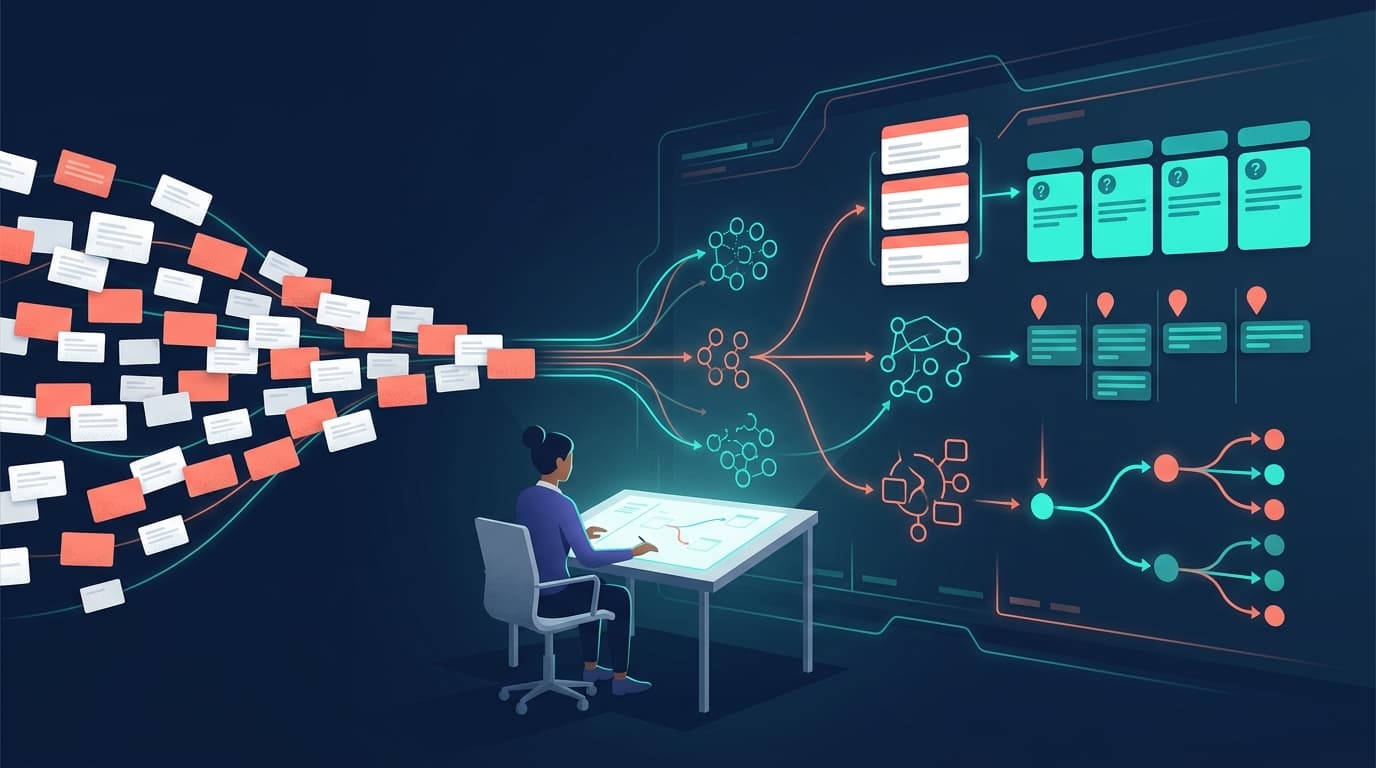
Review mining for user research is the practice of analyzing unsolicited customer feedback to identify recurring situations, behaviors, expectations, breakdowns, and outcomes that deserve deeper investigation. Instead of treating reviews as a shortcut to “what users want,” you use them as a discovery layer: a large, imperfect evidence set that helps you decide whom to interview, what to ask, and which assumptions need testing first.
This guide explains how to build that workflow without confusing review frequency with truth, sentiment with causation, or customer requests with product requirements.
What review mining for user research actually means
Review mining for user research is a form of secondary qualitative research. The raw material may include marketplace reviews, app-store reviews, support conversations, survey comments, community posts, or feedback attached to cancellations and returns.
The goal is not to produce a dashboard full of positive and negative themes. The goal is to create a better research plan.
A useful review-mining output should help a team answer questions such as:
- Which user situations appear repeatedly but remain poorly understood?
- Where does the customer’s expected workflow differ from the actual one?
- Which complaints may be symptoms of a deeper problem?
- What vocabulary do customers use before they know the product team’s terminology?
- Which segments, use cases, environments, or constraints should recruiting cover?
- What contradictory evidence should an interview guide explore?
- Which assumptions are risky enough to validate before building?
That distinction matters. A theme like “setup is confusing” is not yet a research finding. It is a prompt to investigate the setup context, prior experience, attempted actions, failure point, workaround, and consequence.
Why reviews are useful before primary research
Reviews offer three advantages at the beginning of a research cycle. Used carefully, review mining for user research makes each advantage easier to convert into a concrete study plan.
They reveal unsolicited priorities
Interview participants answer the questions you choose to ask. Review writers choose what they consider worth mentioning. That makes reviews useful for finding issues that did not fit the team’s original framing.
They preserve customer language
Users rarely describe a problem with the same taxonomy as the product team. Review mining captures the words customers use for tasks, expectations, alternatives, frustrations, and desired outcomes. That language can improve recruiting screeners and make interview questions easier to understand.
They expose edge conditions at scale
A single interview may reveal an unusual environment, device, household context, team workflow, or product variation. A larger review set can show whether similar conditions appear elsewhere. This does not establish prevalence, but it helps researchers decide which edge cases deserve deliberate sampling.
The UK Government’s guidance on user research in discovery emphasizes learning about users’ goals, context, and problems before settling on a solution. Review evidence can help identify where that learning should begin, but it still needs validation with appropriate research methods.
What customer reviews cannot tell you by themselves
Review mining for user research becomes misleading when a team treats reviews as a representative sample.
Reviews usually cannot establish:
- how common a problem is across the entire customer base;
- why a person behaved a certain way;
- whether a request would solve the underlying problem;
- what non-reviewers experienced;
- whether sentiment was caused by the product, listing, delivery, support, price, or expectations;
- how a proposed design will perform;
- whether a customer would switch, pay, or change behavior;
- which finding applies to a different market, version, channel, or segment.
The people who leave reviews are self-selected. Their feedback may overrepresent unusually strong experiences, specific channels, recent incidents, incentives, or users who successfully completed enough of the journey to post publicly.
That is why reviews should shape questions—not close them.
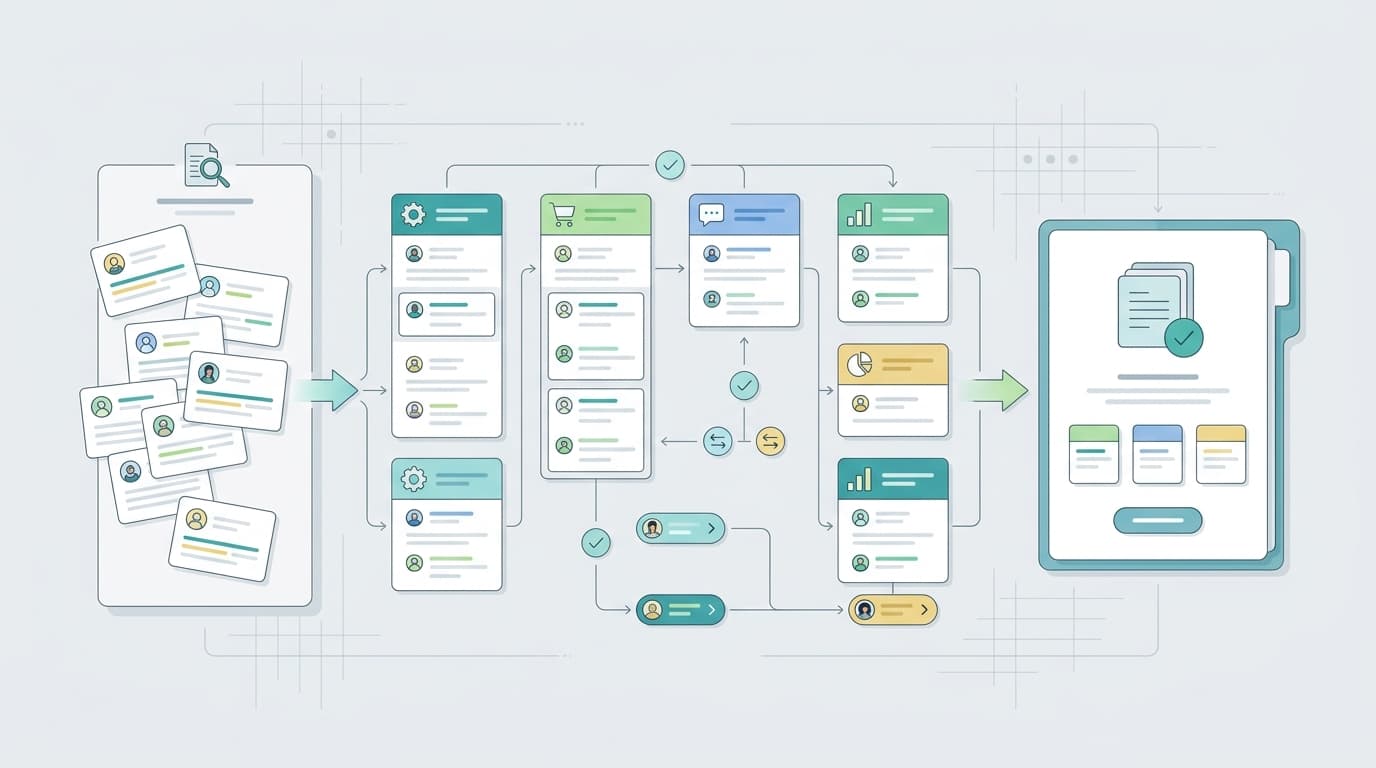
A nine-step review-mining workflow for user research
The following process turns a large review set into a traceable research plan.
1. Start with a decision, not a dataset
Before collecting reviews, write the decision the team expects to make.
Examples:
- Decide which onboarding problem deserves the next discovery sprint.
- Understand why first-time users abandon setup after connecting a data source.
- Identify which customer segment needs a different workflow.
- Test whether a requested feature reflects a real job or a workaround.
- Learn why a highly rated product still receives repeated return-related complaints.
A decision boundary prevents endless theme collection. It also determines which reviews are relevant.
Use a simple framing statement:
Decision:
Target user or customer:
Journey stage:
Product, plan, version, or variation:
Market and language:
Review window:
What evidence would change the decision:
2. Define the evidence set
Record exactly where the reviews came from and what is included.
At minimum, capture:
- source platform;
- product or service reviewed;
- market and language;
- date range;
- product version or variation when available;
- rating distribution;
- inclusion and exclusion rules;
- total review count;
- sampling method;
- known gaps.
If you mix app reviews, marketplace reviews, support tickets, and survey comments, keep the source attached to every observation. Each channel has different prompts, visibility, incentives, and user populations.
For example, a marketplace review may focus on packaging and delivery. A support ticket may overrepresent unresolved issues. An app-store review may be tied to a recent release. Combining them can be useful, but only if the team can still see those differences.
3. Convert each review into an evidence record
Do not code an entire review as one positive or negative unit. Break it into atomic customer events.
A practical evidence record includes:
Source ID:
Date:
Rating or source signal:
User or segment clue:
Situation:
Goal:
Attempted action:
Observed event:
Customer interpretation:
Consequence:
Workaround:
Requested change:
Product or variation:
Evidence excerpt:
Confidence:
One review may contain several records. A customer can praise core performance, criticize setup, mention a delivery problem, and request clearer instructions in the same post.
Atomic records make it possible to separate the event from the customer’s proposed solution. “Add an export button” may really mean “I need to share evidence with someone who does not use this tool.” The first is a request. The second is a researchable job.
4. Code situations, behaviors, breakdowns, and outcomes separately
Broad themes hide the chain of events that user research needs to understand.
Use at least four layers:
| Layer | Question | Example |
|---|---|---|
| Situation | When and where did this occur? | First setup on a work laptop |
| Behavior | What did the user try to do? | Connect a support-data source |
| Breakdown | What blocked or confused them? | Permission language was unclear |
| Outcome | What happened next? | Asked an admin, delayed setup, or left |
You can add an expectation layer when reviews repeatedly compare the experience with an alternative, promise, listing, or prior workflow.
This structure produces better research questions than a flat label like “integration complaint.” It points toward context, behavior, mental models, and consequences.
5. Build clusters without erasing contradictions
Group evidence records by shared situation and outcome, not merely by similar words.
For each cluster, record:
- concise cluster label;
- defining situation;
- common behavior;
- recurring breakdown;
- customer consequence;
- segment or environment clues;
- representative evidence;
- exceptions and contradictions;
- alternative explanations;
- confidence level.
Contradictions are often more useful than clean averages. If some customers describe setup as effortless while others abandon it, ask what differs: role, permissions, device, prior experience, account type, data volume, instructions, or product version.
Do not force contradictory observations into a single sentiment score. Preserve them as competing explanations for primary research.
6. Turn clusters into research hypotheses
A cluster describes what appeared in the evidence set. A hypothesis proposes what may explain it.
Use this format:
For [user or segment] in [situation],
we believe [behavior or breakdown] occurs because [possible explanation],
leading to [consequence].
We are uncertain about [key assumption].
Example:
For first-time workspace owners connecting support data,
we believe setup stalls because permission requirements appear too late,
leading users to postpone activation or hand the task to an administrator.
We are uncertain whether the main barrier is comprehension, access, or trust.
The uncertainty sentence is the most important part. It stops the review cluster from masquerading as a confirmed causal finding.
7. Prioritize research questions by decision risk
The loudest cluster is not automatically the most important one. Prioritize questions based on the risk of being wrong.
A lightweight score can help:
Research priority =
decision impact × uncertainty × consequence severity × evidence diversity
Score each factor from 1 to 5. Use the result to create discussion, not false precision.
- Decision impact: Would the answer change a roadmap, positioning, onboarding, pricing, or operating decision?
- Uncertainty: How much is the team currently assuming?
- Consequence severity: Does the issue create inconvenience, abandonment, returns, lost trust, or operational cost?
- Evidence diversity: Does the pattern appear across different sources, dates, segments, or variations?
Add a confidence penalty when evidence is old, highly duplicated, missing context, or dominated by one source.
8. Translate evidence into a research plan
Now convert the priority hypotheses into methods, participants, and prompts.
Choose participants from the missing context
Recruit for differences that could explain the evidence:
- new and experienced users;
- successful and unsuccessful setup attempts;
- administrators and individual contributors;
- customers who stayed and customers who churned;
- different product variations or account types;
- reviewers and non-reviewers;
- customers who used a workaround;
- customers who contacted support and those who did not.
Choose the method that fits the uncertainty
| Uncertainty | Useful method |
|---|---|
| Goal, context, or mental model | Semi-structured interview |
| Actual workflow and workaround | Contextual inquiry or observation |
| Interface comprehension | Moderated usability test |
| Relative prevalence | Survey or behavioral analytics |
| Sequence of actions | Journey reconstruction or event data |
| Response to a proposed concept | Concept test |
| Cause of a support pattern | Ticket review plus interviews |
Write neutral prompts
Weak prompt:
Was the permissions screen confusing?
Stronger prompt:
Tell me about the last time you tried to connect this data source. What did you expect to happen? What did you do next?
Then probe for the details suggested by the reviews:
- What information were you looking for?
- Who else was involved?
- What made you pause?
- How did you decide what to do next?
- What workaround did you use?
- What was the consequence of the delay?
The review evidence improves the depth of the guide, but it should not turn the interview into a confirmation exercise.
9. Reconcile primary research with review evidence
After interviews, tests, or observations, compare the new evidence with the original clusters. This reconciliation step is what turns review mining for user research into a continuous learning system rather than a one-off analysis.
For each hypothesis, mark it as:
- supported;
- partially supported;
- contradicted;
- segment-specific;
- source-specific;
- unresolved.
Then update the cluster with:
- what primary research added;
- which explanation changed;
- what remains uncertain;
- whether the decision should change;
- what evidence to monitor next.
This creates a learning loop rather than a one-time synthesis document.
From review theme to interview question: a worked example
Imagine a team analyzing reviews for a research-analysis product.
The initial theme is:
Reporting is difficult.
That label is too broad to guide a decision. Atomic evidence reveals three different situations:
- Individual users can create a report but cannot adapt it for executives.
- Team leads need source evidence attached to every conclusion.
- Stakeholders without product access need a portable summary.
The team forms three hypotheses:
- the problem is audience translation;
- the problem is trust and traceability;
- the problem is access and distribution.
Those hypotheses produce different participants and questions.
For audience translation:
Walk me through the last report you changed for an executive. What did you remove, add, or rewrite?
For trust:
Tell me about a time someone challenged a finding. What evidence did they ask to see?
For distribution:
How do people who do not use the product receive and discuss the result?
The original review theme did not provide the answer. It helped the team avoid asking one vague question about “better reporting.”
Common mistakes in review mining for user research
Treating review writers as the whole user base
Reviewers are a segment, not a census. Include non-reviewers and silent users when the decision applies to them.
Using ratings as a research taxonomy
The same rating can contain praise, disappointment, comparison, and a serious breakdown. Code the experience, not just the score.
Asking interviews to confirm a cluster
If every question repeats the language of the reviews, participants are pushed toward the team’s explanation. Start with real events and neutral prompts.
Counting mentions without normalizing the evidence set
Ten mentions from duplicated or syndicated reviews are not equivalent to ten independent observations. Preserve source identity and deduplicate where possible.
Ignoring authenticity and incentives
Teams should understand how a source collects, moderates, displays, and incentivizes reviews. The US Federal Trade Commission provides guidance on endorsements, influencers, and reviews and answers about the Consumer Reviews and Testimonials Rule. Review operations and public claims should follow applicable policies and law.
Losing traceability during AI synthesis
AI can accelerate classification and clustering, but a research team still needs the source record, coding decision, exception, and confidence behind a conclusion. A polished summary without traceability is difficult to challenge or update.
Turning every request into a roadmap item
Feature requests often encode a goal, constraint, or workaround. Research the job behind the request before deciding on the solution.
A reusable review-mining research canvas
Use this template to move from reviews to a research sprint:
Decision:
Target users:
Journey stage:
Evidence sources:
Date range:
Sampling rule:
Known biases and gaps:

Cluster:
Situation:
Behavior:
Breakdown:
Consequence:
Contradictory evidence:
Possible explanations:

Research hypothesis:
Critical uncertainty:
Decision impact:
Recommended method:
Participant contrasts:
Neutral opening question:
Follow-up probes:

Result:
Decision changed:
Remaining uncertainty:
Next evidence to monitor:
How VOC AI can support review mining for user research
VOC AI helps ecommerce teams analyze customer review language and organize recurring feedback across products and competitors. For user research, the useful role is upstream of the interview or test: reducing a large review set into traceable situations, behaviors, breakdowns, consequences, and questions worth validating.
Teams can connect this workflow to review mining for product development, use review mining for competitive analysis to compare customer situations across alternatives, and build a shared evidence view with a customer feedback dashboard for product, support, and marketing.
VOC AI’s Voice of Customer Analysis and review-backed product research can support evidence collection and synthesis. The research team should still define the decision, preserve source context, recruit the right participants, and validate explanations with the method that fits the uncertainty.
Final takeaway
Review mining for user research works best as a question engine.
It helps teams:
- find user situations that deserve investigation;
- preserve the customer’s language and context;
- separate observed events from requested solutions;
- convert clusters into explicit, falsifiable hypotheses;
- recruit participants around meaningful contrasts;
- write neutral interview and test prompts;
- reconcile primary research with ongoing review evidence.
The result is not “research without talking to users.” It is better preparation for talking to the right users about the right problems before the team commits to an answer.