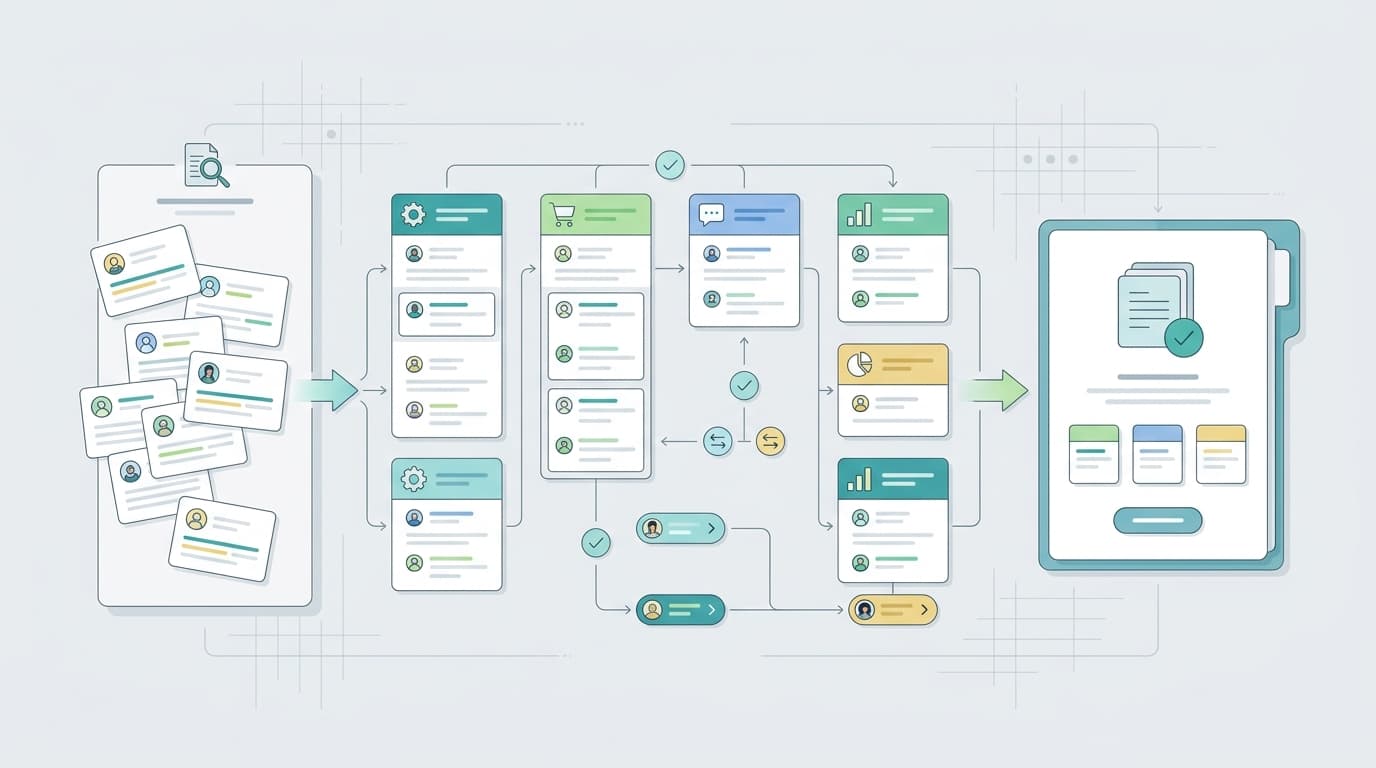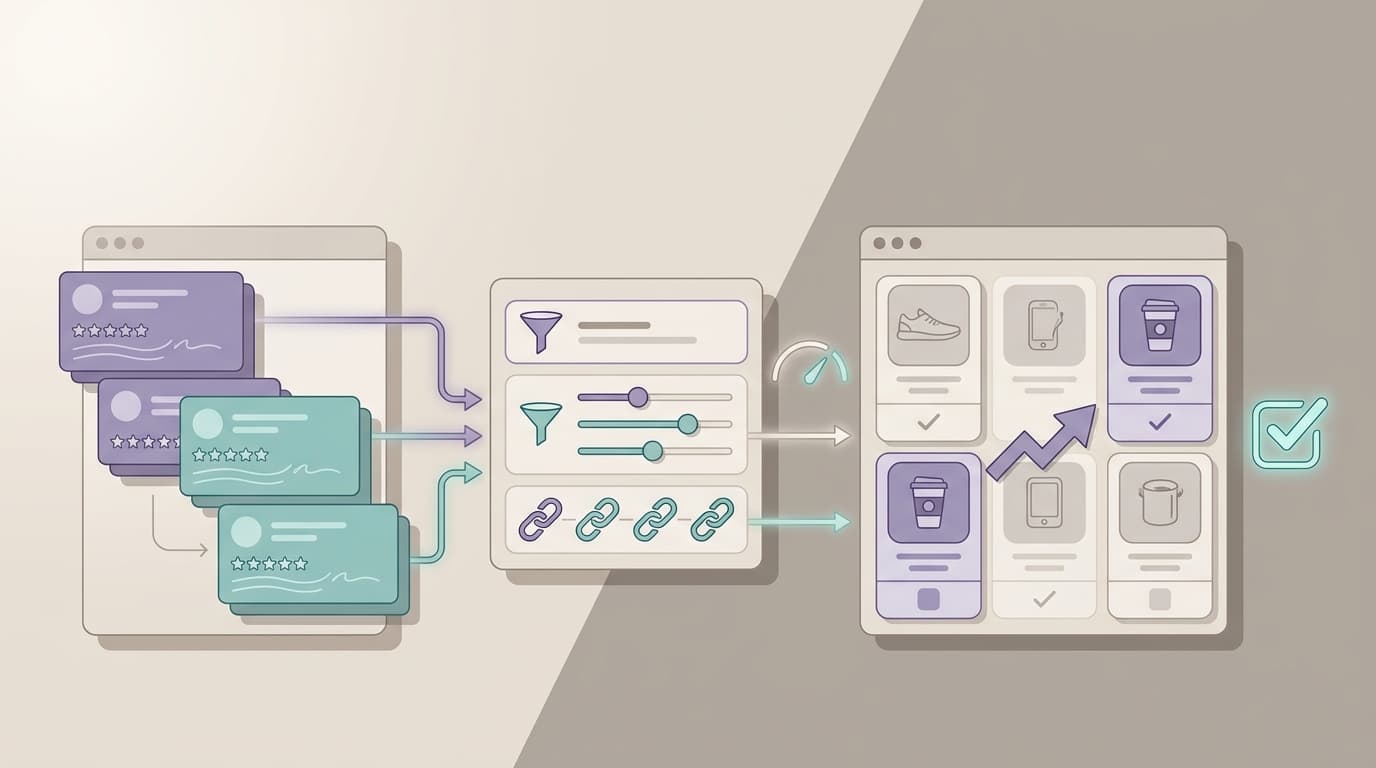
Review mining for pricing can show where customers believe the price and the delivered value stopped matching. It cannot tell you the perfect price, calculate willingness to pay, or prove that a complaint represents the market.
That distinction matters. Reviews contain unusually direct language about “worth it,” hidden costs, subscriptions, durability, bundles, shipping, replacement frequency, and comparisons with alternatives. But they are self-selected accounts of an experience, not a controlled pricing study.
Used carefully, review evidence helps product, ecommerce, and pricing teams decide which questions to validate. It can reveal whether the real objection concerns the sticker price, the total cost of ownership, an expectation gap, a weak value moment, the wrong package, or a customer segment that should not have been targeted in the first place.
This guide shows how to turn that language into traceable pricing hypotheses without pretending that reviews measure demand.
What review mining can—and cannot—tell you about pricing
Review mining can help you identify:
- the situations in which customers call a product expensive or good value;
- the comparison set customers use when judging price;
- costs beyond the initial purchase, including accessories, shipping, maintenance, subscriptions, and replacement;
- the product attributes customers use to justify a premium;
- expectation gaps that make a reasonable price feel unfair;
- package, bundle, plan, or feature-access complaints;
- customer language for pricing-page explanations and value communication;
- hypotheses to validate with interviews, surveys, experiments, win-loss analysis, and commercial data.
Review mining cannot establish:
- a market-wide willingness-to-pay curve;
- the revenue-maximizing price;
- price elasticity;
- the share of customers who hold a particular view;
- whether a lower price will improve conversion or retention;
- whether a reviewer belongs to your target segment;
- the causal reason for a sales decline;
- whether a competitor comparison remains current.
Online reviews are shaped by who chooses to post, where the review was collected, moderation and incentive rules, product age, market conditions, and the experience that prompted the response. Research has long documented selection effects in online review systems. Treat the corpus as evidence about the corpus—not a representative survey of every buyer.
Start with the price-value gap, not sentiment
A positive-versus-negative chart is too blunt for pricing work. A five-star review can still say a subscription is hard to justify. A one-star review can admit that the core product is excellent but describe a costly failure, confusing bundle, or poor recovery experience.
Code the price-value gap instead.
| Evidence group | What to look for | Pricing question |
|---|---|---|
| Sticker-price objection | “Too expensive,” “overpriced,” “waited for a sale” | Is the entry price blocking the intended segment? |
| Total-cost objection | Accessories, consumables, shipping, maintenance, replacement, subscription | Is the full ownership cost visible before purchase? |
| Value proof | Time saved, durability, reliability, avoided effort, better outcome | Which observable outcome earns the price? |
| Expectation gap | “For this price, I expected…” | Did the promise establish a higher standard than the experience delivered? |
| Package mismatch | Missing feature, unwanted bundle, plan restriction, quantity mismatch | Is the offer structured around the wrong job or usage level? |
| Comparison anchor | Cheaper alternative, premium competitor, DIY workaround, previous version | What reference point defines “expensive” or “worth it”? |
| Risk and trust | Warranty, returns, support, trial, proof, uncertainty | Is the objection really about purchase risk rather than price? |
| Segment mismatch | Different use case, budget, frequency, skill, environment | Is the offer reaching people for whom the economics do not fit? |
This model prevents a common mistake: interpreting every use of the word “price” as a request for a discount.
A nine-step review-mining workflow for pricing decisions
1. Define the decision before collecting reviews
Do not begin with “summarize all pricing feedback.” Begin with a bounded decision.
Examples:
- Decide whether a product page needs clearer total-cost disclosure.
- Investigate why a premium version receives “not worth it” comments.
- Test whether buyers understand the difference between two plans.
- Determine which outcomes customers use to justify a higher price.
- Separate product-value problems from shipping or support costs.
- Identify questions for a pricing interview or survey.
Write the boundary first:
Decision:
Product, plan, bundle, or ASIN:
Target segment:
Market and language:
Review window:
Competitors or alternatives:
Commercial data available for validation:
What evidence would change the decision:
This keeps the work tied to an operating choice instead of producing another theme dashboard.
2. Build a comparable evidence set
Record exactly what enters the analysis:
- source platform and URL;
- product, version, plan, bundle, or seller;
- review date and purchase period when available;
- market, language, and currency context;
- rating and verified-purchase status when provided;
- promotional, seasonal, or launch context;
- competitor or alternative being discussed;
- inclusion, exclusion, and deduplication rules.
Do not mix unlike offers without labeling them. A lifetime license, monthly subscription, starter bundle, refurbished unit, and premium package create different price expectations even when the product name is similar.
If you compare products, normalize the attribute taxonomy first. The broader workflow for review mining for competitive analysis explains how to compare evidence without turning raw mention counts into market-share claims.
3. Split reviews into atomic price-value events
One review may contain several different events:
- the initial price seemed high;
- setup was easy;
- an accessory was unexpectedly required;
- the product saved time every week;
- support replaced a failed unit;
- the reviewer would buy again only during a promotion.
Do not force that review into one sentiment label. Create one evidence row per event and preserve the source link.
Use a structure such as:
Customer situation:
Price or cost reference:
Expected value:
Delivered experience:
Consequence:
Comparison anchor:
Workaround or alternative:
Customer wording:
Source URL:
Confidence notes:
Atomic events make it possible to see that the same customer can object to one cost while strongly valuing another part of the offer.
4. Separate the price objection from the value mechanism
For every price-related event, ask two questions:
- What cost is the customer reacting to?
- What value did the customer expect in return?
The cost may be:
- upfront price;
- recurring fee;
- shipping or taxes;
- accessory or consumable cost;
- implementation effort;
- maintenance and replacement;
- switching cost;
- risk of choosing incorrectly;
- time required before value appears.
The expected value may be:
- a functional outcome;
- greater reliability;
- reduced effort;
- faster completion;
- lower operational risk;
- better support;
- premium materials;
- longer useful life;
- easier collaboration;
- status, design, or experience.
This creates a more useful question than “Do customers think the product is expensive?” The question becomes: “Under which conditions does the expected value fail to justify this specific cost?”
5. Code the comparison anchor
Price judgments are relative. Reviewers may compare the offer with:
- a named competitor;
- a cheaper product in another category;
- a previous model or plan;
- a manual workaround;
- doing nothing;
- a sale price;
- an employer-funded or reimbursed purchase;
- a premium product with a different service level.
Store the anchor explicitly. “Overpriced compared with a basic alternative” is different from “not worth the premium over last year’s version.” The first may suggest a segment or positioning issue. The second may suggest weak differentiation.
Also preserve contradictory evidence. If one segment values durability while another values portability, averaging their language can erase the real pricing decision.
6. Create a price-evidence canvas
Turn each recurring cluster into a compact, auditable canvas.
| Field | What to record |
|---|---|
| Customer and situation | Who appears to face the issue, and in what job or context? |
| Cost under discussion | Upfront, recurring, hidden, operational, risk, or switching cost |
| Expected value | The outcome or experience the customer thought the price should buy |
| Observed evidence | Review excerpts, source links, dates, products, and comparison anchors |
| Contradictory evidence | Reviews that describe a different outcome or value judgment |
| Hypothesis | A testable explanation for the price-value gap |
| Decision affected | Packaging, page copy, onboarding, product, support, promotion, or price research |
| Validation needed | Commercial, behavioral, interview, survey, experiment, or operational data |
| Confidence | Strength and limits of the current evidence |
Example hypothesis:
Frequent users may accept the premium because durability reduces replacement effort, while occasional users compare only the upfront price and see little incremental value.
That statement can be tested. “Customers will pay more for durability” cannot be concluded from reviews alone.
7. Prioritize hypotheses transparently
Avoid an opaque AI-generated “pricing opportunity score.” Rank investigation questions with visible criteria.
Score each cluster from 1 to 3 on:
- Decision relevance: Does it affect the current pricing or packaging decision?
- Segment fit: Does the evidence match the customers the offer is designed for?
- Consequence: Does the issue block purchase, create returns, increase support, or reduce realized value?
- Cross-source support: Does another source show the same pattern?
- Testability: Can the team validate the hypothesis within a defined period?
Investigation priority =
Decision relevance + Segment fit + Consequence
+ Cross-source support + Testability
Keep evidence confidence separate. A severe but weakly supported issue should remain visible without being presented as established fact.
8. Validate with the right method
The validation method depends on the question.
| Review-mining question | Better validation source |
|---|---|
| Is the entry price blocking qualified buyers? | Funnel analysis, lost-deal notes, checkout abandonment, controlled offer test |
| Which value outcome justifies the premium? | Customer interviews, usage data, win-loss analysis, message test |
| Is a recurring fee poorly understood? | Pricing-page behavior, support questions, cancellation reasons, comprehension test |
| Does a bundle contain unwanted components? | Choice research, configuration behavior, interviews, bundle experiment |
| Are hidden costs creating dissatisfaction? | Returns, support, warranty, accessory attach, shipping, replacement data |
| Would customers pay a specific price? | Purpose-built pricing research and controlled market evidence—not review counts |
| Is a price complaint segment-specific? | Account, cohort, use-case, frequency, and market analysis |
Reviews generate hypotheses. Validation determines whether the team should change price, packaging, product, communication, or nothing at all.
For product interventions, connect the evidence to review mining for product development. For discovery interviews, use the separate workflow for review mining for user research.
9. Measure the decision, not the dashboard
Define what success means before changing the offer.
Depending on the decision, monitor:
- qualified conversion by segment;
- plan or bundle selection;
- trial-to-paid movement;
- discount dependence;
- accessory or consumable surprise;
- returns and cancellation reasons;
- support contacts about price, billing, or expectations;
- repeat purchase and replacement timing;
- realized usage of the promised value;
- customer language after the change.
Use a bounded test window and note concurrent changes. If the product, campaign, shipping policy, and support process changed together, do not attribute the result to pricing alone.
Worked example: “Too expensive” hides three different problems
Imagine an ecommerce team analyzes reviews for a premium home appliance. The recurring phrases include “too expensive,” “worth it when it works,” “replacement filters cost too much,” and “I expected better support at this price.”
The wrong conclusion is: “Lower the price.”
The team creates three hypotheses instead:
- Entry-price hypothesis: occasional users compare the product with a basic alternative and do not value the premium features.
- Ownership-cost hypothesis: replacement filters make the total cost feel higher than the product page suggests.
- Risk hypothesis: buyers accept the product price but expect faster recovery and stronger warranty support at a premium tier.
Each hypothesis needs a different response:
- clarify the segment and use case for the premium model;
- disclose replacement cadence and total ownership cost earlier;
- test a service or warranty promise;
- validate price sensitivity with purpose-built research before changing the price.
The review language identified the investigation. It did not choose the answer.
Common mistakes in pricing feedback analysis
Treating “too expensive” as a vote for a discount
The objection may concern risk, hidden costs, weak differentiation, poor onboarding, low usage frequency, or a mismatch between the customer and the offer.
Counting mentions without preserving the denominator
“Thirty reviews mention price” means little without the corpus size, source, market, date range, product mix, deduplication method, and inclusion rules. Even with that context, it describes the analyzed evidence set—not the entire market.
Combining markets and currencies
Taxes, shipping, purchasing power, promotions, channel economics, and competitor sets differ. Keep market and currency context attached to every event.
Ignoring the price customers actually paid
Reviews written after a promotion may reflect a different value judgment than reviews written at list price. Record sale, bundle, coupon, and subscription context when available.
Using review excerpts as ungoverned advertising claims
If customer language becomes a testimonial or marketing claim, follow applicable endorsement and review rules. The US Federal Trade Commission’s Consumer Reviews and Testimonials Rule addresses fake or false reviews, incentives conditioned on sentiment, and review suppression. Keep source, permission, typicality, and substantiation requirements separate from the analysis workflow.
Letting an AI summary hide contradictory evidence
Require links back to the original review, preserve counterexamples, and keep coding definitions visible. A polished summary is not an audit trail.
How VOC AI supports review-led pricing investigation
VOC AI’s Voice of Customer Analysis workflow is designed to analyze customer reviews for profiles, purchasing motivations, usage scenarios, sentiment, product strengths, weaknesses, and customer language. Product and ecommerce teams can use that evidence to organize price-value hypotheses, compare competitors, and identify the source reviews behind a theme.
The important operating rule remains the same: review analysis supports the investigation. Pricing decisions still require the relevant commercial, behavioral, and research evidence.
If you need a broader cross-functional system, see how to analyze ecommerce feedback across reviews, support, and social. If you need message development rather than pricing research, use the workflow for review mining for marketing.
Frequently asked questions
Can customer reviews reveal willingness to pay?
They can reveal price objections, comparison anchors, value language, hidden costs, and hypotheses about willingness to pay. They cannot measure a willingness-to-pay distribution or identify an optimal price without purpose-built research and market evidence.
Should every “too expensive” review lead to a lower price?
No. First determine whether the issue is the entry price, total cost, weak differentiation, poor value realization, purchase risk, package design, or segment mismatch.
How many reviews do you need for pricing analysis?
There is no universal number. Use enough evidence to cover the defined product, segment, market, time window, and comparison set, then report the denominator and limitations. Depth, traceability, and validation matter more than a magic sample size.
Can AI summarize pricing complaints automatically?
AI can help classify events and cluster language, but the workflow should preserve source links, coding definitions, contradictory evidence, market context, and human review for consequential decisions.
What should validate a review-mining pricing hypothesis?
Use the source that matches the question: funnel and checkout data, lost-deal notes, interviews, surveys, pricing research, usage, returns, support, cancellations, experiments, or cohort analysis.
Is review mining useful for B2B pricing?
Yes, as qualitative evidence. B2B teams can identify packaging confusion, seat or usage concerns, implementation costs, value moments, and comparison anchors. They should validate those themes against account, pipeline, adoption, renewal, and research data.
Turn price comments into questions you can test
Review mining for pricing is valuable because customers often explain the economics of an experience in language a dashboard cannot capture. The goal is not to let reviews set the price. The goal is to make the next pricing question more precise.
Preserve the original evidence. Separate cost from expected value. Record the comparison anchor. Keep contradictions. Validate with the right method. Then change the price, package, product, communication, or service only when the combined evidence supports it.
Sources
- Federal Trade Commission, Consumer Reviews and Testimonials Rule: Questions and Answers.
- Federal Trade Commission, The FTC’s Endorsement Guides: What People Are Asking.
- Nan Hu, Jie Zhang, and Paul A. Pavlou, Overcoming the J-Shaped Distribution of Product Reviews, Marketing Science.
- Xinxin Li and Lorin M. Hitt, Self-Selection and Information Role of Online Product Reviews, Information Systems Research.