What Is a Review Summarizer and When Does It Matter?
Updated August 25, 2026
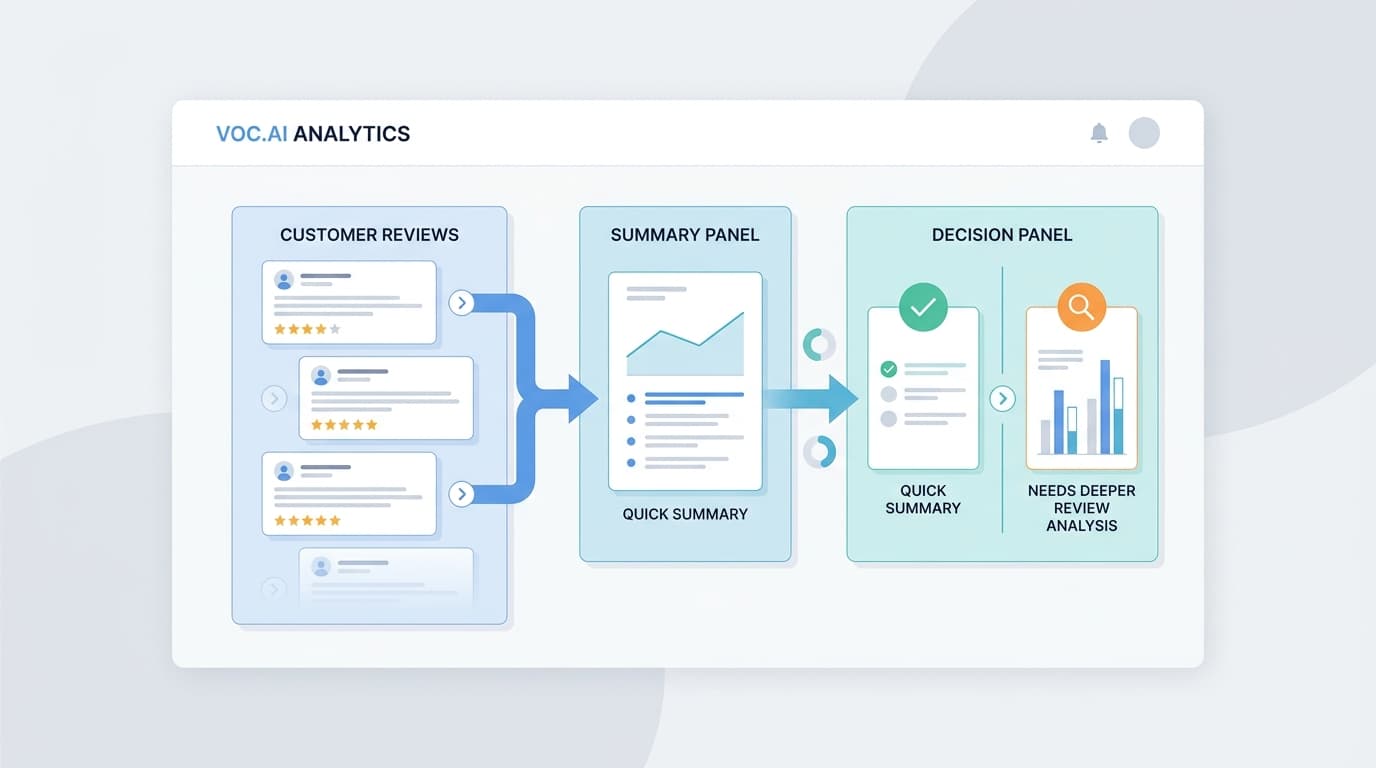
A review summarizer is a fast way to turn customer reviews into a shorter read: the main themes, the common complaints, the repeated praise, and the likely next question. That is useful when you want orientation. It matters when the result will shape a product page, support response, roadmap item, or competitor move.
That split is the whole point of this article. If you only need to read faster, a review summarizer may be enough. If you need to change what a team does next, you need more than a clean paragraph.
If you are choosing tools, start with the review summarizer tools evaluation framework. If you want the seller-output angle, see what an Amazon review summarizer should actually show sellers. If you are comparing lightweight summarizers with a broader workflow, use VOC AI vs. Amazon review summarizers.
What a review summarizer does
A review summarizer compresses review text into something a person can scan quickly. In practice, that usually means:
- recurring themes
- overall sentiment direction
- common pros and cons
- representative quotes
- sometimes counts or frequency hints
That is enough for a first pass. It is not enough when the summary has to support a business decision on its own.
A business-grade review summarizer should also preserve the evidence behind the summary: which cohort was analyzed, what time window was used, and which reviews support or weaken the claim. Without that, the output is just a nicer paragraph.
When a review summarizer is enough
Use a review summarizer when the job is mostly reading, not deciding.
| Situation | Is a review summarizer enough? | Why |
|---|---|---|
| You need a fast scan before a meeting | Yes | It saves time without requiring a deep evidence packet |
| You are shopping for one product | Yes | A quick read of themes and tradeoffs is usually enough |
| The decision is low stakes | Yes | A rough summary is acceptable if a human will verify it |
| The review set is small | Yes | The overhead of a larger workflow may not pay off |
| Only one person will use the output | Usually | A simple summary can be fine if it will not drive a shared decision |
In these cases, a review summarizer is a convenience layer. It helps people understand the reviews faster, but it does not have to carry the whole decision process.
When a review summarizer matters
The moment the output starts changing what your team ships, fixes, says, or prioritizes, the review summarizer matters more.
| Situation | What changes | Better fit |
|---|---|---|
| Product, CX, or marketing will act on the result | The output needs proof | Review analysis with source links |
| You compare variants, markets, or competitors | Cohort differences matter | Review analysis with filters and counterevidence |
| You need recurring reporting | Repeatability matters | Review analysis with export, API, or scheduled workflows |
| Multiple teams will use the same result | Handoff matters | Decision packet plus owner routing |
| The result may become a public claim or product change | Risk matters | Evidence traceability and human review |
This is the point where a review summarizer by itself stops being enough. A summary can say what seems true. A workflow has to show why it is true, who it applies to, and what should happen next.
The simple test
Ask three questions:
- Does this need more than one person to trust it?
- Will this change a decision or a customer-facing message?
- Do we need the raw reviews behind the conclusion?
If the answer to any of those is yes, move beyond a plain review summarizer.
What to use instead
When the work is decision-grade, look for a review analysis workflow with:
- cohort control
- raw-review traceability
- contradiction handling
- owner routing
- export or API support
That is the line between a quick summary and something a product, CX, or ecommerce team can actually reuse.
VOC.AI is built for that second layer. The Voice of Customer Analysis page positions the workflow around 2B+ reviews, buyer language, decision-ready outputs, and clustering by pain point, expectation, and feature mention. The Review Analysis API adds REST API, Python SDK, and MCP support for teams that need the same review intelligence inside their own stack.
A practical rule
Use a review summarizer when it saves reading time.
Use review analysis when customer evidence will change what your team builds, fixes, says, or prioritizes.
That rule keeps the category clean. A review summarizer is a good shortcut. It just should not be mistaken for the whole decision system.
FAQ
What is a review summarizer?
A review summarizer is a tool that condenses customer reviews into shorter themes, pros, cons, and patterns so people can understand the feedback faster.
Is a review summarizer the same as sentiment analysis?
No. Sentiment analysis classifies tone. A review summarizer explains what customers are saying and which themes repeat.
When do I need more than a review summarizer?
You need more when the output must support a team decision, compare cohorts, preserve evidence, or move into a workflow other people rely on.
What should a business review summarizer show?
It should show the cohort, the themes, the supporting reviews, any contradictions, and the next action or owner.
Where does VOC.AI fit?
VOC.AI fits when a review summarizer needs to become a repeatable review intelligence workflow. The product pages for Voice of Customer Analysis and Review Analysis API cover those use cases.
Bottom line
A review summarizer matters when the result is more than a convenience. If you only need the gist, keep it simple. If the output has to survive inspection, comparison, or handoff, use a workflow that preserves evidence and ownership.