Updated August 17, 2026.
A review summarizer is easy to judge badly. Paste in reviews, read a fluent paragraph, and it feels like the tool worked. The harder question is whether that summary is safe enough to change a product page, roadmap item, support macro, retention flow, or competitor response.
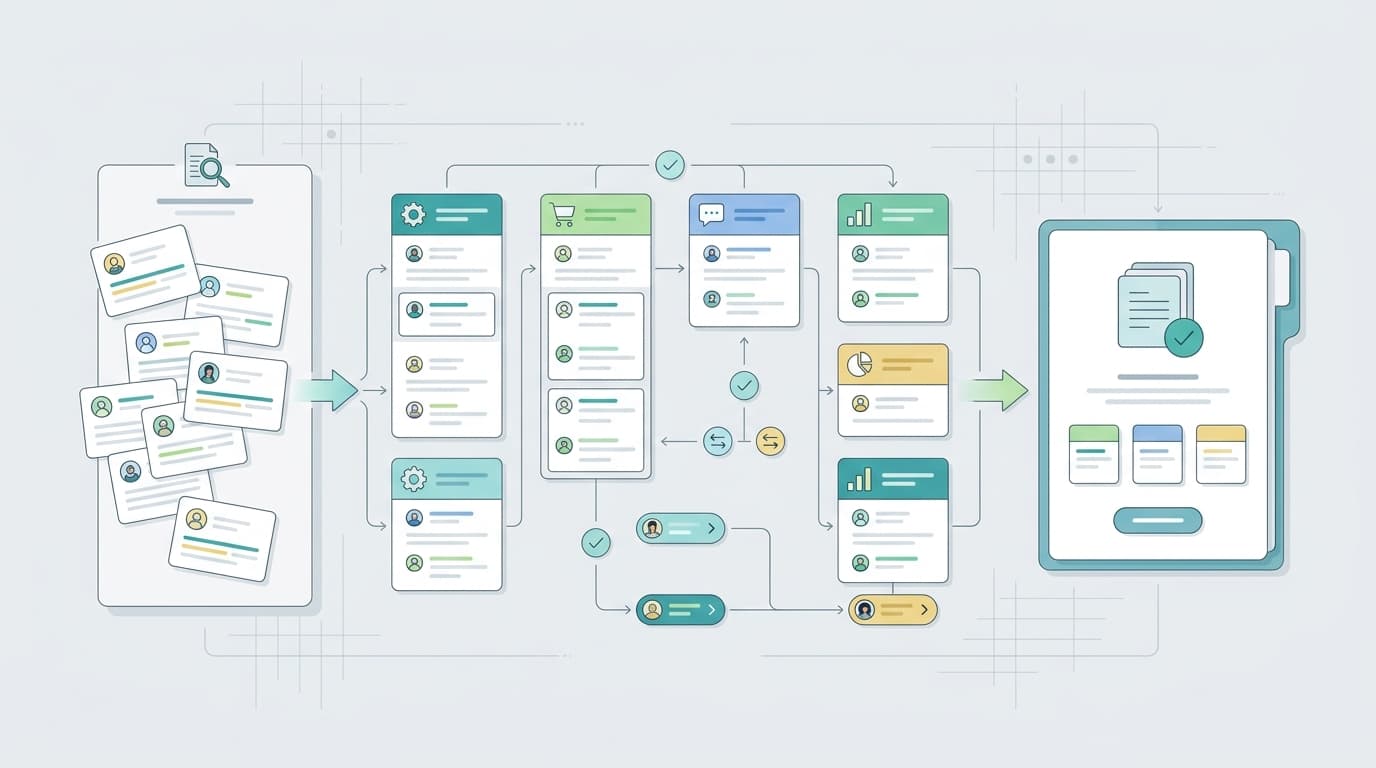
That is the difference between a review summarizer and a review intelligence workflow. A basic summary tells you what the reviews seem to say. A useful review summarizer shows which customers said it, which products or segments it came from, which evidence supports the claim, what contradictions exist, and what decision should happen next.
Use this evaluation framework when you are comparing review summarizer tools for customer feedback, ecommerce reviews, Amazon reviews, app reviews, support-adjacent review data, or AI review summarization inside a product workflow. The goal is not to find the tool with the prettiest paragraph. The goal is to find the tool your team can trust when a decision depends on customer evidence.
What a review summarizer should do
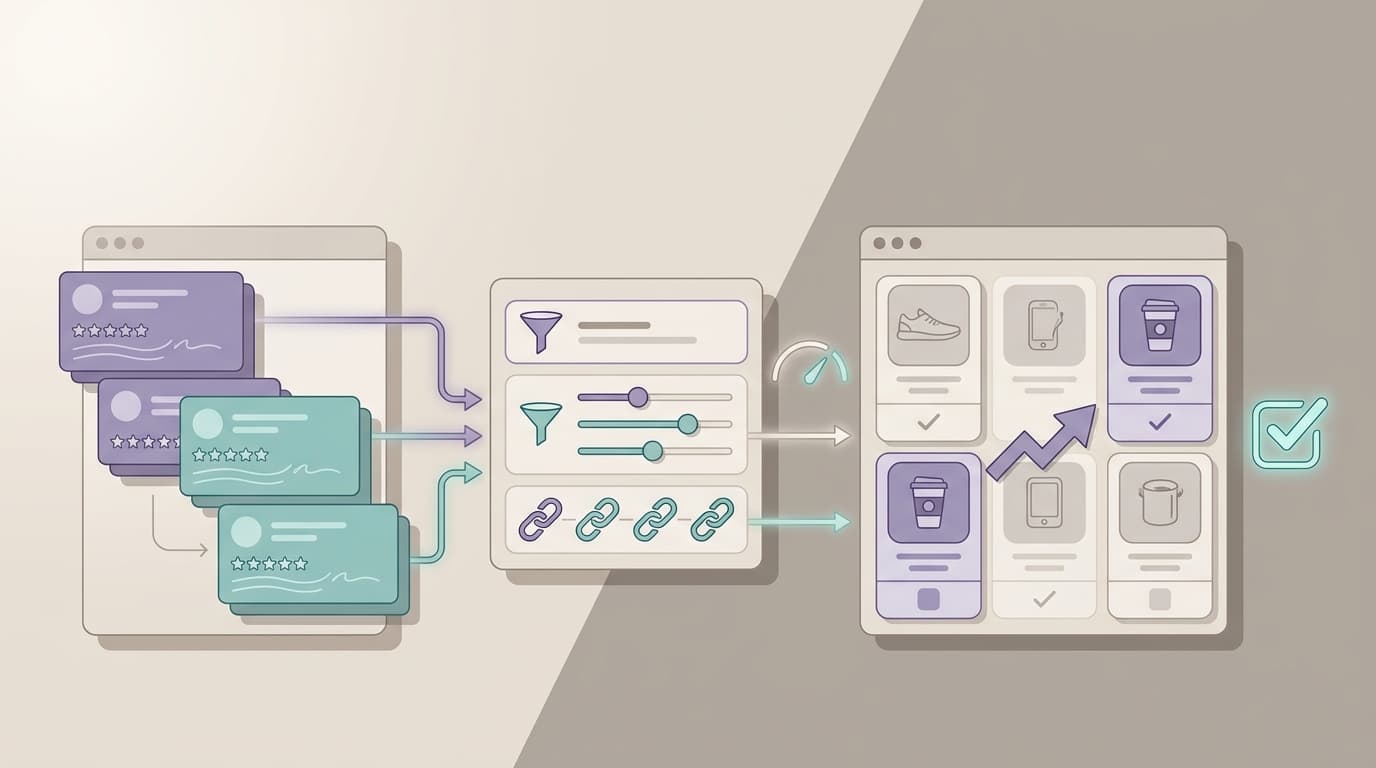
A review summarizer should compress a large set of reviews into themes that preserve enough context for action.
At minimum, it should help you answer five questions:
- What are customers repeatedly praising or complaining about?
- Which segments, products, ratings, regions, versions, or time windows produce those patterns?
- Which raw reviews support each claim?
- What evidence contradicts the main summary?
- What action should a product, CX, marketing, or ecommerce team consider next?
If the review summarizer cannot answer those questions, it may still be useful for quick orientation. It should not be treated as a decision system.
This distinction matters because the public market for summarizers is noisy. A search for review summarizer can return generic text summarizers, article summarizers, shopping helpers, Chrome extensions, customer feedback products, and AI review analysis tools. Generic summarizers can shorten text. Review summarizer tools for business teams need more: source control, cohort filters, theme quality, evidence links, and handoff structure.
Google's Places API documentation for AI-powered review summaries is a useful reminder of the baseline: summaries should be grounded in user reviews, synthesize attributes and sentiment, and help people make decisions. Business teams need the same idea, but with more auditability.
The 10-point review summarizer evaluation framework
Score each review summarizer from 0 to 2 on every criterion:
- 0: missing or not usable.
- 1: present, but manual cleanup or verification is still required.
- 2: reliable enough to use in a repeatable workflow.
| Criterion | What to test | Why it matters |
|---|---|---|
| Corpus control | Can you choose product, channel, rating, date range, language, SKU, version, or competitor set? | A blended review summary hides which customers created the signal. |
| Theme extraction | Does the tool group reviews by concrete issues, benefits, use cases, and objections instead of vague sentiment? | Teams need decision categories, not generic positive or negative labels. |
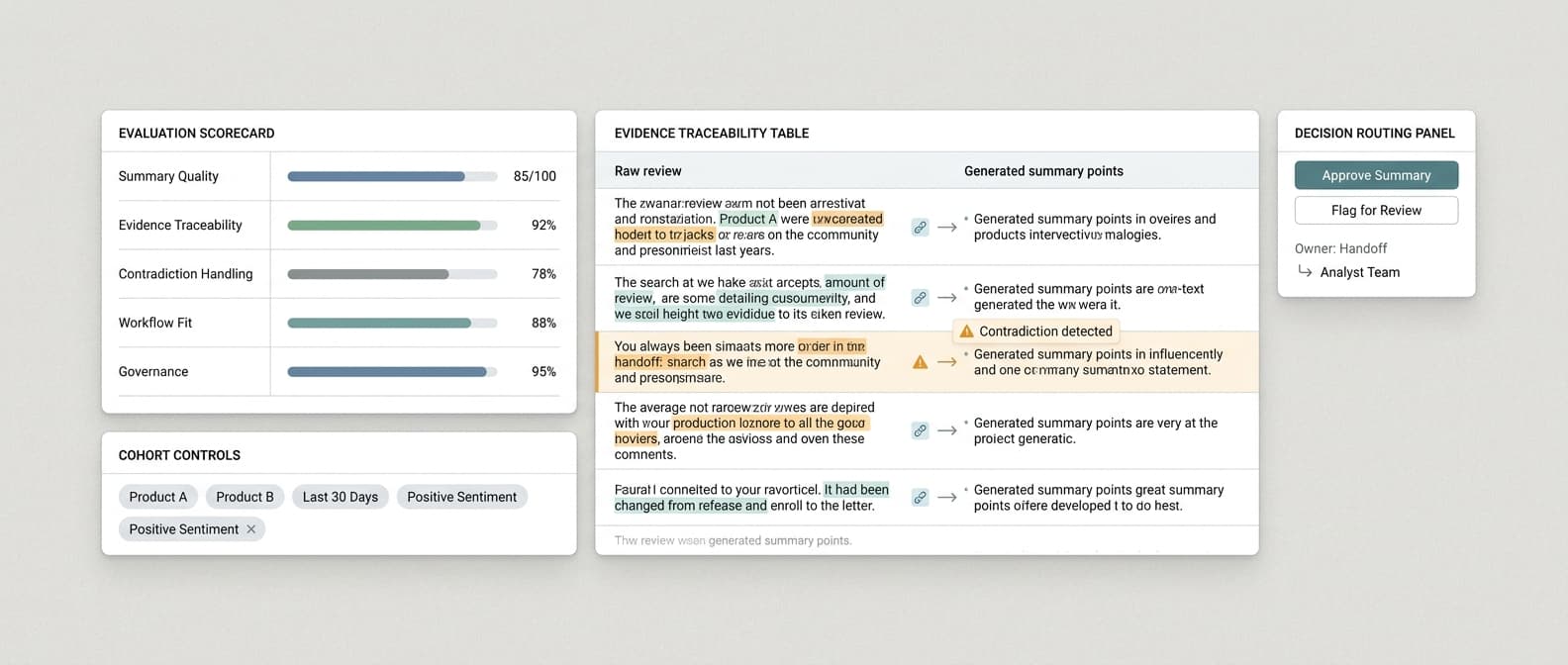
| Evidence traceability | Can every claim link back to raw review examples? | A review summarizer should make verification faster, not impossible. |
| Contradiction handling | Does it show minority opinions, edge cases, and counterexamples? | The summary may be directionally right and still miss a segment that matters. |
| Recency sensitivity | Can it separate new issues from stale historical feedback? | A problem from last week deserves different action than a pattern from two years ago. |
| Segment clarity | Can it distinguish buyer types, use cases, geography, rating bands, or product variants? | Teams rarely act on "customers say"; they act on who says it and where it appears. |
| Decision fit | Does the output route themes to product, listing, support, marketing, QA, or competitor analysis? | A review summary without an owner often becomes a note nobody uses. |
| Quantification | Does it show counts, share of reviews, trend direction, and confidence limits without pretending to be exact science? | Useful numbers help prioritize, but false precision creates bad decisions. |
| Workflow handoff | Can you export, share, assign, schedule, or call the analysis through an API? | The best review summarizer is the one that fits the team's operating loop. |
| Governance | Does it support access control, privacy review, prompt/version tracking, and quality checks? | Review data can contain sensitive details and model outputs can drift. |
For most teams, a review summarizer scoring below 12 is an orientation aid. A score of 13-16 can support manual analysis. A score of 17-20 is closer to an operational review intelligence workflow.
Run a 30-minute review summarizer test
Do not evaluate a review summarizer with a clean sample. Use a messy one. A good test set should contain praise, complaints, short reviews, long reviews, contradictions, duplicate themes, stale reviews, recent reviews, one segment-specific issue, and one product or competitor comparison.
Use this test:
- Choose one product, feature, app, or competitor set with at least 100 reviews.
- Split the reviews into three groups: recent negative, recent positive, and older mixed reviews.
- Ask the review summarizer for the top five themes, supporting evidence, contradictions, and recommended actions.
- Ask it to rerun the same task with a narrower cohort, such as one SKU, one rating band, one market, or one time window.
- Compare the outputs. A reliable review summarizer should change its findings when the evidence changes.
- Pick three claims from the summary and trace each one back to raw reviews.
- Ask a product, CX, or marketing owner which output they could actually use this week.
The pass/fail question is simple: would your team act differently after reading this output, and can you prove why?
If the answer is no, the tool may still be fine for a quick executive scan. It is not yet a source of record for customer decisions.
Review summarizer outputs that are worth paying for
The output format matters as much as the model. A review summarizer should not only produce a paragraph. It should produce a reusable evidence packet.
| Output | Weak version | Strong version |
|---|---|---|
| Executive summary | "Customers like quality but dislike price." | "Recent 1-3 star reviews mention zipper failures in travel use cases; positive reviews still praise capacity and lightweight design." |
| Theme table | Broad sentiment buckets | Specific themes with counts, rating mix, recency, representative quotes, and affected segment |
| Evidence links | No raw review access | Each claim links to review IDs, dates, ratings, product variant, and quote snippets |
| Contradictions | Hidden or ignored | Separate "what may not be true" section with counterevidence |
| Action list | Generic recommendations | Owner-ready next actions for product, listing, support, CX, or marketing |
| Confidence notes | Overconfident prose | Clear confidence level based on sample size, recency, consistency, and evidence diversity |
| Export path | Copy-paste only | CSV, dashboard, API, scheduled report, ticket, or roadmap handoff |
This is why a review summarizer evaluation should include both output quality and operating fit. A summary that reads well but cannot be traced, filtered, or shared will not survive a real workflow.
For Amazon-heavy teams, the existing guide on what an Amazon review summarizer should show sellers goes deeper into seller-specific outputs. This article is broader: it gives a review summarizer evaluation framework that works across ecommerce, product, CX, and research workflows.
How to judge summary quality without guessing
Review summarizer quality is not one score. Use separate tests for accuracy, usefulness, and risk.
1. Faithfulness
Does the summary stay inside the evidence? A review summarizer should not invent reasons, customer identities, competitor comparisons, or product defects that are not present in the source reviews.
OpenAI's current evals guidance frames evaluations as a way to test outputs against the criteria you specify. For review summarizer tools, your criteria should include faithfulness, evidence coverage, contradiction handling, and actionability.
2. Coverage
Does the review summarizer cover both frequent themes and important low-frequency issues? A rare safety, defect, compliance, or churn signal can matter more than a frequent cosmetic complaint.
3. Specificity
Can the summary name concrete attributes, use cases, buyer expectations, and affected segments? "Customers dislike quality" is weak. "Recent low-star reviews from heavy daily users mention the latch loosening after two weeks" is usable.
4. Counterevidence
Can the tool show why the conclusion might be wrong? A trustworthy review summarizer should make contradictions visible. If 60 reviews complain about battery life but 40 praise battery life in a different use case, the output should explain the split.
5. Repeatability
Does the same prompt on the same corpus produce materially similar findings? If the tool changes the top themes every run without evidence changes, your team will not be able to build process around it.
6. Decision handoff
Does the output tell someone what to do next? The best review summarizer tools do not end with "monitor this issue." They route the evidence to a product fix, listing copy test, support article, competitor response, roadmap discussion, or follow-up research question.
For teams building the pipeline themselves, the AI review summarization implementation checklist covers the technical architecture behind grounded summaries. If you are buying, the AI review summarization vendor evaluation checklist turns similar ideas into procurement questions.
Security and governance checks
Review data often looks harmless because it is public or customer-submitted. That does not mean the workflow is risk-free.
Before adopting a review summarizer, check four things:
- Input safety: Customer reviews are untrusted input. A malicious or irrelevant review can include instructions, links, personal details, or attempts to manipulate the model.
- Data boundaries: Confirm what data is sent to models, vendors, dashboards, and exports.
- Access control: Make sure raw reviews, summaries, customer identifiers, and exports are only available to appropriate users.
- Output review: Decide which summaries can trigger action automatically and which require human approval.
The OWASP GenAI Security Project maintains current guidance on LLM application risks, and NIST's AI Risk Management Framework is a useful reference for trustworthy AI governance. You do not need enterprise bureaucracy for every review summarizer pilot, but you do need a basic rule: no unverified AI summary should silently become a product requirement, public claim, or customer-facing answer.
When a review summarizer is enough
A lightweight review summarizer is usually enough when:
- You need a fast scan before reading raw reviews.
- The decision is low stakes.
- The review set is small.
- A human will verify every claim before action.
- You only need a buyer-facing or personal shopping summary.
In these cases, a simple tool can save time. Do not overbuy if the workflow is only "help me understand this product faster."
When you need review analysis, not just summarization
You probably need a broader review analysis workflow when:
- Multiple teams depend on the output.
- You compare products, versions, markets, or competitors.
- You need trend detection over time.
- You want to turn reviews into roadmap, listing, support, or campaign decisions.
- You need repeatable reporting.
- You need API access, scheduled workflows, or internal agent integration.
- You need evidence traceability for every recommendation.
VOC.AI's Voice of Customer Analysis is built around that broader workflow: clustering feedback by pain point, expectation, and feature mention; turning recurring complaints into product priorities and listing changes; and using the same review dataset across dashboards, agents, and API workflows. The current product page describes VOC.AI as working from a 2B+ review corpus with buyer-language and decision-ready outputs.
Engineering teams can also use the Review Analysis API when review summarization needs to run inside internal tools, agents, or scheduled data pipelines. The current API page lists REST API, Python SDK, and MCP support, with review, keyword, listing, and sales-estimate signals available for integration workflows.
If you are comparing categories, the customer review analysis tool guide separates summarization, sentiment analysis, monitoring, competitor analysis, and product research. Use that guide when the question is "what type of tool do we need?" Use this framework when the question is "can this review summarizer be trusted?"
A practical scoring template
Copy this into a spreadsheet before your next demo.
| Evaluation area | Score 0-2 | Evidence to collect |
|---|---|---|
| Corpus filters | Screenshot of available product, rating, date, segment, and channel filters | |
| Theme quality | Top five themes and whether they are concrete enough for action | |
| Raw-review links | Three summary claims traced back to source reviews | |
| Contradictions | Examples of minority opinions or counterevidence surfaced by the tool | |
| Recency | Same query on all-time reviews versus last 30 or 90 days | |
| Segment handling | Same query on a narrower SKU, market, rating band, or user group | |
| Counts and trend | Theme counts, share of reviews, direction, and sample-size caveats | |
| Decision handoff | Output mapped to owner, action, priority, and next review date | |
| Export/API | CSV, dashboard, ticket, API, MCP, or scheduled report proof | |
| Governance | Access control, data use, retention, prompt/version, and approval notes |
Set the buying rule before the demo:
- 0-10: Do not use for decisions. Orientation only.
- 11-14: Use with manual analyst verification.
- 15-17: Pilot with one team and a narrow decision workflow.
- 18-20: Consider operational rollout, provided security and integration checks pass.
That buying rule keeps the review summarizer conversation grounded. You are not asking whether the AI sounds smart. You are asking whether the output survives evidence review.
FAQ
What is a review summarizer?
A review summarizer is a tool that condenses customer reviews into shorter themes, patterns, pros, cons, complaints, praise, and decision notes. A business-grade review summarizer should also preserve evidence, segments, recency, contradictions, and handoff actions.
What is the difference between a review summarizer and sentiment analysis?
Sentiment analysis classifies emotional polarity or tone. A review summarizer explains what customers are saying and why it matters. The strongest workflows use sentiment as one signal, but they still need themes, evidence, segments, and decisions.
How many reviews do you need before using a review summarizer?
There is no universal minimum. For a quick scan, dozens of reviews can help. For product, CX, or marketing decisions, use enough reviews to cover rating bands, time windows, variants, and important customer segments. Always record sample size and source boundaries.
Can a generic AI summarizer summarize reviews?
Yes, but a generic summarizer usually lacks review-specific filters, evidence traceability, contradiction handling, trend views, and workflow exports. That may be fine for personal reading. It is risky for repeated business decisions.
What should teams test before buying review summarizer tools?
Test the tool on a messy real corpus, not a vendor demo set. Check corpus filters, theme quality, raw-review traceability, contradictions, recency sensitivity, segment clarity, owner-ready actions, exports, API access, and governance controls.
Final rule
Use a review summarizer when it saves reading time. Use a review intelligence workflow when customer evidence will change what your team builds, fixes, says, automates, or prioritizes.
The best review summarizer is not the one that writes the smoothest paragraph. It is the one that lets your team trace every important claim back to the people who said it, understand who the claim applies to, and decide what should happen next.