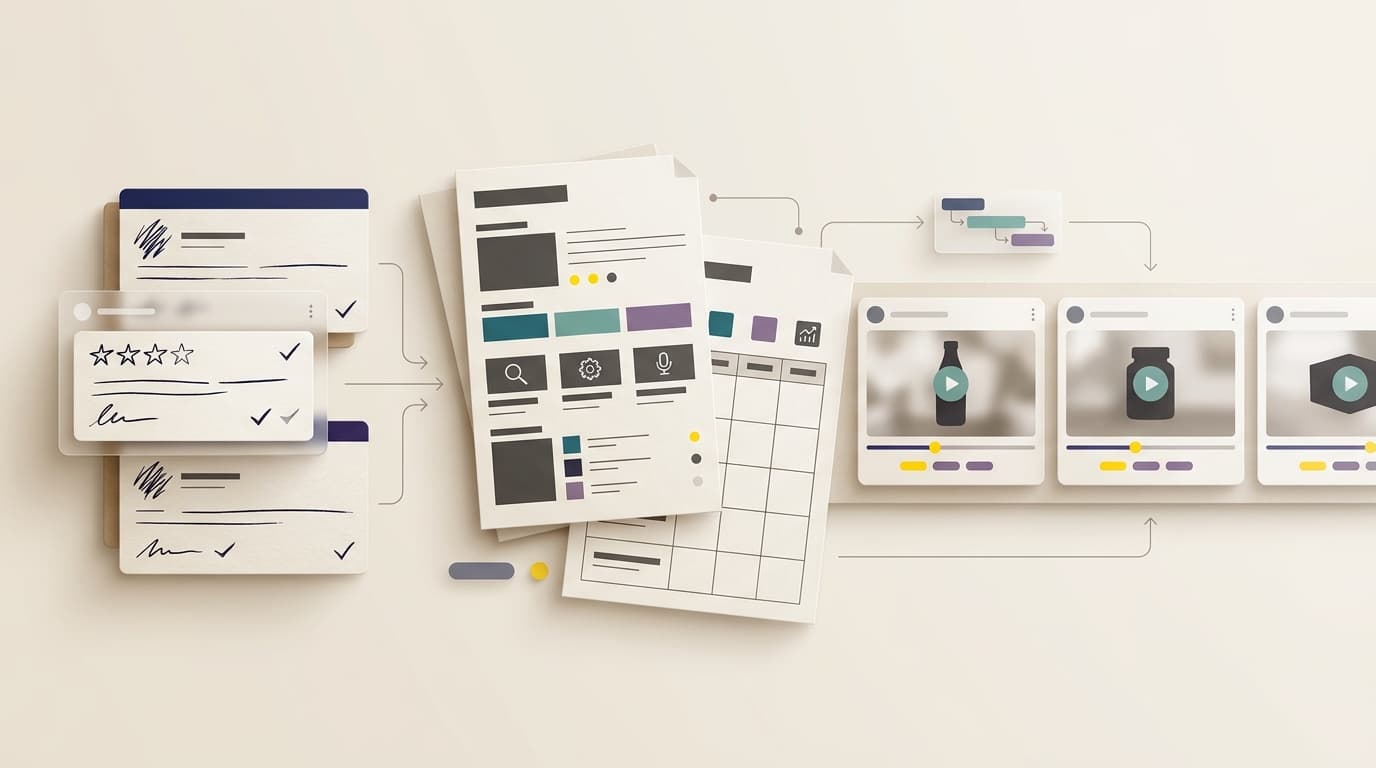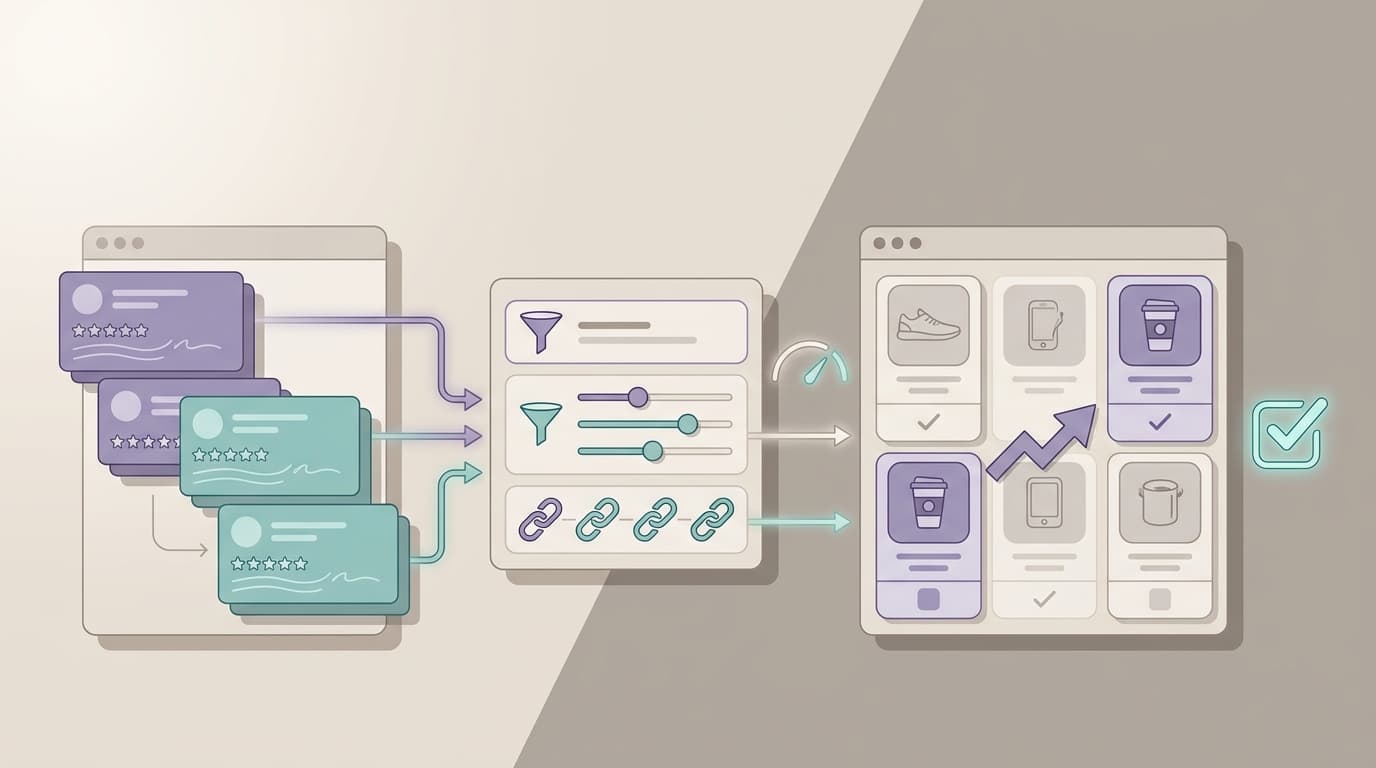
Product, CX, and growth often read the same customer feedback for different reasons. Product looks for defects, unmet needs, and roadmap risk. CX—often including the support team—looks for confusion, expectation gaps, and repeated friction. Growth looks for objections, buyer language, and places where a campaign or product-page promise does not match the experience.
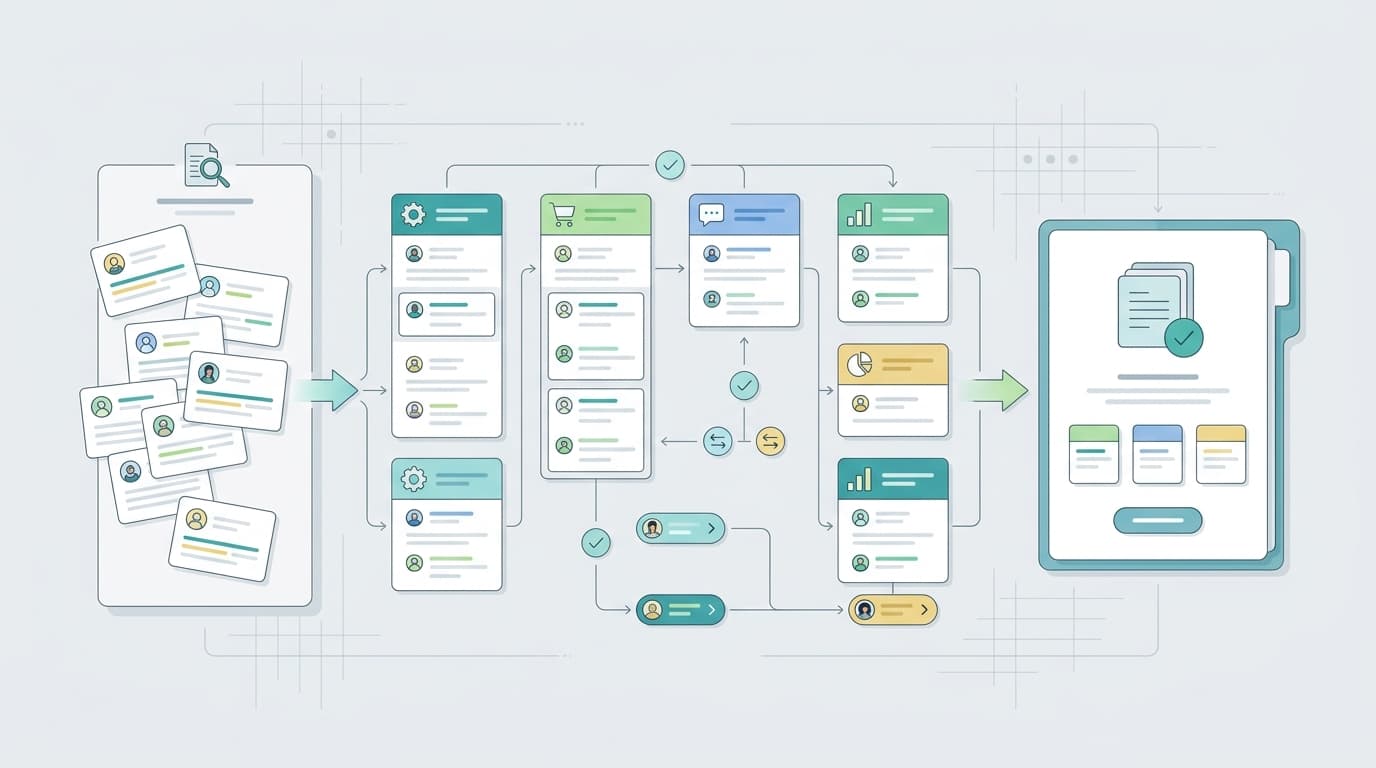
When each team creates its own report, the company ends up with three versions of the customer. A voice of customer dashboard should solve that problem without forcing every team to use one universal metric. The practical model is simpler: keep one shared evidence layer, let each team apply a clear decision lens, and use a recurring review to turn customer signals into owned actions.
This guide shows how to structure that operating model, run a focused 30-minute meeting, and avoid the failure modes that turn a useful customer feedback dashboard into another status report.
What Is a Voice of Customer Dashboard?
A voice of customer dashboard is a shared view of customer signals, supporting evidence, team interpretations, and follow-up actions. It should help a team answer four questions:
- What are customers repeatedly saying?
- What evidence supports that theme?
- What does the theme mean for product, CX, and growth?
- Who will act, and when will the team recheck the signal?
That definition matters because a dashboard is not merely a sentiment chart. A positive or negative score may summarize direction, but it rarely tells a team whether the root issue is a product defect, unclear guidance, an overpromising product page, or a segment-specific use case.
A useful voice of customer dashboard keeps the original signal visible. Representative customer wording, product or ASIN context, date range, theme movement, and evidence confidence should appear before recommendations. The team can then separate what the customer said from what each function thinks should happen next.
Why Separate Feedback Reports Create Three Versions of the Customer
Imagine that buyers repeatedly say a storage container is “hard to close.” That one phrase can trigger three different interpretations:
- Product may suspect a lid-tolerance or hinge problem.
- CX may see an expectation-setting or usage-guidance issue.
- Growth may discover that the product page implies effortless one-handed use.
All three interpretations could be reasonable. The mistake is deciding which one is true before reviewing the evidence together.
Separate reports make that mistake more likely. Product may count the theme under “closure defect,” CX under “setup question,” and growth under “message mismatch.” The same evidence is summarized three times, labeled three ways, and discussed in different meetings. Nobody can easily see whether the proposed responses conflict.
The goal of cross-functional customer feedback is not to erase those perspectives. It is to make the perspectives explicit while preserving a stable evidence base. A shared voice of customer dashboard gives the team one place to compare interpretations and route the theme to the right next action.
If your team is still defining sources, taxonomy, and evidence records, start with this guide to analyzing ecommerce feedback across reviews, support, and social. The workflow here begins after you can bring a credible theme and its supporting context into a weekly review.
A Shared Voice of Customer Dashboard Needs Three Layers
The dashboard should separate evidence, decisions, and actions. Mixing them into one crowded table makes it difficult to see whether a statement is a customer fact, a team hypothesis, or an approved commitment.
| Layer | What it contains | Why it is shared |
|---|---|---|
| Evidence layer | Theme, representative wording, source, date range, product or ASIN, segment, usage scenario, sentiment direction, frequency or movement context | Keeps every team anchored to the same customer signal |
| Decision layer | Product interpretation, CX interpretation, growth interpretation, confidence, business context, open question | Allows different functions to examine the same evidence without rewriting it |
| Action layer | Decision, owner, next step, due date, status, recheck date, recheck scope | Turns analysis into accountable work and learning |
1. The evidence layer: keep the customer visible
The evidence layer should answer “What do we know?” rather than “What should we do?” A practical record may include:
- A plain-language theme such as “lid is difficult to close.”
- Two or three representative excerpts that show the actual buyer wording.
- Product, model, ASIN, category, or product-line context.
- The evidence window and relevant customer segment.
- The use case or expectation connected to the theme.
- Whether the theme appears stable, rising, falling, or newly visible.
- A confidence note explaining any gaps or ambiguity.
Do not overload the record with every possible metric. The purpose is to make the signal inspectable. A reviewer should be able to understand what customers experienced and where the evidence came from before reading a recommendation.
2. The decision layer: preserve functional differences
The decision layer asks, “What might this mean?” Product, CX, and growth should be allowed to disagree. Their interpretations should sit beside the shared evidence instead of replacing it.
For example, product might write, “Possible tolerance issue on one variation.” CX might write, “Current setup guidance does not explain the locking motion.” Growth might write, “The phrase ‘opens and closes effortlessly’ may overstate the experience.” Those are hypotheses to test, not facts to merge into one artificial score.
3. The action layer: make the feedback loop visible
The action layer asks, “What are we doing, who owns it, and when will we learn?” Every material decision should include one accountable owner and a recheck date. Without those fields, a review insights dashboard becomes an archive of observations rather than a feedback loop.
The recheck field is especially important. If product changes a component, CX updates guidance, or growth revises a product-page claim, the team should define what evidence window and product scope it will compare later. Otherwise, the action may be completed without learning whether the customer signal changed.
Give Product, CX, and Growth Different Questions—Not Different Data
The same theme can support multiple decisions, but each team needs a disciplined question set. This keeps a voice of customer dashboard useful without turning it into a collection of unrelated team widgets.
| Team | Questions to ask | Useful fields | Typical next actions | Avoid |
|---|---|---|---|---|
| Product | Is this a recurring defect, unmet need, tradeoff, or segment-specific request? What evidence would justify discovery or a test? | Theme movement, product or ASIN, feature mention, usage scenario, severity context, representative wording, competitor pattern | Investigate root cause, write a discovery question, prioritize a test, monitor after release | Treating every complaint as a roadmap item |
| CX/support | Is the issue caused by confusion, expectation mismatch, missing guidance, or a true limitation? What response needs review? | Repeated confusion, expectation wording, use case, escalation need, guidance gap, resolution note | Improve guidance, revise macros, update education, flag escalation patterns | Claiming that clearer support can solve a product defect |
| Growth | What desired outcome or objection appears in the customer’s language? Does current messaging set the right expectation? | Buyer wording, praise theme, objection, segment, promise-message gap, usage scenario | Test positioning, revise a PDP claim, improve FAQ copy, create an objection-handling hypothesis | Using isolated praise as proof of a broad claim |
Product lens: turn themes into discovery questions
Product should resist converting frequency directly into priority. A common issue may be minor, while a lower-frequency theme may indicate severe risk for an important segment. The dashboard should help product ask better questions: Is the theme concentrated in one child ASIN? Does it appear after a packaging change? Is it tied to a specific usage scenario? Do competitor review patterns reveal that the problem is category-wide or product-specific?
The output may be a root-cause investigation, a usability test, a requirement, or a decision to monitor. Review-backed product research is most useful when the evidence leads to a clear discovery question rather than an automatic feature request.
CX lens: separate confusion from limitation
CX should determine whether the team can reduce friction through expectation setting, education, or response quality—and whether the signal must be escalated as a product problem. A recurring “does not fit” theme, for example, may point to unclear dimensions, an unusual use case, variation confusion, or a genuine design limitation.
The customer feedback dashboard should preserve that distinction. CX can update help content or macros when guidance is missing, but it should not relabel a product limitation as a communication issue merely because communication is easier to change.
Growth lens: pair desired outcomes with friction
Growth teams can use customer wording to improve positioning, product pages, campaigns, and objection handling. But praise should never be separated from the conditions around it. “Perfect for small apartments” may be powerful language for one segment while signaling insufficient capacity for another.
The growth lens should pair desired outcomes with objections, tradeoffs, and usage context. This produces more credible message hypotheses and reduces the risk of making a promise that increases expectation gaps downstream.
How to Run a 30-Minute Weekly VOC Review
A voice of customer dashboard creates value when it supports a decision rhythm. The meeting should not review every chart or read status updates aloud. It should focus on changed signals, unresolved questions, and decisions that require more than one team.
Use this six-step agenda:
| Time | Activity | Output |
|---|---|---|
| 0–3 minutes | Confirm the evidence window and scope | Shared context for product line, ASINs, segments, and dates |
| 3–8 minutes | Review what changed since the last meeting | New, rising, falling, or resolved themes |
| 8–14 minutes | Inspect representative customer evidence | Agreement on what customers actually said |
| 14–23 minutes | Apply product, CX, and growth lenses | One decision or open question per relevant team |
| 23–28 minutes | Assign owners and recheck dates | Named actions with deadlines and learning criteria |
| 28–30 minutes | Record disagreements and parked questions | Decision log and unresolved evidence needs |
Keep the meeting operational with six rules:
- Review no more than three priority themes.
- Show customer evidence before recommendations.
- Separate facts, interpretations, and decisions.
- Assign one accountable owner per action.
- Set the recheck date and scope before closing the item.
- Move routine status updates outside the meeting unless they change a decision.
The dashboard owner should prepare the evidence and keep the record consistent, but that person should not be expected to own every action. Product decisions belong to product owners, CX changes belong to CX owners, and messaging experiments belong to growth owners.
How to Prioritize Which Themes Reach the Meeting
Do not build a pseudo-precise score simply because the dashboard can calculate one. A lightweight filter is easier to explain and harder to game.
Ask four questions:
- Repeat: Does the theme recur across enough evidence to merit attention?
- Movement: Is the signal rising, falling, or newly appearing?
- Decision relevance: Can product, CX, or growth act on it now?
- Confidence: Is the source context strong enough to support a decision, or only a question?
This filter prevents the meeting from becoming a list of the most frequent phrases. Frequency is context, not the decision. Add severity, segment importance, usage scenario, and confidence when deciding what reaches the agenda.
If the team needs a more detailed dashboard anatomy before applying this filter, review how to structure a customer feedback dashboard for product, support, and marketing. Keep the boundary clear: that resource explains what to display, while this workflow explains how teams review shared evidence and commit to actions.
Common Failure Modes of a Cross-Functional Feedback Dashboard
| Failure mode | What happens | Fix |
|---|---|---|
| One sentiment score leads the meeting | Teams debate the number instead of the customer problem | Start with concrete themes and representative evidence |
| Every team maintains its own taxonomy | Similar issues receive different labels and cannot be compared | Use a shared minimum taxonomy with team-specific interpretation fields |
| The dashboard becomes a status report | Actions are read aloud, but no new decision is made | Review only changed signals, open questions, and decisions |
| Growth uses praise without friction context | Messaging ignores limitations or overstates the outcome | Pair desired outcomes with objections and usage conditions |
| Product treats volume as roadmap priority | Frequent minor issues crowd out severe or strategic signals | Add severity, segment, confidence, and decision context |
| No recheck date exists | The team cannot learn whether an action changed the signal | Attach a date, evidence window, and product scope to each action |
| The dashboard hides source context | Summaries sound certain even when evidence is narrow | Show source, date range, sample context, and confidence notes |
Another common failure is trying to represent every customer channel before the operating rhythm works. A customer feedback analytics dashboard becomes harder to trust when sources are added faster than the team can normalize their meaning. Start with a bounded evidence set, establish the review habit, and expand only when the new source helps answer a real decision question.
How VOC AI Can Support the Shared Evidence Layer
VOC AI’s Voice of Customer Analysis can support the review-backed evidence layer by helping teams work with review themes, customer language, and decision-oriented analysis. Product Research and Competitive Analysis provide adjacent paths for investigating product and competitor questions.
Teams building a more technical workflow can also explore the Review Analysis API as a path for bringing structured review-analysis outputs into their own systems.
The operating model still matters. Software can help organize evidence, but it does not automatically decide whether a theme belongs to product, CX, or growth. Human owners must review the customer context, document interpretations, make the decision, and define how the signal will be checked again.
Start With One Product Line Before Scaling the Ritual
You do not need a company-wide transformation to test this model. Build a seven-day pilot around one product line or ASIN:
- Choose one recent evidence window.
- Select three recurring themes and attach representative customer wording.
- Add one product, CX, and growth question to each theme.
- Hold one 30-minute review using the agenda above.
- Assign no more than three actions.
- Set a recheck date and comparison scope for each material action.
- After the recheck, decide which dashboard fields helped and which created noise.
The result should be a small, usable voice of customer dashboard with a repeatable cadence—not a perfect enterprise reporting system. Once the team can preserve evidence, compare functional interpretations, and close the loop on decisions, it can add product lines, segments, or sources with more confidence.
Build one shared feedback review before the next weekly planning cycle. If you need a structured review-intelligence layer to support that process, explore VOC AI’s Voice of Customer Analysis.
Frequently Asked Questions
Should product, CX, and growth use the same customer feedback dashboard?
They should share the same evidence layer and action log, but they do not need identical views. Product, CX, and growth should apply different decision questions to the same customer signals so that interpretations remain visible without creating separate versions of the evidence.
What should a voice of customer dashboard include?
A voice of customer dashboard should include customer themes, representative wording, source and date context, product or segment fields, signal movement, team interpretations, confidence, decisions, owners, due dates, and recheck dates. The exact metrics can vary, but evidence, decisions, and actions should remain separate.
How often should teams review a voice of customer dashboard?
A weekly review is a practical starting cadence for active ecommerce teams, but the right frequency depends on feedback volume and decision speed. The meeting should focus on changed signals and decisions rather than rereading the entire dashboard.
Who should own a voice of customer dashboard?
One operator should own dashboard consistency, meeting preparation, and the decision log. Individual actions should be owned by the function responsible for the change. Central ownership of the dashboard should not become central ownership of every product, CX, or growth decision.