Updated August 21, 2026.
Shopify review analytics comparisons get messy because vendors use the word "analytics" for very different jobs.
One tool may mean review-request performance. Another may mean photo-review conversion. Another may mean sentiment charts. Another may mean AI summaries. A buyer searching for Shopify review analytics needs to know which tool can actually support the decision they are trying to make.
Use this comparison guide when you are choosing between a Shopify review app, a broader ecommerce reporting stack, a customer-marketing platform, or a review intelligence workflow.
The short version: do not compare tools by feature count first. Compare them by the proof they can produce.
Shopify review analytics comparison: the five jobs to separate
Start by separating the jobs that often get bundled into one buying conversation.
| Job | What the buyer wants | Typical tool layer | Proof to ask for |
|---|---|---|---|
| Review collection | More credible reviews after purchase | Shopify review app | Request flow, moderation controls, review volume, response rate, review quality |
| Review display | More trust on product and collection pages | Review widget / UGC app | Star snippets, photo/video reviews, Q&A, placement controls, speed impact |
| Review marketing | More reuse across email, ads, referrals, loyalty, and Google surfaces | Customer marketing platform | Syndication, campaign reporting, attribution logic, UGC reuse workflow |
| Review reporting | A store-level view of what is happening | Shopify analytics, BI, app reports | Product performance, conversion, sessions, sales, return/refund signals |
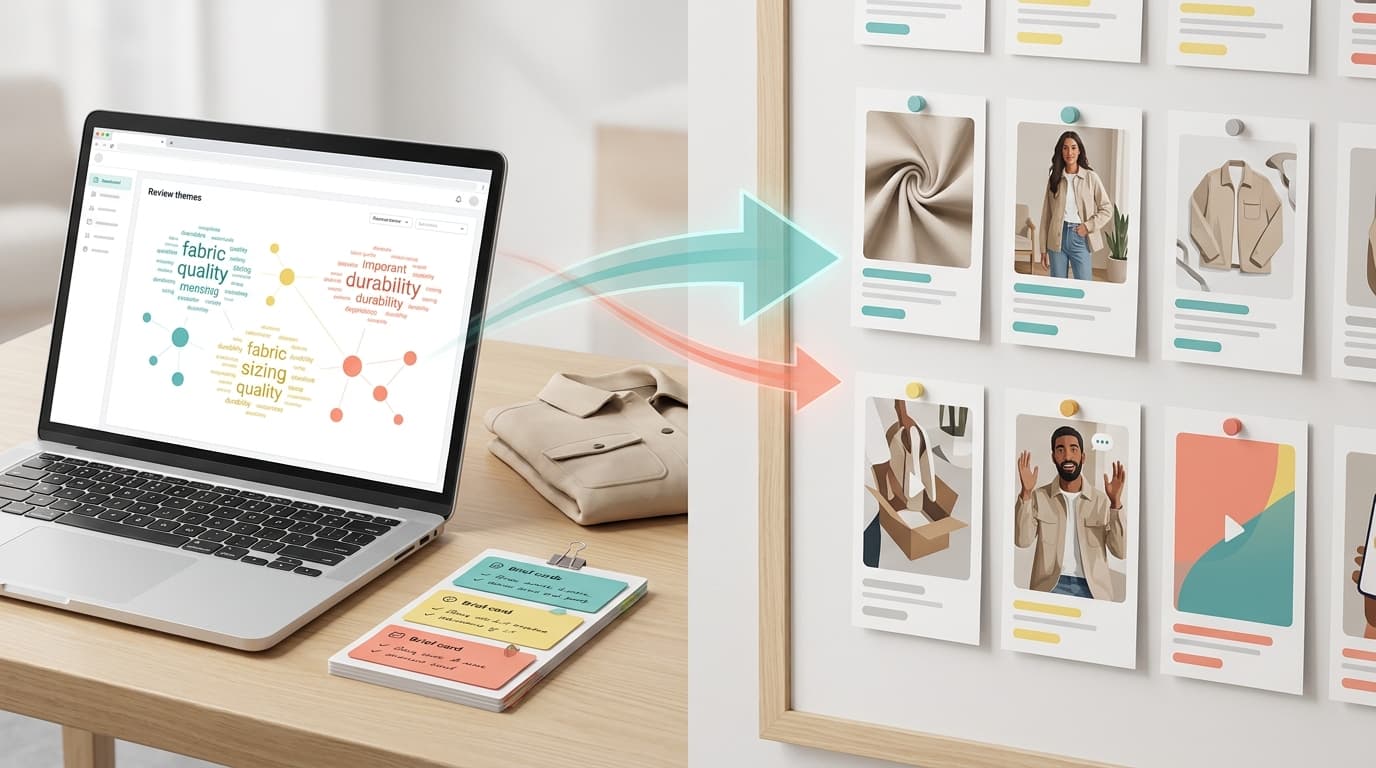
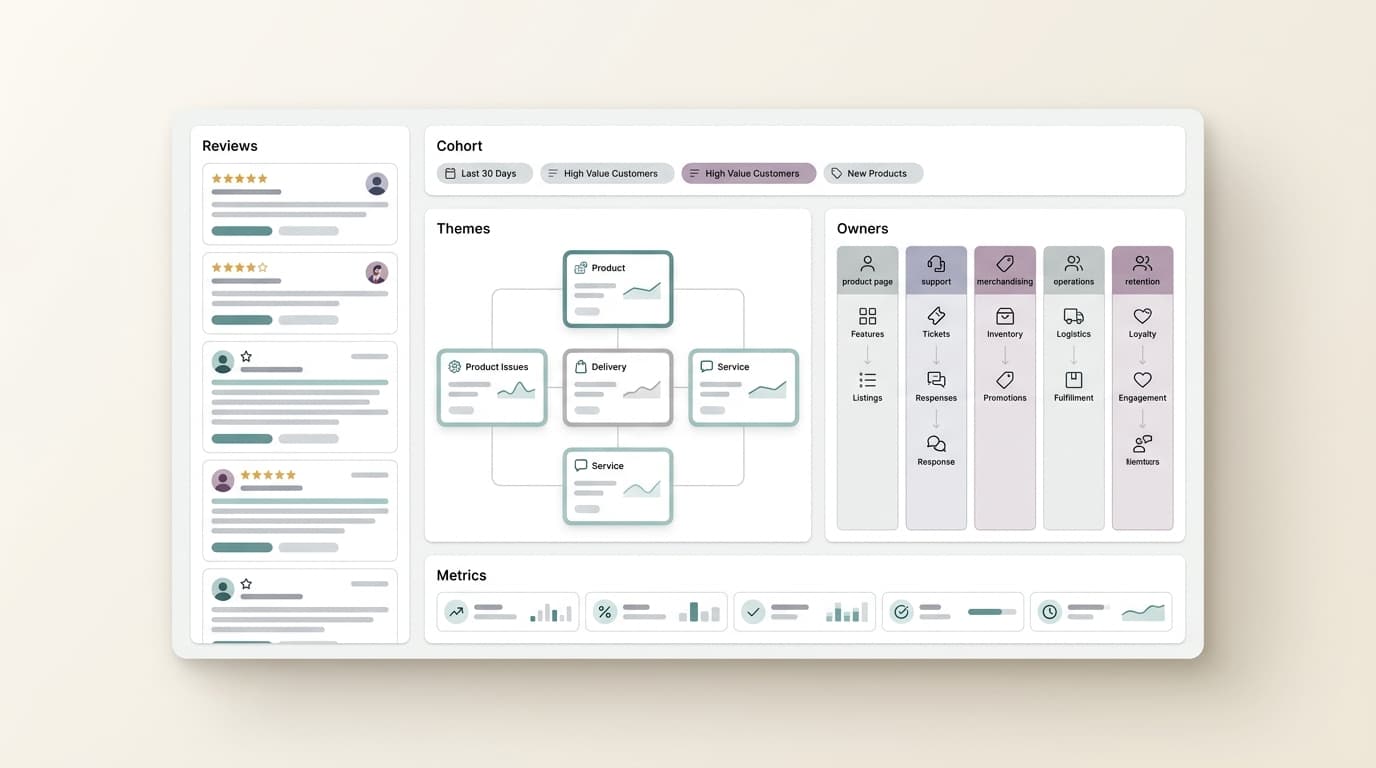
| Review intelligence | Evidence-backed decisions from customer language | VOC / AI review analysis workflow | Cohorts, source reviews, themes, counterevidence, owner handoff, export/API path |
Most Shopify merchants need collection and display before they need deep analysis. But once reviews start influencing product, CX, merchandising, or retention decisions, basic review reporting is not enough.
That is where a Shopify review analytics comparison should become more specific: which layer can turn review language into a defensible action?
Do not buy "analytics" until you know what it measures
When a vendor says it has review analytics, ask what the dashboard is actually measuring.
| Analytics claim | Useful when it measures | Not enough when you need |
|---|---|---|
| Review request analytics | Request sends, opens, conversions, review volume, review quality | The product or page change customers are asking for |
| Widget analytics | Review display impact, UGC engagement, star visibility, onsite proof usage | Source evidence behind a theme |
| Sentiment analytics | Attribute-level positive and negative language by product or cohort | Specific owner, action, and follow-up metric |
| AI review summaries | Fast compression of review text | Traceable, review-level proof and counterevidence |
| Product analytics | Sales, conversion, sessions, refund signals, product performance | The review language explaining why behavior changed |
| API analytics | Repeatable data movement and automated reporting | Nontechnical setup and storefront display |
The comparison mistake is treating all six as the same capability. They are not.
A Shopify review app can be excellent at collecting and displaying reviews while staying weak at decision-grade review intelligence. A BI or store analytics workflow can show conversion movement without explaining the review evidence behind it. An AI summary can sound confident while hiding the source reviews that would prove or weaken the claim.
Compare tool categories, not only vendor names
The Shopify App Store has a dedicated product reviews category with free and paid apps for collecting, displaying, and using reviews. Current examples include Judge.me, Loox, Yotpo Product Reviews, Stamped Reviews & Loyalty, and Okendo Reviews & Loyalty.
Those products do not all compete on the same job.
| Category | Common strengths | Buyer should check |
|---|---|---|
| Lightweight review collection apps | Review requests, star ratings, review widgets, basic social proof, affordable setup | Can the app export reviews, preserve review context, and support product/variant/date cohorts? |
| Visual review and UGC apps | Photo/video reviews, onsite proof, referrals, upsells, social proof surfaces | Are analytics focused on conversion/display, or can the team inspect themes and source reviews? |
| Customer marketing platforms | Reviews plus loyalty, referrals, quizzes, surveys, campaigns, syndication | Does the platform explain review language, or mainly orchestrate customer marketing programs? |
| Store analytics / BI | Sales, conversion, sessions, orders, product reports, operational metrics | Can review themes be connected to these metrics without losing source evidence? |
| AI review intelligence | Theme extraction, sentiment by attribute, buyer language, competitor context, evidence packets | Can the workflow ingest the sources you need and push results to owners, dashboards, docs, or APIs? |
| API-first workflows | Repeatable analysis, internal dashboards, agent workflows, governed data movement | Who owns implementation, data quality, and maintenance after launch? |
This is why a useful Shopify review analytics comparison should not ask, "Which tool has the most features?" It should ask, "Which tool layer owns the decision we keep repeating?"
The buyer proof matrix
Use this matrix in demos and trials. Ask each finalist to show the same proof using the same review cohort.
| Buyer question | Weak proof | Strong proof |
|---|---|---|
| Can we control the cohort? | "Here is a summary of all reviews." | Product, variant, rating, date range, market, and source are locked and visible. |
| Can we trust the theme? | "AI says quality is the top issue." | Theme links to source reviews, dates, products, examples, and frequency by cohort. |
| Can we see counterevidence? | Only positive evidence is shown. | The workflow shows reviews that narrow, contradict, or weaken the finding. |
| Can we route the work? | Insight stays in a dashboard. | Output names product, CX, merchandising, support, operations, or growth owner. |
| Can we connect to metrics? | Review chart is isolated. | Theme connects to conversion, return reason, support volume, refund, repeat purchase, or campaign signal. |
| Can we repeat it? | Manual export and prompt cleanup every time. | Export, API, scheduled report, dashboard, or agent workflow can rerun the same analysis. |
| Can we leave later? | Data and outputs are trapped in screenshots. | Reviews, tags, themes, evidence, and reports can be exported in useful formats. |
The strongest Shopify review analytics tool is the one that can produce strong proof for your highest-value decision, not the one with the longest app listing.
What buyers should check before choosing
1. Source coverage
Ask which review sources the tool can analyze.
For a small Shopify store, storefront reviews may be enough. For a multi-channel ecommerce team, Shopify reviews may need to be compared with Amazon reviews, competitor reviews, support conversations, returns, social comments, and survey responses.
The key question is not "Does the tool ingest everything?" The better question is: "Can it preserve source context well enough that we know where each finding came from?"
2. Cohort controls
Shopify review analytics becomes unreliable when all reviews are blended together. Buyers should check whether they can filter by:
- Product
- Variant
- Rating
- Date range
- Review source
- Market or geography
- Purchase status
- Customer segment
- Campaign or collection
Without cohort control, a tool may turn one narrow issue into a fake company-wide theme.
3. Evidence traceability
Every major finding should link back to source reviews. This matters because teams need to inspect the evidence before changing a product page, filing a product issue, rewriting support macros, or changing a retention offer.
If a tool only provides polished AI summaries, ask for the underlying reviews. If the underlying reviews are hard to inspect, treat the summary as a starting point, not decision evidence.
4. Theme quality
Broad themes rarely create action. "Quality issue" is weak. "Low-star reviews after the April packaging change mention cracked caps during shipping" is useful.
Good Shopify review analytics should preserve:
- The product or variant affected
- The customer language
- The context of use
- The expectation gap
- The severity
- The owner who can act
- The metric that should change afterward
5. Counterevidence
Buyer teams often make the wrong call because a review summary confirms the loudest pattern and hides the exceptions.
Ask the tool to show counterevidence. For example:
- Reviews that praise the same attribute others criticize
- Recent reviews that no longer mention the issue
- One variant where the problem does not appear
- One market where the complaint is absent
- Happy reviews that use different buyer language than the negative cohort
Counterevidence prevents overreacting to noisy review patterns.
6. Handoff quality
Shopify review analytics should end in work the business can ship. Ask whether the output can become:
- A product-page copy change
- A support macro update
- A product or operations ticket
- A merchandising test
- A retention or bundle experiment
- A competitor positioning note
- A product research brief
If the tool stops at "insights," your team still has to build the operating layer.
7. Export, API, and governance
Small teams may be fine with a dashboard. Larger teams usually need review evidence to move into docs, dashboards, agents, tickets, BI, or internal reporting.
Ask about export formats, API access, scheduled reports, permissions, data retention, and how source evidence is preserved. The goal is not to over-engineer the first workflow. The goal is to avoid buying a closed box that cannot support the next workflow.
A practical same-cohort comparison test
Run this test before buying or renewing a tool.
- Pick one product with enough recent reviews.
- Choose one decision lane: product page, support, product fix, retention, merchandising, or competitor response.
- Lock one review cohort by product, rating range, and date range.
- Ask every finalist to produce the same output.
- Score the output before looking at extra features.
Use this scoring table:
| Test area | 1 point | 3 points | 5 points |
|---|---|---|---|
| Cohort setup | Broad summary only | Some filters | Exact cohort preserved and reusable |
| Source proof | No source reviews | A few examples | Every major theme links to source reviews |
| Theme specificity | Generic labels | Useful but broad | Specific enough to assign an owner |
| Counterevidence | Missing | Manual only | Visible in the workflow |
| Action handoff | Summary only | Suggested action | Owner, action, risk, and follow-up metric |
| Repeatability | One-off export | Repeatable with cleanup | Repeatable through report, export, API, or workflow |
| Decision fit | Nice dashboard | Some useful signals | Directly supports the chosen decision lane |
Do not average the score too quickly. If evidence traceability or cohort setup fails, the rest of the dashboard may not matter.
Where VOC.AI fits in a Shopify review analytics comparison
VOC.AI is not a replacement for a Shopify storefront review widget. If your main goal is to collect more reviews, show star ratings, display photo reviews, or run basic review-request flows, a Shopify-native review app should stay on your shortlist.
VOC.AI fits when the buyer needs a review intelligence layer around ecommerce customer language. The public Voice of Customer Analysis page positions VOC.AI around review ingestion, signal compression, buyer language, pain points, feature mentions, sentiment, and decision-ready outputs. The Review Analysis API page is relevant when teams need review, keyword, listing, and sales-estimate signals inside their own workflows, agents, or dashboards.
That makes VOC.AI most relevant when a Shopify review analytics comparison includes questions like:
- Are the same complaints appearing in Shopify reviews, Amazon reviews, and competitor reviews?
- Which review themes should become product, support, listing, or merchandising work?
- Which buyer phrases should be reused in product pages, marketplace listings, ads, or lifecycle emails?
- Which review evidence needs to move into a dashboard, report, agent, or internal workflow?
- Which product gap is visible in review language before it shows up in sales reports?
If the comparison is only about storefront review collection and display, VOC.AI should complement that layer rather than replace it. If the comparison is about turning review evidence into repeatable decisions, VOC.AI belongs in the buyer conversation. The existing Shopify review analytics tools evaluation framework is useful when you need a fuller scorecard, while the Shopify review analytics practical guide covers the weekly team workflow after a tool is in place.
Common red flags in Shopify review analytics demos
Watch for these signals:
- The demo uses vendor sample data instead of your review cohort.
- The tool cannot show source reviews behind AI themes.
- The "analytics" tab mostly reports request performance or widget engagement.
- Product, variant, date, and rating filters are weak.
- Themes are too broad to route to an owner.
- The workflow cannot show counterevidence.
- Export and API options are unclear.
- The tool cannot explain how a review finding connects to a business metric.
- Every useful output requires screenshots and manual cleanup.
None of these red flags means the product is bad. They mean the product may be solving collection, display, or marketing automation rather than decision-grade Shopify review analytics.
Final buyer checklist
Before you choose a Shopify review analytics tool, answer these questions:
- What decision do we need reviews to support?
- Do we need collection/display, review marketing, store reporting, review intelligence, or API workflows?
- Which sources must be analyzed now, and which sources will matter in six months?
- Can the tool preserve cohorts by product, variant, rating, date, source, and market?
- Can every major theme be traced to source reviews?
- Can the workflow show counterevidence?
- Can the output name an owner and a next action?
- Can the result connect to conversion, support, returns, repeat purchase, or product work?
- Can we export or rerun the analysis without starting over?
- What happens if we leave the tool later?
This checklist keeps the comparison grounded. You are not buying a dashboard. You are buying a way to make review-backed decisions faster and with less cleanup.
FAQ
What is Shopify review analytics?
Shopify review analytics is the process of turning Shopify product reviews and related customer feedback into evidence-backed decisions about product pages, support, product improvements, merchandising, retention, and growth.
What should a Shopify review analytics comparison include?
A useful comparison should include source coverage, cohort controls, evidence traceability, theme quality, counterevidence, handoff quality, metric connection, export options, API support, and operating cost.
Is a Shopify review app enough for analytics?
Sometimes. A Shopify review app may be enough if the main job is collecting reviews, displaying ratings, showing photo reviews, or improving social proof. A separate review intelligence layer becomes useful when teams need source evidence, cross-channel context, owner routing, and repeatable analysis.
Should buyers compare Shopify review analytics tools by price?
Price matters, but compare proof first. A cheaper tool that solves collection may be better for a young store. A more advanced workflow may be worth it for a team that repeatedly uses reviews for product, support, merchandising, or competitor decisions.
How do you test a Shopify review analytics tool?
Run a same-cohort test. Give each finalist the same product, rating range, date range, and decision lane. Ask for source-backed themes, counterevidence, owner handoff, follow-up metric, and repeat workflow path.
Conclusion
The right Shopify review analytics tool depends on the job.
If the job is trust building, prioritize review collection, widgets, photo/video reviews, and social proof. If the job is customer marketing, prioritize UGC reuse, loyalty, referrals, campaigns, and syndication. If the job is decision support, prioritize cohort control, source evidence, counterevidence, action handoff, metric connection, and repeatability.
Do the same-cohort test before you buy. A tool that turns one real review cohort into a decision your team can defend is doing the work that Shopify review analytics is supposed to do.