Updated September 9, 2026.
VOC analysis gets weaker when every customer comment is pushed into the same bucket. A pricing objection, an onboarding complaint, a competitor comparison, and a renewal risk may all mention the same product area, but they do not belong to the same decision.
That is why this guide maps VOC analysis use cases by funnel stage. Use it when your team already has customer reviews, support tickets, survey responses, interviews, sales notes, product analytics, or competitor feedback and needs to decide which evidence belongs at awareness, consideration, purchase, activation, retention, and expansion.
If you need the basic method first, start with the VOC analysis beginner guide. If you need a fast evidence-quality gate, use the VOC analysis checklist for faster decisions. If you need growth cadence, read VOC analysis strategy for growth teams. This article stays narrower: which funnel-stage decision each VOC analysis use case should improve.
The practical question is:
Which funnel decision will this customer evidence improve, and what output would make the owner comfortable acting on it?
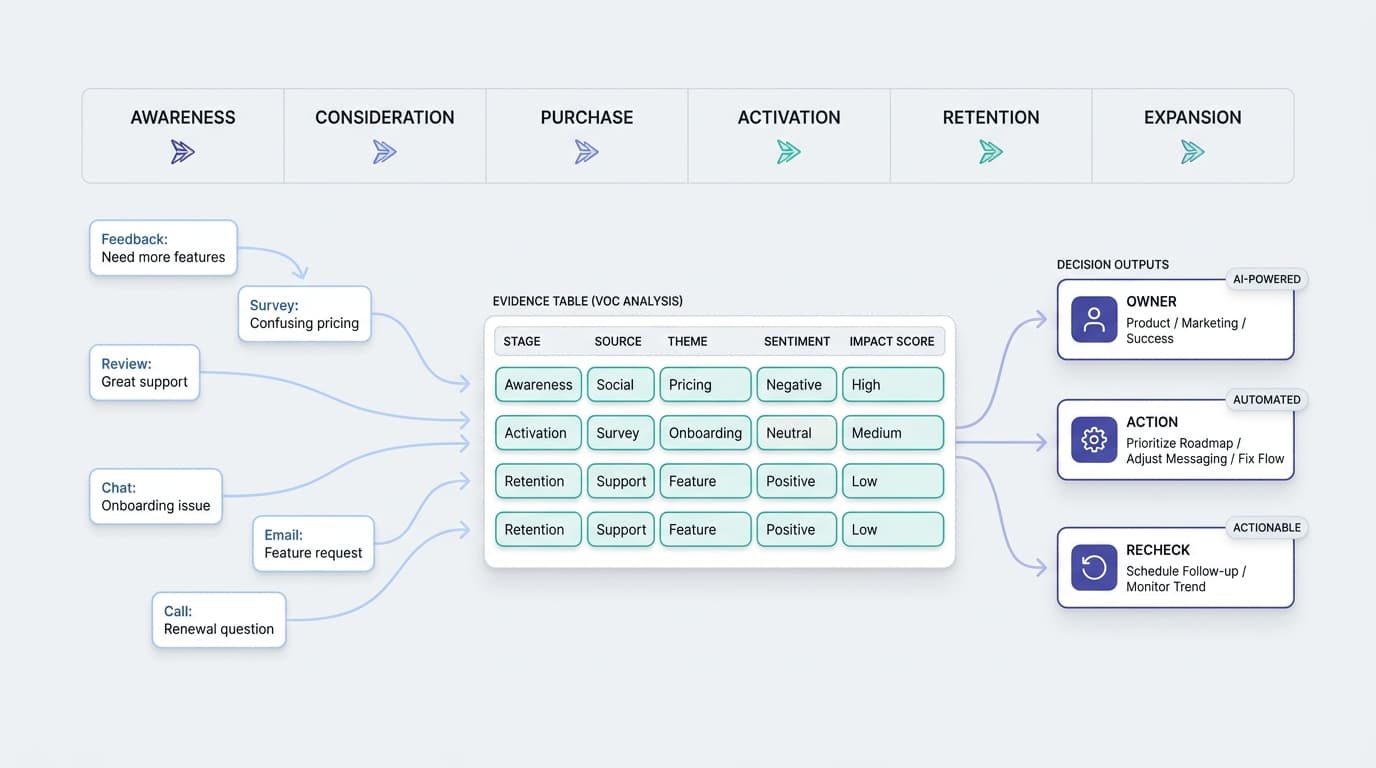
The VOC analysis funnel-stage map
Start with the funnel stage. Then choose the evidence. Then choose the output. Good VOC analysis should end in a decision owner, not a prettier theme cloud.
| Funnel stage | Core decision | Best evidence | VOC analysis output | Next action |
|---|---|---|---|---|
| Awareness | Which problem language should we lead with? | Public reviews, competitor reviews, community posts, search questions, social comments | Buyer-language and pain-point map | Pick content angles, campaign hooks, market-entry hypotheses |
| Consideration | What proof or comparison changes trust? | Review pros and cons, sales objections, comparison-page behavior, pre-sale questions | Objection and proof-gap matrix | Rewrite comparison copy, FAQs, proof blocks, sales enablement |
| Purchase | What blocks the buyer at the decision point? | Pricing questions, checkout feedback, product-page feedback, listing reviews, support chats | Purchase-friction report | Clarify price, offer, guarantee, product detail, or CTA path |
| Activation | What expectation gap appears after signup or delivery? | Onboarding tickets, first-use surveys, setup chats, low-star reviews, product usage data | Expectation-gap diagnosis | Fix onboarding, docs, packaging, setup flow, or first-value message |
| Retention | What recurring issue threatens repeat use, renewal, or trust? | Churn notes, repeat complaints, support escalations, returns, rating trends | Retention-risk board | Assign product, support, CX, or operations owner |
| Expansion | What positive language reveals a new use case or segment? | Positive reviews, advanced usage notes, expansion calls, accessory requests, competitor demand | Expansion-opportunity brief | Test bundle, upsell, persona page, feature, or product line |
This is the minimum operating model. If the output does not name the stage, evidence cohort, customer mechanism, counterevidence, owner, and next step, the VOC analysis is not ready to drive a real decision.
Awareness: find the problem language buyers already use
Awareness-stage VOC analysis should answer one thing: what language already exists before a buyer knows your brand.
Use this stage when the team is choosing a category narrative, ad hook, SEO angle, product launch message, or audience hypothesis. The best evidence is usually public and messy: marketplace reviews, competitor reviews, app store reviews, forum posts, creator comments, social complaints, and recurring search questions.
The useful output is a buyer-language map:
| Field | What to capture |
|---|---|
| Pain phrase | The exact words customers use to describe the problem |
| Trigger | The situation that made the problem visible |
| Current workaround | What the customer does when the product or process fails |
| Desired outcome | What the customer expected instead |
| Segment clue | Role, company type, use case, product variant, or market |
| Source | Review, ticket, post, sales note, survey answer, or competitor evidence |
Weak awareness output says, "customers care about ease of use." Strong awareness output says, "first-time admins describe setup as risky because they cannot tell who else will be affected; the phrase 'I do not want to break the team workspace' appears across onboarding survey comments and support tickets."
That difference matters. The first sentence is a generic theme. The second can shape a landing-page headline, a comparison angle, an onboarding promise, or a sales discovery question.
VOC.AI's Voice of Customer Analysis page positions the product around customer needs, dislikes, expectations, buyer language, and decision-ready outputs from Amazon review data. That makes review-backed VOC analysis especially useful at awareness when the team needs language from the market, not internal brainstorming.
Consideration: turn objections into proof
Consideration-stage VOC analysis is about shortlist pressure. Buyers are comparing alternatives and looking for a reason to trust one path.
Use this stage when the team needs to answer:
- What objections appear before a buyer chooses?
- Which competitor strength is real versus just louder marketing?
- Which proof points belong on comparison pages, product pages, and sales collateral?
- Which claims create skepticism because customers have seen them fail before?
- Which customer segment cares about a tradeoff enough to change vendors?
Turn the evidence into an objection matrix:
| Objection | Evidence to inspect | Better VOC analysis output | Owner |
|---|---|---|---|
| "Will this work for my use case?" | Reviews, sales calls, support questions, demo notes | Use-case proof with customer examples and boundaries | Product marketing |
| "Is this better than the alternative?" | Competitor reviews, comparison queries, win-loss notes | Competitor strength and weakness map | Growth or sales |
| "Can I trust the claim?" | Low-star reviews, refund reasons, support escalations | Claim-risk list with counterevidence | Marketing |
| "Is the price justified?" | Pricing-page questions, trial feedback, review tradeoffs | Value proof tied to a job and segment | Growth |
The goal is not to prove that customers have objections. The goal is to show which objection deserves a proof block, which claim should be softened, and which comparison deserves its own page.
This is where VOC analysis tools can help, but only if they preserve source evidence. A smooth summary is not enough for consideration-stage work. The marketer or product owner needs to inspect the original language before turning it into copy.
Purchase: isolate the friction closest to conversion
Purchase-stage VOC analysis should stay close to the moment of decision. Broad sentiment is less useful here than specific friction.
Look for:
- pricing or plan confusion
- checkout hesitation
- product-detail uncertainty
- sizing, compatibility, or setup questions
- trust, warranty, guarantee, or delivery doubts
- final objection language in reviews, chats, and sales notes
Use a purchase-friction report:
| Friction | Customer evidence | Decision to make | Fastest test |
|---|---|---|---|
| Price confusion | Prospects ask what is included or when credits reset | Should plan copy be clearer? | Add plan-fit language near the CTA |
| Compatibility doubt | Buyers ask whether the product works with their workflow | Should the page show fit boundaries? | Add compatibility FAQ and source examples |
| Trust gap | Customers want proof before committing | Which proof matters most? | Move the strongest proof block above the CTA |
| Missing detail | Reviews mention surprise after purchase | Which product detail was unclear? | Add image, comparison table, or setup note |
VOC.AI's current pricing page separates the VOC review analytics platform from API and MCP subscriptions, with a free trial path and paid platform/API options. For purchase-stage VOC analysis, that kind of page should be checked for recurring questions: what the buyer misunderstood, which plan boundary caused hesitation, and what evidence would reduce confusion before conversion.
Do not use purchase-stage VOC analysis to make broad roadmap decisions. Use it to remove the blocker closest to revenue, then monitor whether the next cohort repeats the same complaint.
Activation: close the promise-versus-experience gap
Activation-stage VOC analysis starts after signup, purchase, installation, delivery, or first use.
The central question is:
What did the customer expect, and where did the experience fail to match that expectation?
Useful sources include onboarding surveys, setup tickets, first-use chats, documentation searches, early product analytics, product returns, low-star reviews, and comments that begin with "I thought it would..."
Separate the expectation gap before assigning work:
| Gap type | What it means | Evidence pattern | Likely owner |
|---|---|---|---|
| Promise gap | The marketing or sales promise set the wrong expectation | Customers say the result was different from what they expected | Marketing or sales |
| Setup gap | The product can work, but first success is too hard | Repeated setup questions, failed imports, confusing first step | Product, CX, docs |
| Education gap | The value exists, but customers miss it | Customers ask for a feature that already exists | Product marketing or lifecycle |
| Product gap | The experience does not deliver the promised outcome | Complaints persist after docs and support improvements | Product or operations |
This stage is where VOC analysis needs cohort control. Do not rewrite onboarding for every user because one segment struggled. Do not change product positioning because an old version generated complaints. Record the segment, source, time window, lifecycle moment, and exclusion rule before you act.
Retention: catch recurring risk before it becomes churn
Retention-stage VOC analysis is about recurrence, severity, and drift. The question is not "are customers unhappy?" The question is which repeated issue threatens repeat purchase, renewal, trust, support cost, or long-term adoption.
Use this stage when the team sees:
- repeat complaints in support tickets
- rating decline or review theme drift
- churn notes that match product friction
- return reasons that match public complaints
- customers who praise the product but stop using it
- negative competitor comparisons after renewal or repeat purchase
Build a retention-risk board:
| Signal | What to check | Output | Action threshold |
|---|---|---|---|
| Recurring complaint | Does the same issue repeat across sources or segments? | Theme, source examples, affected cohort | Assign owner if repeated in a recent cohort |
| Rating or sentiment drift | Is the issue getting worse or just visible? | Trend note plus strongest recent evidence | Monitor if weak; escalate if recent and severe |
| Support spike | Are tickets repeating the same customer job? | Root-cause hypothesis and support/product split | Fix workflow if support keeps handling the same failure |
| Churn or return reason | Does cancellation language match review or ticket evidence? | Risk packet with counterevidence | Prioritize if tied to high-value segment |
The most useful retention output names what will be checked next. A theme without a recheck date becomes a dashboard artifact. A theme with owner, action, expected signal, and review date becomes operating work.
Expansion: mine positive language for new growth bets
Expansion-stage VOC analysis is easy to miss because teams often focus only on complaints. Positive feedback can reveal the next segment, bundle, feature, content angle, or sales motion.
Look for customer language such as:
- "I also use this for..."
- "I bought another one for..."
- "This works better than..."
- "I wish there were a version for..."
- "Our team started using it when..."
- "It would be perfect if it included..."
Turn those signals into an expansion brief:
| Brief field | What to write |
|---|---|
| New use case | The exact customer situation, not a generic segment label |
| Evidence | Source, date, product, segment, and representative language |
| Confidence | How many sources repeat it and what contradicts it |
| Action | Bundle, cross-sell, persona page, feature test, campaign, or product line |
| Owner | Growth, product, sales, lifecycle, ecommerce, or leadership |
| Follow-up | Metric, review theme, support volume, or adoption signal to recheck |
VOC.AI's Review Analysis API is relevant when the team wants review, keyword, listing, and sales-estimate signals to flow into internal dashboards, agents, or recurring reports. That matters for expansion because opportunity scans often need to run across many products, competitors, or categories rather than one manual export.
Same signal, different funnel-stage decision
The same customer phrase can mean different things depending on the stage. That is why VOC analysis should label journey context before ranking themes.
| Customer evidence | If it appears at awareness | If it appears at consideration | If it appears at purchase | If it appears at activation or retention |
|---|---|---|---|---|
| "Confusing pricing" | Market category may feel risky or opaque | Buyers need comparison and proof | CTA path needs clearer plan fit | Existing customers may misunderstand renewal or usage limits |
| "Setup took too long" | Lead with easier-start language if true | Prove implementation effort honestly | Add setup expectations before purchase | Fix onboarding, docs, support, or product flow |
| "Competitor was simpler" | Category education may need simpler framing | Comparison page needs sharper tradeoffs | Buyer may need a fast-start offer | Product may need usability improvements |
| "Great support" | Trust language can shape campaigns | Proof can reduce risk | Support guarantee may help conversion | Retention asset and expansion proof |
| "Missing feature" | Market demand may be emerging | Objection may block shortlist | Buyer may need workaround explanation | Roadmap or churn-risk signal |
This table is the article's main operating point: do not rank VOC analysis themes before you know the stage. First decide where the evidence sits in the funnel. Then decide whether the team should message, prove, clarify, fix, monitor, or expand.
The 30-minute VOC analysis funnel-stage test
Use this test before building a dashboard, buying a tool, or sending a stakeholder report.
- Pick one funnel stage.
- Write one decision sentence.
- Choose one evidence cohort.
- Extract five to ten repeated themes.
- Preserve at least three source examples for each accepted theme.
- Add counterevidence or boundary conditions.
- Assign one owner and one next action.
- Set the recheck date and expected signal.
Use this template:
| Field | Fill this in |
|---|---|
| Funnel stage | Awareness, consideration, purchase, activation, retention, or expansion |
| Decision sentence | "We need to decide whether..." |
| Evidence cohort | Source, date range, segment, journey moment, product, competitor, or rating band |
| Accepted theme | The specific customer mechanism, not a broad label |
| Source examples | Review snippets, ticket IDs, survey responses, call notes, or analytics references |
| Counterevidence | What weakens, narrows, or contradicts the finding |
| Owner | Product, UX, growth, marketing, support, CX, sales, operations, or leadership |
| Next action | Message, prove, clarify, fix, monitor, expand, or decline |
| Recheck date | When the next cohort will be inspected |
The test succeeds only when the output changes the next action. If the result is just a list of themes, the VOC analysis is not finished.
How VOC.AI fits the workflow
VOC.AI fits best when customer reviews and market evidence need to become product, listing, support, or growth decisions.
- Use Voice of Customer Analysis when the team needs review themes, buyer language, pain points, expectations, and decision-ready outputs from Amazon review evidence.
- Use Product Research when the decision is what to build, improve, package, or test next.
- Use Market Insight when the question is category movement, competitor context, or market opportunity.
- Use Review Analysis API when VOC analysis needs to flow into an internal dashboard, agent, report, or recurring workflow.
- Use Pricing when the team is choosing between a trial, review analytics platform workflow, or API/MCP subscription path.
That fit is strongest for review-backed ecommerce, Amazon, and marketplace workflows. If your main evidence is only product telemetry, finance data, or offline interviews, VOC.AI should be paired with the system that owns that data rather than treated as the only source of truth.
Common failure modes
| Failure mode | What it looks like | Fix |
|---|---|---|
| Mixed funnel stages | Awareness language is used to justify retention priority | Pick one stage before analysis |
| Pooled evidence | Old reviews, new tickets, enterprise calls, and competitor complaints are ranked together | Lock source, segment, and date window |
| Sentiment-only output | The report says positive or negative but not why it matters | Add customer job, consequence, and owner |
| No counterevidence | The analysis hides where the theme does not apply | Require one contradiction pass |
| No owner | The report ends with "monitor this" | Name the decision owner and next action |
| No recheck | The finding never gets validated after action | Set the follow-up signal and date |
These failures are not tooling problems only. They are operating-model problems. A better tool helps, but the team still needs a stage, question, evidence boundary, owner, and recheck loop.
FAQ
What is VOC analysis?
VOC analysis is the process of turning customer language from reviews, surveys, interviews, support tickets, sales notes, and other feedback sources into patterns a team can inspect and use for decisions.
What are VOC analysis use cases by funnel stage?
VOC analysis use cases by funnel stage are the different decisions customer evidence can support at awareness, consideration, purchase, activation, retention, and expansion. Each stage needs a different evidence set, output, owner, and next action.
Which funnel stage should I start with?
Start where a decision is already waiting. If messaging is unclear, start with awareness or consideration. If conversion is blocked, start with purchase. If customers struggle after signup or delivery, start with activation or retention. If happy customers reveal new jobs, start with expansion.
Do I need VOC analysis tools for this workflow?
Not always. A small, narrow evidence cohort can be analyzed manually. VOC analysis tools matter when the team needs repeatability, source traceability, cohort filtering, exports, API workflows, or recurring review intelligence across many products and competitors.
How is this different from a VOC analysis strategy?
A VOC analysis strategy defines the operating cadence, governance, decision inventory, and feedback loop. This page is narrower: it maps VOC analysis use cases to funnel stages so each customer signal goes to the right decision.
Conclusion
VOC analysis becomes useful when each funnel stage has one question, one evidence boundary, one output, one owner, and one follow-up signal.
Use the stage map before you rank themes. Awareness needs buyer language. Consideration needs proof. Purchase needs friction removal. Activation needs expectation-gap diagnosis. Retention needs recurring-risk monitoring. Expansion needs new-use-case evidence.
That is how VOC analysis turns customer feedback into decisions instead of another archive of comments.