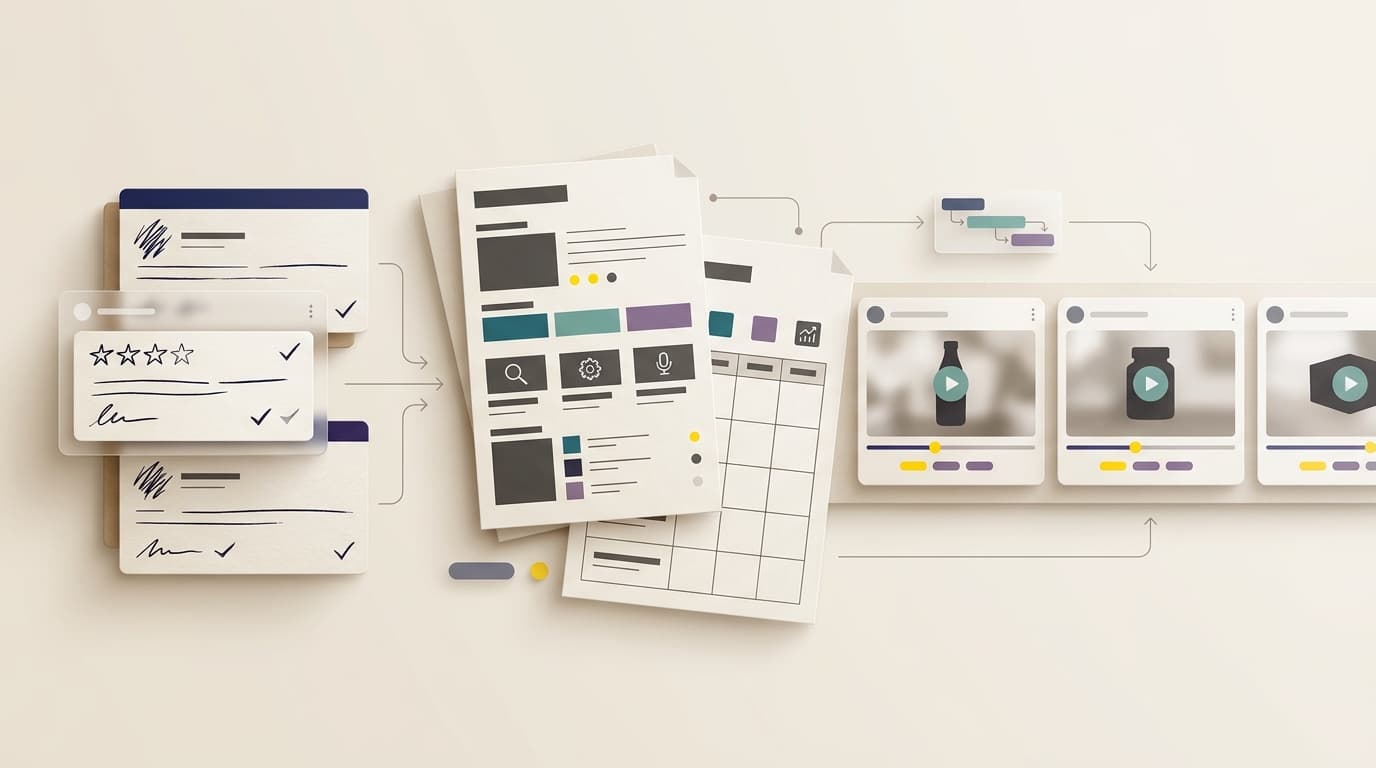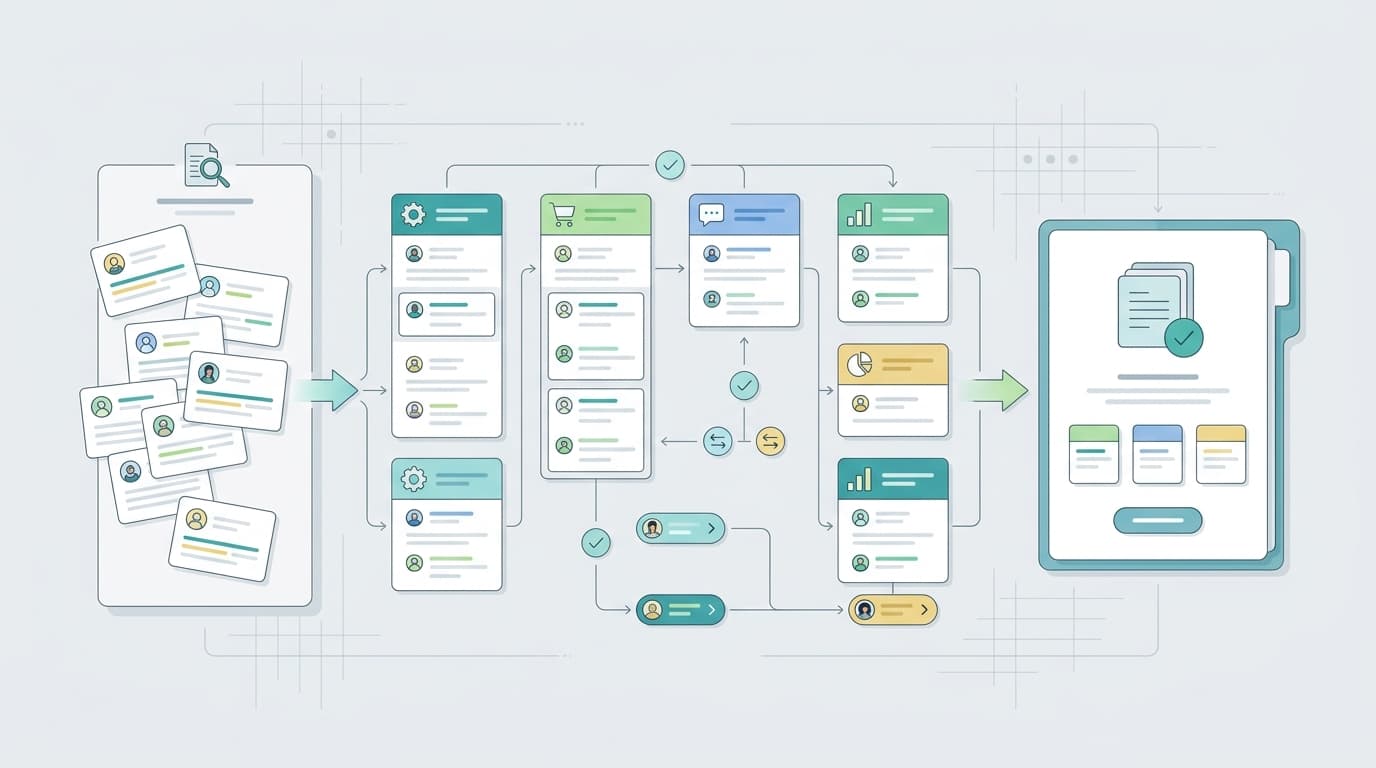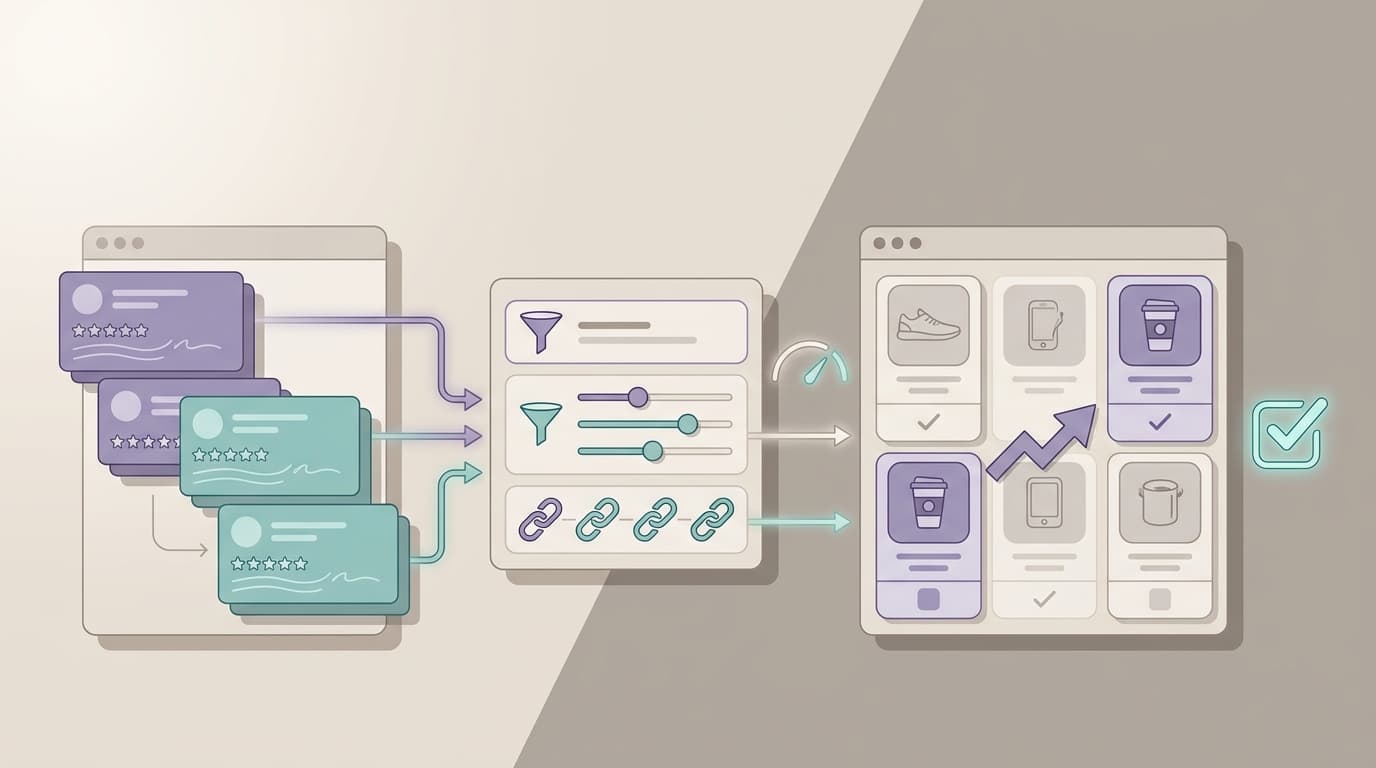
Updated September 5, 2026: this checklist focuses on the moment after feedback has arrived and before a team makes a product, UX, support, or messaging decision. If you need the full beginner method first, start with the VOC analysis beginner guide. If you want workflow examples by decision type, use the VOC analysis examples companion.
VOC analysis slows down when teams try to answer every customer question at once. The raw material is familiar: support tickets, survey comments, interviews, sales notes, product reviews, cancellation reasons, and competitor feedback. The bottleneck is deciding which signal is strong enough to use this week.
This VOC analysis checklist gives you a faster path. It helps you turn a bounded evidence set into one inspectable decision packet: what changed, who said it, what weakens the finding, what action is proposed, and who owns the next step.
Use it when you need a product manager, UX researcher, support lead, founder, or ecommerce operator to make a decision without waiting for a full research repository cleanup.
The 10-minute VOC analysis checklist
Run this checklist before you write a theme, open a roadmap item, change listing copy, brief support, or send a stakeholder summary.
| Check | Pass condition | If it fails |
|---|---|---|
| 1. Decision is named | The team can say what will change if the finding is true | Rewrite the question before coding |
| 2. Evidence window is fixed | Source, date range, segment, and journey moment are clear | Split the dataset or narrow the scope |
| 3. Original wording is preserved | Another person can inspect the actual customer language | Add source references before summarizing |
| 4. Customer job is visible | The analysis explains what the customer was trying to do | Recode by situation, not product area |
| 5. Theme has a consequence | The theme names the cost, friction, delay, risk, or missed expectation | Do not ship a label-only theme |
| 6. Contradictions are checked | At least one counterexample or boundary condition is recorded | Search for evidence that weakens the pattern |
| 7. Frequency is not treated as priority | Volume is compared with severity, segment, and actionability | Add a decision score before ranking |
| 8. Owner is assigned | One team owns the next action or the decision to do nothing | Park the theme until ownership is real |
| 9. Confidence is labeled | The finding is marked strong, directional, weak, or blocked | Do not present it as settled evidence |
| 10. Handoff is one page | The decision owner can review the finding in five minutes | Compress the packet before the meeting |
This is not a replacement for deeper research. It is the minimum gate for fast VOC analysis that still respects evidence quality.
Step 1: Name the decision before you analyze
The fastest way to waste VOC analysis time is to start with a general question:
- What do customers think?
- What are our biggest problems?
- What should we build next?
- Why are users unhappy?
Those questions create large theme maps but weak decisions. A faster VOC analysis checklist starts with a narrower sentence:
We are analyzing [source] from [segment] during [time or journey stage]
to decide whether [owner] should [act, test, investigate, monitor, or decline].
Examples:
| Weak question | Faster decision question |
|---|---|
| What do customers dislike? | Should the activation PM test dependency warnings for new workspace administrators? |
| What feature should we build? | Should the product team investigate export formatting as a reporting job, not just a CSV request? |
| What do reviews say? | Should the listing owner change copy around setup effort before the next campaign? |
| Why are customers leaving? | Should customer success test an adoption path for accounts that cancel after one project? |
If the decision cannot be named, the analysis is not ready. Do not fix that with more data. Fix it by shrinking the question.
Step 2: Freeze the evidence boundary
Fast VOC analysis depends on a small, defensible evidence boundary. Without one, old feedback, new feedback, enterprise accounts, small accounts, prospects, active customers, and competitor reviews all blend into one messy pattern.
Use this evidence-boundary check:
| Boundary field | What to record | Example |
|---|---|---|
| Source | Where the feedback came from | Support tickets and onboarding survey comments |
| Date range | When the feedback appeared | Last 60 days |
| Segment | Whose feedback counts | New admins at 20-200 employee SaaS teams |
| Journey moment | When the friction happened | First setup week |
| Exclusion rule | What does not count | Feature requests from sales calls outside the segment |
| Decision owner | Who can use the result | Activation PM |
This boundary is what makes the final VOC analysis reviewable. It also prevents a common error: ranking a large pile of mixed feedback as if every row had the same meaning.
If you are starting from scratch, the VOC analysis beginner worksheet gives you a smaller first-pass format. Use this checklist when you already have a bounded evidence set and need to turn it into a decision.
Step 3: Preserve the original customer language
Summaries are useful, but they are not evidence by themselves. A decision owner should be able to inspect the original wording or the permitted source reference behind every important theme.
Use these minimum fields:
Record ID
Source
Date
Customer segment
Lifecycle stage
Original feedback
Customer job
Situation
Draft code
Theme candidate
Contradiction or ambiguity
Possible decision
Owner
For public reviews, preserve the exact buyer language that explains the expectation or friction. For support tickets, keep the action the customer tried to complete. For interviews, keep the quote or source reference allowed by your research policy. For survey comments, keep the prompt that produced the answer.
VOC AI's Voice of Customer Analysis page describes the product around clustering feedback by pain point, expectation, and feature mention. That is the same discipline this checklist uses: do not collapse feedback into sentiment alone when the team needs to understand the job, situation, and consequence.
Step 4: Code by customer situation, not internal taxonomy
Internal labels are usually too broad for fast decisions:
- onboarding
- pricing
- performance
- reporting
- integrations
- support
Those labels help route work, but they rarely explain what the customer needed. A stronger VOC analysis code describes the situation and consequence.
| Weak code | Better code | Why it is better |
|---|---|---|
| Onboarding | Admin hesitates before changing shared settings | Names the actor, moment, and risk |
| Reporting | User needs evidence formatted for a stakeholder | Explains the job behind the export request |
| Pricing | Buyer expected a feature to be included | Separates value confusion from price objection |
| Support | Customer cannot recover after a failed self-service step | Shows the failure path |
| Reviews | Buyer praises speed but complains about setup effort | Preserves the tradeoff |
This is where many VOC analysis tools help: clustering and retrieval can speed up first-pass labeling. The analyst still has to review whether the codes reflect customer situations or merely mirror the product navigation.
Step 5: Turn a theme into a decision-ready finding
A theme is not decision-ready until it has a consequence, a boundary, and a next action.
Use this format:
Finding:
[Customer segment] in [situation] repeatedly says [evidence-backed pattern],
which creates [consequence].

Evidence:
[Count or directional signal] from [sources and window], with example records [IDs].

Boundary:
This applies to [included group] and does not yet prove [excluded group].

Contradiction:
[Evidence that weakens, narrows, or complicates the theme].

Decision:
[Owner] should [act, test, investigate, monitor, or decline] by [date or review point].
Example:
| Field | Filled example |
|---|---|
| Finding | New workspace administrators hesitate before changing shared settings because they cannot tell which teammates will be affected. |
| Evidence | Directional signal across onboarding survey comments and setup tickets from the last 60 days. |
| Boundary | Applies to first-week admins at smaller teams; not yet proven for enterprise admins. |
| Contradiction | Some retained teams solved the issue through internal enablement, not product guidance. |
| Decision | Activation PM should test a dependency-warning concept before changing the entire onboarding flow. |
This format is intentionally plain. The value of VOC analysis is not a polished insight sentence. It is a finding that another person can inspect, challenge, and act on.
Step 6: Check contradictions before you rank themes
Fast decisions are risky when teams only collect confirming evidence. Every VOC analysis checklist should force a contradiction pass.
Ask:
- Which customers did not experience this problem?
- Which comments point to a different cause?
- Which source might overrepresent the issue?
- Which high-value segment is missing from the evidence?
- Which retained or successful customers faced the same situation?
- Which competitor review pattern suggests the problem is category-wide, not product-specific?
Contradictions do not always kill a finding. Often they make it more useful. They tell you where the decision applies, where it does not, and what the next research question should be.
Use the VOC analysis quality checklist when you need a stricter validation pass before using a theme in roadmap, messaging, support, or retention planning.
Step 7: Score speed, confidence, and decision value separately
The loudest feedback should not automatically win. Neither should the easiest fix. Separate the score into three parts:
| Score | Question | 1-point signal | 3-point signal | 5-point signal |
|---|---|---|---|---|
| Decision value | Would acting on this change a real decision? | Interesting but no owner | Owner might use it later | Owner has a live decision |
| Evidence confidence | Is the pattern inspectable and bounded? | Anecdotal | Directional across one source | Repeated across bounded sources with contradictions checked |
| Speed to action | Can the next step happen soon? | Requires broad strategy work | Needs one discovery pass | Can be tested, monitored, or routed this week |
Then use the score to choose the next action:
| Combined signal | Decision |
|---|---|
| High value, high confidence, high speed | Act or test now |
| High value, medium confidence | Run a targeted validation pass |
| Medium value, high confidence | Route to the right owner or backlog |
| Low value, high volume | Monitor but do not overreact |
| Low confidence, high urgency | Escalate as a risk, not a settled finding |
This keeps VOC analysis from becoming a popularity contest.
Step 8: Build the five-minute decision packet
The handoff should be short enough for a product review, support standup, founder check-in, or campaign meeting.
Use this one-page structure:
| Section | What to include |
|---|---|
| Decision question | One sentence that names owner, source, segment, and action |
| Evidence boundary | Source, date range, segment, journey moment, exclusion rule |
| Finding | One decision-ready finding with consequence |
| Evidence table | 3-5 representative rows with original wording or source reference |
| Contradiction | The strongest counterexample or scope limitation |
| Recommended action | Act, test, investigate, monitor, or decline |
| Owner and review date | Who owns the next step and when it will be checked |
Do not include every chart. Do not include every theme. Do not include the entire export. Keep those available for audit, but make the decision packet clear enough to review in five minutes.
A same-day VOC analysis workflow
Here is the checklist as a same-day workflow:
| Timebox | Work | Output |
|---|---|---|
| 0-10 minutes | Name the decision and owner | One decision question |
| 10-20 minutes | Freeze source, segment, date range, and exclusions | Evidence boundary |
| 20-45 minutes | Read records and mark customer jobs before codes | Job and situation notes |
| 45-75 minutes | Code by situation, consequence, and ambiguity | Draft coded set |
| 75-95 minutes | Group one or two themes | Candidate finding |
| 95-115 minutes | Search for contradictions and missing segments | Boundary note |
| 115-130 minutes | Score decision value, confidence, and speed | Action recommendation |
| 130-150 minutes | Write the five-minute packet | Decision handoff |
This workflow is not designed for a company-wide research program. It is designed for one decision that cannot wait for perfect taxonomy work.
When to use VOC analysis tools
A spreadsheet is enough for a single bounded decision. VOC analysis tools become useful when the same checklist has to run repeatedly, across larger evidence sets, or across multiple teams.
Use this tool-readiness checklist:
| Need | Why it matters |
|---|---|
| Searchable source evidence | Decision owners can inspect the original language |
| Theme clustering with review | AI can speed grouping, but humans still need to review boundaries |
| Contradiction handling | The workflow should expose weak evidence, not hide it |
| Segment and source filters | Mixed datasets create weak conclusions |
| Owner handoff | Themes should route to a product, support, CX, marketing, or research owner |
| Repeatable exports or API | Mature teams need the workflow to run again, not just once |
VOC AI's Review Analysis API is relevant when a team wants review, keyword, listing, and market signals available in repeatable workflows or an internal agent stack. For a broader commercial comparison, use the VOC analysis software evaluation guide.
If you are still validating whether the workflow is worth scaling, start manually. If the checklist produces repeat decisions and the source volume keeps growing, then evaluate software with the same evidence-boundary, contradiction, and handoff requirements.
Common failure modes
| Failure mode | What it looks like | Fix |
|---|---|---|
| Theme without decision | "Customers are confused" | Name the owner and action before analysis |
| Volume without context | "36% mention onboarding" | Add segment, journey stage, and consequence |
| Sentiment without job | "Negative reviews increased" | Identify what customers were trying to accomplish |
| AI summary without evidence | "The model says setup is the top issue" | Attach original records and contradiction checks |
| Contradiction ignored | Only confirming examples appear | Search for counterexamples before ranking |
| No owner | Insight lives in a deck | Route the finding to act, test, investigate, monitor, or decline |
These failures are normal. The point of a checklist is to catch them before a team treats weak VOC analysis as decision evidence.
FAQ
What is a VOC analysis checklist?
A VOC analysis checklist is a set of evidence checks that helps a team turn customer feedback into a decision-ready finding. It usually covers decision scope, source context, original wording, customer job, theme strength, contradictions, owner handoff, and next action.
How is this different from a VOC analysis guide?
A VOC analysis guide explains the full method. This checklist is a faster operating gate for teams that already have feedback and need to decide whether one finding is strong enough to use.
Can AI do VOC analysis?
AI can help with clustering, retrieval, summarization, and first-pass labeling. A human still needs to define the decision, preserve source context, review contradictions, and decide what action the evidence supports.
How many feedback records do you need?
You do not need a huge dataset for a narrow decision. You need a bounded dataset with enough context to inspect the theme. A small set of well-scoped records is often more useful than a large mixed export.
What should a VOC analysis output include?
The output should include the decision question, evidence boundary, finding, representative evidence, contradiction or limitation, confidence label, recommended action, owner, and review date.
When should we use VOC analysis tools instead of a spreadsheet?
Use tools when feedback volume, repeat analysis, cross-team handoff, source traceability, or API/workflow integration becomes difficult to manage manually. For one narrow decision, a spreadsheet can still be enough.
Bottom line
Fast VOC analysis is not rushed analysis. It is bounded analysis.
Name the decision, preserve the evidence, code by customer situation, check contradictions, score confidence separately from volume, and hand the result to an owner. That is how a team moves from "we heard this a lot" to "we know what to do next."
If review-backed customer feedback is central to your workflow, start with VOC AI's Voice of Customer Analysis page, or compare current plans on pricing.