Updated August 18, 2026.
VOC analysis is useful to a growth team only when it changes a growth decision. A clean theme map is not enough. The team needs to know which customer language should shape the next landing page, which objection blocks conversion, which product gap deserves a test, which support issue is slowing activation, and which competitor complaint can become a sharper promise.
That is why a growth-team VOC analysis strategy needs a tighter operating system than a generic Voice of Customer program. The goal is not to collect every customer comment. The goal is to turn the right customer evidence into repeatable experiments, product bets, messaging tests, and learning loops.
This guide gives growth, product, and ecommerce teams a practical VOC analysis strategy:
- a decision inventory that keeps analysis tied to growth work
- an evidence map for reviews, surveys, support, sales, analytics, and competitor signals
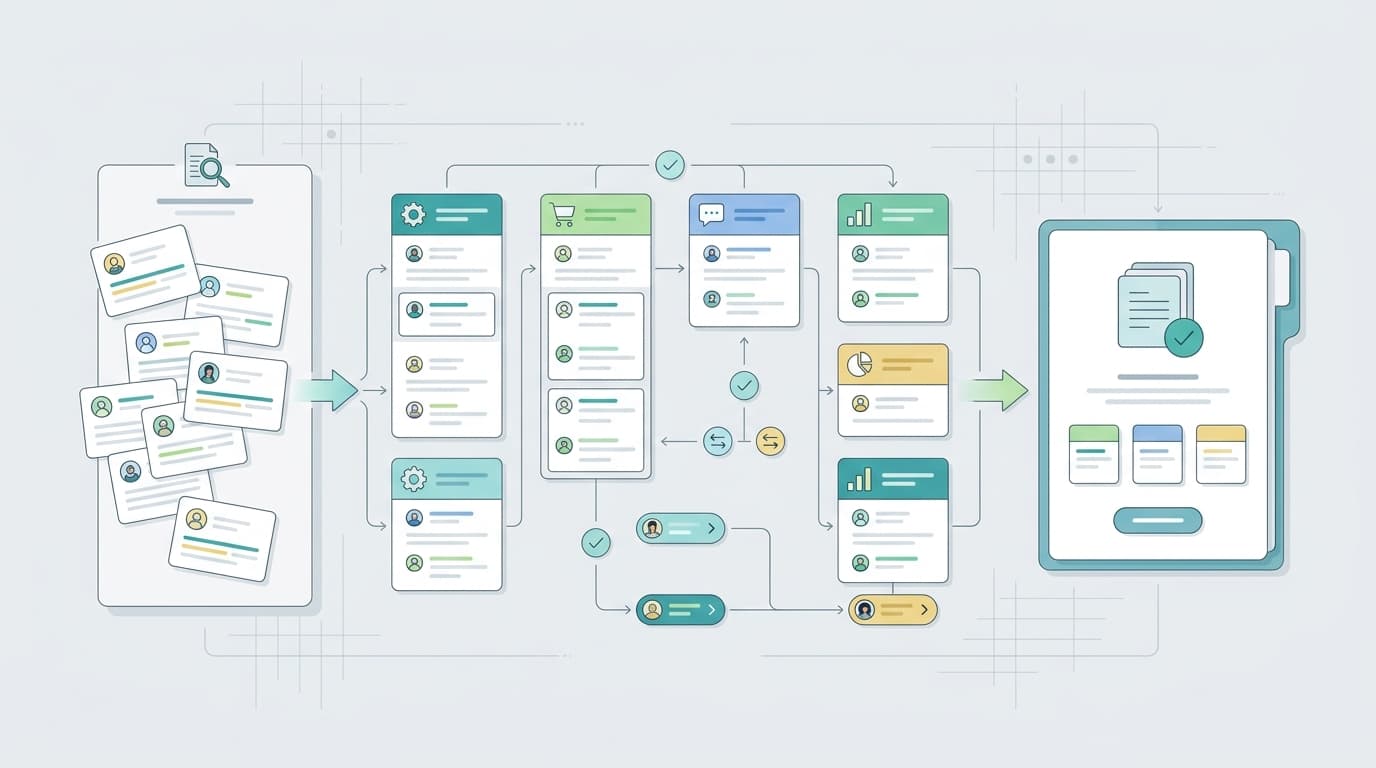
- a weekly VOC analysis loop
- a counterevidence check before a theme becomes a test
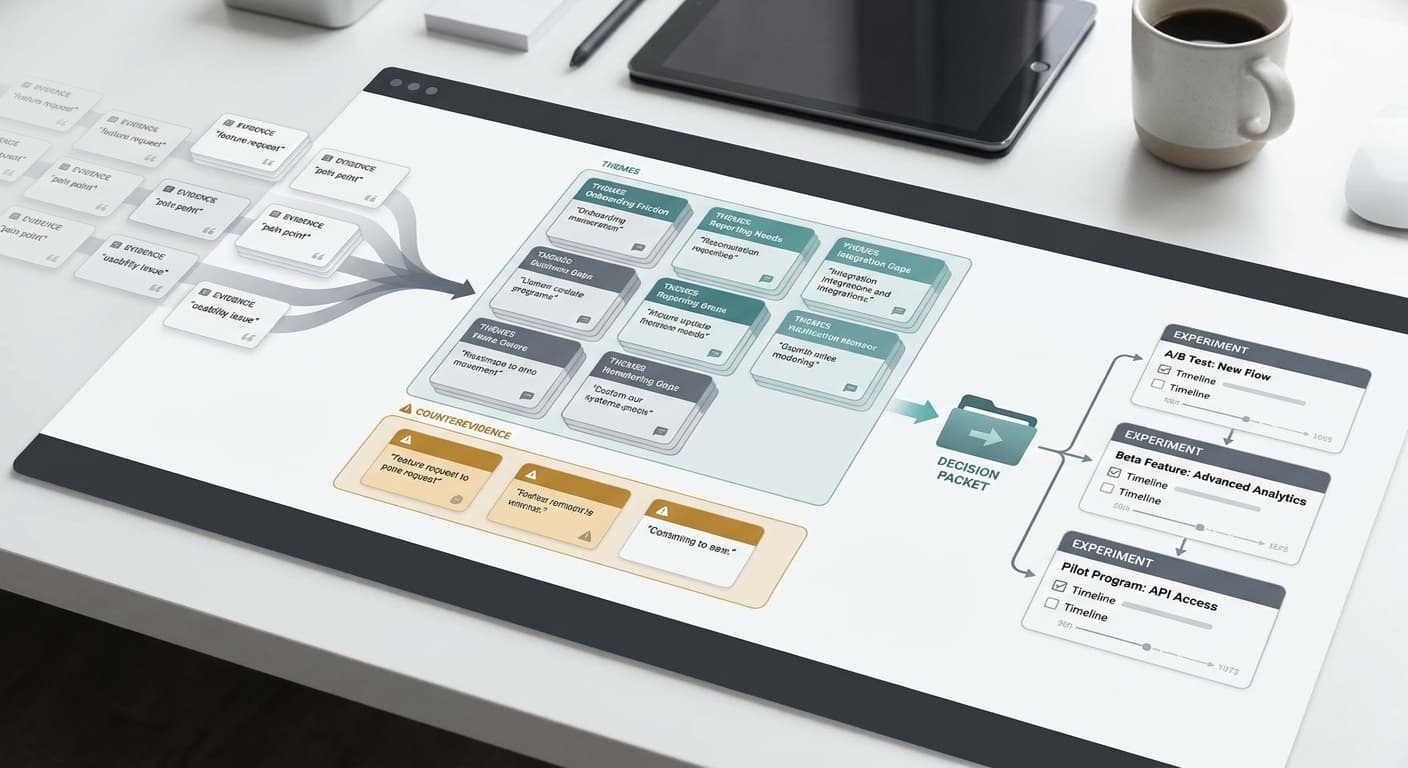
- a decision packet template
- a 30-day rollout plan
- a scorecard for deciding whether your VOC analysis process is working
If you need the basic method first, start with the VOC analysis beginner guide. If you want workflow examples by use case, use the VOC analysis examples article. This article is narrower: it shows how a growth team should run VOC analysis as an operating cadence.
What VOC analysis should do for a growth team
For growth teams, VOC analysis should answer one question:
Which customer-backed change should we test, ship, rewrite, escalate, or stop next?
That question keeps the work from becoming a feedback archive. A growth team usually has too many possible actions: landing page tests, onboarding experiments, pricing explanation changes, lifecycle emails, product-led growth improvements, review-response playbooks, support deflection fixes, and competitor-positioning ideas.
VOC analysis helps when it narrows that list with customer evidence.
| Growth decision | What VOC analysis should reveal | Output |
|---|---|---|
| Audience | Which segment shows repeated need, urgency, or mismatch | Segment hypothesis |
| Messaging | Which words customers use to describe value, anxiety, or tradeoff | Copy test brief |
| Activation | Which expectation gap blocks the first successful moment | Onboarding experiment |
| Conversion | Which objection slows purchase, trial, or demo intent | Page or offer test |
| Retention | Which repeated friction predicts downgrade, return, churn, or non-renewal | Retention investigation |
| Roadmap | Which customer job appears behind repeated requests or complaints | Product discovery brief |
| Competitive positioning | Which competitor weakness appears in public reviews or sales objections | Positioning angle |
This is the first difference between generic VOC analysis and growth-team VOC analysis. Generic analysis asks, "What are customers saying?" Growth analysis asks, "Which customer signal should change the next growth action?"
Start with a growth decision inventory
Before collecting more feedback, list the decisions the team needs to make in the next four to six weeks. This prevents a common failure: analyzing customer feedback in broad categories that do not map to anyone's work.
Use this inventory before the first VOC analysis meeting.
| Decision owner | Upcoming decision | Customer evidence needed | Action if evidence is strong |
|---|---|---|---|
| Growth lead | Which homepage promise should we test? | Review language, sales objections, support questions, search terms | Launch copy test |
| Product manager | Which activation friction enters discovery? | Onboarding tickets, activation survey comments, session notes | Open discovery brief |
| Lifecycle marketer | Which trial email should change? | Trial replies, cancellation notes, usage drop-off context | Rewrite sequence |
| Support/CX lead | Which repeat issue should be escalated? | Tickets, macros, help searches, complaint clusters | Route product or docs fix |
| Ecommerce/category lead | Which listing claim needs proof? | Product reviews, competitor reviews, Q&A, returns | Rewrite listing or FAQ |
Do not add a source just because it exists. Add it because it can help one named owner make one named decision.
Map the evidence before analyzing it
A growth team usually works with uneven evidence. Reviews are public and specific, but may overrepresent unhappy buyers. Support tickets are concrete, but may overrepresent people who needed help. Surveys are structured, but may miss the language customers use before purchase. Product analytics shows behavior, but not the reason behind it.
Good VOC analysis strategy keeps those differences visible.
| Evidence source | Best for | Watch out for | Growth use |
|---|---|---|---|
| Customer reviews | Buyer language, product gaps, expectation gaps, competitor comparison | Rating bias, missing customer segment context | Listing copy, product research, objection mining |
| Support tickets and chats | Repeated friction, confusing workflows, preventable effort | Only captures customers who contact support | Activation fixes, support deflection, docs |
| Surveys and forms | Direct responses to a planned question | Question wording and respondent bias | Message validation, satisfaction drivers |
| Sales and success notes | Objections, no-decision reasons, renewal risk | Anecdotal weighting if not tagged consistently | Offer tests, onboarding and retention themes |
| Product analytics | Where behavior changed | Cannot explain why on its own | Prioritize which feedback deserves investigation |
| Competitor reviews | Alternative expectations and switching triggers | Different customer base or product promise | Positioning, roadmap gaps, comparison copy |
| Community and social comments | Emerging questions and public language | High noise and weak ownership | Topic discovery, content angles, objection discovery |
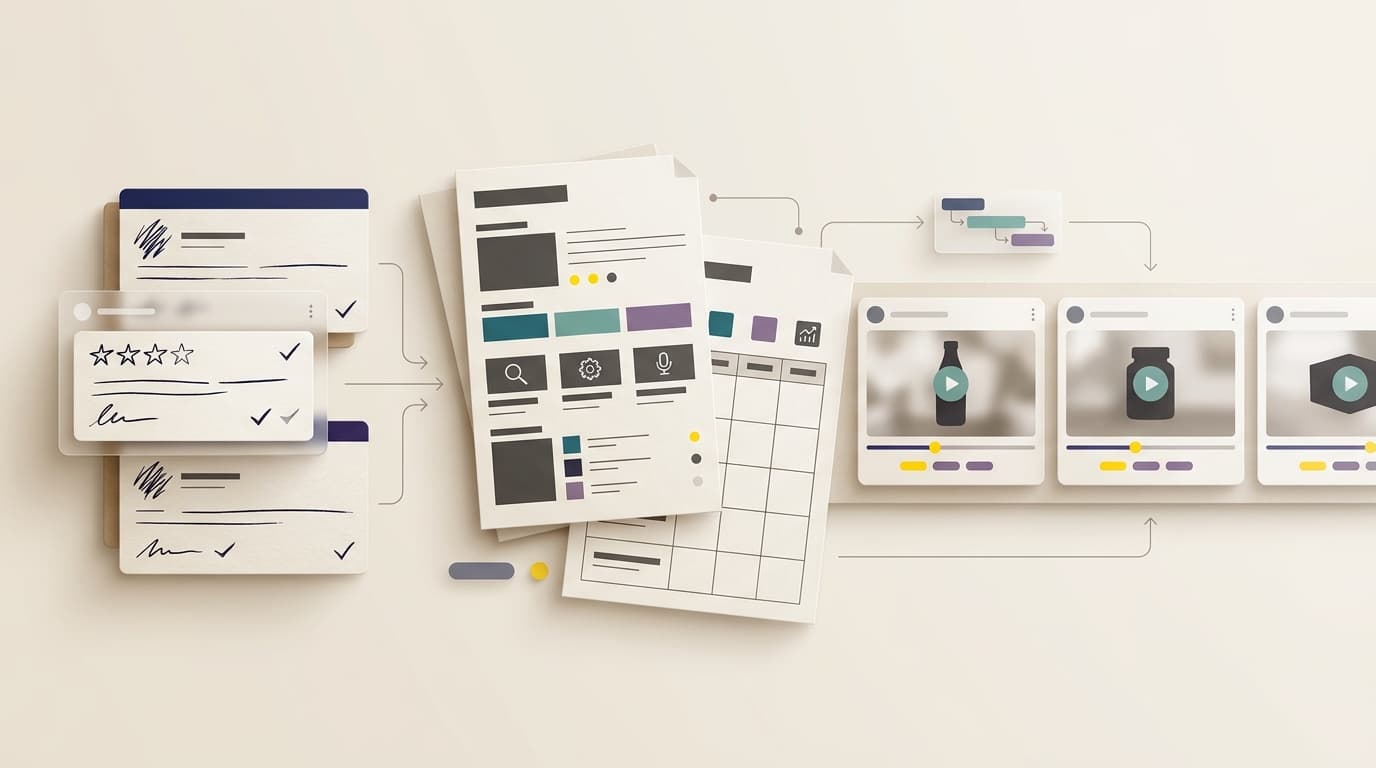
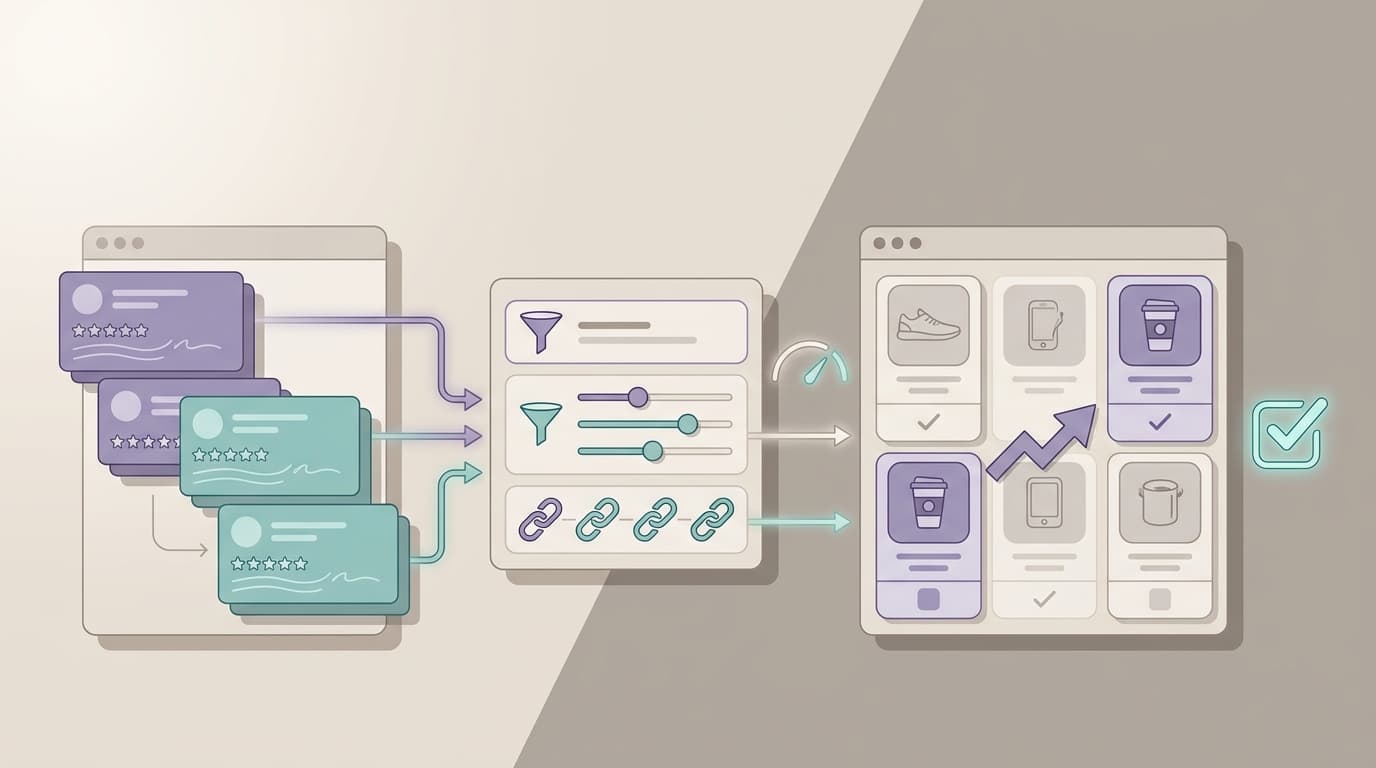
VOC.AI's Voice of Customer Analysis page positions the product around clustering Amazon feedback by pain point, expectation, and feature mention, with 2B+ reviews, buyer language, and decision-ready outputs. Its Review Analysis API supports REST API, Python SDK, and MCP workflows for teams that need review, keyword, listing, and sales-estimate signals inside their own systems.
That makes review-backed VOC analysis especially useful when the growth question depends on ecommerce buyer language, marketplace reviews, competitor complaints, or repeatable review-intelligence workflows. It should still be connected to the decision inventory, not treated as a standalone dashboard.
The weekly VOC analysis loop
Run VOC analysis weekly when growth work moves quickly. Monthly analysis is often too slow for experiments, and daily analysis usually creates noise.
The loop has five steps.
| Step | Owner | Output |
|---|---|---|
| 1. Choose one decision | Growth or product lead | One bounded VOC analysis question |
| 2. Freeze the evidence set | Analyst or operator | Source list, date window, segment, exclusions |
| 3. Cluster by customer situation | Analyst, PM, or researcher | Theme candidates with source examples |
| 4. Check counterevidence | Same reviewer plus decision owner | Confidence note and boundary conditions |
| 5. Hand off the decision packet | Decision owner | Test, ship, investigate, monitor, or decline |
The key is the first step. A weak weekly question is "What did customers say this week?" A stronger question is "Which objection from recent trial and support evidence should change the pricing-page FAQ before the next acquisition test?"
That sharper question tells you what sources to use, what to ignore, and what output matters.
Cluster by situation, not by department label
Growth teams often label feedback by internal category: pricing, onboarding, support, features, quality, checkout, billing, or shipping. Those labels are useful for routing, but they do not explain the customer situation.
Weak label: "pricing complaint."
Useful VOC analysis theme: "Trial users who compared plans twice are confused about credits and usage boundaries, so they hesitate before starting the workflow."
Weak label: "onboarding issue."
Useful VOC analysis theme: "New administrators can import data, but they do not understand which fields affect teammates, so they delay setup."
Weak label: "missing feature."
Useful VOC analysis theme: "Customers ask for export because weekly stakeholder reviews require source quotes outside the product."
This shift matters because growth teams test mechanisms, not labels. A pricing complaint might require a price change, a packaging explanation, a proof point, a calculator, a plan comparison, or no action. The situation tells you which one is plausible.
Add a counterevidence lane before every test
VOC analysis can easily become confirmation work. A team expects onboarding to be the problem, finds five onboarding comments, and launches an onboarding test. That may be right, but the evidence is not strong until the team has asked what would weaken the conclusion.
Before a theme becomes a growth action, check:
- Segment boundary: Does the theme apply to the target segment, or only to a low-priority cohort?
- Source boundary: Does the theme appear across more than one source, or only in one channel?
- Time boundary: Is the theme current, or did it come from an older product state?
- Contradiction: Which customers succeed despite the supposed friction?
- Alternative cause: Could behavior data point to a different explanation?
- Action fit: Can the team test or change something within the current planning window?
Counterevidence does not kill a good idea. It keeps the team from overstating it.
Use a decision packet, not a theme report
A theme report summarizes what customers said. A decision packet tells an owner what to do with it.
Use this copyable template for every VOC analysis finding that enters a growth review.
Decision question:
Owner:
Evidence window:
Included sources:
Excluded sources:
Target segment:

Theme:
Customer situation:
Representative evidence:
Counterevidence:
Confidence:
Decision implication:
Recommended action:
Expected signal change:
Follow-up date:
Decision outcome:
Learning note:
The decision outcome should be one of five choices:
- Test: Run an experiment because evidence is strong enough and the action is reversible.
- Ship: Make the change because evidence is strong and the fix is low risk.
- Investigate: Collect more evidence because the theme is plausible but incomplete.
- Monitor: Keep watching because the issue is real but not urgent.
- Decline: Do not act because the evidence does not support the decision.
This is the handoff most VOC analysis programs miss. Without an outcome, the team only has a prettier feedback summary.
Turn customer language into growth assets
VOC analysis should produce reusable assets, not just one-off insights. Each weekly review should leave behind something the team can reuse.
| Customer signal | Reusable growth asset | Where it goes |
|---|---|---|
| Buyer phrase | Headline, subhead, FAQ answer, ad concept | Copy library |
| Objection | Sales proof, pricing explanation, comparison block | Objection library |
| Product gap | Discovery brief, roadmap note, competitor gap file | Product backlog |
| Onboarding friction | Experiment brief, lifecycle email, help article | Activation backlog |
| Review-backed praise | Proof point, testimonial prompt, product-page section | Conversion assets |
| Counterevidence | Boundary note, segment warning, test exclusion | Learning log |
The learning log is important. A failed experiment can still improve future VOC analysis if it records why the evidence did not translate into behavior change.
A 30-day VOC analysis strategy rollout
Do not start by connecting every feedback source. Start by proving the loop with one decision owner and one recurring growth decision.
Days 1-3: Pick the operating question
- Choose one growth decision that matters in the next month.
- Name the owner and review meeting where the result will be used.
- Define the target segment, date window, and acceptable sources.
- Write what would count as contradiction.
Days 4-10: Build the first evidence set
- Pull a manageable sample from two or three sources.
- Preserve source, date, segment, original language, product context, and link or record ID.
- Remove duplicates and out-of-scope records.
- Read a small sample manually before using AI or automation.
Days 11-17: Create and challenge themes
- Code records by customer situation and desired outcome.
- Separate complaints, requests, praise, objections, and workarounds.
- Create two or three candidate themes.
- Search for counterevidence before choosing the strongest theme.
Days 18-24: Hand off one decision packet
- Write the decision packet.
- Review the evidence with the owner.
- Choose test, ship, investigate, monitor, or decline.
- Record the expected signal change and follow-up date.
Days 25-30: Close the loop
- Check whether the decision changed.
- Add the outcome to the learning log.
- Decide whether to repeat the same question, add another source, or expand to another owner.
- Save reusable customer language, objections, and segment notes.
After 30 days, the question is not "Do we have a VOC dashboard?" The question is "Did VOC analysis change a growth decision and leave behind reusable learning?"
When VOC analysis software becomes worth it
A spreadsheet is enough for one narrow VOC analysis sprint. Software becomes valuable when the team needs recurring analysis, larger evidence sets, source traceability, cohort control, collaboration, API workflows, or shared decision handoffs.
Use the VOC analysis software evaluation guide if you are comparing tools. Use the broader customer feedback analysis tools framework if the buying question spans research repositories, survey platforms, support intelligence, social listening, review intelligence, and API-first workflows.
For ecommerce and Amazon-centered teams, VOC.AI is strongest when customer reviews and competitor reviews are central to the workflow. The public VOC Analysis page emphasizes review ingestion, signal compression, and execution support, while the Review Analysis API page supports teams that want to connect review intelligence into dashboards, agents, or internal growth systems.
If pricing is part of the evaluation, use the current VOC.AI pricing page rather than copying old plan notes. The page currently describes a free trial, paid personal plans, team plans, and enterprise custom options.
VOC analysis strategy scorecard
Use this scorecard after the first month. Score each item from 0 to 3.
| Criterion | 0 | 1 | 2 | 3 |
|---|---|---|---|---|
| Decision fit | No named decision | Decision exists but owner is vague | Owner and decision are clear | Decision changed or was deliberately declined |
| Source discipline | Sources are mixed without context | Some source fields preserved | Source, date, segment, and original language preserved | Evidence set can be reproduced |
| Theme quality | Labels only | Some customer situations visible | Themes explain situation and desired outcome | Themes also show boundaries and implications |
| Counterevidence | Not checked | Mentioned informally | Reviewed before handoff | Changes confidence or action choice |
| Handoff | Summary only | Recommendation without owner | Decision packet with owner | Outcome and follow-up signal recorded |
| Reuse | No learning log | Notes exist but are hard to retrieve | Reusable language and objections saved | Learning informs future tests and content |
The highest-scoring VOC analysis strategy is not the one with the most data. It is the one that repeatedly improves the quality of growth decisions.
FAQ
What is VOC analysis in growth marketing?
VOC analysis in growth marketing is the process of turning customer feedback, reviews, objections, support issues, and behavior context into evidence for growth decisions. It helps teams choose messages, experiments, product fixes, onboarding improvements, and retention actions.
How is growth-team VOC analysis different from general Voice of Customer analysis?
General Voice of Customer analysis may focus on understanding customer needs across the business. Growth-team VOC analysis is narrower. It ties customer evidence to a near-term growth action, such as a landing page test, activation fix, offer change, product discovery brief, or retention investigation.
Which sources should a growth team analyze first?
Start with the sources that match the decision. For conversion messaging, use reviews, sales objections, support questions, and page behavior. For activation, use onboarding tickets, trial surveys, setup calls, and product analytics. For ecommerce positioning, use customer reviews, competitor reviews, Q&A, and listing performance context.
Do growth teams need VOC analysis tools?
Not always. A spreadsheet can work for one small decision. A VOC analysis tool becomes useful when the team needs repeatable source traceability, large review sets, cohort control, collaboration, API access, or recurring decision packets.
What should a VOC analysis report include?
For growth teams, a VOC analysis report should include a decision question, evidence window, sources, target segment, theme, representative evidence, counterevidence, confidence, owner, recommended action, expected signal change, follow-up date, and final decision outcome.
How often should growth teams run VOC analysis?
Weekly is a practical cadence for most growth teams because experiments and campaigns move quickly. The team can run a deeper monthly review for broader roadmap, positioning, or retention questions, but the weekly loop keeps customer evidence connected to active decisions.
Bottom line
VOC analysis should not become another reporting ritual. For growth teams, the work earns its place when it changes what the team tests, ships, investigates, monitors, or declines.
Start with one decision. Freeze the evidence. Cluster by customer situation. Check counterevidence. Hand off a decision packet. Then record what happened after the team acted.
That is the VOC analysis strategy that compounds: customer language becomes better copy, objections become better proof, complaints become better experiments, and every growth review becomes a little harder to bluff.