Updated August 11, 2026.
Customer feedback intelligence is not a sentiment dashboard with a larger dataset. It is an operating system that turns scattered customer evidence into a bounded decision, assigns that decision to an owner, and checks whether the action changed anything.
Most teams already have more feedback than they can use. Support tickets live in a help desk. Survey comments collect in spreadsheets. Sales calls sit in recordings. Reviews, community posts, cancellation reasons, and product analytics add still more context. The hard part is not collecting another channel. It is moving from uneven evidence to repeatable action without losing the original customer language.
This customer feedback intelligence workflow playbook organizes that work into three connected workflows:
- Feedback triage: decide what needs attention now.
- Feedback investigation: test what mechanism is actually producing the pattern.
- Decision follow-through: turn the evidence into an owned action and measurable learning.
This customer feedback intelligence: workflow playbook also adds the implementation layer between those workflows: the records that preserve context, the transition rules that prevent premature conclusions, the decision-review packet that makes evidence usable in a real operating forum, the 30-day rollout controls that prove the loop can survive one real decision, the operating review that keeps owners accountable, and a software-evaluation pilot that exposes broken handoffs before the team buys or scales a platform. That is where many systems fail. A team collects evidence but cannot decide when a signal deserves investigation. It finds a theme but cannot tell when the evidence is strong enough for a decision. It ships a change but never reconnects the result to the original feedback.
The customer feedback intelligence workflow at a glance
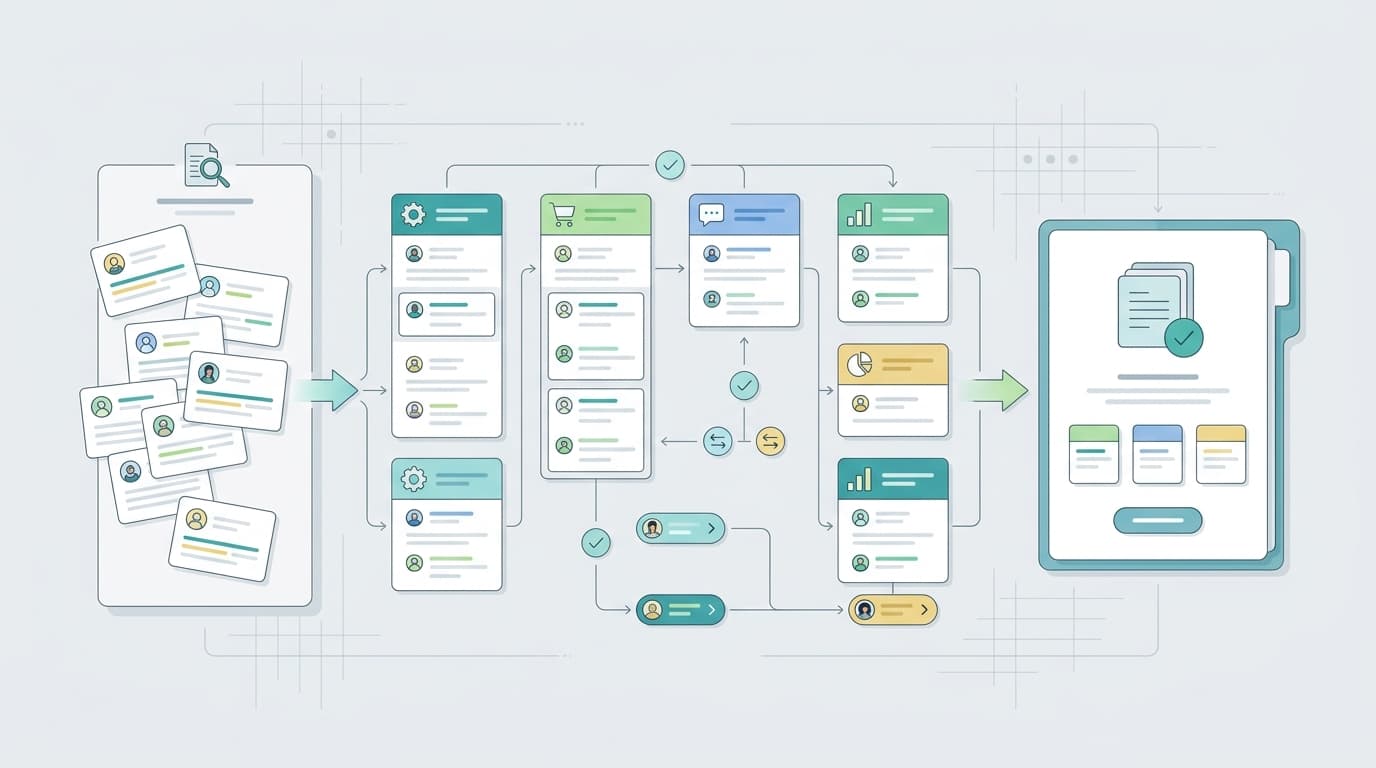
Use this map before configuring tools or building a dashboard. It gives the team a shared route from raw evidence to a decision loop instead of a pile of tagged comments.
| Stage | Core question | Required output | Quality gate |
|---|---|---|---|
| Capture | What exactly did the customer say or do? | Traceable evidence record | Can a reviewer return to the source? |
| Normalize | What customer event does this describe? | Specific problem or desired outcome | Is the wording more precise than a broad topic? |
| Triage | What should happen next? | Monitor, respond, investigate, or escalate | Is the routing reason explicit? |
| Deduplicate | Is this the same mechanism as an existing signal? | Linked evidence cluster | Did the team preserve meaningful variation? |
| Investigate | What decision are we trying to make? | Bounded decision question | Can the investigation end with a choice? |
| Test | What evidence supports and contradicts the hypothesis? | Evidence set with counterevidence | Could another reviewer challenge the conclusion? |
| Decide | What changes, what does not, and why? | Decision record with owner and check date | Is the prediction falsifiable? |
| Learn | Did the signal and business outcome change? | Outcome review | Did the result update the team’s model? |
This is not a linear waterfall. Urgent evidence may move directly from capture to escalation. A weak pattern may return from investigation to monitoring. An action may produce no effect and send the team back to the mechanism hypothesis. The important requirement is that every transition has a reason.
What customer feedback intelligence actually means
Customer feedback intelligence is a traceable path from raw customer language to organizational learning.
It preserves five layers:
- Evidence: what the customer actually said or did
- Context: product, segment, journey stage, channel, and time period
- Interpretation: the theme or mechanism the team believes is present
- Decision: what will change, what will not change, and why
- Learning: what happened after the decision
If a dashboard stops at positive, negative, and neutral, it has classified feedback but has not yet created intelligence. If an AI summary cannot link a theme back to examples, it has compressed information but has not made it auditable. If a team creates a backlog but never checks the result, it has created activity rather than learning.
For a deeper scoring model after themes are formed, use the guide on how to prioritize customer feedback without letting the loudest voice win. This playbook starts one level earlier and ends one level later: it covers how signals enter the system, how teams investigate them, and how decisions return to the evidence loop.
Before the workflows: define the evidence contract
Do not begin by asking AI to summarize every comment. Begin by deciding what every useful evidence record must preserve.
Build a minimum evidence record
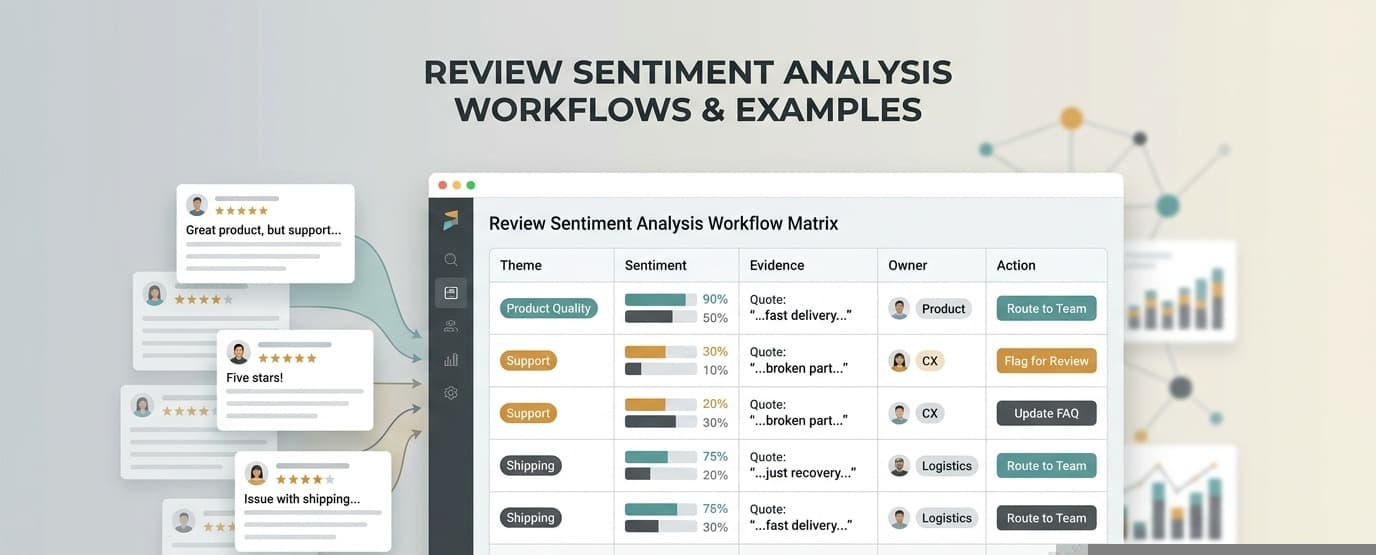
| Field | What to capture | Why it matters |
|---|---|---|
| Evidence ID | Stable link or identifier | Lets a reviewer return to the source |
| Customer language | Verbatim excerpt | Preserves meaning and specificity |
| Source | Review, ticket, survey, call, return, or community | Prevents channel context from disappearing |
| Date | When the feedback occurred | Supports recency and trend checks |
| Product context | Plan, SKU, feature, device, or workflow | Makes the issue investigable |
| Journey stage | Discover, buy, onboard, use, renew, or leave | Connects evidence to the experience |
| Observed outcome | Rating, return, escalation, cancellation, or conversion | Adds behavioral or operational context |
| Working theme | Normalized problem or desired outcome | Makes related evidence comparable |
| Confidence note | Clear, ambiguous, duplicate, or inferred | Keeps uncertainty visible |
The record does not need to be perfect before it is useful. It does need to make unsupported interpretation harder.
Record the denominator when it exists
“Twenty customers mentioned onboarding” is incomplete. Twenty out of how many new accounts, tickets, sessions, survey responses, or reviewed conversations?
Not every source gives a clean denominator, but the workflow should preserve one when available. This prevents a high-visibility channel from masquerading as a representative sample.
Feedback sources are not interchangeable:
- A public review is self-selected public evidence.
- A support ticket represents someone who contacted support.
- A cancellation form represents someone who reached a specific exit step.
- A sales objection comes from a prospect, not an active user.
- A usability session answers a designed research question.
The point is not to downgrade any source. It is to stop different sources from being blended into false certainty.
The UK Government Service Manual recommends analyzing research throughout a project rather than leaving synthesis until the end, while keeping findings connected to the underlying observations. That principle matters beyond formal user research: customer feedback becomes easier to act on when interpretation happens close to the evidence and remains reviewable later.
Define the AI boundary before automation
AI can help classify, cluster, retrieve, summarize, and monitor evidence. It should not silently decide what counts as a valid source, invent missing context, erase disagreement, or make consequential product decisions.
The NIST AI Risk Management Framework emphasizes validity, reliability, transparency, and ongoing measurement for AI systems. Applied to feedback intelligence, those principles become practical controls:
- preserve source links;
- label inferred fields;
- sample-check classifications;
- inspect counterevidence;
- log human overrides;
- measure errors after taxonomy or model changes.
The same discipline belongs inside the workflow: do not present an AI-generated theme as established fact merely because the summary sounds confident.
August 11 decision-review layer: turn this customer feedback intelligence: workflow playbook into an operating packet
A workflow becomes useful only when it changes the quality of a decision meeting. If the output is a dashboard screenshot, a theme list, or a long research memo, the owner still has to translate feedback into a choice. That translation is where customer feedback intelligence usually breaks.
Use this decision-review layer when the team already has triage, investigation, and follow-through artifacts, but leaders still ask, “So what should we do?” The goal is to create a packet that a product, CX, support, or growth owner can inspect in one operating review without losing the customer evidence behind it.
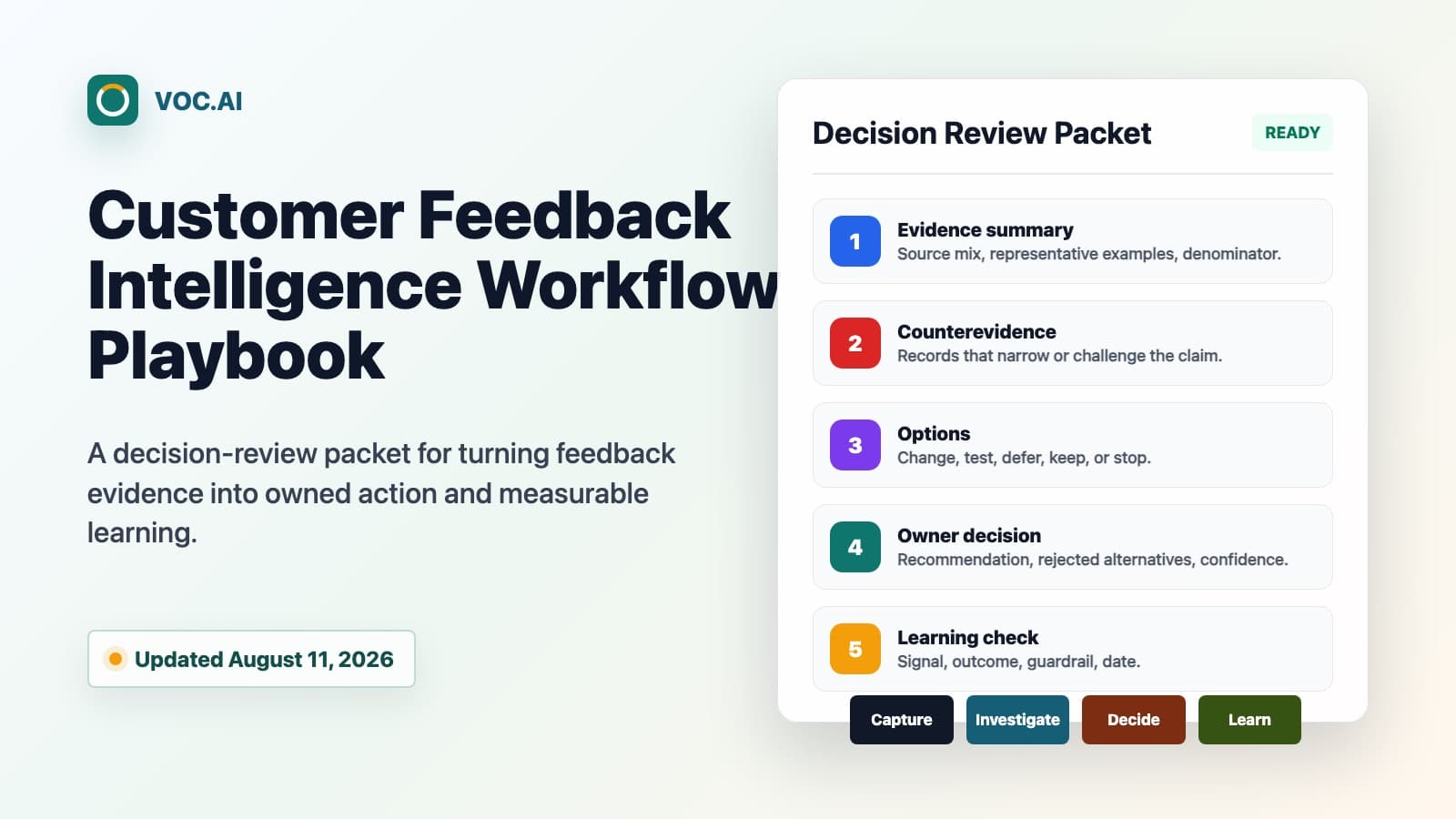
Build the six-part decision-review packet
Every decision packet should be short enough to read before a meeting and specific enough to challenge during the meeting.
| Packet section | What it must contain | What the reviewer should be able to challenge |
|---|---|---|
| Decision question | The exact choice, owner, deadline, segment, and source window | Whether the decision is narrow enough to answer |
| Evidence summary | The mechanism, source mix, representative examples, and denominator if available | Whether the sample supports the claim |
| Counterevidence | Records that weaken, narrow, or contradict the dominant interpretation | Whether the team is overfitting a loud pattern |
| Options | Change, keep, test, defer, or stop, with the cost of each option | Whether the alternatives are real choices |
| Recommendation | The chosen option, reasoning, rejected alternatives, and confidence level | Whether the recommendation follows from the evidence |
| Learning check | Signal, outcome metric, guardrail, owner, and check date | Whether the decision can be proven wrong later |
This format keeps the customer feedback intelligence workflow tied to action. The reviewer should not need to trust the summary. They should be able to open the evidence, inspect the boundary, question the counterexamples, and see what will be measured after the decision.
Separate evidence confidence from business priority
Teams often mix two questions:
- How confident are we that this customer mechanism is real?
- How important is it to act on this mechanism now?
Those are different judgments. A pattern can be well-supported but low priority. A weak signal can still need rapid escalation if the consequence is severe. Keep the scores separate so the workflow does not turn confidence into automatic priority.
Use this quick gate before a recommendation leaves the packet:
| Gate | Green | Yellow | Red |
|---|---|---|---|
| Evidence confidence | Multiple sources or repeated source-level records support the same mechanism | Pattern is plausible but source mix or denominator is thin | Claim depends on one anecdote or unsupported inference |
| Decision consequence | Delay creates visible customer, revenue, risk, or operating cost | Delay is uncomfortable but reversible | No clear cost of waiting |
| Reversibility | Action can be tested, rolled back, or narrowed | Action is partly reversible | Action is costly, broad, or difficult to unwind |
| Measurement | Signal, outcome, and guardrail are already available | At least one measure needs setup | No practical learning check exists |
This does not replace prioritization. It prevents the meeting from treating the loudest quote, the cleanest chart, or the most senior opinion as the decision rule.
Use a five-minute packet review before the meeting
Before the decision owner sees the packet, run a short review with one person who did not prepare it. Ask them to answer five questions:
- What choice is the owner being asked to make?
- What is the strongest customer evidence?
- What evidence could make the recommendation wrong?
- What option is being rejected, and why?
- What will the team check after action?
If the reviewer cannot answer those questions from the packet, the workflow has not produced decision intelligence yet. It has produced analysis that still needs translation.
Decide what the meeting is allowed to do
A decision-review meeting should not reopen the whole archive. It should choose one of four outcomes:
| Outcome | Use when | Required record |
|---|---|---|
| Decide | Evidence is strong enough and the action owner accepts the recommendation | Decision, owner, rejected alternatives, learning check |
| Narrow | The mechanism is plausible but the segment, source, or scope is too broad | Revised decision question and next evidence request |
| Test | The decision is consequential or uncertain but reversible | Test plan, success signal, guardrail, and date |
| Park | Evidence is weak, stale, low-consequence, or not decision-ready | Reason for parking and revisit trigger |
The meeting should not end with “keep monitoring” unless the packet records what would change that status. Otherwise monitoring becomes a polite name for losing the signal.
Add this packet to vendor and workflow evaluation
For commercial evaluation, ask any customer feedback intelligence platform to produce this packet from one real decision. A tool that can cluster themes but cannot preserve evidence, counterevidence, rejected alternatives, and learning checks may still be useful for exploration. It is not yet supporting the full customer feedback intelligence: workflow playbook.
The practical test is simple: after a pilot, can a decision owner explain what changed, why it changed, what evidence mattered, what evidence did not fit, and when the team will know whether the decision worked? If not, the workflow is still a reporting workflow, not an intelligence workflow.
August 10 rollout layer: use this customer feedback intelligence: workflow playbook in the first 30 days
A customer feedback intelligence workflow fails when it is designed as a permanent system before it has survived one real decision. The first 30 days should prove that the team can move a signal from source evidence to decision learning with the smallest credible operating model.
Use this rollout layer when the team already agrees that feedback is scattered, but has not yet agreed how evidence should move between product, CX, research, support, and growth. This customer feedback intelligence: workflow playbook keeps that agreement operational instead of aspirational. The goal is not to configure every source. The goal is to make one loop durable enough that more sources will not create more noise.
Week 1: choose the decision and freeze the evidence contract
Start with one decision that has a visible owner and a real business consequence. Good candidates include onboarding friction, repeated support escalations, cancellation reasons, competitor complaints, product defects, review-driven listing changes, or a recurring feature request that keeps resurfacing without resolution.
Write the decision in one sentence:
By [date], [owner] must decide whether to [change, keep, pause, or test] [specific experience] for [customer or segment], using evidence from [sources].
Then freeze the minimum evidence contract before anyone touches the taxonomy. The first version should include source ID, customer language, date, product or journey context, normalized event, risk flag, confidence note, owner, workflow state, decision link, and learning check date.
Do not add optional fields because a tool makes them easy. Add fields only when they prevent a real failure: lost source context, vague theme naming, owner ambiguity, weak counterevidence, or no way to revisit the outcome.
Week 2: run triage in public, not as private analysis
The second week should expose how the team routes feedback. Take a sample of real records and run the triage lane assignment where product, support, CX, and the decision owner can see the reasoning.
For each signal, record four things:
| Triage record | Required answer | Failure it prevents |
|---|---|---|
| Normalized event | What happened to which customer in what context? | Broad labels such as “UX issue” or “pricing complaint” |
| Lane | Monitor, respond, investigate, or escalate | Everything becoming backlog material |
| Routing reason | Why this lane, and why now? | Hidden prioritization logic |
| Next review | Owner, date, or trigger | Signals disappearing after tagging |
This is the first behavioral test of the customer feedback intelligence: workflow playbook. If stakeholders disagree on lane assignment, do not resolve the disagreement with a meeting opinion. Add the missing rule to the workflow and rerun the same records.
Week 3: open one investigation with a stop condition
In the third week, move one cluster into investigation. The investigation must have a stop condition, otherwise the team will continue collecting quotes after the decision is already clear.
Use this investigation packet:
| Packet element | What to write | Pass condition |
|---|---|---|
| Decision question | The specific choice the owner will make | The answer can be yes, no, defer, or test |
| Mechanism hypothesis | How the experience creates the observed outcome | It can be disproved by counterevidence |
| Evidence set | Representative supporting and contradicting records | Each claim links to source evidence |
| Segment boundary | Who the claim applies to and who it may not apply to | The team does not overgeneralize |
| Decision threshold | What evidence is enough for action | The investigation can end |
| Learning check | Signal, outcome, guardrail, and date | The decision reconnects to results |
A practical threshold might be: “If the same mechanism appears in at least two sources, affects new workspace admins, and has no stronger counterevidence from successful first imports, the owner will ship a progress-state test rather than more onboarding copy.”
The threshold does not need to be universal. It needs to be explicit enough that the team can judge whether the investigation changed the decision.
Week 4: publish the decision record and inspect the operating cost
The fourth week should produce a decision record, not a presentation. At this point, the customer feedback intelligence: workflow playbook becomes a governance artifact as much as an analysis method. The record should explain what changed, what did not change, why, who owns the action, what would prove the decision wrong, and when the team will inspect the result.
Use the final week to measure operating cost as well as output quality:
| Operating check | Ask this before scaling | What to do if it fails |
|---|---|---|
| Source retrieval | Could another reviewer reopen the original evidence? | Repair IDs, links, permissions, or redaction rules |
| Normalization consistency | Did two reviewers describe the same event similarly? | Tighten the event-writing rule and examples |
| Triage speed | Did routing happen quickly enough for the decision cadence? | Reduce fields or define escalation shortcuts |
| Investigation effort | Did the team need excessive cleanup before analysis? | Improve source hygiene before adding more channels |
| Decision adoption | Did the real owner use the output in the real forum? | Move the workflow closer to the decision meeting |
| Learning follow-through | Is the check date owned and visible? | Block closure until a learning owner is named |
A 30-day rollout should end with a go, fix, or stop decision for the workflow itself. If the loop worked, add one more source or one more decision type. If the loop required heroic cleanup, fix the weakest control before scaling. If the decision owner ignored the output, the workflow is in the wrong forum.
The rollout definition of done
The first version of customer feedback intelligence is ready to scale only when the team can show these artifacts from one live decision:
- source manifest;
- minimum evidence contract;
- triage log with lane reasons;
- investigation packet with counterevidence;
- decision record with owner and rejected alternatives;
- learning check with signal, outcome, guardrail, and date;
- operating-cost note explaining what was hard to repeat.
That package is more useful than a large dashboard screenshot because it shows whether the customer feedback intelligence: workflow playbook can be repeated by the people who will own it. It proves that customer feedback intelligence can survive the path from messy customer language to an owned business choice.
Workflow 1: feedback triage
Use triage when new feedback arrives faster than the team can investigate it.
The output is not a roadmap item. It is a routing decision: monitor, respond, investigate, or escalate.
Step 1: normalize the signal into a customer event
Weak theme:
Onboarding problem
Stronger event:
Workspace admins cannot tell whether the first data import is still processing, so they retry the upload and create duplicate records.
The stronger version includes an actor, context, friction, and consequence. That is enough specificity to compare related evidence and assign the right owner.
Use this sentence structure:
[Customer or segment] cannot [complete goal] when [context], which causes [customer or business consequence].
Do not force every comment into this structure. Praise, desired outcomes, and competitive comparisons may require different wording. The rule is specificity, not grammatical uniformity.
Step 2: check for immediate risk
Some signals should bypass normal prioritization:
- safety or security concerns;
- possible legal, privacy, or accessibility failures;
- payment or account-access incidents;
- fast-growing service disruption;
- coordinated abuse or fraud;
- a vulnerable customer who requires immediate support.
Escalation does not prove the claim is correct. It means the cost of waiting is high enough to trigger rapid human review.
Step 3: route the signal into one lane
| Lane | Use when | Next action |
|---|---|---|
| Monitor | Evidence is isolated, low-impact, or ambiguous | Add to an existing watch cluster with an expiry date |
| Respond | A customer needs an answer or recovery | Route to support, success, or community owner |
| Investigate | Multiple signals suggest a recurring mechanism | Open a bounded investigation |
| Escalate | Potential harm or urgent business risk exists | Trigger the incident or specialist process |
Avoid a fifth lane called “backlog.” Backlogs often become a place where evidence loses urgency, ownership, and context. If a signal is not ready for a decision, it should remain a monitored or investigated evidence object rather than a disguised feature request.
Step 4: deduplicate without erasing variation
Two comments are duplicates only when they describe the same underlying mechanism in a comparable context.
“Search is slow” and “search results are irrelevant” share a feature area but not a mechanism. Combining them produces a large theme with little decision value. Keep them separate until evidence shows that the same cause produces both experiences.
When linking a signal to a cluster, preserve:
- the original source;
- customer segment;
- product or plan context;
- severity;
- expected outcome;
- meaningful wording differences.
Triage definition of done
A signal leaves triage only when it has:
- a traceable source;
- a normalized event statement;
- a risk check;
- an explicit lane;
- a routing reason;
- an owner or next review date.
If one of those is missing, the signal is not triaged. It is merely tagged.
Workflow 2: feedback investigation
Use investigation when a pattern might change a product, service, message, policy, or process.
The goal is not to create a larger pile of quotes. The goal is to reduce uncertainty around a specific decision.
Step 1: write the decision question
Weak question:
Why do customers dislike onboarding?
Better question:
Should we change the first-import experience for new workspace admins before investing in additional onboarding education?
A useful decision question names:
- the customer or segment;
- the experience or mechanism;
- the decision owner;
- the plausible alternatives;
- the time horizon.
If the investigation cannot end with a choice, narrow the question.
Step 2: state a mechanism hypothesis
A theme is a label. A mechanism hypothesis explains how the experience creates the outcome.
Hypothesis: New admins retry the first import because progress is invisible after the initial upload. Duplicate records are therefore caused mainly by state uncertainty, not by misunderstanding the file format.
The hypothesis makes the next evidence request clearer. It also gives the team something that can be disproved.
Step 3: assemble the smallest useful evidence set
Start with enough evidence to test the mechanism, not every comment in the archive.
A practical evidence set may include:
- representative positive and negative excerpts;
- source and segment coverage;
- recurrence over time;
- relevant product or operational data;
- current workflow screenshots or recordings;
- support or success context;
- examples that do not fit the dominant interpretation.
The smallest useful set depends on the decision. A wording change may require a narrow sample. A major workflow redesign needs broader coverage and stronger behavioral evidence.
Step 4: cluster by mechanism, not vocabulary
Keyword clustering often confuses related words with related causes.
These comments may use different words but describe the same mechanism:
- “I uploaded it twice because nothing happened.”
- “The page looked frozen after I clicked import.”
- “I did not know whether the CSV was still running.”
These comments may share a keyword but describe different mechanisms:
- “Import took too long.”
- “Import rejected my date format.”
- “Import permissions were unclear.”
Mechanism-based clusters are smaller, but they are easier to act on and validate.
Step 5: search for counterevidence
Before accepting a theme, ask what would make the conclusion wrong.
Look for:
- successful customers in the same context;
- customers who experienced the issue but achieved the goal;
- adjacent segments with a different pattern;
- a product or policy change that already altered the experience;
- another channel that contradicts the dominant source;
- evidence that the proposed fix would not affect the outcome.
Counterevidence does not weaken good research. It reveals the boundary of the claim.
Step 6: label confidence instead of hiding uncertainty
Use a simple ladder:
- Exploratory: a plausible pattern with limited coverage;
- Directional: repeated evidence across relevant contexts;
- Decision-ready: sufficient evidence for the defined choice, with known limitations;
- Validated: an intervention produced the predicted signal or outcome change.
Confidence belongs to the specific decision question. A theme may be decision-ready for a small copy test but only directional for a full onboarding redesign.
Investigation definition of done
An investigation is ready for decision review when it contains:
- a bounded decision question;
- a mechanism hypothesis;
- traceable supporting evidence;
- explicit counterevidence;
- source and segment limitations;
- a confidence label;
- at least two plausible actions, including “do nothing yet.”
For copy-and-paste versions of these artifacts, use the customer feedback intelligence workflow templates.
Workflow 3: decision follow-through
Use follow-through after the team understands the likely mechanism well enough to choose an intervention.
The output is not “insight shared.” It is a recorded choice, an owner, a predicted change, and a scheduled learning check.
Step 1: choose the intervention layer
Customer feedback can point to more than a product feature.
| Layer | Example intervention |
|---|---|
| Product | Add visible import progress and prevent duplicate submission |
| Service | Change the first-import support handoff |
| Content | Explain expected processing time before upload |
| Policy | Clarify limits, eligibility, or refund rules |
| Positioning | Stop promising a use case the product does not reliably support |
| Operations | Add monitoring for failed or repeated imports |
| Research | Run a targeted study because the mechanism remains uncertain |
Starting with the intervention layer prevents every feedback pattern from becoming a feature request.
Step 2: write a decision record
A useful decision record states:
- the decision question;
- the evidence considered;
- the chosen action;
- alternatives rejected;
- what will not change;
- known risks and limitations;
- owner;
- expected signal change;
- expected business or customer outcome;
- check date.
The decision record should be short enough to maintain and specific enough to challenge later.
Step 3: make the prediction falsifiable
Weak prediction:
Customers will like onboarding more.
Stronger prediction:
Adding import progress and disabling repeat submission will reduce duplicate-import tickets among new workspace admins within four weeks, without increasing failed-import completion time.
The stronger version names the segment, intervention, signal, time window, and guardrail.
Step 4: separate signal change from outcome change
A signal can improve before the business outcome moves.
Signal measures may include:
- fewer mentions of the mechanism;
- lower ticket recurrence;
- fewer repeated actions;
- improved task completion;
- clearer customer language after the change.
Outcome measures may include:
- activation;
- conversion;
- retention;
- return or cancellation rate;
- support cost;
- expansion;
- task success.
Tracking both helps the team distinguish “the friction changed” from “the business result changed.”
Step 5: close the loop without manufacturing agreement
Closing the loop does not mean telling every customer that the requested feature shipped.
It can mean:
- acknowledging the evidence;
- explaining what changed;
- explaining why the team chose a different intervention;
- inviting the customer to validate a new workflow;
- documenting why no action was taken;
- updating internal teams that supplied the evidence.
Honest follow-through is more useful than a generic “we heard you” message.
Step 6: run an outcome review
At the scheduled check date, record one result:
- Confirmed: the predicted signal and outcome moved as expected;
- Partially confirmed: the signal changed but the outcome did not, or vice versa;
- Disconfirmed: the intervention did not affect the mechanism;
- Inconclusive: measurement or exposure was insufficient;
- Replaced: new evidence changed the decision question.
Then link the outcome review to the original evidence cluster and decision record. That connection turns a customer story into reusable intelligence.
Follow-through definition of done
A decision is not complete when work ships. It is complete when the system contains:
- a recorded choice;
- an owner;
- a falsifiable prediction;
- a signal measure;
- an outcome measure or explicit reason one is unavailable;
- a check date;
- an outcome review linked back to the evidence.
The four transition gates that keep the workflow honest
The three workflows become one operating system through four gates.
Gate 1: capture to triage
Ask:
- Can another person open the source?
- Is customer language preserved?
- Is inferred context labeled?
- Is the source type visible?
If not, repair the evidence record before routing it.
Gate 2: triage to investigation
Ask:
- Is there a repeated or consequential mechanism?
- Is there a real decision owner?
- Is the decision time-sensitive enough to justify investigation?
- Would more evidence change the choice?
If no decision can be affected, monitor the signal instead of opening research theater.
Gate 3: investigation to decision
Ask:
- Does the evidence answer the bounded question?
- Has counterevidence been inspected?
- Are source and segment limits visible?
- Are alternatives explicit?
- Is confidence sufficient for the size of the intervention?
The gate is not “do we have enough quotes?” It is “do we have enough evidence for this choice?”
Gate 4: action to learning
Ask:
- Was the intervention exposed to the intended segment?
- Did the target signal move?
- Did the customer or business outcome move?
- Did a guardrail worsen?
- What should the next team inherit from this result?
This last question makes the workflow compound. Without it, every team starts the same investigation from zero.
Implement the playbook in 30 days
A customer feedback intelligence workflow becomes useful when it is small enough to operate every week. Do not start with every channel, every taxonomy label, or every executive dashboard. Start with one decision type, one evidence contract, and one review cadence.
Use this 30-day sequence when the team needs to move from scattered feedback to an operating workflow.
| Day range | Implementation job | Output | Failure to avoid |
|---|---|---|---|
| Days 1-3 | Choose one recurring decision | Decision scope statement | Building a general repository with no decision owner |
| Days 4-6 | Define the minimum evidence record | Evidence contract and source rules | Letting AI summaries replace source language |
| Days 7-10 | Create triage lanes and escalation rules | Monitor, respond, investigate, escalate definitions | Sending every signal to a backlog |
| Days 11-14 | Normalize 20-30 real signals | Mechanism-based evidence clusters | Clustering by broad topic or sentiment only |
| Days 15-18 | Open one bounded investigation | Decision question, hypothesis, counterevidence list | Writing a research question that cannot end in a choice |
| Days 19-22 | Hold the first decision review | Decision record with owner, prediction, and check date | Treating insight sharing as completion |
| Days 23-26 | Connect the action to signal and outcome measures | Outcome review plan | Measuring only delivery status |
| Days 27-30 | Audit the handoffs and revise the rules | Updated workflow state definitions | Adding more sources before the first loop works |
This is deliberately narrower than a full Voice of Customer program. The goal is to prove that customer feedback intelligence can move one signal through capture, triage, investigation, decision, action, and learning without losing the original evidence.
Pick the first decision type
The first workflow should support a decision the team already makes. Good candidates include:
- which onboarding friction to fix this sprint;
- which support issue needs product intervention rather than better documentation;
- which cancellation reason deserves a focused investigation;
- which competitor complaint should influence positioning;
- which repeated review theme should affect a listing, message, or product requirement.
Avoid a first use case that requires a company-wide taxonomy, a new data warehouse, or a long executive approval cycle. The first loop should be important enough to matter and bounded enough to complete.
Assign four operating roles
The same person can hold multiple roles on a small team, but the responsibilities should be explicit.
| Role | Owns | Must be able to answer |
|---|---|---|
| Evidence steward | Source integrity, redaction, deduplication, and evidence IDs | Can we inspect the original customer language? |
| Triage owner | Lane assignment, escalation, and review date | What happens to this signal next? |
| Decision owner | Intervention choice, rejected alternatives, and tradeoffs | What will change, and what will not? |
| Learning owner | Signal measure, outcome measure, guardrail, and review | Did the intervention work as predicted? |
When these roles are implicit, the workflow usually stalls between investigation and decision. Everyone agrees the feedback is interesting, but nobody owns the choice.
Set the weekly operating review
Run a 30-minute weekly review until the loop is stable. The agenda should be operational, not performative.
| Minute | Question | Artifact updated |
|---|---|---|
| 0-5 | Which signals need escalation or customer response? | Signal ledger |
| 5-12 | Which monitored clusters changed enough to investigate? | Triage lane and review date |
| 12-20 | Which investigations are ready for decision, blocked, or too broad? | Investigation brief |
| 20-26 | Which decisions need an owner, prediction, or check date? | Decision register |
| 26-30 | Which shipped actions are due for outcome review? | Learning log |
The meeting should end with changed records, not a slide summary. If no record changes, either the workflow is too broad or the review is happening too far from the people who can act.
Define exit criteria before adding sources
Add another feedback source only after the first loop can show:
- at least one signal moved from source evidence to a recorded decision;
- the decision record links back to source examples;
- a reviewer can see supporting and contradicting evidence;
- the action has a named owner;
- the outcome review has a date and measure;
- the team can explain what it learned after the action.
This stop rule prevents ingestion theater. More sources help only when the operating system can absorb them without erasing context.
Build a customer feedback intelligence control plane
The three workflows describe what the team does. The control plane describes what the organization must preserve while the work moves between people, tools, and meetings.
Without this layer, each handoff becomes a lossy summary. A support ticket becomes a theme label. The theme becomes a roadmap card. The roadmap card becomes a release note. By the time the outcome is reviewed, nobody can reconstruct why the decision was made.
A practical control plane uses four connected records.
| Record | What it contains | What it prevents |
|---|---|---|
| Signal ledger | Evidence ID, source, customer language, context, time, current workflow state | Orphaned feedback and duplicate analysis |
| Investigation brief | Decision question, mechanism hypothesis, supporting evidence, counterevidence, confidence | Themes being mistaken for explanations |
| Decision register | Chosen action, rejected alternatives, owner, prediction, guardrail, check date | Insight decks that never become accountable choices |
| Learning log | Signal movement, outcome movement, surprises, revised mechanism, next action | Teams repeating the same debate every quarter |
These do not need to be separate tools. A small team can implement all four in one database. A larger team may distribute them across research, support, product, and analytics systems. The requirement is not centralization for its own sake. It is a stable chain of custody from source evidence to outcome review.
Use one immutable evidence ID
Every useful customer signal needs a stable identifier that survives exports, clustering, summaries, backlog tickets, and presentations.
That identifier lets a reviewer answer:
- Which source examples support this claim?
- Did the examples come from one customer or many?
- Was the same comment counted in multiple channels?
- Did the context change after the evidence was captured?
- Can we inspect the original wording instead of an AI-generated paraphrase?
The evidence can be redacted or access-controlled, but the reference should remain stable. The NIST AI Risk Management Framework emphasizes traceability, transparency, validity, and ongoing measurement. In a feedback workflow, a stable evidence ID is the smallest practical unit of that traceability.
Separate workflow state from topic tags
Topic tags describe what the feedback is about. Workflow state describes what the organization is doing with it.
A signal tagged billing, onboarding, or search might be in any of these states:
- captured;
- awaiting triage;
- monitoring;
- under investigation;
- decision pending;
- action in progress;
- outcome review due;
- closed with learning.
Mixing those concepts creates dashboards that show popular topics but cannot answer whether anything is moving. Keep taxonomy and workflow state as separate fields.
Preserve transformations, not just the latest summary
AI-assisted systems often overwrite the path from evidence to conclusion with a polished theme description. A stronger workflow preserves the transformations:
- original customer language;
- normalized customer event;
- proposed mechanism;
- evidence cluster;
- decision question;
- chosen intervention;
- observed result.
This history makes disagreement productive. A reviewer can challenge the normalization, mechanism, or evidence boundary without discarding the entire analysis.
Run a 45-minute workflow stress test
Before connecting every source or committing to a customer feedback intelligence platform, run one realistic signal through the full loop. The goal is not to prove the tool can ingest data. It is to prove the operating model can produce a reviewable decision.
Minutes 0–10: capture and normalize
Choose a real comment with enough context to investigate. Create the minimum evidence record, preserve the original wording, and rewrite it as a specific customer event.
Pass condition: another person can open the source, understand the context, and distinguish the observation from the interpretation.
Minutes 10–20: triage and deduplicate
Check immediate risk, search for related evidence, and assign one route: respond, monitor, investigate, or escalate. Link similar signals without erasing differences in segment, journey stage, or mechanism.
Pass condition: the route has a written reason and the cluster boundary can be explained.
Minutes 20–30: investigate the mechanism
Write one bounded decision question. Assemble supporting examples, counterexamples, and any behavioral or operational evidence available. State what the evidence does not establish.
Pass condition: the team can name at least two plausible actions and one reason to do nothing yet.
Minutes 30–40: record the decision
Choose an intervention layer, assign an owner, write a falsifiable prediction, and set one guardrail. Record the rejected alternatives instead of deleting them.
Pass condition: a person outside the meeting can understand what will change, why, and what result would challenge the choice.
Minutes 40–45: schedule the learning check
Choose a review date and define both the signal measure and the outcome measure. Make sure the original evidence cluster is linked to the future outcome review.
Pass condition: the decision cannot silently disappear after delivery.
If the team cannot complete the test, identify the exact break:
- source retrieval;
- missing context;
- inconsistent taxonomy;
- no routing rule;
- weak counterevidence search;
- unclear decision rights;
- no outcome owner;
- no way to reconnect results to the source evidence.
That break is the next system requirement. Do not use a broad feature checklist to hide it.
Diagnose seven common workflow failures
| Failure mode | What it looks like | Corrective control |
|---|---|---|
| Ingestion theater | More sources connect, but decisions do not improve | Measure completed evidence-to-learning loops, not connected channels |
| Sentiment substitution | Negative volume becomes the priority score | Investigate mechanism, affected context, consequence, and decision relevance |
| Taxonomy drift | Teams use different labels for the same event | Version the taxonomy and preserve the normalization rule |
| Theme inflation | Broad clusters absorb unrelated causes | Cluster by mechanism and keep counterexamples visible |
| Executive anecdote override | One vivid comment resets the roadmap | Route the anecdote through the same evidence contract and risk check |
| AI summary opacity | A theme cannot be traced to source examples | Require source links, transformation history, and reviewer sampling |
| Closure without learning | A ticket closes when work ships | Close only after the scheduled signal and outcome review |
The same control logic applies to AI claims inside the workflow. A customer feedback system should describe what automation actually does—such as classification, retrieval, clustering, or summarization—without implying that generated outputs are automatically accurate, representative, or decision-ready.
Use this customer feedback intelligence: workflow playbook to evaluate software
For business evaluation, do not ask vendors or internal teams to show a generic dashboard. Ask them to run this customer feedback intelligence workflow playbook on one real decision. The evaluation should prove that the system can move evidence through triage, investigation, decision, and learning without turning customer language into an unreviewable summary.
The pilot can be small. The standard should be strict.
Build a one-decision pilot packet
Start with a decision the team already needs to make, then assemble a packet that every tool, analyst, or AI workflow must handle.
| Pilot input | Minimum requirement | Why it matters |
|---|---|---|
| Decision question | One bounded product, support, messaging, or retention decision | Prevents a broad insight repository demo |
| Evidence corpus | 30-100 real records from one or two sources | Keeps the pilot realistic without becoming a data migration |
| Source manifest | Source, date range, segment, denominator when available, and exclusion rules | Makes the output reproducible |
| Ground-truth sample | 10-20 records reviewed manually by a domain owner | Gives the team a benchmark for AI or taxonomy output |
| Counterevidence seed | At least five records that do not fit the expected pattern | Tests whether the system can resist theme inflation |
| Decision forum | The meeting or workflow where the result will be used | Tests adoption at the point of action |
Do not let the pilot begin with every feedback source connected. A customer feedback intelligence workflow is useful only when it can preserve context for one decision loop. Source expansion comes after the loop works.
Run the same evidence through six gates
Use these gates as the live demo script. Each gate should produce an artifact, not a verbal promise.
| Gate | Question | Pass evidence |
|---|---|---|
| Source integrity | Can a reviewer return to the original customer language? | Evidence IDs, source links, redaction rules, and corpus manifest |
| Normalization | Can the system turn broad comments into specific customer events? | Event statements with actor, context, friction, and consequence |
| Triage | Can the team route signals without hiding uncertainty? | Monitor, respond, investigate, or escalate lane with reason |
| Investigation | Can it test a mechanism instead of naming a theme? | Decision question, hypothesis, supporting evidence, counterevidence, and confidence |
| Decision | Can the output become an accountable choice? | Decision record with owner, rejected alternatives, prediction, and check date |
| Learning | Can the system reconnect outcome data to the original evidence? | Scheduled review with signal measure, outcome measure, and guardrail |
If a tool performs well at capture but fails at decision or learning, it is not yet a customer feedback intelligence system. It is a collection and synthesis aid. That can still be useful, but the operating gap should be visible in the buying decision.
Score the pilot by failure cost, not feature volume
Feature checklists reward surface area. Workflow pilots should reward the system’s ability to prevent expensive failure modes.
| Evaluation dimension | Weight | What good looks like | Red flag |
|---|---|---|---|
| Record-level traceability | 15 | Every claim links back to inspectable evidence | Themes cannot be traced to source records |
| Decision-question fit | 12 | Output answers the chosen decision, not a generic topic | Demo produces broad insights with no owner |
| Counterevidence handling | 12 | Contradictory examples remain visible | The system hides or absorbs exceptions |
| Workflow-state clarity | 10 | Each signal has a current state and next action | Tags are treated as progress |
| AI review controls | 10 | Generated claims show sources, limits, and human-review points | AI output is presented as self-validating |
| Decision-record support | 10 | The handoff includes owner, action, prediction, guardrail, and check date | Output ends as a deck or summary |
| Outcome-loop support | 10 | Learning review is scheduled and linked to source evidence | Work is closed when delivery ships |
| Integration and export resilience | 8 | Exports preserve IDs, timestamps, taxonomy, decisions, and links | Migration would destroy auditability |
| Operating effort | 7 | A trained teammate can rerun the workflow consistently | Specialist cleanup is required every cycle |
| Adoption at the decision point | 6 | Product, support, or CX owners use the result in the real forum | Stakeholders admire the dashboard but keep deciding elsewhere |
The score is less important than the evidence behind it. A lower-scoring tool may still be acceptable if the team can name the missing controls and operate around them. A high-scoring demo is weak if it used a polished sample dataset that your team cannot reproduce.
Decide with a three-lane outcome
End the evaluation with one of three outcomes:
| Outcome | Use when | Next step |
|---|---|---|
| Buy or scale | The pilot completes the evidence-to-learning loop with acceptable operating effort | Expand to one more decision type and one more source |
| Conditional pilot | The workflow works, but one control is weak | Fix the control and rerun the same decision packet |
| Do not scale | Traceability, decision ownership, AI review, or outcome follow-through fails | Keep using the current workflow and repair the operating model first |
The wrong outcome is “the dashboard looked promising.” The useful outcome is knowing whether the team can make a better decision, preserve the reason for that decision, and learn from the result. That is why a customer feedback intelligence: workflow playbook belongs in the evaluation process before source expansion, automation rollout, or executive reporting.
A worked example: from support noise to an onboarding decision
Imagine a B2B SaaS team sees a rise in tickets mentioning “CSV import.” The initial theme is too broad to act on.
Triage
The team normalizes 28 tickets and separates three mechanisms:
- unsupported date formats;
- invisible processing state after upload;
- permission errors for non-admin users.
The processing-state cluster appears across two customer segments and includes repeated submissions. It moves to investigation. Date formats remain monitored because the volume is stable. Permission errors route to support documentation because the product behavior is currently intentional.
Investigation
The decision question becomes:
Should the team prioritize visible import progress and duplicate-submission prevention before adding more import education?
The evidence set includes tickets, session replays, repeated-upload events, successful first imports, and several customers who waited without retrying. Counterevidence shows that some failures still come from file-format errors, so the claim is narrowed: state uncertainty is a primary cause of duplicate submissions, not of every failed import.
Decision
The team chooses a product intervention plus an operational guardrail:
- show import progress;
- disable repeat submission while processing;
- monitor failed processing time;
- leave file-format education unchanged for now.
The prediction is that duplicate-import tickets will fall among new admins within four weeks without increasing failed-import completion time.
Learning
After four weeks, duplicate-import tickets fall, but total import-related tickets change little because date-format failures remain. The original mechanism is confirmed. The result also creates a cleaner next investigation instead of a vague conclusion that “the onboarding fix did not work.”
That is the difference between feedback collection and customer feedback intelligence: the workflow preserves what was learned even when the top-line metric does not move.
Where software should help—and where it should stop
Software should reduce the cost of evidence handling without hiding the reasoning.
Useful capabilities include:
- connecting multiple feedback sources;
- preserving source-level evidence;
- applying and revising a shared taxonomy;
- retrieving representative examples;
- surfacing emerging or changing clusters;
- recording confidence and counterevidence;
- linking evidence to decisions and outcomes;
- supporting role-based access and review.
Be cautious when a system cannot show how a summary was formed, merges channels without source context, treats sentiment as priority, presents generated themes without review controls, or cannot produce the one-decision pilot artifacts described above.
For a pre-purchase evaluation method, use the 15-point customer feedback workflow audit. For operating health after implementation, use the customer feedback workflow metrics and SLA playbook.
Where VOC.AI fits
VOC.AI is positioned around turning customer reviews and other customer signals into structured direction for ecommerce research, product decisions, buyer language, competitive analysis, and customer experience work.
Within this playbook, VOC.AI Voice of Customer Analysis can support the evidence layer by bringing review language into a more structured view and helping teams move from manual reading toward repeatable analysis.
The operating model still matters. Software can accelerate collection, clustering, retrieval, and monitoring. Your team must still define the decision question, inspect the evidence, look for counterexamples, select the intervention, and measure the result. Treat this customer feedback intelligence: workflow playbook as the acceptance test for whether the software improves that operating model.
That is the practical meaning of customer feedback intelligence: not automated certainty, but a faster and more traceable path from customer evidence to organizational learning.
Start with one decision loop
Do not try to centralize every customer signal on day one.
Choose one recurring decision with visible cost:
- a support escalation review;
- a product opportunity review;
- an onboarding friction investigation;
- a cancellation-reason review;
- a listing or messaging update cycle.
Then implement the minimum loop:
- capture traceable evidence;
- normalize the customer event;
- route the signal explicitly;
- investigate a bounded decision question;
- inspect counterevidence;
- record the chosen intervention;
- check the signal and outcome after action.
Once the team can complete that loop reliably, add more sources and decisions. Revisit this customer feedback intelligence: workflow playbook every time a new source, model, owner, or decision forum changes the evidence path. The best customer feedback intelligence system is not the one with the most data. It is the one that helps the team make a clearer decision, preserve why it made that decision, and learn whether it was right.
Frequently asked questions
What is customer feedback intelligence?
Customer feedback intelligence is the process of turning traceable customer evidence into an interpretation, a bounded decision, an owned action, and a measurable learning loop. It goes beyond collecting comments or displaying sentiment.
What is a customer feedback intelligence workflow?
A customer feedback intelligence workflow is the repeatable path from evidence capture through normalization, triage, investigation, decision, action, and outcome review. Each transition should preserve the source and record why the signal moved forward.
How is customer feedback intelligence different from Voice of Customer analysis?
Voice of Customer analysis describes the broader practice of understanding customer needs, language, expectations, and experiences. Customer feedback intelligence emphasizes the operational path from those signals to triage, investigation, decisions, and follow-through.
Can AI automate customer feedback analysis?
AI can help classify, cluster, summarize, retrieve examples, and monitor changes. Human reviewers should still define decision questions, inspect source evidence, evaluate counterevidence, choose interventions, and own consequential decisions.
What are the three workflows in this playbook?
The three workflows are feedback triage, feedback investigation, and decision follow-through. Triage routes signals, investigation tests the likely mechanism, and follow-through connects a decision to an owner and measurable result.
What should a customer feedback intelligence dashboard show?
It should show traceable evidence, source and context, workflow state, theme or mechanism, confidence, owner, decision status, and scheduled learning checks. Sentiment alone is not enough.
How should teams evaluate customer feedback intelligence software?
Evaluate customer feedback intelligence software with one real decision packet, not a generic dashboard tour. The pilot should test source traceability, event normalization, triage, mechanism investigation, counterevidence, decision records, AI review controls, and outcome follow-through.
How often should teams review customer feedback?
High-risk signals should be triaged continuously or daily. Investigation and decision review can run weekly, while source coverage, clustering quality, and outcome follow-through should receive a deeper monthly audit. The exact cadence should match the volume and consequence of the decisions.