Customer feedback software is easy to demo and hard to evaluate.
Most products can import comments, generate themes, and display a polished summary. The real question is whether the system can support your full path from raw evidence to a decision—and whether another person can inspect, challenge, repeat, and improve that path.
This customer feedback intelligence workflow playbook is a buyer's audit, not a feature checklist. It gives you 15 tests for evaluating a platform against a real operating workflow. It also includes a weighted scorecard, a two-week pilot, rejection criteria, and questions to ask when a vendor's demo looks better than its evidence.
Use it before buying a new tool, consolidating several feedback systems, or expanding an AI-assisted analysis workflow.
Updated August 4, 2026.
The short version: audit the workflow, not the dashboard
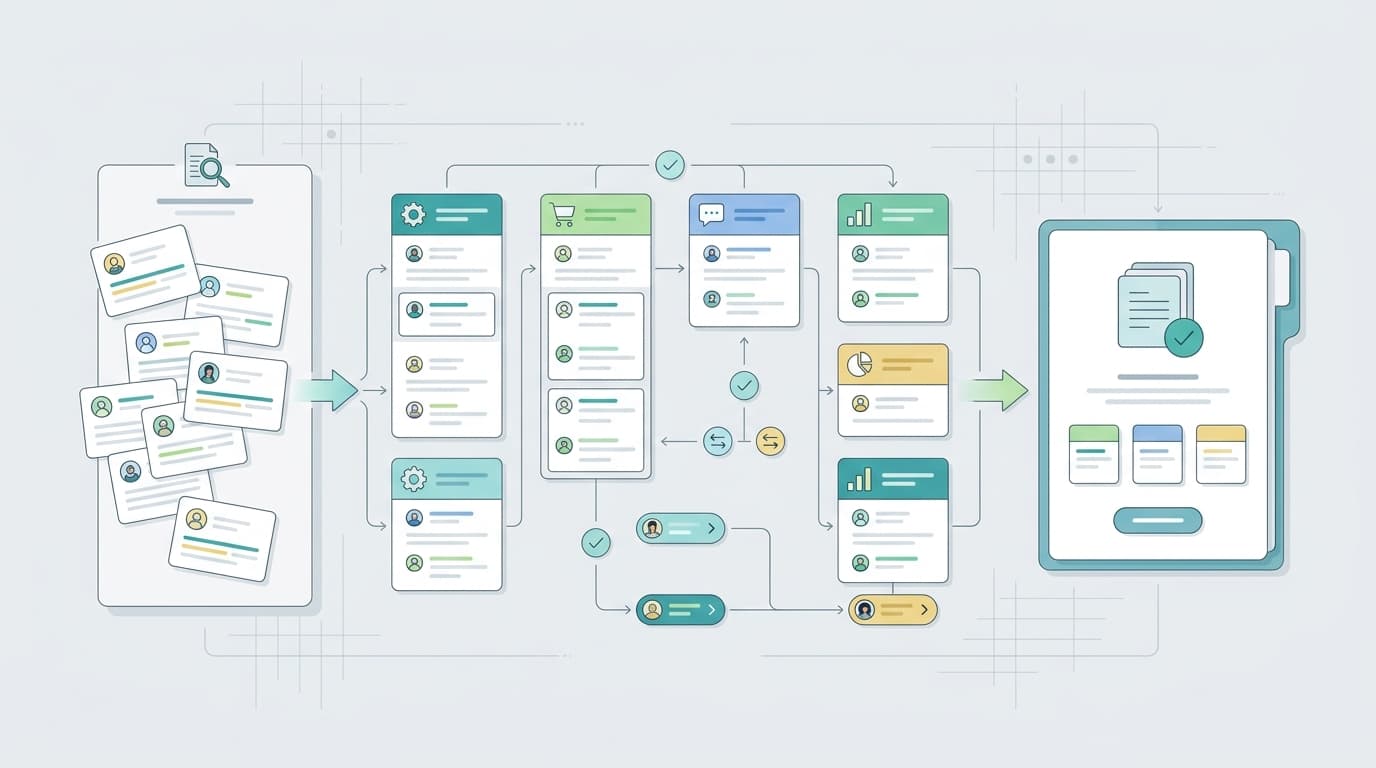
A credible customer feedback intelligence system should help your team complete six jobs:
- Define the decision and the evidence scope.
- Preserve traceable customer records.
- Build and test themes instead of accepting instant summaries.
- Route findings into an owned decision.
- Track the action and expected change.
- Recheck the evidence and outcome after action.
That is different from asking whether a tool has sentiment analysis, AI summaries, integrations, or attractive charts. Those features may help, but they do not prove that the workflow is reliable.
The broad customer feedback intelligence workflow playbook explains how triage, investigation, and decision follow-through fit together. This guide focuses on the buying question: can a proposed tool support that operating model without breaking traceability, governance, or adoption?
First, write the decision the tool must improve
Do not start the evaluation with a vendor shortlist. Start with one recurring decision.
Examples:
- Which onboarding problem deserves the next product sprint?
- Which complaint pattern should support operations escalate this week?
- Which product weakness is causing recent rating or return risk?
- Which buyer language should inform a listing or campaign update?
- Which feature request is specific enough to investigate?
- Which customer segment is experiencing a different mechanism?
Write the decision in this format:
We need to decide [decision] for [product, journey, or segment] by [date], using [sources and time window], and the output must be usable by [owner or decision forum].
If you cannot complete that sentence, you are not ready to compare platforms. You are shopping for possibilities rather than testing a workflow.
The 15-point customer feedback workflow audit
Score every item from 0 to 3:
- 0 — Absent: the workflow cannot complete the job.
- 1 — Manual workaround: possible, but fragile or difficult to repeat.
- 2 — Operational: works for the pilot with documented limits.
- 3 — Production-ready: repeatable, inspectable, governed, and scalable for the intended use.
Set your required score and non-negotiables before the demos. Otherwise, the most charismatic demo will quietly redefine what matters.
1. Decision-question fit
Can the system preserve the question being investigated, the intended decision, the deadline, and the owner?
Weak systems begin with a search box and end with a summary. Stronger systems connect analysis to a bounded decision. That boundary prevents a theme such as “setup is confusing” from becoming an all-purpose claim about the whole customer experience.
Evidence to request: a saved analysis brief or project record that includes the decision question, scope, owner, and due date.
2. Source and corpus definition
Can you see exactly which records are included and excluded?
The system should expose source channel, product or journey context, date window, language, market, segment, and relevant filters. It should also preserve the denominator. Twenty complaints out of 40 records is different from 20 complaints out of 20,000.
Self-selected reviews, tickets, and comments are valuable evidence, but they are not automatically representative of the full customer population. Treat frequency as a signal to investigate, not a universal prevalence estimate.
Evidence to request: a corpus manifest that another analyst can recreate.
3. Record-level traceability
Can every important theme, quote, and recommendation be traced back to its original record?
Traceability should survive export, filtering, collaboration, and presentation. A copied quote without source context is not enough. You need the source identifier, date, product or journey context, rating or ticket type when relevant, and a path back to the original record.
Reject the tool if: a high-confidence theme cannot be audited at the record level.
4. Taxonomy transparency
Can you understand, edit, version, and reuse the labels applied to feedback?
A useful taxonomy separates topics, mechanisms, outcomes, severity, customer segments, and workflow state. It should not collapse everything into “positive,” “negative,” and “neutral.”
Ask whether AI-generated labels can be renamed, merged, split, excluded, or locked. Ask what happens to historical comparisons when the taxonomy changes.
Evidence to request: a taxonomy export and a change-history example.
5. Theme validation and counterevidence
Can the workflow test a theme instead of merely generating one?
A theme should have:
- A precise statement
- Supporting evidence
- Contradictory or negative cases
- Segment and time boundaries
- A plausible mechanism
- A confidence note
- An unanswered question
If the system only returns the strongest examples, it may amplify confirmation bias. A credible workflow helps reviewers search for disconfirming records and competing explanations.
For a deeper post-analysis review, use the VOC analysis quality checklist.
6. Comparison logic
Can the tool compare like with like?
The workflow should support consistent products, segments, sources, date windows, denominators, and taxonomies. It should distinguish all-time volume from recent change.
For example, “Product A has more battery complaints” is weak unless the comparison accounts for record volume, time period, product maturity, and source mix. The useful question may be whether battery complaints are increasing within Product A's recent cohort.
Evidence to request: a saved comparison with visible filters and denominators.
7. Prioritization without false precision
Can the system keep urgency, evidence strength, reach, severity, strategic fit, and effort separate?
One composite score can be useful for sorting, but it should not hide why an item is high priority. A severe safety complaint with limited frequency belongs in a different lane from a common low-severity request.
The guide to prioritizing customer feedback covers scoring in more depth. In this audit, verify that the tool preserves the component inputs and supports explicit triage lanes.
8. Decision-record support
Can the output become a decision record rather than a disposable presentation?
A decision record should capture:
- The decision made
- Evidence considered
- Important counterevidence
- Alternatives rejected
- Decision owner
- Action owner
- Expected customer or business change
- Check date
- Conditions that would reverse the decision
If the analysis dies in a slide deck, the organization cannot later reconstruct why it acted.
9. Workflow ownership and handoffs
Can the system show who owns triage, investigation, decision, action, and outcome review?
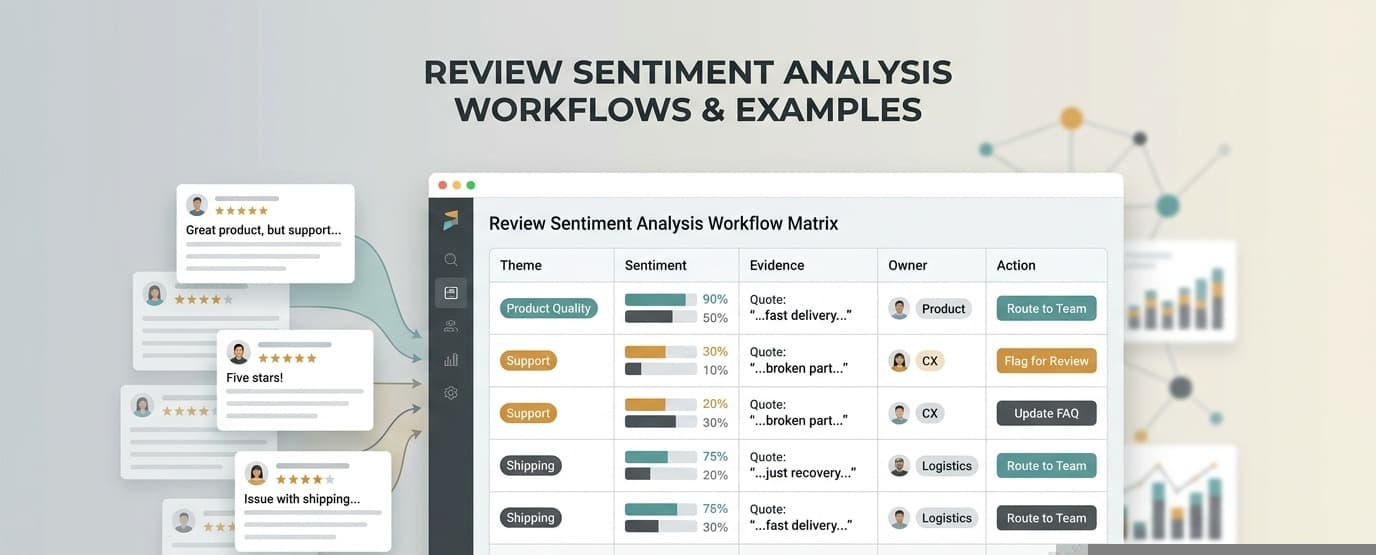
Integrations are useful only when they preserve context. Sending a theme title into Jira is not a complete handoff. The destination should receive the decision question, evidence links, scope, confidence, owner, and expected result.
The weekly customer feedback operating playbook defines roles, handoffs, and review cadence. During evaluation, test whether the tool supports those responsibilities or creates another inbox.
10. Outcome and learning-loop tracking
Can the team return after an action and compare the expected change with the observed result?
Customer feedback intelligence is incomplete when it stops at “insight delivered.” The system should support a scheduled check, relevant signal, relevant outcome, interpretation, and next decision.
Examples:
- Did complaint share decline after a packaging change?
- Did onboarding completion improve after a setup redesign?
- Did return reasons shift after a product correction?
- Did support contacts fall after a documentation update?
Track workflow health with the customer feedback KPI and SLA playbook.
11. AI review controls
Can you see where AI is used, what input it received, what output it produced, and where a human review is required?
The NIST AI Risk Management Framework emphasizes governance, documented roles, measurement, and ongoing management of AI risks. Applied to customer feedback work, that means consequential outputs should not become unreviewed facts simply because the interface presents them confidently.
At minimum, test whether the system supports:
- Human review before consequential recommendations
- Source retrieval for generated claims
- Prompt or configuration versioning where relevant
- Confidence and limitation notes
- Access controls for sensitive feedback
- Monitoring for quality drift
- A way to correct labels or summaries
Reject the tool if: it cannot show the evidence behind an AI-generated claim.
12. Privacy, access, and retention controls
Can the platform match your feedback-data policy?
Check role-based access, authentication, deletion, retention settings, data export, subprocessors, regional requirements, and treatment of personally identifiable or sensitive information. Do not assume a generic security page answers your use case.
Build a source-by-source inventory: public reviews, support tickets, interviews, surveys, call transcripts, community posts, and product analytics may have different permissions and retention rules.
Evidence to request: the vendor's documented controls mapped to your data inventory and internal policy.
13. Integration and export resilience
Can the workflow survive outside the tool?
Test imports, exports, APIs, webhooks, identity mapping, timestamps, deleted records, attachments, taxonomy fields, and deep links. Export should preserve enough structure to audit prior work and migrate later.
Do not award full points because a logo appears on an integrations page. Run the actual handoff with a real record and inspect what arrives.
14. Repeatability and operating effort
Can another trained teammate rerun the analysis and produce a comparable result?
Measure setup time, cleaning time, coding time, QA time, meeting time, and maintenance time. A tool that saves analyst time but adds taxonomy repair, integration troubleshooting, and manual presentation work may not improve the full cycle.
Your evaluation should calculate useful output per unit of effort, not dashboards per subscription.
15. Adoption at the decision point
Will the intended decision-makers actually use the output where decisions happen?
Ask product managers, support leaders, researchers, marketers, and operators to consume the same pilot deliverable. Observe where they hesitate:
- They cannot inspect the evidence.
- The theme is too broad.
- The denominator is missing.
- The output does not fit the meeting.
- The owner is unclear.
- The recommendation is detached from business context.
- The system requires a specialist for every question.
Adoption is not login count. It is repeated use of the evidence in a real decision.
Weighted customer feedback tool scorecard
Use weights that reflect your decision. The table below is a strong starting point for a cross-functional team.
| Audit dimension | Weight | Non-negotiable? | Pilot evidence |
|---|---|---|---|
| Decision-question fit | 6 | Yes | Saved brief with scope and owner |
| Source and corpus definition | 8 | Yes | Reproducible corpus manifest |
| Record-level traceability | 12 | Yes | Theme-to-record audit |
| Taxonomy transparency | 7 | No | Editable taxonomy and version history |
| Theme validation and counterevidence | 10 | Yes | Tested theme with negative cases |
| Comparison logic | 6 | No | Like-for-like comparison |
| Prioritization logic | 6 | No | Component scores and triage lanes |
| Decision-record support | 8 | Yes | Completed decision record |
| Ownership and handoffs | 6 | No | Real downstream handoff |
| Outcome tracking | 7 | Yes | Scheduled learning check |
| AI review controls | 8 | Yes | Source-backed AI audit |
| Privacy, access, and retention | 6 | Yes | Policy-control mapping |
| Integration and export resilience | 4 | No | Complete export and handoff |
| Repeatability and operating effort | 3 | No | Second analyst rerun |
| Adoption at the decision point | 3 | No | Decision-forum observation |
| Total | 100 |
Calculate the weighted score as:
Weighted score = sum of
(dimension score ÷ 3) × dimension weight
Do not let the total score override a failed non-negotiable. A platform scoring 82 out of 100 should still be rejected if evidence traceability or required privacy controls score zero.
Run a two-week workflow pilot
A short pilot should produce a decision artifact, not a tour of features.
Days 1–2: lock the test
- Select one recurring decision.
- Freeze the sources, date window, products, markets, and segments.
- Prepare known edge cases and contradictory records.
- Set weights and non-negotiables.
- Define the required final deliverable.
Days 3–5: build the evidence layer
- Import the same corpus into each finalist.
- Verify counts, metadata, duplicates, and exclusions.
- Create or adapt the taxonomy.
- Audit ten records end to end.
- Export the corpus and taxonomy.
Days 6–8: test interpretation
- Generate candidate themes.
- Inspect supporting records.
- Search for counterevidence.
- Compare segments and time windows.
- Write one bounded finding with a confidence note.
Days 9–10: complete the decision workflow
- Build the decision record.
- Route it to the real owner.
- Create the downstream task or action.
- Define the expected change and check date.
- Test export and integration behavior.
Days 11–12: rerun and challenge
- Ask a second analyst to rerun the work.
- Ask a skeptical reviewer to challenge the conclusion.
- Compare output differences.
- Log manual workarounds and failure points.
Days 13–14: decide
- Score every dimension using collected evidence.
- Calculate operating effort and expected annual usage.
- Confirm privacy and governance requirements.
- Record the selection or rejection rationale.
- Define production acceptance criteria.
The customer feedback workflow templates provide reusable evidence, investigation, decision, and outcome records for this test.
Questions to ask in every vendor demo
Use these questions to move the conversation from features to proof:
- Show the original records behind this theme.
- Show records that contradict the theme.
- Show the exact corpus and denominator.
- Show what changed when the taxonomy changed.
- Show how two products or segments are compared consistently.
- Show how an AI-generated claim is reviewed and corrected.
- Show the full handoff into the system where action happens.
- Show the decision record six months later.
- Show how an outcome check is scheduled and completed.
- Show the export we would receive if we left the platform.
A vague answer is data. Record it in the scorecard.
Where VOC.AI fits
VOC.AI is positioned around turning customer reviews and related customer signals into structured direction for ecommerce product research, market analysis, competitor analysis, listing decisions, and customer experience work.
Within this audit, VOC.AI Voice of Customer Analysis is most relevant when review language is a central evidence source and the team wants to move beyond manual reading toward repeatable theme analysis and evidence retrieval. Teams that need an embedded workflow can also evaluate the Review Analysis API.
The same rule applies to VOC.AI as to every finalist: run the controlled pilot. Confirm corpus coverage, inspect record-level evidence, test the required comparison, complete a real decision record, and measure the operating effort.
Final buying rule
Choose the smallest system that can complete your important decision workflow reliably.
Do not buy a customer feedback intelligence platform because it produces the fastest summary. Buy it when it can preserve the evidence, withstand a challenge, move a decision to an owner, and help the team learn whether the action worked.
That is the difference between another feedback dashboard and an operating system for customer learning.
FAQ
What is a customer feedback intelligence workflow?
It is the operating path that turns customer records into scoped evidence, tested themes, decisions, owned actions, and outcome checks. Collection and summarization are only the first parts of the workflow.
How do you evaluate customer feedback software?
Use one real decision, one frozen corpus, predetermined weights, and non-negotiable controls. Test traceability, taxonomy, validation, comparisons, decision records, handoffs, outcome tracking, AI review, governance, exports, operating effort, and adoption.
What is the most important feature in a feedback intelligence platform?
For most consequential workflows, record-level evidence traceability is the foundational requirement. If reviewers cannot inspect the records behind a theme or recommendation, they cannot evaluate the claim reliably.
Can AI replace human analysis of customer feedback?
AI can accelerate classification, clustering, retrieval, summarization, and monitoring. Humans should still define decision questions, review source evidence, test counterevidence, interpret business context, and own consequential decisions.
How long should a customer feedback tool pilot run?
Two weeks is often enough to test one bounded workflow if the corpus and decision are prepared in advance. The pilot should end with a usable decision artifact, documented operating effort, a scorecard, and production acceptance criteria.
Should a small team use a spreadsheet or a platform?
Use a spreadsheet when the corpus is small, the analysis is one-off, and one analyst can preserve evidence consistently. Consider a platform when the workflow is recurring, several people need the evidence, comparisons must remain consistent, monitoring matters, or the output must connect to other systems.