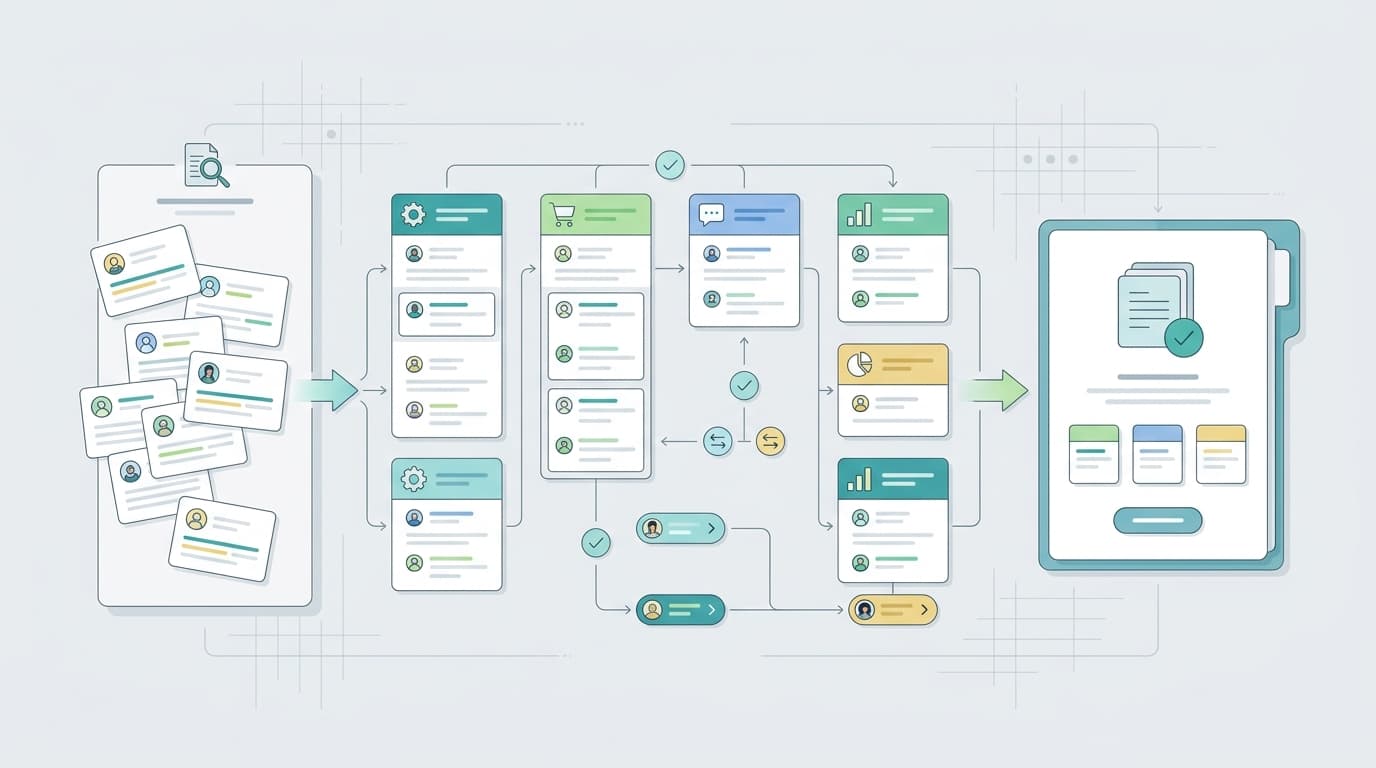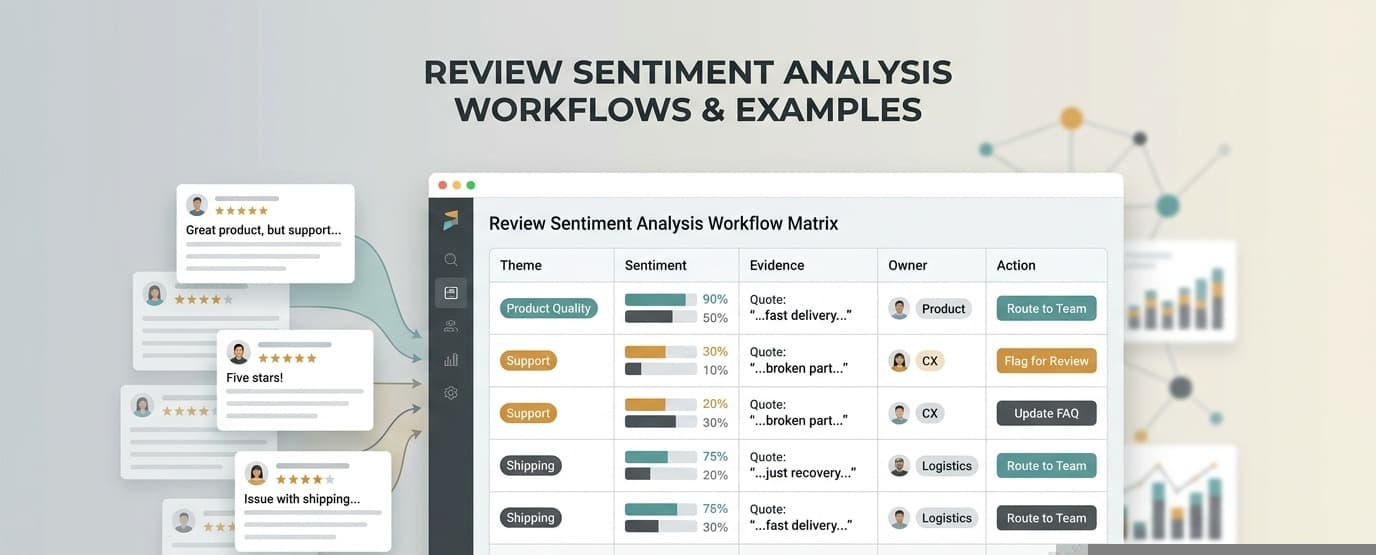
An AI review summarization pipeline is not finished when the prompt produces a convincing paragraph. It is finished when another engineer can reproduce the output, a reviewer can trace material claims to source reviews, and the team can tell exactly what changed between two summary versions.
That requires implementation artifacts—not just implementation steps.
VOC AI's broader AI review summarization implementation checklist explains the five quality gates for building a grounded pipeline. This companion guide turns those gates into 11 concrete files, schemas, and test assets your engineering team can put in a repository.
Use it as a definition of done for the build phase. If an artifact is missing, the system may still generate summaries, but it will be harder to audit, test, hand off, or improve safely.
The 11-artifact checklist at a glance
| # | Engineering artifact | What it prevents | Minimum acceptance check |
|---|---|---|---|
| 1 | Decision contract | Generic summaries with no operational purpose | One named user, decision, corpus, and prohibited claim set |
| 2 | Source manifest | Silent changes in input coverage | Every batch records source, market, date window, filters, and counts |
| 3 | Review input schema | Lost traceability and inconsistent fields | Every review has a stable ID and required provenance fields |
| 4 | Normalization and deduplication spec | Inflated themes and erased customer meaning | Transformations are deterministic and originals remain recoverable |
| 5 | Aspect taxonomy | Drifting or overlapping themes | Labels have definitions, examples, exclusions, and version IDs |
| 6 | Evidence record schema | Unsupported summary claims | Every claim points to review-level evidence records |
| 7 | Summary output schema | Attractive but unusable prose | Output validates against a machine-readable contract |
| 8 | Prompt and model manifest | Irreproducible results | Prompt, model, parameters, taxonomy, and schema are versioned together |
| 9 | Pre-generation test suite | Bad inputs reaching the model | Invalid, sparse, duplicated, or mixed-scope batches fail early |
| 10 | Evaluation set and scorecard | Subjective “looks good” QA | Groundedness, coverage, polarity, and usefulness have pass thresholds |
| 11 | Release and change record | Unexplained regressions | Every release links inputs, versions, eval results, owner, and rollback target |
The key design principle is simple: the prose summary is a view; the evidence and version records are the system of record.
1. Decision contract
The decision contract defines why the summary exists. Without it, teams optimize for fluency instead of usefulness.
Store the contract as YAML or JSON beside the pipeline configuration:
decision_contract_id: complaint-triage-us-v1
primary_user: product_quality_manager
decision: select_complaint_themes_for_weekly_investigation
unit_of_analysis: product_id
market: US
rating_scope: [1, 2, 3]
time_window_days: 30
required_outputs:
  - theme
  - evidence_count
  - source_review_ids
  - representative_quotes
  - exceptions
prohibited_claims:
  - population_prevalence
  - causal_defect_rate
  - revenue_impact
human_review_required_for:
  - safety
  - medical
  - legal
  - privacy
Acceptance checks
- The contract names one primary user and one decision.
- The corpus boundary is explicit.
- Required evidence is specified before prompt design starts.
- Claims that cannot be inferred from reviews alone are prohibited.
- High-risk subjects have an escalation rule.
If two teams need different decisions, create two contracts. Do not overload one “universal” summary.
2. Source manifest
A source manifest records exactly what entered a summarization run. It separates real customer-signal changes from ingestion changes.
{
  "manifest_id": "batch-2026-08-04-us-widget-a",
  "source": "approved-review-source",
  "product_ids": ["widget-a"],
  "markets": ["US"],
  "languages": ["en"],
  "rating_filter": [1, 2, 3, 4, 5],
  "start_date": "2026-07-05",
  "end_date": "2026-08-03",
  "raw_record_count": 1842,
  "included_record_count": 1761,
  "excluded_record_count": 81,
  "exclusion_reasons": {
    "empty_body": 12,
    "duplicate": 54,
    "unsupported_language": 15
  },
  "source_snapshot_hash": "sha256:..."
}
Record counts before and after each filter. A sudden drop in complaints can otherwise look like product improvement when the real cause is a broken connector or a changed filter.
Acceptance checks
- Every run has one immutable manifest ID.
- Raw, included, and excluded counts reconcile.
- Exclusions are grouped by reason.
- The manifest identifies the source snapshot or query version.
- A prior batch can be reconstructed from retained inputs or approved references.
3. Review input schema
The input schema is the stable contract between ingestion and analysis. Preserve source text and provenance even if downstream stages use normalized fields.
{
  "review_id": "source-stable-id",
  "source": "marketplace-or-channel",
  "source_url": "approved-source-reference",
  "product_id": "widget-a",
  "variation_id": "widget-a-blue-large",
  "market": "US",
  "language": "en",
  "rating": 2,
  "review_date": "2026-07-28",
  "title_original": "Stopped working",
  "body_original": "Original review text",
  "body_normalized": "Normalized review text",
  "verified_status": "source-provided-value",
  "ingested_at": "2026-08-04T00:15:00Z"
}
Use schema validation before analysis. Reject or quarantine records that lack stable IDs, source fields, dates, or text. Do not silently synthesize provenance.
Acceptance checks
- Original text is immutable.
- Normalized text is stored separately.
- Rating, market, language, date, product, and source are typed fields.
- Every record has a stable source ID.
- Missing required fields produce explicit errors or quarantine states.
4. Normalization and deduplication spec
Normalization should make records comparable without rewriting the customer's meaning. The specification must state what changes, in what order, and how duplicates are detected.
normalization_version: review-normalization-v3
steps:
  - unicode_normalization: NFKC
  - whitespace: collapse_internal_preserve_paragraphs
  - html: strip_tags_preserve_text
  - locale: map_to_bcp47
  - rating: coerce_integer_1_to_5
deduplication:
  exact_key:
    - source
    - review_id
  near_duplicate:
    method: text_similarity_plus_product_scope
    threshold: 0.96
  action: retain_one_and_link_duplicate_ids
never_modify:
  - body_original
  - review_date
  - rating
  - product_id
Near-duplicate rules should be tested carefully. Similar reviews may describe the same real defect, while syndicated or copied reviews may artificially inflate a theme. Keep the duplicate relationship so analysts can inspect borderline cases.
Acceptance checks
- Re-running normalization produces identical results.
- Original text remains available.
- Exact and near-duplicate logic are separate.
- Duplicate removals are counted in the source manifest.
- A sample of borderline duplicates is reviewed before threshold changes ship.
5. Aspect taxonomy
An aspect taxonomy turns open-ended review language into stable analytical categories. It should be versioned like code, not maintained as an informal list in a prompt.
taxonomy_id: small-appliance-aspects-v2
aspects:
  - id: durability
    definition: Product life, breakage, wear, and repeated-use reliability
    include:
      - stopped working after repeated use
      - cracked under normal use
    exclude:
      - arrived broken
      - shipping box damage
  - id: packaging
    definition: Protective packaging, seals, box condition, and transit presentation
    include:
      - crushed box
      - missing protective insert
    exclude:
      - product material cracked during normal use
fallback_labels:
  - other
  - ambiguous
  - insufficient_context
Definitions, inclusions, and exclusions reduce label overlap. Fallback labels prevent the model from forcing every sentence into a known category.
Acceptance checks
- Each label has a definition and boundary examples.
- Taxonomy versions are immutable after release.
- Multi-label behavior is defined.
- Unknown and ambiguous evidence can remain unresolved.
- Taxonomy changes are evaluated on a frozen review set.
6. Evidence record schema
The evidence record is the most important artifact in a grounded system. It sits between raw reviews and generated prose.
{
  "evidence_id": "ev-7f31",
  "review_id": "source-stable-id",
  "aspect_id": "durability",
  "polarity": "negative",
  "claim": "motor stopped during normal repeated use",
  "quote_start": 18,
  "quote_end": 62,
  "quote_text": "stopped after the third week of daily use",
  "product_id": "widget-a",
  "market": "US",
  "rating": 2,
  "extractor_version": "extractor-v5",
  "confidence": 0.87,
  "review_status": "machine_extracted"
}
Character offsets or sentence IDs let the interface highlight exact supporting text. The extraction stage should produce explicit uncertainty instead of inventing a clean claim from unclear language.
Acceptance checks
- Every evidence record points to one source review.
- Extracted quotes exist verbatim in the retained source text.
- Aspect and polarity use controlled values.
- Extraction version is recorded.
- Low-confidence or contradictory evidence can be routed for review.
7. Summary output schema
Do not let the model define the product interface. Define the output schema first, validate generated objects, and render prose from validated fields.
{
  "summary_id": "summary-2026-08-04-widget-a",
  "decision_contract_id": "complaint-triage-us-v1",
  "source_manifest_id": "batch-2026-08-04-us-widget-a",
  "themes": [
    {
      "theme_id": "durability",
      "headline": "Early-use motor failures",
      "description": "Some reviewers report the motor stopping during repeated normal use.",
      "evidence_count": 23,
      "review_count": 21,
      "evidence_ids": ["ev-7f31"],
      "exceptions": "Several recent reviews report sustained daily use without failure.",
      "confidence_label": "moderate"
    }
  ],
  "limitations": [
    "The analyzed reviews are not a population defect-rate estimate."
  ]
}
Structured output enforcement can reduce malformed responses, but schema compliance does not prove factual correctness. OpenAI's official guidance on Structured Outputs distinguishes structural adherence from the quality of the values placed inside the structure. You still need evidence and evaluation checks.
Acceptance checks
- Generated output validates against the schema.
- Every displayed theme lists evidence IDs.
- Counts are computed from records, not written freely by the model.
- Limitations are visible in the rendered summary.
- Unsupported extra fields are rejected or ignored deliberately.
8. Prompt and model manifest
Summaries are not reproducible if the prompt lives in an application string and the model name is only visible in logs.
{
  "generation_manifest_id": "summary-generator-v8",
  "system_prompt_version": "review-summary-system-v8",
  "user_template_version": "review-summary-input-v4",
  "model_provider": "configured-provider",
  "model_id": "pinned-model-version",
  "temperature": 0,
  "max_output_tokens": 2400,
  "input_schema_version": "review-input-v3",
  "taxonomy_id": "small-appliance-aspects-v2",
  "evidence_schema_version": "evidence-v4",
  "output_schema_version": "summary-v5",
  "evaluation_suite_version": "review-summary-evals-v6"
}
Version the full generation bundle. A prompt change, taxonomy change, model change, or schema change can alter output behavior even when the application code is untouched.
Acceptance checks
- Production requests use pinned, recorded configurations.
- Prompt templates are stored outside ad hoc application code.
- The manifest links every schema and taxonomy version.
- Output records include the generation manifest ID.
- A prior output can be rerun with the same configuration when the provider supports it.
9. Pre-generation test suite
Many failures can be caught before an expensive or nondeterministic generation step. Build deterministic tests around the corpus and evidence records.
| Test | Failure condition | Default action |
|---|---|---|
| Required fields | Missing stable ID, date, source, product, or text | Reject or quarantine record |
| Scope integrity | Multiple products or markets violate the decision contract | Split batch or stop |
| Minimum corpus | Too few usable reviews for the configured summary | Return insufficient-evidence state |
| Duplicate rate | Duplicate share exceeds the normal operating range | Investigate ingestion |
| Evidence coverage | Too many reviews have no extractable evidence | Flag extraction regression |
| Quote integrity | Evidence quote cannot be found in source text | Stop generation |
| Count reconciliation | Evidence, review, and manifest counts disagree | Stop generation |
| Taxonomy validity | Evidence uses unknown aspect labels | Reject evidence record |
| Risk-topic detection | Safety, legal, medical, or privacy terms appear | Require human review |
These checks make failure explicit. A blank or sparse batch should not become a confident paragraph.
10. Evaluation set and scorecard
Create a frozen evaluation set before tuning the system. Include easy cases, long reviews, mixed sentiment, rare complaints, contradictory evidence, duplicates, sparse evidence, multilingual inputs, and intentionally unsupported claims.
OpenAI's official evaluation best-practices guide recommends task-specific evals, representative datasets, and continuous evaluation rather than relying on generic metrics or informal inspection. NIST's AI Risk Management Framework similarly emphasizes documented measurement, monitoring, and governance across the AI lifecycle.
Use a scorecard that separates failure types:
| Dimension | Question | Example pass rule |
|---|---|---|
| Groundedness | Are material statements supported by linked evidence? | No unsupported material claim |
| Coverage | Are decision-relevant themes represented? | Meets benchmark recall threshold |
| Polarity | Does the summary preserve praise, complaint, and mixed sentiment? | No material polarity reversal |
| Count accuracy | Do displayed counts match evidence records? | Exact match |
| Boundary control | Does the summary avoid prohibited inference? | Zero prohibited claims |
| Exception handling | Are contradictions and minority signals visible? | Required exceptions retained |
| Usefulness | Can the named user take the intended next step? | Reviewer score meets threshold |
Define thresholds before comparing prompt or model variants. Keep human evaluation examples with written rationales so rubric drift is visible.
Acceptance checks
- The evaluation set is versioned and cannot be silently rewritten.
- Each test case represents a known behavior or failure mode.
- Automated and human scores are stored separately.
- Pass thresholds are defined before release.
- Every production change runs the same regression suite.
11. Release and change record
The release record joins the other artifacts into one auditable package.
release_id: review-summary-release-2026-08-04
owner: applied-ai-team
decision_contract_id: complaint-triage-us-v1
generation_manifest_id: summary-generator-v8
evaluation_suite_version: review-summary-evals-v6
evaluation_result: pass
approved_at: 2026-08-04T00:45:00Z
changes:
  - narrowed durability definition
  - added insufficient-context fallback
known_limitations:
  - multilingual mixed-language reviews require manual sampling
rollback_target: review-summary-release-2026-07-27
This record is the handoff point from engineering to operations. For the next phase, use the AI review summarization acceptance testing and handoff checklist to validate the benchmark and sign-off process, then the production rollout checklist for shadow mode, service levels, monitoring, incident response, and rollback.
Recommended repository structure
Keep the artifacts close enough that a pull request can show their relationships:
review-summarization/
├── contracts/
│   ├── decision-contract.yaml
│   ├── review-input.schema.json
│   ├── evidence.schema.json
│   └── summary-output.schema.json
├── taxonomy/
│   └── aspects-v2.yaml
├── pipeline/
│   ├── normalization-v3.yaml
│   └── generation-manifest-v8.json
├── tests/
│   ├── pre-generation/
│   ├── fixtures/
│   └── eval-set-v6.jsonl
├── releases/
│   └── 2026-08-04.yaml
└── docs/
    └── failure-taxonomy.md
The exact folders matter less than the dependency chain. A summary should link to a source manifest and generation manifest; the generation manifest should link to schemas, taxonomy, prompt, model, and evaluation versions.
Pull-request definition of done
Before merging a summarization implementation, confirm:
- [ ] The decision contract names the user, decision, scope, evidence requirements, and prohibited claims.
- [ ] The source manifest records input coverage and exclusion counts.
- [ ] The input schema preserves original text and provenance.
- [ ] Normalization and deduplication are deterministic and versioned.
- [ ] The aspect taxonomy defines inclusions, exclusions, and fallback labels.
- [ ] Evidence records contain source links or stable IDs and exact quote spans.
- [ ] The output schema requires evidence IDs, counts, exceptions, and limitations.
- [ ] The generation manifest pins prompt, model, parameter, schema, and taxonomy versions.
- [ ] Pre-generation tests stop invalid or unsafe batches.
- [ ] The evaluation set covers known failure modes and has written thresholds.
- [ ] The release record identifies the owner, eval result, limitations, and rollback target.
Common implementation shortcuts to reject
“The prompt contains the schema”
A prompt description is not a machine-enforced contract. Store schemas as versioned artifacts and validate both inputs and outputs.
“The model can calculate the counts”
Compute counts from evidence records. Let the model explain patterns, not invent arithmetic.
“We can add citations later”
Traceability must begin at ingestion and extraction. Retrofitting source links after prose generation is unreliable.
“A better model will fix the pipeline”
A model change cannot repair missing provenance, undefined labels, silent deduplication, or an absent evaluation set.
“Human review is the eval”
Human review is necessary for some judgments, but it must use a stable rubric and recorded outcomes. Otherwise each reviewer applies a different standard.
Frequently asked questions
What is the minimum viable artifact set?
For a narrow internal pilot, start with the decision contract, source manifest, input schema, evidence record, output schema, generation manifest, and a small evaluation set. Add the full normalization specification, taxonomy governance, pre-generation suite, and release record before broader production use.
Should the model summarize raw reviews directly?
For small exploratory tasks, direct summarization can help a human scan data. For a repeatable operational workflow, extract or assemble structured evidence first so claims, counts, and quotations can be validated independently of the prose.
How large should the evaluation set be?
There is no universal number. Start with enough examples to cover the decision scope and known failure modes, then add every material production failure as a regression case. Coverage and representativeness matter more than a round target count.
Where should human review happen?
Place it where risk and ambiguity are highest: taxonomy changes, low-confidence evidence, contradictory findings, high-risk topics, evaluation disagreements, and releases that materially change behavior.
How does this checklist relate to vendor evaluation?
Use these artifacts as evidence requests during procurement. The AI review summarization vendor evaluation checklist covers pilot design, security, operating economics, and exit planning. Ask vendors which of these artifacts they expose, version, or let customers export.
Build the evidence layer before polishing the prose
The fastest way to make AI review summaries trustworthy is not to keep rewriting the prompt. It is to make the system inspectable.
Create the contracts, schemas, evidence records, tests, and version manifests first. Then every prompt or model improvement has a stable foundation—and every regression has somewhere concrete to look.
For teams that need a broader review-intelligence workflow rather than a custom pipeline, explore VOC AI's Voice of Customer Analysis. Technical teams building review-driven applications can also review the VOC AI Review Analysis API.