Amazon Review Analyzer Strategy for Growth Teams
Most teams stop at "what did customers say?" Growth teams need the next question: what should we change, test, or monitor now? That is where an Amazon review analyzer becomes useful. It should not just summarize reviews. It should help a team move from customer language to a decision.
The practical loop is:
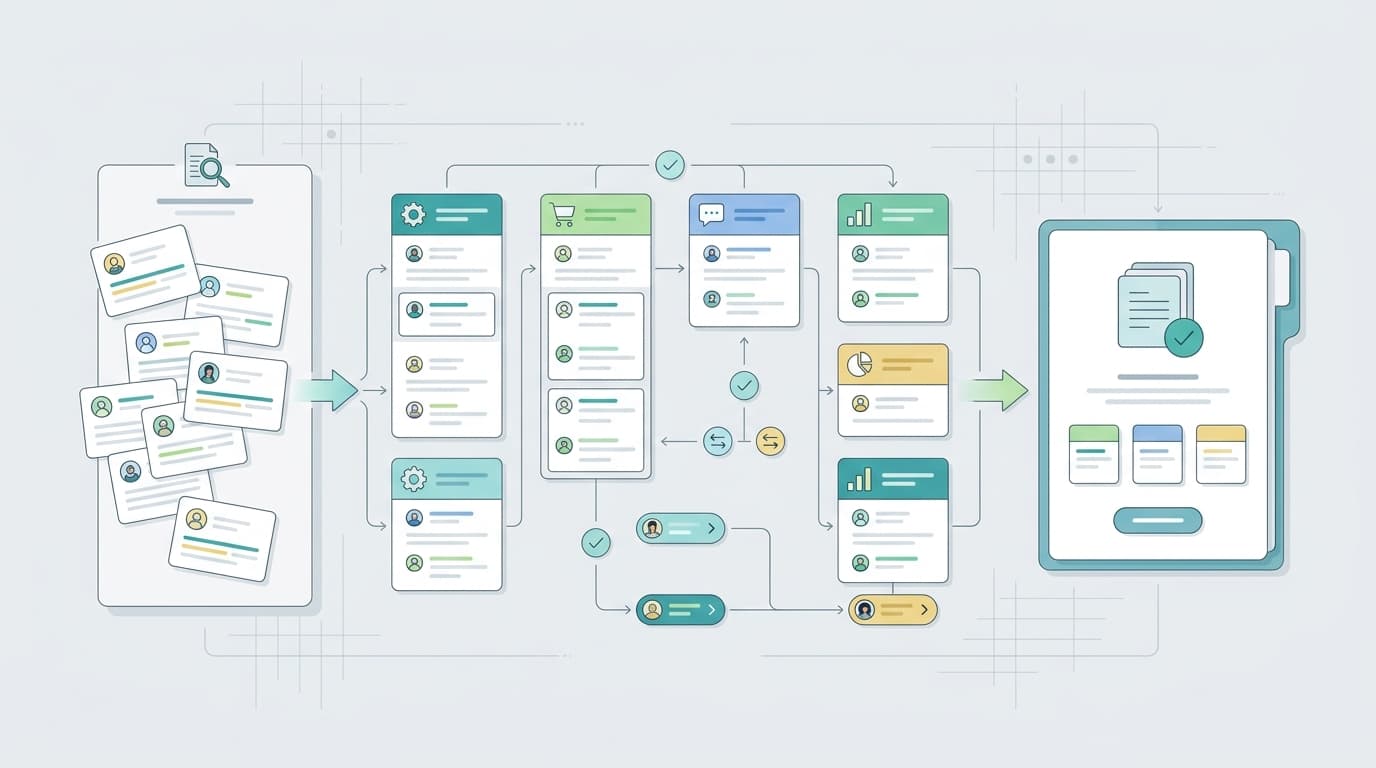
decision -> cohort -> themes -> owner -> action -> measurement
Use this article when you want Amazon reviews to inform growth work, not just research notes. The output should be strong enough for product, lifecycle, content, support, and experimentation teams to share.
Why growth teams use an Amazon review analyzer differently
Amazon already tells sellers to treat customer signals as inputs, not autopilot. Its Product Opportunity Explorer frames search, purchase, reviews, pricing, and return trends as directional evidence. Its Customer Reviews tool is for viewing and responding to product reviews and uncovering product insights.
Growth teams should read that as a warning: an Amazon review analyzer is only valuable when it changes a message, page, offer, or test.
The growth-team operating loop
Use the same loop every time:
| Stage | Question | Output |
|---|---|---|
| Decision | What are we trying to change? | One-sentence decision |
| Cohort | Which ASIN, market, rating band, and time window matter? | Locked review set |
| Themes | What repeats across reviews? | Theme list |
| Owner | Who can act on it? | Routing map |
| Action | Is this copy, UX, product, support, or monitoring? | Test or fix |
| Measurement | What should move if we were right? | KPI pair |
If the Amazon review analyzer cannot produce those six outputs, it is not yet good enough for a growth workflow.
What growth teams should pull from reviews
The point is not generic sentiment. The point is decision material.
| Review signal | Growth question | Typical output |
|---|---|---|
| Repeated objection | What is blocking conversion? | PDP copy test |
| Repeated praise | What value should we protect? | Messaging anchor |
| Competitor advantage | Where do we lose the comparison? | Comparison page |
| Support confusion | Where does onboarding fail? | FAQ or help content |
| Emerging complaint | Is this getting worse? | Monitoring rule |
That is the real job of an Amazon review analyzer: compress the review stream into something a team can use before the next sprint, campaign, or launch.
What to do with the output
Use the theme to decide the work, then assign the owner.
- Product: fix the issue or validate whether it is a true roadmap need
- Growth: rewrite the headline, bullets, offer, or landing page proof
- CX: update macros, troubleshooting, or post-purchase education
- Ops: check packaging, fulfillment, or batch-specific defects
- Research: turn the pattern into a competitor or category brief
If the analysis ends with "interesting," it is unfinished.
How VOC.AI fits
VOC.AI's VOC Analysis page says it clusters feedback by pain point, expectation, and feature mention, then turns recurring complaints into product priorities and listing changes. Its Review Analysis API adds REST API, Python SDK, and MCP support for teams that want the same signals in their own workflows.
That is the right fit for a growth team: one shared signal engine across dashboards, operations, and experiments.
If you are still deciding how broad the workflow should be, pair this article with How to Use Amazon Review Analyzer in 2026 and the Amazon review analyzer checklist for faster decisions. For broader tool selection, use the Amazon review analysis tool buyer scorecard.
A practical 30-minute growth workflow
- Write one decision sentence.
- Freeze one cohort.
- Pull the top repeated themes.
- Keep the buyer language visible.
- Mark the strongest contradiction.
- Route each theme to one owner.
- Pick one action to test or ship.
- Choose one KPI that should move next.
That is enough to turn an Amazon review analyzer into a working growth process.
What to measure
The right KPI depends on the work:
| Use case | Main metric | Support metric |
|---|---|---|
| Message test | Click-through rate | Scroll or time on page |
| PDP rewrite | Conversion rate | Add-to-cart rate |
| New offer | Trial or signup rate | Qualified signup rate |
| Support fix | Ticket reduction | CSAT or repeat contact |
| Monitoring | Complaint frequency | New review volume |
For this task, the content KPI is simpler: organic clicks, indexed URL count, qualified signups, and assisted conversions from the article URL.
Ground rules from Amazon
Use Amazon review evidence carefully:
- Product Opportunity Explorer is directional, not final truth.
- Customer Reviews data should be filtered by rating, time, and context.
- Review language should be validated before it becomes claims or copy.
That keeps the Amazon review analyzer useful without over-reading any one cohort.
FAQ
Is an Amazon review analyzer just a review summarizer?
No. A summarizer compresses text. An Amazon review analyzer should tell you what to change, test, or monitor next.
Should growth teams use the same workflow as product teams?
Mostly, but growth teams should care more about message, page, and experiment outputs, while product teams care more about roadmap and issue resolution.
When should I use an API instead of a dashboard?
Use the API when you need repeatable review intelligence across many ASINs, markets, or systems.
What is the shortest useful workflow?
Decision, cohort, themes, owner, action, measurement.
Final takeaway
The best Amazon review analyzer strategy for growth teams is simple: turn customer language into the next test, change, or monitoring rule. If the review output does not help the team act, it is not yet useful.