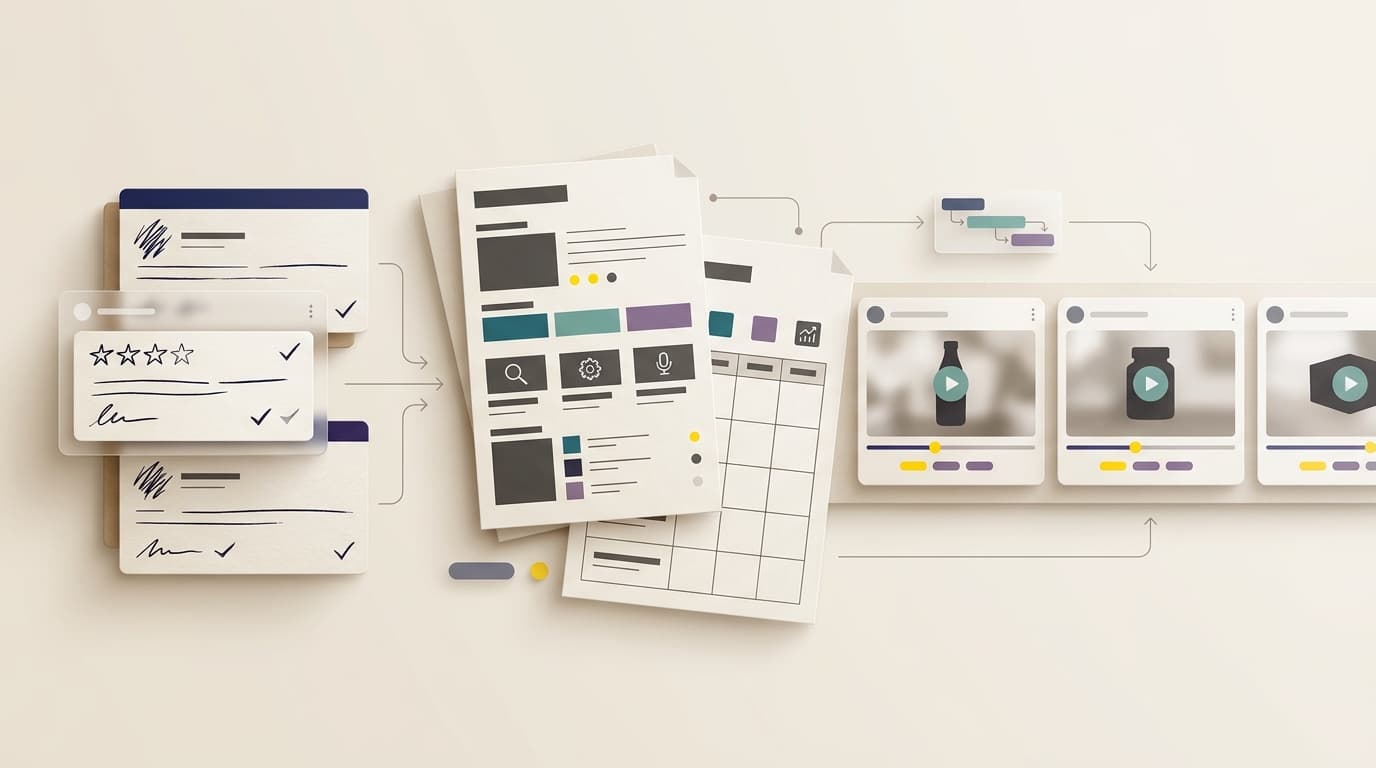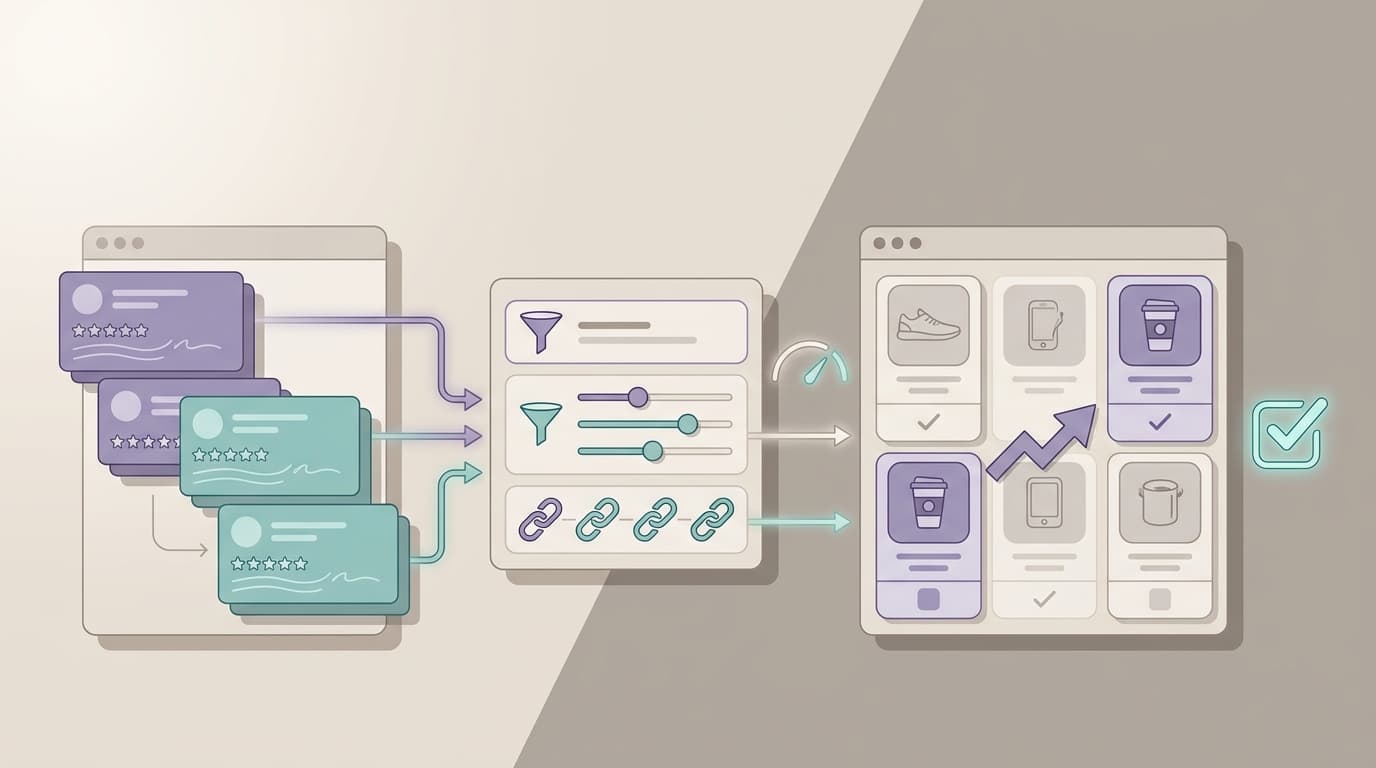
Ecommerce teams rarely suffer from a lack of feedback. They suffer from a weak path between evidence and product decisions.
Reviews, support conversations, returns, and competitor comments can reveal recurring defects, missing capabilities, setup confusion, packaging failures, and buyer expectations. Yet many roadmap meetings still begin with the loudest anecdote, the newest request, or the opinion of the most senior person in the room.
The job of customer feedback analysis software for ecommerce is not to replace product judgment. It is to make that judgment more evidence-based by turning scattered customer language into traceable themes, decision-ready proof, named owners, and recheck dates.
This guide shows how to move from reviews to a product roadmap without treating every request as a feature, every complaint as a crisis, or every cluster as a promise.
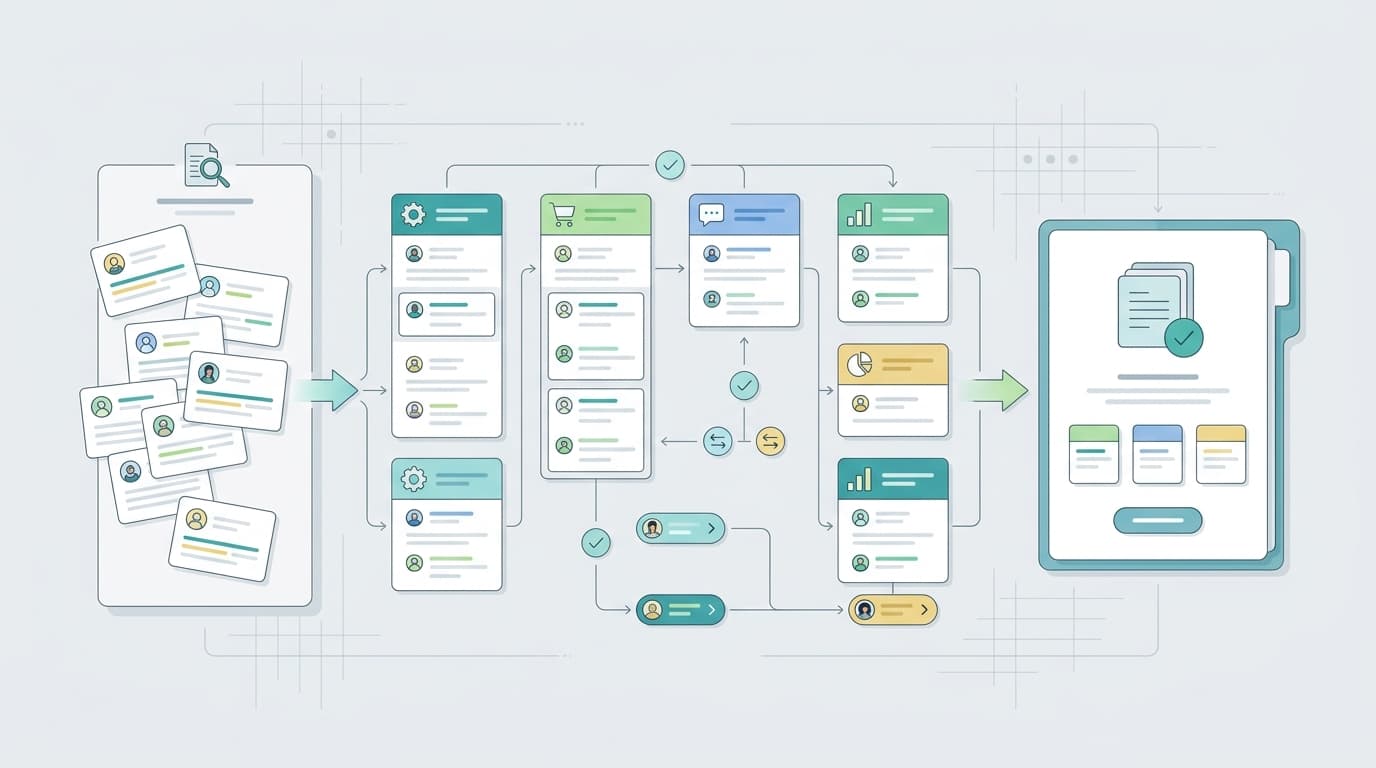
The Reviews-to-Roadmap Workflow at a Glance
Use a seven-stage loop:
- Define the decision question.
- Collect a bounded evidence set.
- Cluster feedback by customer problem.
- Validate recurrence, severity, and context.
- Compare competitor and category evidence.
- Route the theme to the right owner and action.
- Recheck the signal after the decision.
The output is not a list of popular requests. It is a compact decision record showing what customers experience, how confident the team is, what action it chose, and what evidence would change that choice.
Why Feedback Collections Fail to Influence the Roadmap
Many teams collect reviews but do not build a reliable customer feedback loop. The evidence is present, but it is not structured for decisions.
Common failure modes include:
- Anecdote bias: one vivid review outweighs a recurring but less dramatic problem.
- Request counting: the team counts feature requests without investigating the underlying job.
- Theme mixing: defects, expectation gaps, packaging issues, and missing capabilities share one label.
- Stale evidence: old complaints remain prominent after the product or listing has changed.
- Source blindness: the summary loses product, variant, market, rating, and date context.
- No competitive check: the team cannot tell whether a problem is category-wide or a differentiable gap.
- No owner: the insight appears in a report but never becomes a product, operations, listing, or support action.
- No recheck: the team ships a change but never tests whether the customer signal moved.
A useful workflow prevents these failures before the roadmap meeting. It does not ask stakeholders to trust an AI summary without evidence. It gives them a repeatable way to inspect the signal and challenge the conclusion.
Step 1: Start With a Decision Question
Do not begin with “analyze all our reviews.” Begin with a decision the team can make.
Examples:
- Which product-quality issue should enter the next roadmap review?
- Is a recurring complaint a design defect or an expectation gap?
- Which missing capability appears important enough to test?
- Should the team change the product, packaging, listing, onboarding, or support content?
- Is a competitor advantage becoming a customer expectation for the category?
A bounded question determines the evidence window, products, competitors, and owners. It also prevents the analysis from turning into an impressive but unactionable theme cloud.
For example, a kitchen-appliance team might ask: What is the most actionable reason customers struggle to clean the product after repeated use? That is more useful than asking for a general sentiment summary.
Step 2: Build a Bounded Evidence Set
Select evidence that matches the decision.
At minimum, record:
| Field | Why it matters |
|---|---|
| Product or ASIN | Prevents themes from blending across unrelated items |
| Variant | Reveals size, color, bundle, or generation-specific issues |
| Market and language | Preserves regional expectations and translation context |
| Review date | Separates current signals from resolved historical problems |
| Rating or sentiment context | Helps distinguish praise, friction, and severe dissatisfaction |
| Customer wording | Preserves the language behind the theme |
| Usage scenario | Shows when and why the issue appears |
| Source link or record | Makes the conclusion traceable |
Choose a recent evidence window large enough to reveal recurring patterns but narrow enough to reflect the current product. If a design, packaging, listing, or policy change occurred, split the evidence before and after that date.
Customer feedback analysis becomes less reliable when the scope changes halfway through the discussion. Write the product, market, source, and date range at the top of the decision record.
Step 3: Cluster Problems, Not Just Phrases
Customers rarely describe the same problem with identical words.
One review may say “the gasket traps food.” Another says “it smells after washing.” A third says “too many parts to clean.” These phrases may belong to one higher-level problem—cleaning effort—but they may also point to different causes.
Use a three-level taxonomy:
- Customer problem: the outcome or friction the customer experiences.
- Cause or mechanism: the product, packaging, instruction, or expectation factor behind it.
- Representative evidence: verbatim customer language with source context.
For the appliance example:
| Customer problem | Possible cause | Representative evidence type |
|---|---|---|
| Cleaning takes too long | Too many removable parts | Reviews describing disassembly effort |
| Product smells after use | Residue remains near gasket | Reviews mentioning odor after washing |
| Customer fears incorrect cleaning | Instructions do not show the gasket step | Questions and complaints about cleaning guidance |
This structure matters because the same broad theme can lead to different actions. A design issue may belong on the product roadmap. An expectation or instruction issue may need a listing image, insert, onboarding flow, or support article first.
If your team needs a cross-source taxonomy, use the workflow for analyzing ecommerce feedback across reviews, support, and social.
Step 4: Validate Each Theme Before Prioritizing It
Frequency alone is not enough. A common low-impact complaint may matter less than a less frequent issue that prevents product use or drives returns.
Evaluate every candidate theme across six dimensions.
Recurrence
Does the issue appear repeatedly, or is the cluster based on a few similar phrases? Check whether recurrence is spread across customers, products, or time periods rather than concentrated in one unusual event.
Freshness
Is the evidence current? Remove or label reviews that refer to an older version, retired bundle, outdated instruction, or resolved defect.
Severity
What customer outcome is affected? Distinguish inconvenience from inability to use the product, safety concerns, repeat contacts, returns, or abandonment.
Spread
Does the theme occur across variants, markets, ratings, and usage scenarios? A broad signal may justify a different response than one isolated to a specific version.
Confidence
Can the team trace the theme to enough representative evidence? Confidence should fall when source context is missing, clustering is ambiguous, or the evidence window is too narrow.
Actionability
Can the organization name an owner and a reasonable next test? If not, the theme may need more research rather than roadmap commitment.
The team can combine these checks in a decision table.
| Theme | Recurrence | Severity | Spread | Confidence | Likely owner | Next step |
|---|---|---|---|---|---|---|
| Gasket traps residue | High | Medium | Two variants | High | Product / quality | Inspect design and returns evidence |
| Cleaning instructions unclear | Medium | Low–medium | Several markets | High | Product marketing / CX | Test revised visual instructions |
| Missing storage accessory | Low | Low | One bundle | Medium | Category owner | Monitor and compare competitor evidence |
For a fuller ranking method, see how to prioritize customer feedback without letting the loudest voice win.
Step 5: Add Competitor and Category Context
A customer theme becomes more useful when the team understands its competitive meaning.
Use competitor review analysis to answer four questions:
- Do competitors receive the same complaint?
- Does a competitor solve the problem in a way customers praise?
- Is the issue a category expectation or a gap unique to your product?
- Are customers trading one benefit for another, such as easier cleaning versus stronger performance?
The answers change the roadmap decision.
If every product in the category receives similar cleaning complaints, the team may have an opportunity to differentiate. If one competitor earns repeated praise for a removable component, that evidence can support product feature gap analysis. If complaints disappear when instructions are clearer, the right first action may be educational rather than structural.
VOC AI’s Competitive Analysis can support comparison of customer feedback across competing products. Product Research provides an adjacent path for investigating needs, buyer language, and product opportunities. Market Insight can add category movement and market context around the review evidence.
Keep the evidence types separate. Competitor praise is a signal, not proof that copying a feature will succeed for your product, customer, price point, or supply chain.
Step 6: Route the Theme to the Right Action
Not every validated theme belongs on the product roadmap.
| Signal type | Primary owner | Likely action |
|---|---|---|
| Repeated defect or missing capability | Product / engineering / quality | Design change, quality fix, feature test |
| Setup confusion or expectation mismatch | Product marketing / onboarding | Listing copy, images, insert, guide, onboarding change |
| Packaging complaint | Operations / supply chain | Packaging revision, fulfillment QA, insert change |
| Repeat support question | CX / support | Macro, help article, chatbot flow, escalation rule |
| Competitor praise exposing a gap | Product + marketing | Gap analysis, positioning test, roadmap candidate |
| Buyer language around a valued outcome | Growth / listing team | Messaging, creative, and product-page test |
Routing prevents roadmap inflation. A revised instruction card can sometimes test the cause faster than a design project. A support macro can reduce friction while product investigates a deeper fix. A listing change can correct an expectation gap without pretending the underlying product changed.
The decision record should include:
- Theme and customer problem.
- Representative evidence.
- Product, market, and date scope.
- Recurrence, severity, spread, and confidence.
- Competitor or category context.
- Chosen action and owner.
- What the team decided not to do.
- Recheck date and success signal.
Step 7: Recheck the Customer Signal
A feedback loop is not closed when a ticket moves to “done.” It is closed when the team returns to the evidence and decides whether the customer problem changed.
Set the recheck before work begins. The timing depends on the action and review volume. A listing or instruction change may be evaluated sooner than a physical product redesign.
Compare equivalent evidence windows where possible. Review the same products, markets, variants, and theme definition. Check whether:
- The complaint rate or recurrence moved.
- Severity changed.
- Customer wording changed.
- New confusion appeared.
- Support or return evidence confirms the review signal.
- Competitors or category expectations changed during the test.
Avoid declaring success from a few positive comments. The purpose of the recheck is to update confidence, not to confirm the team’s preferred story.
A Monthly Reviews-to-Roadmap Meeting
Run a 45-minute monthly review around changed evidence rather than rereading every dashboard.
Before the meeting
The analyst or VOC owner prepares no more than five candidate themes. Each includes representative evidence, the validation checks, competitor context, and a recommended owner.
During the meeting
- Confirm the decision scope and evidence window.
- Review what changed since the last cycle.
- Challenge the cause behind each theme.
- Choose one of four decisions: act, test, monitor, or reject.
- Assign an owner and recheck date.
- Record disconfirming evidence that would reverse the choice.
After the meeting
Move the action into the correct execution system. Keep the customer evidence and decision record connected so future reviewers can understand why the team acted.
A voice of customer dashboard shared across product, CX, and growth can support this cadence without forcing every function to use the same metrics.
How VOC AI Supports the Workflow
VOC AI’s Voice of Customer Analysis can help ecommerce teams work with review themes, customer pain points, buyer language, product strengths and weaknesses, and decision-oriented reports. Public VOC AI materials also position the platform around product research, competitor analysis, and broader market insight.
Teams building a structured internal workflow can evaluate the Review Analysis API for access to original review fields and AI-analyzed conclusion data.
The software should support the operating loop, not replace it. Human owners still need to confirm evidence scope, challenge clusters, decide what action fits the cause, and recheck the signal after implementation.
When comparing platforms, use the broader guide to customer feedback analysis software for ecommerce teams.
Frequently Asked Questions
How do you turn customer reviews into roadmap priorities?
Define a decision question, cluster reviews by customer problem, preserve representative evidence, validate recurrence and severity, compare competitor context, route the theme to an owner, and set a recheck date.
Should every common feature request go on the roadmap?
No. A request may point to a deeper customer job, an expectation gap, or a workaround problem. Investigate the desired outcome and context before treating the requested feature as the solution.
What makes a review theme decision-ready?
A decision-ready theme has a clear scope, recurring evidence, representative customer language, severity and spread context, confidence notes, competitive meaning, a likely owner, and a testable next step.
How often should ecommerce teams review feedback themes?
A monthly roadmap review is a practical starting point for product decisions, with faster monitoring for severe or rapidly changing signals. The cadence should match feedback volume and decision urgency.
Can customer feedback analysis software make roadmap decisions automatically?
It can help organize evidence and surface patterns, but product teams remain responsible for interpreting context, constraints, tradeoffs, and disconfirming evidence.
Build a Feedback Loop That Produces Decisions
Customer feedback analysis software for ecommerce creates value when it shortens the path from customer language to a traceable action. The goal is not to turn every review into a roadmap item. The goal is to distinguish product problems from expectation, packaging, onboarding, and support problems—then route each signal to the owner who can test it.
Start with one product line and one decision question. Build the evidence set, validate the themes, choose an action, and schedule the recheck before expanding the workflow.