Updated August 17, 2026.
Ecommerce insights are only useful when they change a growth decision. A dashboard can show traffic, conversion rate, average order value, repeat purchase, reviews, refunds, support volume, and ad performance. But the growth team still has to answer the harder question:
What should we change this week because customers are telling us something important?
That is where most ecommerce insights workflows break. Teams collect more reports, but the reports do not explain which customer segment is hesitating, which product promise is weak, which review complaint is growing, which competitor gap is real, or which owner should act next.
Use this ecommerce insights guide to build a practical strategy for growth teams. The goal is not another analytics dashboard. The goal is a repeatable operating loop that turns customer evidence into product, listing, merchandising, support, retention, and campaign decisions.
What ecommerce insights should mean for a growth team
Ecommerce insights are patterns from customer, product, market, and competitor evidence that help a team decide what to change.
Useful ecommerce insights usually answer one of seven questions:
- Demand: Which customer need, use case, or category shift is becoming more important?
- Positioning: Which promise, proof point, or objection should the next page or campaign address?
- Product: Which feature gap, quality issue, bundle idea, or variant problem is worth testing?
- Merchandising: Which product, collection, listing, or comparison needs clearer buyer language?
- Support: Which repeated question or complaint should become a help article, macro, product fix, or automation rule?
- Retention: Which post-purchase friction is creating returns, churn, weak repeat purchase, or negative reviews?
- Competitive response: Which competitor strength or weakness should change your offer, copy, roadmap, or pricing explanation?
If an insight does not point toward a decision, it is probably a metric, a summary, or a research note. Those can still be useful, but they should not be confused with strategy.
The broader customer insights platform strategy article explains how to evaluate platform categories. This article is narrower: it shows how an ecommerce growth team can turn review, support, marketplace, and performance evidence into a weekly decision system.
Start with an ecommerce insight inventory
Before comparing ecommerce insights tools, list the decisions your team already makes. This keeps the workflow tied to growth work instead of tool features.
| Decision | Weak insight | Useful ecommerce insight |
|---|---|---|
| Product page test | "Conversion is down." | Recent review and support evidence shows buyers hesitate because durability proof is missing before purchase. |
| Listing rewrite | "Customers like quality." | Buyers use the phrase "sturdy after daily travel" in positive reviews, but the listing only says "premium materials." |
| Product fix | "Rating dropped." | Two- and three-star reviews from the last 45 days mention leaking around the cap, concentrated in one SKU and one fulfillment window. |
| Competitor response | "Competitor has more reviews." | Competitor reviews praise setup speed but complain about replacement parts; answer setup ease without copying their weak spot. |
| Support automation | "Tickets increased." | Pre-sale chats repeatedly ask whether the product fits a specific use case that reviews already prove. |
| Retention | "Repeat purchase is low." | Happy customers ask about refills and bundles, but the post-purchase flow does not surface the next best product. |
This inventory tells you which evidence matters. A team focused on Amazon growth may need review intelligence, Market Insight, ASIN monitoring, and competitor analysis. A Shopify-heavy brand may need owned-store reviews, support conversations, social comments, and product-page behavior. A large team may need an API workflow so recurring questions can run on schedule.
Build the ecommerce insights stack by evidence type
Do not start with tool names. Start with evidence types. Each type answers a different growth question.
| Evidence type | What it explains | What to avoid |
|---|---|---|
| Product reviews | Buyer language, expectations, pain points, feature gaps, use cases, quality issues | Treating all reviews as one blended sentiment score |
| Competitor reviews | Market gaps, competitor promises, unmet needs, switching triggers | Copying competitor claims without checking your own fit |
| Support conversations | Confusing flows, repeated questions, service failures, product education gaps | Optimizing support speed while ignoring root causes |
| On-site behavior | Where shoppers hesitate, abandon, compare, or repeat | Assuming behavior explains motivation by itself |
| Surveys and forms | Direct answers to controlled questions | Over-weighting survey respondents against broader market evidence |
| Social and creator comments | Public perception, emerging questions, language, and category chatter | Treating viral noise as purchase evidence without validation |
| Market and category data | Demand direction, pricing range, trend movement, competitor changes | Using market size as proof that your offer is clear |
The best ecommerce insights strategy connects these sources without flattening them. A review, a support ticket, a survey response, and a conversion-rate drop should not be merged into one generic conclusion. Keep the source, date, product, segment, channel, and confidence level visible.
That is why review-backed evidence is often the strongest starting point for ecommerce teams. Reviews contain buyer language after real use. They show expectations, tradeoffs, failure points, praise, and comparison language in a way that traffic dashboards rarely do.
The review-backed ecommerce insights loop
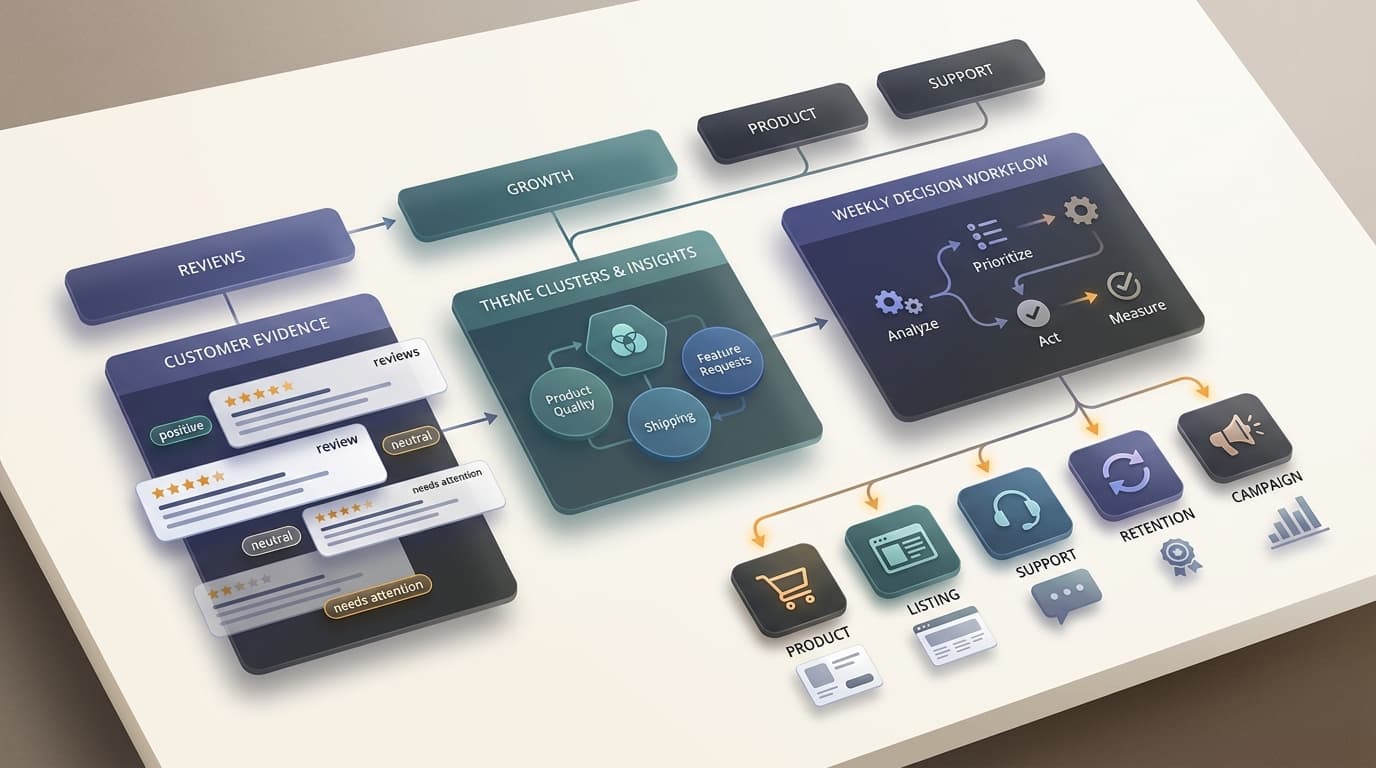
A practical ecommerce insights workflow has five stages.
| Stage | Growth question | Output |
|---|---|---|
| Detect | What changed or repeated? | Signal list from reviews, support, social, market, and analytics |
| Explain | Why might customers be behaving this way? | Theme with source evidence and counterevidence |
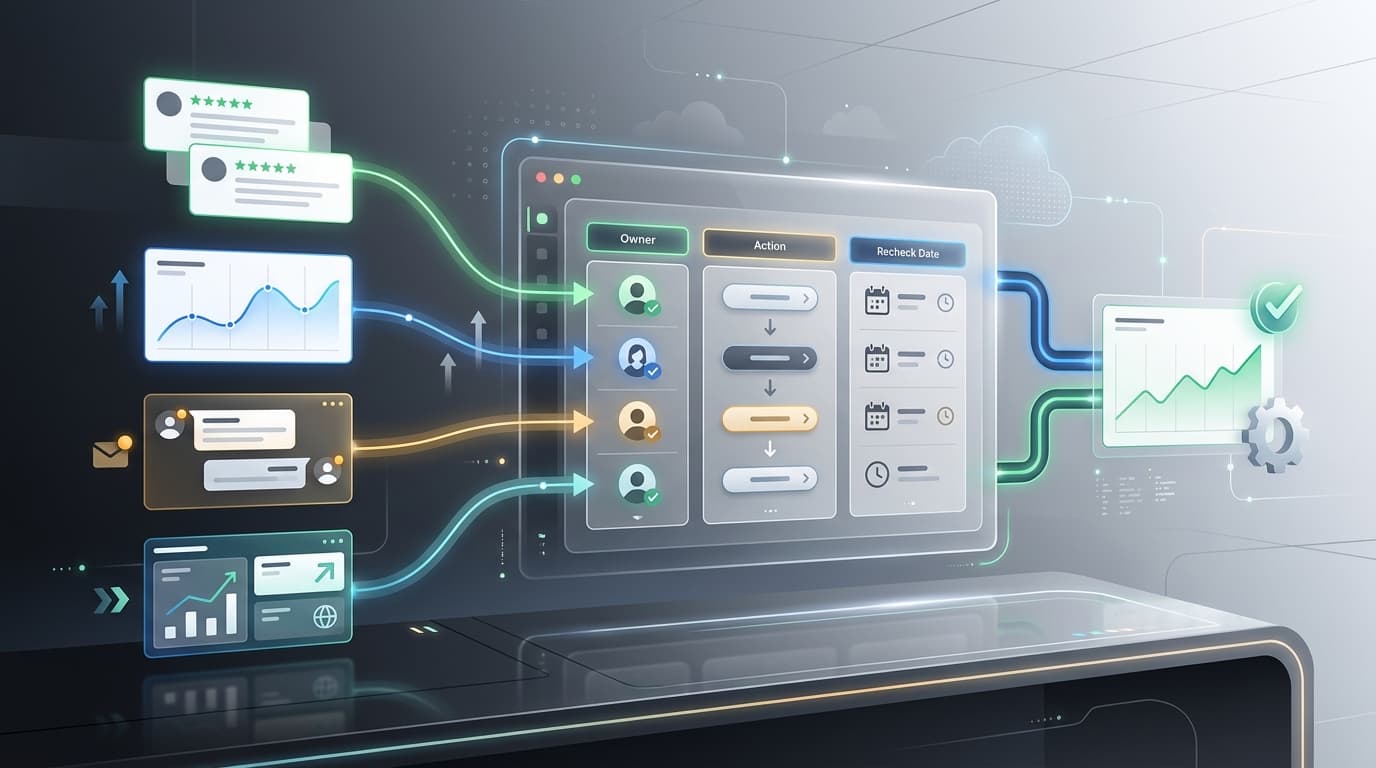
| Decide | What should we change first? | Owner-owned decision packet |
| Test | Did the change move the expected signal? | Experiment, content, product, support, or listing result |
| Reuse | What should become reusable customer knowledge? | Saved buyer language, objections, and decision history |
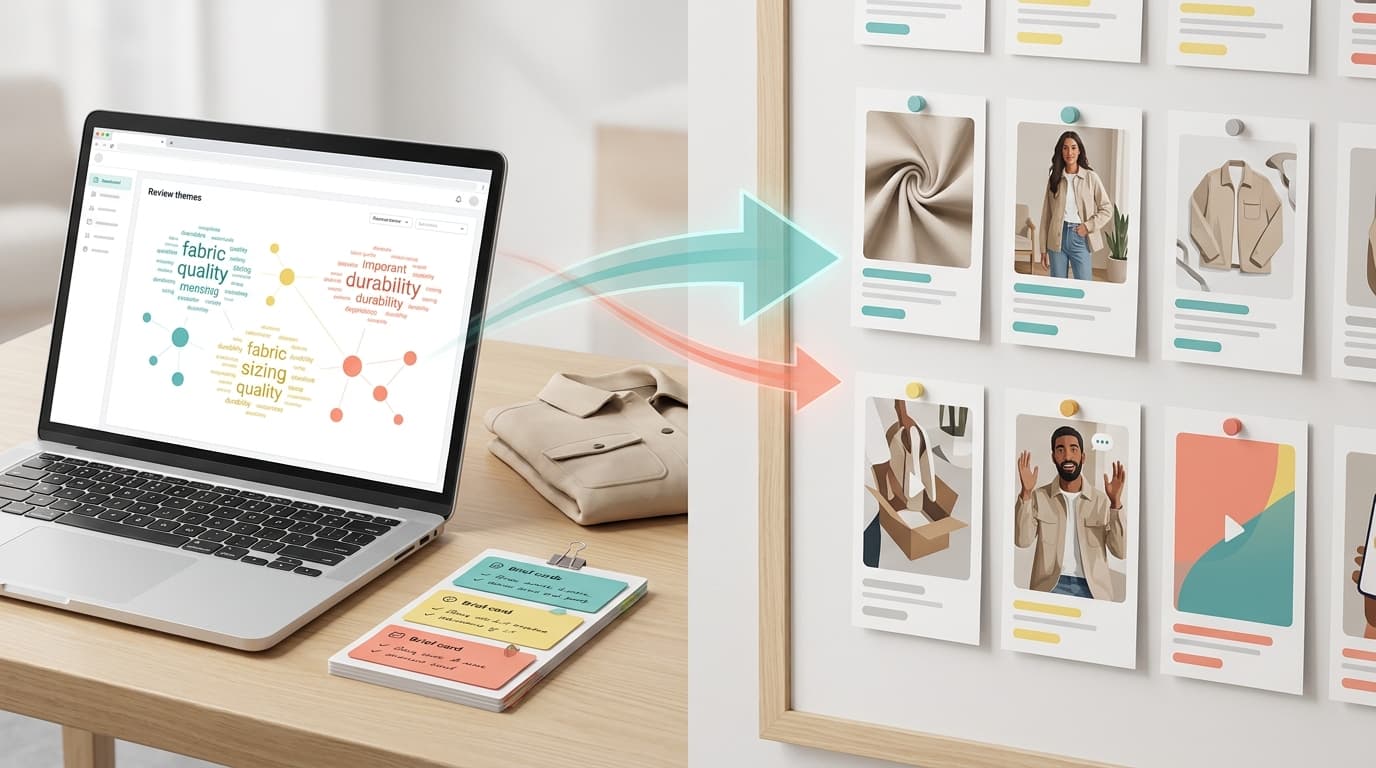
This loop keeps ecommerce insights close to action. A team should be able to move from "review complaints about setup are rising" to "update the product page comparison block, add a setup FAQ, route one issue to support, and recheck complaint share in 30 days."
The customer feedback intelligence workflow playbook covers this evidence-to-decision operating model in more detail. For ecommerce, the key is adding product, marketplace, competitor, and listing context so the insight can change a commercial action.
What to inspect before trusting an ecommerce insight
Growth teams move fast, so weak insights can become expensive tests. Use this six-point check before changing copy, merchandising, product, or support workflows.
1. Source traceability
Can the team inspect the original reviews, tickets, comments, or analytics cohort behind the finding? If not, the insight is not ready for a growth decision.
2. Cohort control
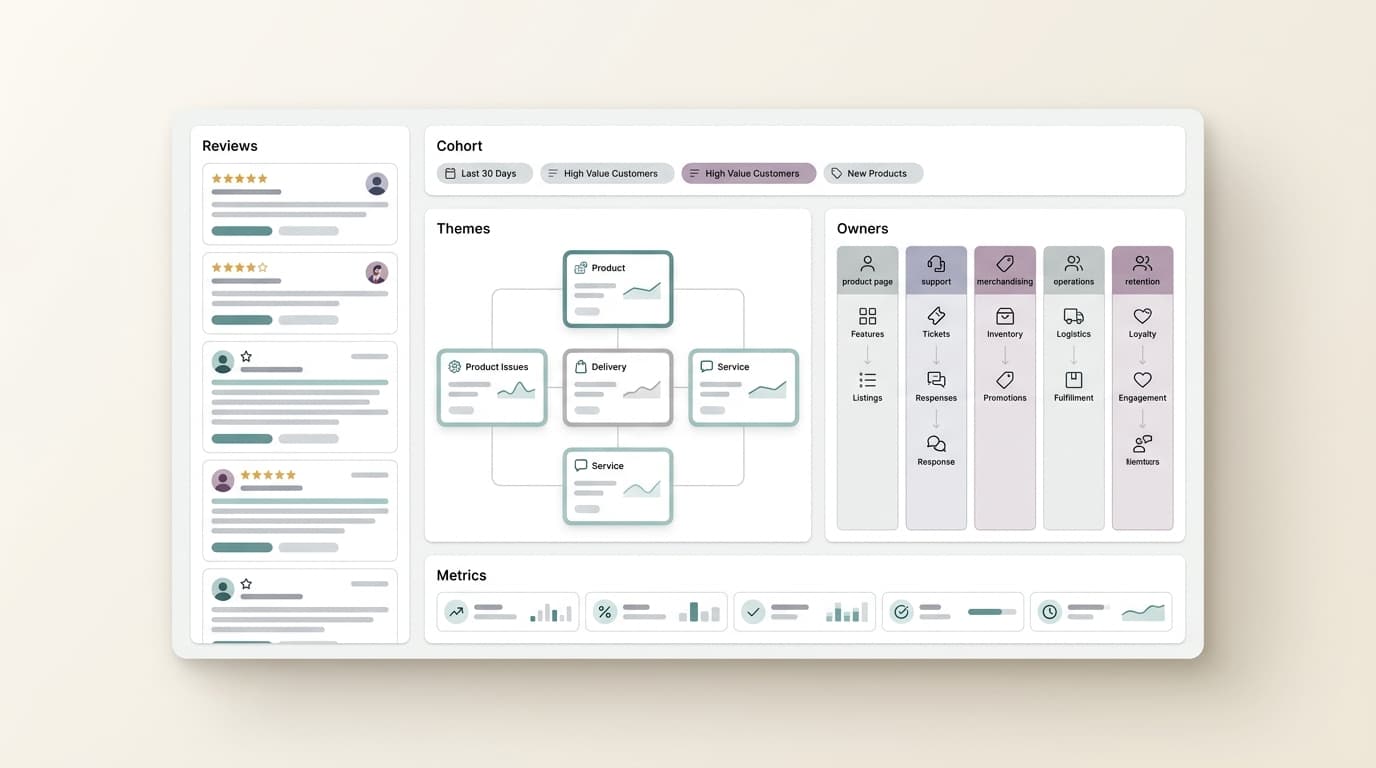
The same issue means different things depending on product, rating band, date window, market, channel, variant, or competitor. Three-star reviews from the last 60 days answer a different question than all reviews since launch.
3. Theme specificity
"Quality issue" is not specific enough. "Recent buyers report zipper failure after repeated travel use" is specific enough to route to product, supplier, support, and listing owners.
4. Counterevidence
Look for customers who disagree, segments where the issue is absent, date windows where it improved, or behavior data that narrows the conclusion. Counterevidence protects the team from overreacting to loud anecdotes.
5. Decision owner
Every ecommerce insight should have an owner: growth, product, merchandising, support, operations, lifecycle, marketplace, or creative. If nobody owns the next action, the insight will sit in a report.
6. Follow-up signal
Define what should change after action: complaint share, rating mix, conversion on one page, support contact rate, return reason, refund rate, repeat purchase, ad comment theme, or competitor comparison language.
Ecommerce insights tools: what each category is good for
The phrase "ecommerce insights tools" covers several different jobs. Use this matrix before you buy, renew, or replace a tool.
| Tool category | Best for | What to test |
|---|---|---|
| Web analytics and product analytics | Funnels, conversion paths, cohorts, retention, behavior changes | Can the team connect behavior to customer language? |
| Review intelligence | Product reviews, buyer language, pain points, feature gaps, competitor review patterns | Can themes link back to exact reviews and cohorts? |
| Marketplace intelligence | Category trends, demand shifts, share, pricing, BSR, competitor movement | Can market signals be tied to product and positioning decisions? |
| Customer support intelligence | Ticket trends, repeated questions, escalation reasons, macro gaps | Can support evidence become product, page, or automation work? |
| Social listening | Public conversation, creator comments, emerging objections, sentiment shifts | Can noise be separated from purchase or product evidence? |
| Survey and post-purchase feedback | Controlled questions, NPS, CSAT, cancellation reasons, direct buyer input | Can open text be analyzed without losing source context? |
| API-first insight workflows | Scheduled reports, dashboards, agents, internal tools, repeat analysis | Can structured outputs preserve source evidence and governance? |
Most growth teams need more than one category. The strategic choice is which source becomes the decision backbone.
If reviews are central to product, listing, marketplace, and competitor decisions, a review intelligence layer should be near the center of the stack. If the team mainly needs funnel diagnosis, analytics may lead while review evidence explains the "why." If the team needs recurring internal workflows, API access matters more than another dashboard.
Where VOC.AI fits in an ecommerce insights strategy
VOC.AI fits best when ecommerce insights depend on customer reviews, marketplace evidence, competitor review patterns, product research, listing language, and repeatable analysis.
The current Voice of Customer Analysis page positions VOC.AI around turning customer reviews into product direction, buyer language, and market-ready decisions. The Product Research and Competitor Analysis pages support adjacent workflows for product ideas and competitor review patterns. The Review Analysis API is relevant when the team wants review, keyword, listing, and sales-estimate data inside repeatable API or MCP workflows.
Use VOC.AI as a finalist when your ecommerce insights workflow needs to answer questions such as:
- Which review-backed objection should the next product page answer?
- Which buyer phrase should appear in listing copy, ads, FAQs, or comparison tables?
- Which competitor complaint reveals a product gap or positioning opening?
- Which product issue is rising before it becomes a rating or support problem?
- Which review cohort should be monitored after a launch, traffic spike, supplier change, or campaign?
- Which recurring insight workflow should move from manual research into an API-backed process?
If your immediate need is only clickstream reporting, start with analytics. If your immediate need is only review collection and display, start with a review app. If your growth team needs to turn customer language into decisions, add review intelligence to the ecommerce insights stack.
A weekly ecommerce insights cadence
The workflow works best when it becomes a short weekly operating rhythm.
| Day | Work | Output |
|---|---|---|
| Monday | Review signal changes from reviews, support, social, analytics, and market data | Signal list with source links |
| Tuesday | Pick one decision question | Decision question, owner, cohort, and scope |
| Wednesday | Inspect themes and counterevidence | Evidence table and confidence note |
| Thursday | Choose action | Listing, product, support, merchandising, retention, or campaign decision |
| Friday | Ship or schedule the test | Owner, action, expected signal, and review date |
Keep the first version small. One useful ecommerce insight per week is better than a dashboard full of unowned observations.
A 30-day rollout plan
Use this plan if your team is starting from scattered dashboards, manual exports, and ad hoc review reading.
| Window | What to do | Definition of done |
|---|---|---|
| Days 1-3 | List the top five recurring growth decisions | Decision inventory with owners |
| Days 4-7 | Choose the first evidence sources | Reviews, support, analytics, and competitor evidence are scoped |
| Days 8-12 | Build the first cohort manifest | Source, product, date range, rating band, and filters are documented |
| Days 13-17 | Generate and review themes | Each theme has source evidence and counterevidence |
| Days 18-21 | Create the decision packet | Owner, action, rationale, and expected signal are named |
| Days 22-27 | Ship one change | Product page, listing, support, campaign, or product action goes live |
| Days 28-30 | Review the signal | Team records what changed, what did not, and what to reuse |
This creates a working ecommerce insights system before the team debates a larger tool stack.
Ecommerce insights checklist for tool evaluation
Before choosing ecommerce insights tools, ask each finalist to prove the same workflow with your own evidence.
- Can the tool preserve source records behind every theme?
- Can it filter by product, SKU, ASIN, variant, rating, market, channel, and date?
- Can it compare your product evidence with competitor evidence?
- Can it show exact buyer language, not only sentiment labels?
- Can it surface counterevidence before the team acts?
- Can it create an owner-ready decision handoff?
- Can it track whether the signal changed after action?
- Can the team export evidence or use an API for recurring workflows?
- Can pricing, credits, seats, and usage limits support the weekly cadence?
- Can non-analysts understand and repeat the workflow?
The customer feedback analysis tools framework gives a broader software scorecard. For ecommerce insights, weight review evidence, competitor context, cohort control, and owner handoff more heavily than generic dashboard volume.
FAQ
What are ecommerce insights?
Ecommerce insights are decision-ready patterns from customer, product, market, competitor, and performance evidence. They help teams decide what to change in product pages, listings, merchandising, support, retention, campaigns, or product strategy.
What is the difference between ecommerce analytics and ecommerce insights?
Ecommerce analytics usually explains what happened: traffic, conversion, revenue, retention, average order value, and funnel behavior. Ecommerce insights explain what the team should do next by connecting those metrics with customer language, review evidence, support themes, and market context.
What are the best ecommerce insights tools?
The best ecommerce insights tools depend on the decision. Growth teams often combine web analytics, review intelligence, marketplace intelligence, support analysis, social listening, surveys, and API workflows. Choose tools by the evidence and decisions they support, not by dashboard count.
Why are customer reviews important for ecommerce insights?
Customer reviews show buyer language after real use. They can reveal purchase motivations, objections, use cases, product gaps, quality issues, competitor comparisons, and wording that should influence product pages, listings, support, and campaigns.
How often should a growth team review ecommerce insights?
Weekly is a practical cadence for most growth teams. The team should review signal changes, choose one decision question, inspect evidence, assign an owner, ship one action, and define the follow-up signal.
Conclusion
Ecommerce insights should make growth work easier to defend. They should show the customer evidence, narrow the cohort, explain the theme, surface counterevidence, name the owner, and define the next signal to check.
Start with one decision inventory and one weekly loop. Then choose ecommerce insights tools that support that loop. If customer reviews, competitor review patterns, product research, and buyer language are central to your growth strategy, review intelligence should be part of the stack from the beginning.