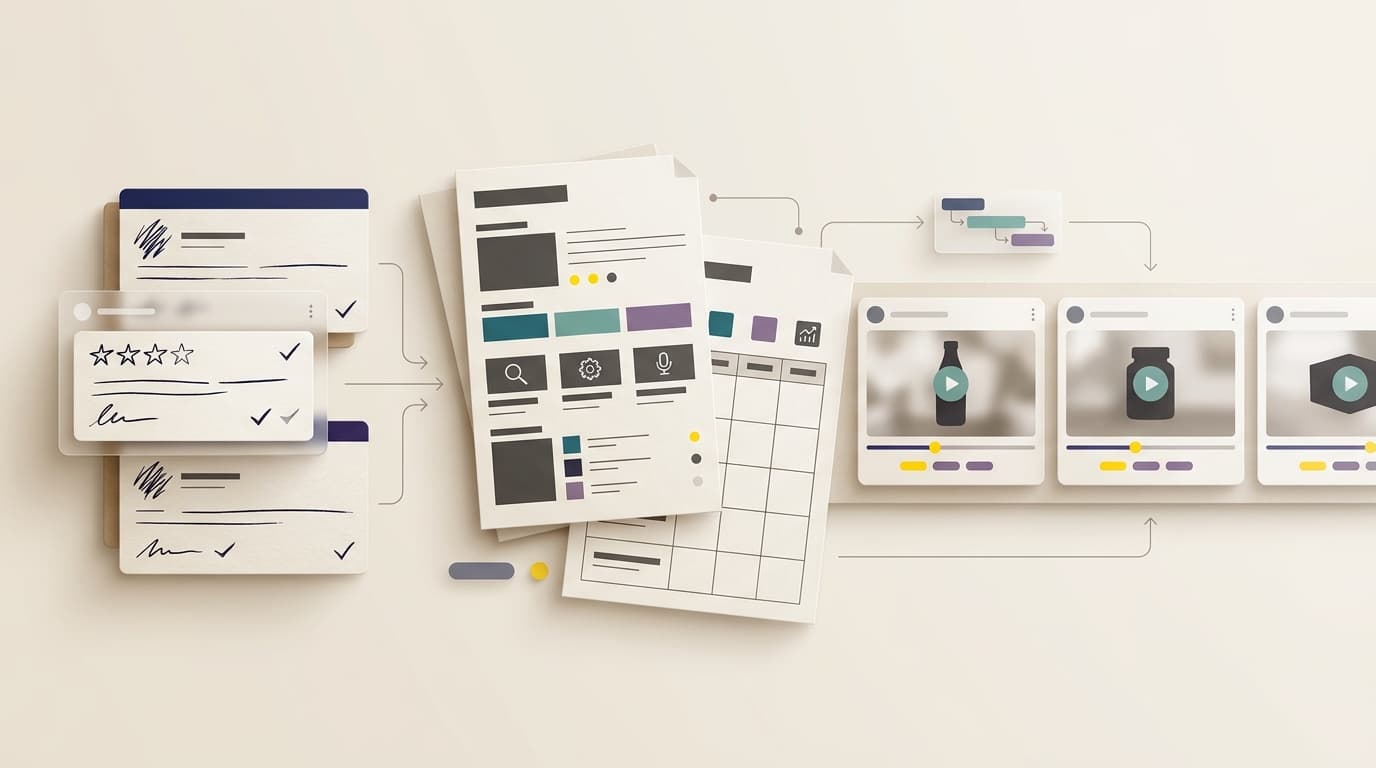
Most software shortlists begin with feature parity. Nearly every customer review analysis tool can claim AI analysis, sentiment detection, dashboards, exports, or automated summaries. Those labels help you discover a category, but they do not tell you whether a tool can support a decision your team needs to make.
A stronger comparison starts with proof. Can the vendor show what data enters the system, how a theme connects back to source evidence, who acts on the output, and how a buyer can validate the workflow before rollout? This guide gives ecommerce, product, customer experience, and support teams a practical way to compare review analysis software without treating marketing claims as verified outcomes.
Definition: A proof-led customer review analysis tool evaluation checks whether a vendor connects product claims to bounded source data, traceable evidence, a specific decision workflow, named customer context, and a reproducible pilot.
Why feature checklists create false confidence
Feature checklists are useful when they test objective requirements such as supported data sources, export formats, permissions, languages, integrations, or retention controls. They become less useful when broad labels hide meaningful differences.
For example, two vendors may both list “sentiment analysis.” One may show only an aggregate positive-versus-negative chart. Another may let an analyst filter by product, market, rating, date, or customer segment; inspect the reviews behind a theme; identify contradictory feedback; and export evidence for a product manager. The checkbox is the same, but the decision value is not.
The same problem appears in comparisons of AI customer service for ecommerce. “AI replies” says little about knowledge sources, escalation rules, channel coverage, evaluation methods, or what happens when confidence is low. Buyers need to move from capability labels to evidence, workflow, and validation.
That does not mean a vendor with limited public documentation has a weak product. It means the buyer has missing evidence. Give every shortlisted vendor an opportunity to supply that evidence in a demo, security review, or bounded pilot.
The evidence ladder for review analysis software
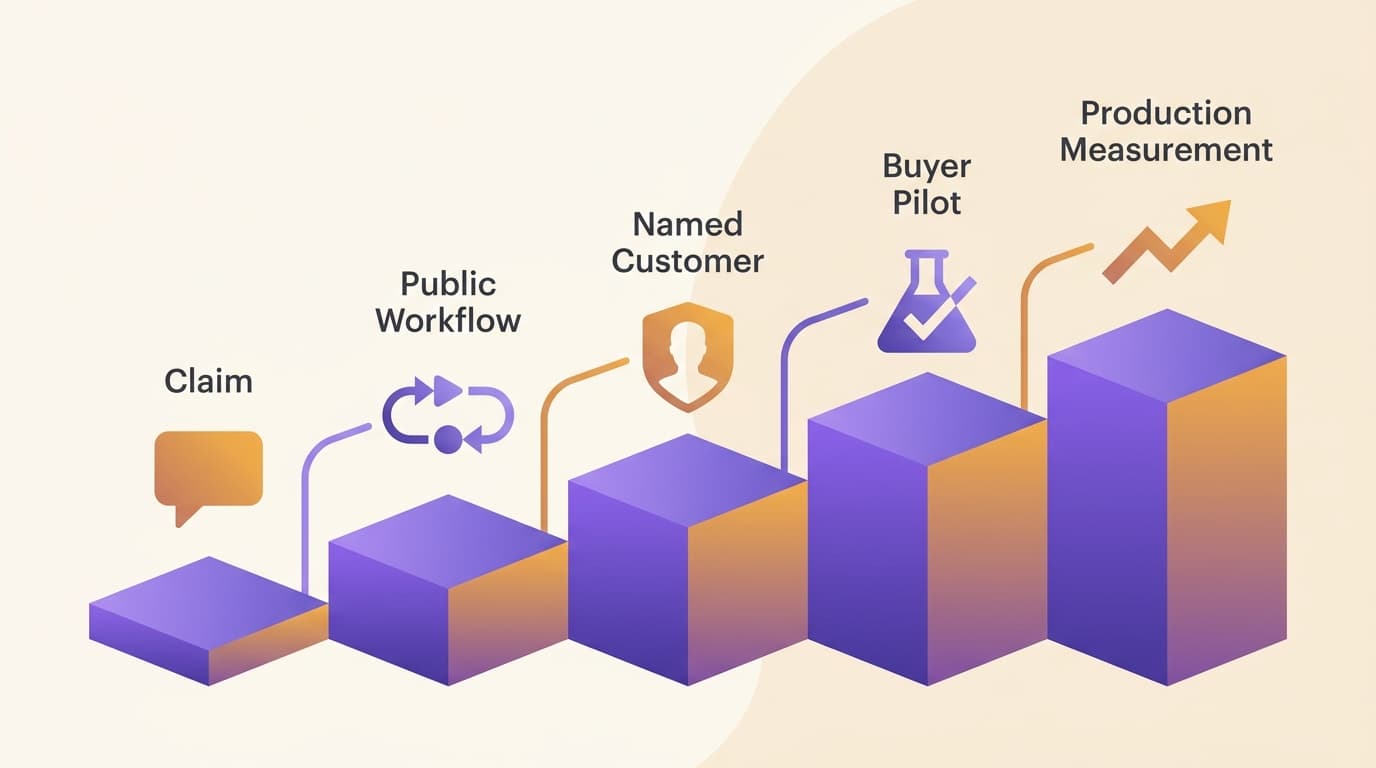
Use the following ladder to separate what a claim supports from what it cannot establish on its own.
| Evidence level | What it supports | What it does not support |
|---|---|---|
| Public feature statement | The vendor describes a capability | Effectiveness, accuracy, adoption, or customer outcome |
| Detailed workflow page | The vendor specifies inputs, outputs, and use cases | Successful implementation in your environment |
| Product demonstration | The workflow can operate on a selected example | Generalization to other datasets, teams, or decisions |
| Named customer story | A customer reportedly used the workflow in context | Guaranteed replication, independent audit, or universal ROI |
| Buyer-side pilot | The workflow met agreed criteria on bounded buyer data | Long-term adoption or causal business impact |
| Production measurement | The team can track operational and business signals over time | Automatic proof that the tool alone caused every outcome |
The important move is not to reject lower levels. It is to ask the next question. A public feature statement should lead to a workflow demonstration. A demonstration should lead to a test on known data. A successful test should lead to production measurement with clear owners and baselines.
A proof-led customer review analysis tool scorecard
Score each shortlisted tool from 0 to 5 on the nine criteria below, multiply each score by its weight, and total the result out of 100. Use the score to structure discussion rather than to manufacture a precise universal ranking.
| Criterion | Weight | What strong evidence looks like | Question to ask |
|---|---|---|---|
| Named customer proof | 15% | A named customer, operating context, use case, and attributable reported result | Which public customer example most closely matches our channel and decision? |
| Evidence boundary | 15% | Defined sources, products, markets, languages, time range, and cohort rules | Can we reproduce a finding for one SKU, market, rating band, or date range? |
| Evidence traceability | 15% | Themes link to representative records, exceptions, and contradictions | Can an analyst inspect and export the source records behind each theme? |
| Workflow specificity | 15% | Signal, analysis, reviewer, owner, action, and remeasurement are connected | Show how an insight reaches a product, support, or marketing owner. |
| Product specificity | 10% | The tool distinguishes products, variants, categories, regions, and channels | How does the analysis avoid mixing feedback from materially different cohorts? |
| Outcome quality | 10% | The vendor distinguishes operational metrics from business outcomes | Which metric changed, over what period, and what else may have influenced it? |
| Transferability | 8% | Similarities and differences between the proof example and your environment are explicit | Which assumptions must hold for this workflow to transfer to us? |
| Pilot readiness | 7% | A bounded dataset, questions, success criteria, owners, and timeline are defined | What can we validate with one product or one queue before rollout? |
| Governance | 5% | Human review, permissions, escalation, retention, and measurement are addressed | Where can a reviewer challenge an output or override an automated action? |
How to interpret the score
- 80–100: Strong decision evidence. Proceed to commercial, technical, security, and implementation validation.
- 60–79: Promising, with material evidence gaps to close in the demo or pilot.
- 40–59: High uncertainty. Narrow the use case and require a bounded proof of value.
- Below 40: Insufficient decision evidence. Remove the tool from the shortlist or redefine the use case.
A low public score may mean the vendor has not documented its evidence, not that the product cannot perform. Record the missing proof and let the vendor respond. Apply the same standard to VOC AI and every other option.
How to test evidence traceability
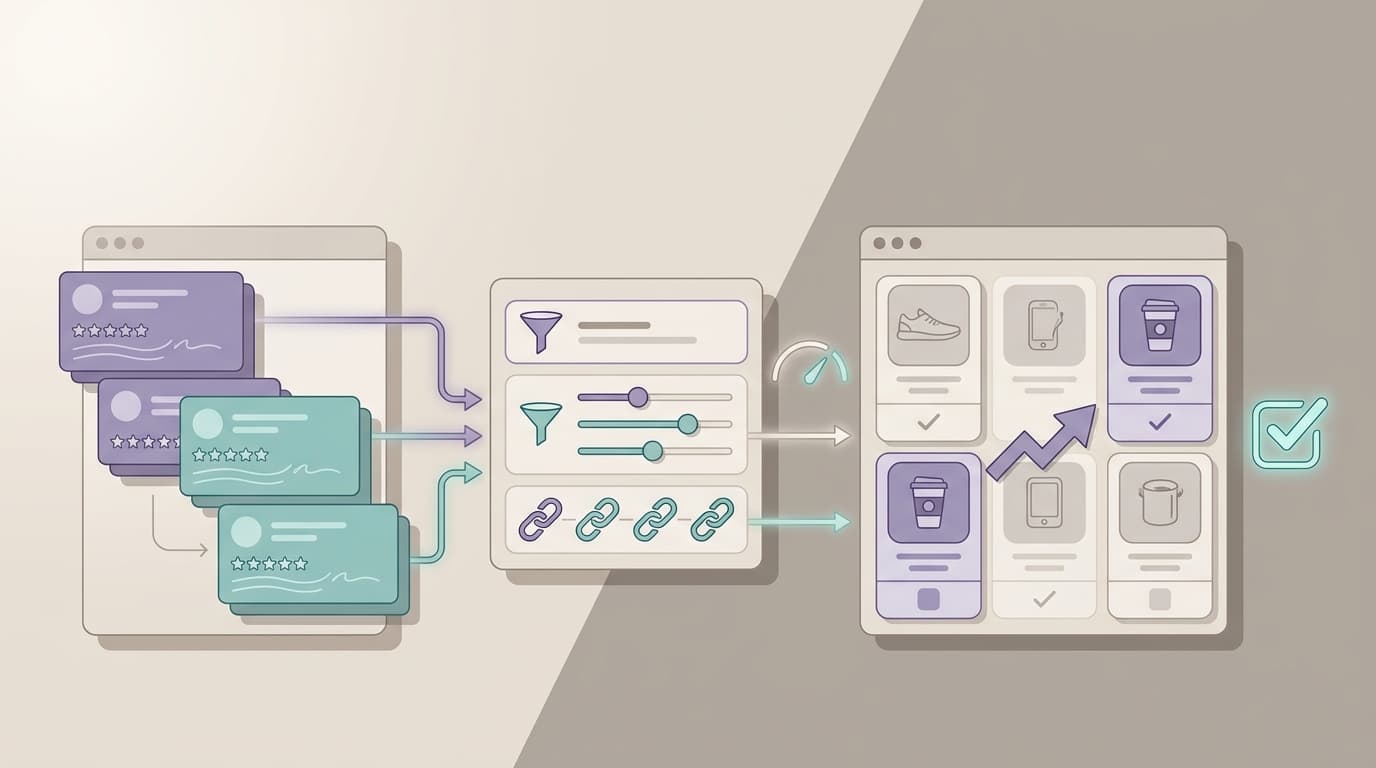
Evidence traceability is one of the clearest differences between a compelling summary and a dependable workflow. A useful customer review analysis tool should help a reviewer move from an insight to the records that support it.
During a demo, bring a dataset or product cohort you already understand. Ask the vendor to identify a theme, then inspect:
- The source reviews or conversations behind the theme.
- The filters and date range used to build the cohort.
- Representative positive, negative, and contradictory examples.
- How duplicates, spam, translation, and ambiguous language are handled.
- Whether the evidence can be exported for another team.
- Whether a reviewer can correct the theme or classification.
This test does not require a perfect model. It reveals whether the system supports scrutiny. If a summary cannot be traced to evidence, it is difficult for product, research, support, or compliance teams to challenge and use responsibly.
For a broader category-selection framework, see this guide to customer feedback analysis software for ecommerce. Amazon-focused teams can also use the Amazon review analysis tool buyer scorecard for platform-specific requirements.
Workflow specificity matters as much as analysis quality
An insight creates value only when it reaches an owner and changes a decision. Ask each vendor to demonstrate the path from raw signal to action:
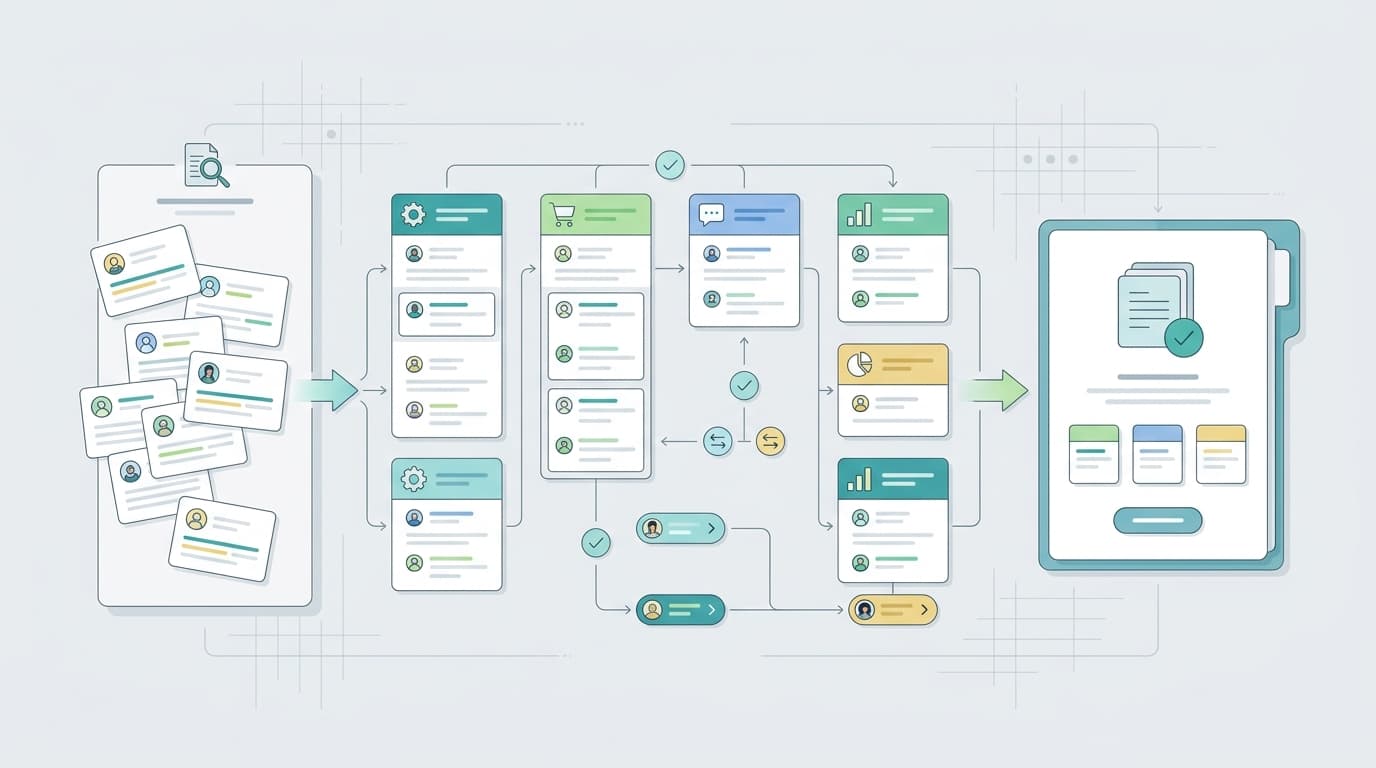
Source → cohort → theme → evidence → reviewer → owner → action → remeasurement
For product teams, the action may be a requirement, packaging change, quality investigation, or roadmap decision. For support teams, it may be a knowledge-base update, escalation rule, or response workflow. For marketing teams, it may be a message test grounded in customer language.
Public pages can help establish workflow specificity before a demo. VOC AI, for example, documents a Voice of Customer Analysis use case, an AI customer service for ecommerce route, and a customer service chat workflow. These pages show the workflows the vendor describes. They do not replace validation on your data.
When comparing an AI customer-service tool, add questions about knowledge sources, channel handoffs, confidence, escalation, human review, and measurement. A tool can produce fluent answers and still be poorly matched to the operational boundaries of a specific service queue.
How to use customer stories without overclaiming
Named customer stories are useful because they add context and accountability. They can show the customer, operating problem, deployment shape, workflow, and reported result. They are still vendor-published evidence, not an independent audit or a guarantee.
VOC AI's detailed Anker customer story is an example buyers can inspect. The live story describes Anker's service and voice-of-customer workflows and reports, in that deployment context, service-efficiency improvement of 70%, ticket processing moving from more than 30 minutes to five minutes, and automation that addressed 70% of manual work. Treat those figures as attributable customer proof and validate whether the data, channels, team, and operating model are transferable to your environment.
The related Anker voice of customer case study focuses on the feedback-to-action operating model rather than owning the exact figures. Together, these pages illustrate a useful buyer habit: separate the canonical metric source from the interpretation of how a workflow may transfer.
You can apply the same approach to any VOC AI case study or competitor story:
- Is the customer named?
- Is the starting condition described?
- Is the workflow specific enough to inspect?
- Is the reported result tied to a time period and context?
- Are operational metrics separated from business outcomes?
- Which differences could prevent transfer to your team?
- What would you need to reproduce in a pilot?
For a deeper due-diligence framework, read how customer stories help evaluate software and browse the current VOC AI customer stories.
Run a bounded proof-of-value pilot
A proof-of-value pilot should reduce uncertainty around a specific decision. It should not become a miniature implementation with undefined success criteria.
Choose one product, one market, or one service queue. Then define the pilot before the vendor analyzes the data.
1. Set the boundary
Specify the data source, date range, product or queue, language, exclusions, and access method. Preserve a known comparison set so your team can verify the output.
2. Write the decision questions
Examples include:
- Which complaints are increasing for this product version?
- Which themes differ between one- and five-star reviews?
- Which support issues should become knowledge-base updates?
- Which feature request has enough evidence for discovery?
- Which claim needs more research before a product change?
3. Define success criteria
Evaluate more than whether the tool produces a dashboard. Criteria may include source coverage, traceability, analyst time, reviewer agreement, export quality, workflow fit, and the number of findings that survive manual validation.
4. Assign owners
Name the analyst, business reviewer, decision owner, and technical or governance reviewer. Decide who can reject a theme, request more evidence, and approve an action.
5. Compare against a baseline
Use the current manual process, an existing tool, or a predefined human-coded sample. The goal is not to prove that AI is universally better. It is to understand where the proposed workflow improves speed, coverage, consistency, or decision confidence—and where it does not.
6. Plan remeasurement
If the team takes action, define when the relevant signal will be checked again. Without remeasurement, the process ends at insight generation instead of becoming a feedback-to-action loop.
Five questions to ask every vendor
What should I look for in a customer review analysis tool?
Look for bounded data scope, evidence traceability, cohort controls, contradiction handling, workflow ownership, exports, integrations, human review, governance, and pilot readiness. Product fit also depends on security, usability, total cost, and the channels your team actually uses.
Are software case studies reliable?
They are useful as attributable vendor evidence when they name the customer and provide context. They are not equivalent to an independent audit and do not guarantee a similar result for another buyer.
How can I compare AI customer-service tools for ecommerce?
Compare channel coverage, knowledge sources, escalation, human review, evidence, integrations, measurement, and governance. Test the workflow on a known service queue instead of evaluating only a polished demonstration.
What is a proof-of-value pilot?
A proof-of-value pilot is a bounded test with agreed data, decision questions, success criteria, owners, and a validation method defined before the analysis begins.
Does named customer proof guarantee similar results?
No. Named proof improves context and accountability, but buyers still need to assess transferability and validate the workflow with their own data.
Choose the tool whose claims can survive validation
Proof quality does not replace product fit, security, integrations, usability, implementation capacity, or total cost. It makes those decisions more disciplined by showing what is known, what is missing, and what should be tested next.
The strongest customer review analysis tool for your team is not necessarily the one with the longest feature list. It is the one that can connect claims to bounded data, traceable evidence, a specific decision workflow, and a pilot your team can evaluate.
If you want to test that process with one product or one workflow, discuss a proof-of-value workflow with VOC AI.