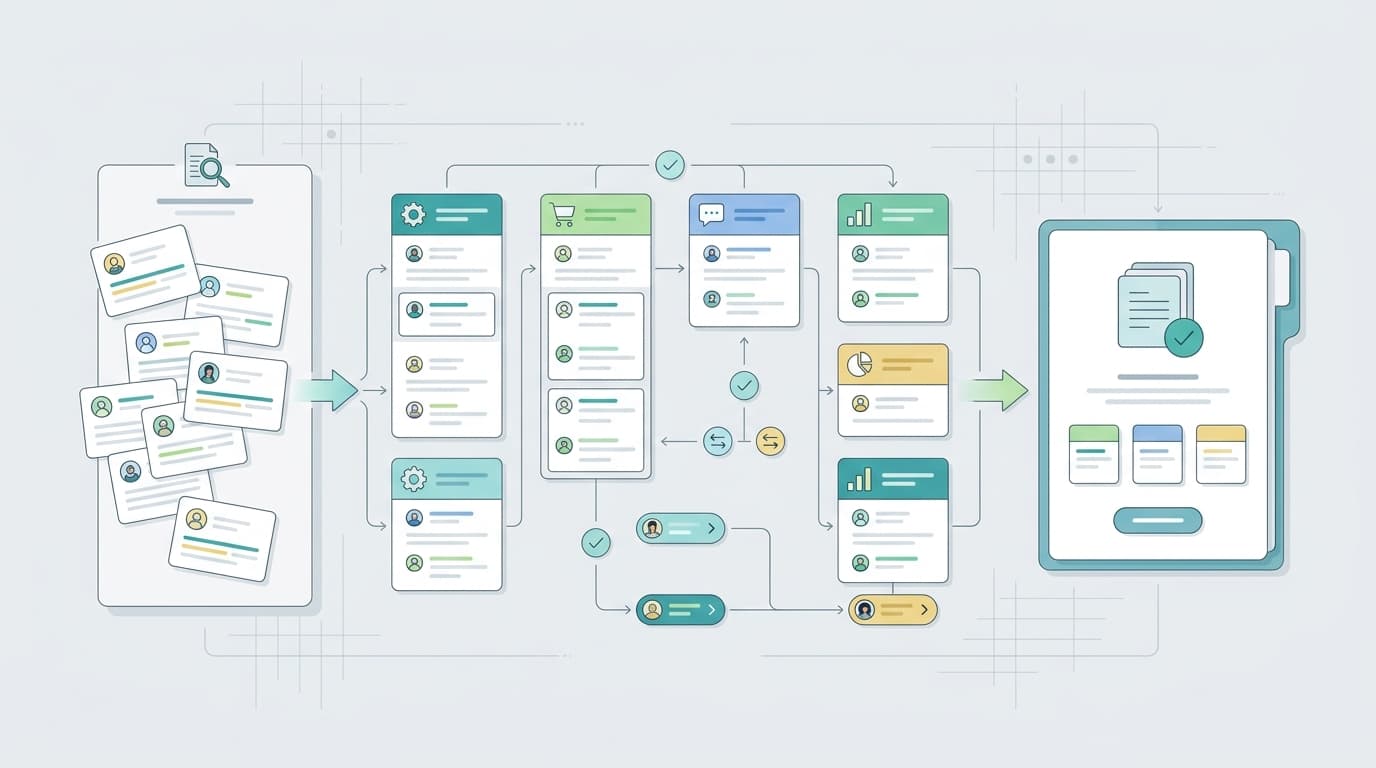
Reading a handful of Amazon reviews is easy. You can usually spot a few obvious complaints in ten minutes.
The hard part starts when you have thousands of reviews across multiple ASINs, variations, competitors, and marketplaces. At that point, review analysis is no longer about “reading faster.” It is about finding patterns you can trust.
Amazon reviews can show why buyers love a product, why they return it, what competitors are missing, and what your listing fails to explain. A tool like VOC AI can help when those signals are spread across too many reviews for one person to track manually.
What Amazon Review Analysis at Scale Means
Review Analysis at Scale
Amazon review analysis at scale means looking at customer feedback across many products, variations, ratings, dates, and competitors without losing the original context.
The goal is not to collect a few dramatic quotes. The goal is to find repeated patterns that are strong enough to guide product, listing, packaging, support, or operations decisions.
For example:
- A product may have strong ratings overall, but one color variation gets repeated complaints.
- A competitor may lose buyers because of confusing instructions.
- A new packaging change may reduce one complaint but create another.
- A three-star review may reveal a fixable issue that one-star reviews do not explain clearly.
Amazon explains that customer reviews and star ratings help shoppers evaluate product quality and satisfaction. Sellers can treat those same reviews as a customer research source, as long as they keep the evidence tied to the original review.
Why Manual Review Reading Breaks
Manual review reading works for a small product. It breaks when the catalog grows.
The common problems are familiar:
- Too many reviews to read consistently
- Old reviews mixed with new problems
- One variation hiding inside the overall rating
- Different team members using different labels
- Competitor reviews sitting in separate files
- AI summaries that sound useful but cannot be verified
This is why scale matters. When the review count grows, sellers need a system that keeps reviews organized before anyone starts drawing conclusions.
Step 1: Set the Scope Before You Analyze
ASIN Scope
Start with the products that matter to the decision.
If you are investigating a packaging complaint, focus on the affected ASINs and variations. If you are planning a new launch, include competitor ASINs in the same category. If one child ASIN is pulling down the rating, separate it from the parent product before you analyze.
Useful scopes include:
- One hero ASIN
- One product family
- One variation group
- One marketplace
- One competitor set
- One recently updated listing
- One product line before and after a change
The biggest mistake is mixing everything together too early. A broad analysis can look impressive, but it can also hide the exact issue you need to fix.
Time Scope
Reviews also need time boundaries.
A review from three years ago may explain an old product issue, but it may not describe what buyers receive today. A review from last week may be urgent, but it may not represent a pattern yet.
Use time windows based on the question:
- Last 30 days for urgent monitoring
- Last 90 days for current product quality
- Last 6 months for listing and support themes
- Last 12 months for category-level trends
- Before and after a product, packaging, or listing update
This keeps old noise from taking over the analysis.
Step 2: Keep Review Data Structured
Review Fields
At scale, review text alone is not enough. You need the details around each review so the team can filter and check the source later.
Keep fields such as:
- ASIN
- Marketplace
- Review date
- Star rating
- Review title
- Review body
- Product variation
- Verified purchase status when available
- Review URL
- Owned product or competitor product
Amazon’s Customer Reviews tool can help eligible brand owners track and respond to certain customer feedback. For larger analysis, the important point is the same: keep reviews connected to the product and context they came from.
VOC AI’s Review Analysis API is useful when teams need review data or AI-analyzed outputs connected to internal dashboards, reports, or seller workflows.
Source Context
A summary without source context is risky.
If an analysis says “customers dislike the material,” someone should be able to check the actual reviews behind that statement. Which ASIN? Which variation? Which date range? How many buyers said it?
Keep review URLs, dates, ratings, and variation details attached to the analysis. This slows the process down a little at the start, but it prevents bad decisions later.
Step 3: Separate Products and Variations
Product Mapping
Many Amazon catalogs are messy behind the scenes. A parent ASIN may have several child ASINs. One product may have different versions, bundles, colors, sizes, or marketplace listings.
Before analysis, map the basics:
- Parent ASIN to child ASIN
- ASIN to internal SKU
- Variation to attribute
- Product version to launch date
- Competitor ASIN to category
- Marketplace to region
This step sounds boring. It is also the step that stops teams from blaming the wrong product.
Variation Issues
A lot of review problems are not product-wide.
Fit complaints may apply to one size. Color complaints may apply to one variation. Compatibility issues may affect one model. Packaging problems may come from one fulfillment path.
So before you decide that “the product has a quality problem,” check whether the complaint is tied to a specific variation.
For example:
If only the blue version receives color mismatch complaints, do not rewrite the whole product listing. Fix the images, expectations, or supplier issue for that variation first.
At scale, this kind of filtering saves teams from overcorrecting.
Step 4: Group Reviews Into Useful Themes
Theme Categories
Themes are the bridge between raw reviews and business action.
Common Amazon review themes include:
- Quality
- Durability
- Fit
- Sizing
- Packaging
- Shipping damage
- Setup
- Instructions
- Compatibility
- Missing parts
- Customer support
- Value
- Design
- Comfort
- Performance
- Listing mismatch
Keep the labels simple enough for everyone to use. If the theme list becomes too detailed, every review turns into its own category.
Evidence Phrases
Each theme should keep a few real phrases from the reviews. This helps teams avoid vague summaries like “buyers are unhappy.”
For example:
Theme: Packaging damage
Evidence phrases: “box arrived crushed,” “item cracked in transit,” “packaging was not protective enough”
Likely owner: Logistics or operations
Another example:
Theme: Setup confusion
Evidence phrases: “instructions were hard to follow,” “could not find the right part,” “setup took longer than expected”
Likely owner: Content or product education
VOC AI can help when this tagging becomes too much to do manually, especially across larger review sets where the same complaint appears in slightly different wording.
Step 5: Use Sentiment Without Letting It Decide Everything
Sentiment Signals
Sentiment analysis can be helpful, but it should not be treated as the whole answer.
Amazon Comprehend can identify positive, negative, neutral, or mixed sentiment. Google Cloud Natural Language uses score and magnitude to describe sentiment direction and strength.
That is useful for dashboards. But sellers still need to know what the sentiment is about.
A negative review about sizing is different from a negative review about safety. A negative review about packaging may not mean the product itself is bad. A mixed review may reveal a product that customers want to love but cannot fully recommend.
Use sentiment to prioritize. Use review themes to decide what to fix.
Mixed Reviews
Mixed reviews are often the most useful at scale.
They sound like this:
- “Great design, but the battery does not last.”
- “Comfortable, but too hard to assemble.”
- “Good quality, but the size chart is confusing.”
- “Works well, but the packaging arrived damaged.”
These reviews show both the reason customers bought and the reason they hesitated. That combination is valuable for product improvements, listing updates, and support content.
Step 6: Compare Competitor Reviews
Competitor Sets
Competitor reviews show what buyers expect from the category.
Choose competitors carefully. Compare products with similar use cases, price ranges, customer segments, and marketplace positions. A premium product and a budget product may share some complaints, but buyer expectations will not be the same.
Useful competitor sets include:
- Top-ranking ASINs
- Similar-price products
- Similar-use products
- New challenger products
- Products with fast rating changes
- Products that frequently appear in buyer comparisons
Gap Signals
A competitor gap is only useful if reviews support it.
Look for signals such as:
- Several competitors receive the same complaint
- Buyers describe what they wished the product had
- Positive reviews praise a feature your listing underplays
- Negative reviews reveal a missing accessory or unclear instruction
- Customers compare products directly in the review text
If you want to go deeper on this part, VOC AI’s Amazon review competitor benchmarking guide is a useful next read.
The rule is simple: do not turn competitor complaints into exaggerated claims. Use them to understand the market, then make factual improvements.
Step 7: Turn Review Themes Into Business Actions
Action Ownership
Review analysis only matters if someone can act on it.
Product issues usually go to product, sourcing, R&D, or quality control. Listing mismatch goes to content, merchandising, or brand. Packaging damage goes to operations or logistics. Setup confusion goes to instructions, FAQs, and post-purchase education. Support complaints go to customer service.
A few examples:
If recent reviews repeatedly mention confusing setup, the next action may be clearer instructions, updated images, or a product FAQ.
If buyers say items arrive cracked, the team may need to inspect packaging, carrier handling, or warehouse process.
If fit complaints appear mostly in one variation, the listing team may need to update the size chart, compatibility notes, or image callouts.
If buyers complain about slow replies, the issue belongs to support, not the product team.
The output should not be “customers are unhappy.” It should be “this theme appeared repeatedly, here is the evidence, and this team should inspect it.”
Decision Log
Keep a simple decision log so the same issue does not get rediscovered every month.
Record:
- Theme
- Evidence
- Affected ASIN
- Affected variation
- Priority
- Owner
- Action taken
- Date of change
- Follow-up date
This makes review analysis easier to repeat. It also helps teams see whether past changes actually worked.
Step 8: Monitor After Changes
Before and After Analysis
After you change packaging, listing copy, instructions, product specs, support scripts, or supplier processes, watch the next wave of reviews.
Track whether:
- The complaint rate drops
- Recent sentiment improves
- The same issue appears again
- A new issue appears
- One variation still has problems
- Customer language changes
- Support-related complaints decrease
This is where large-scale review analysis becomes ongoing work rather than a one-time report.
VOC AI’s customer analytics tools can help teams monitor whether review patterns change after product, listing, packaging, or support updates.
Weekly Review Brief
For larger catalogs, a weekly brief is more useful than waiting for a rating drop.
A strong weekly brief should cover:
- New negative themes
- Rising complaint clusters
- Positive themes worth reinforcing
- ASINs that need attention
- Competitor shifts
- Support follow-up needs
- Listing updates to consider
- Product or packaging issues to inspect
Keep it short. If the brief becomes a 30-page report, no one will use it.
Step 9: Protect Data Quality
Sampling Bias
Large datasets can still lead to bad conclusions if the sample is biased.
Watch for these mistakes:
- Reading only one-star reviews
- Ignoring three-star reviews
- Ignoring recent reviews
- Mixing old and new product versions
- Combining unrelated variations
- Overweighting one marketplace
- Comparing competitors with very different review volumes
Before acting, ask: is this signal repeated, recent, and tied to the right product context?
Privacy and Data Handling
Large-scale review analysis can involve customer text, support records, internal notes, and exported data. Keep unnecessary personal information out of prompts and shared files.
The NIST Privacy Framework is a useful general reference for managing privacy risk in data-driven workflows. For sellers, the practical version is simple: process only the data you need, and do not expose sensitive information when it is not required for the analysis.
Step 10: Stay Compliant
Review Integrity
Amazon review analysis should help sellers understand customers. It should not be used to manipulate reviews.
Amazon explains its work on creating a trustworthy reviews experience, and the FTC final rule on fake reviews and testimonials targets fake reviews, false testimonials, and review suppression.
Avoid workflows that:
- Generate fake reviews
- Create fake testimonials
- Ask only happy customers for reviews
- Pressure buyers to remove negative reviews
- Misrepresent customer sentiment
- Hide legitimate negative feedback
- Turn buyer language into fabricated quotes
The safe use of review analysis is simple: understand real customer feedback, then improve the product, listing, packaging, or support experience.
AI Summary Risk
AI summaries are useful, but they are not proof.
Academic work such as AmazonQA shows that product reviews and buyer questions can contain useful information for answering product questions. That makes review text valuable, but sellers still need to preserve source evidence.
Use AI summaries as a starting point. Use original reviews as the evidence.
FAQ
What does it mean to analyze Amazon reviews at scale?
It means analyzing large volumes of customer feedback across many ASINs, variations, competitors, time periods, and marketplaces with a repeatable process.
Why is manual review analysis not enough?
Manual review analysis breaks down when review volume grows. Teams may miss patterns, overreact to individual reviews, lose source context, or use inconsistent labels.
What data should sellers collect for large-scale review analysis?
Sellers should collect review text, star rating, review date, ASIN, marketplace, product variation, verified purchase status when available, and source links for validation.
Is sentiment analysis enough for Amazon reviews?
No. Sentiment analysis helps prioritize issues, but sellers still need themes, evidence phrases, product context, and clear follow-up actions.
How can VOC AI help with Amazon review analysis at scale?
VOC AI can help teams organize larger review sets, group repeated buyer language, compare products, and monitor whether review patterns change after business updates.
How often should sellers analyze Amazon reviews?
High-volume sellers should monitor reviews weekly or after major changes to packaging, listings, product specs, fulfillment, or support workflows.