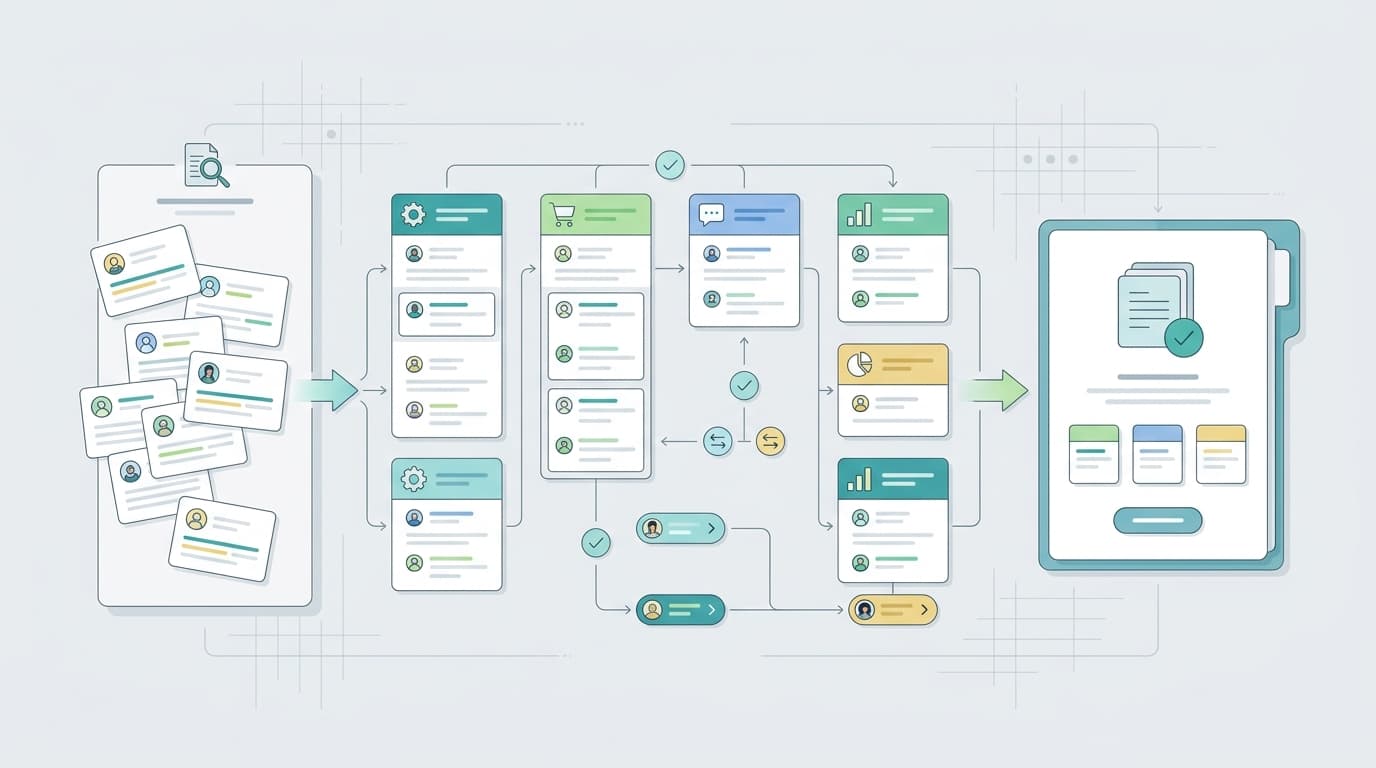
Amazon review competitor benchmarking compares how buyers describe your product against the products you compete with. It is not a vanity exercise about having a higher star rating. The purpose is to understand why customers choose, criticize, praise, return, or recommend products in the same buying situation. Done well, the benchmark tells a seller which claims to sharpen, which product gaps to fix, which risks to monitor, and which competitor advantages are real.
This workflow is designed for Amazon teams that need a repeatable method. It starts with a clear competitor set, turns review text into comparable themes, separates review intelligence from policy accusations, and ends with an action matrix. The output should be practical enough for a listing owner, product manager, marketplace lead, or agency strategist to use without reading thousands of individual reviews.
TL;DR
Benchmark element | What to compare |
Competitor set | Your ASIN, direct substitutes, category leaders, premium anchors, and lower-priced alternatives. |
Review signals | Rating, theme, sentiment, review date, variation, scenario, and repeated buyer language. |
Best output | A theme-by-ASIN matrix with owner, evidence, and recommended action. |
VOC AI fit | VOC AI helps compare review themes across competitor cohorts instead of one ASIN at a time. |
What Is Amazon Review Competitor Benchmarking?
Amazon review competitor benchmarking is the practice of comparing review themes across a defined group of competing ASINs.
The benchmark can be simple, such as “our product has fewer assembly complaints than Competitor A.” It can also be strategic, such as “premium competitors win praise for durability while budget competitors win praise for price; our product needs to own ease of cleaning.”
The useful benchmark is not the table itself. The useful benchmark is the decision that follows.
Unlike keyword competitor analysis, review benchmarking listens to buyers after purchase. That makes it valuable for product and brand decisions that keyword tools cannot answer. Search volume can tell you what shoppers type. Reviews tell you what customers felt after the promise became a real product.
Harvard Business School’s overview of Porter’s Five Forces is a helpful reminder that competition is not only about direct rivals. On Amazon, buyers also compare alternatives, substitutes, price expectations, product quality, and perceived risk. Review benchmarking gives sellers a way to see those forces in customer language.
Step 1: Define the Competitor Cohort
Do not benchmark against random high-review products. Choose competitors by job-to-be-done and buying context.
A strong cohort includes your product, three direct substitutes, one premium product, one budget product, and one fast-rising challenger. If your category has meaningful use cases, build separate cohorts for each use case instead of mixing all products into one analysis.
Write down why each ASIN belongs in the cohort.
Good reasons include:
- Same material
- Same size
- Same buyer segment
- Same price band
- Same use case
- Same ad auction
- Same category shelf
- Same product promise
The reason becomes important when you interpret results. A complaint on a budget competitor may signal an accepted tradeoff. The same complaint on a premium competitor may signal a real market opening.
VOC AI fits this stage when teams need to keep competitor cohorts organized across multiple ASINs instead of rebuilding the comparison set every time a report is needed.
Step 2: Create a Comparable Review Dataset
For each ASIN, collect a consistent review window and keep the same fields.
At minimum, store:
- Star rating
- Review title
- Review text
- Review date
- Variation
- Verified-purchase visibility where available
- Review URL
- ASIN
- Marketplace
- Competitor label
For your own enrolled brand, Amazon’s Customer Reviews tool is the official source for monitoring and responding to certain customer concerns. It is useful for owned-product feedback, especially when the goal is to connect review signals with customer follow-up.
Keep time windows consistent. Comparing your last 90 days with a competitor’s all-time reviews can create false conclusions.
If your product recently changed packaging, split reviews before and after the change. If a competitor launched a new variation, treat that variation separately until there is enough review volume to merge it into the broader read.
This is where teams often lose accuracy. A benchmark is only as useful as the review sample behind it.
Step 3: Build a Theme Taxonomy
A benchmark needs shared categories.
Start with common review dimensions:
- Quality
- Durability
- Ease of use
- Setup
- Fit
- Sizing
- Packaging
- Shipping damage
- Instructions
- Customer service
- Value for money
- Design
- Safety
- Missing accessories
Then add category-specific themes.
A kitchen appliance may need cleaning, noise, heat, and counter space. A beauty product may need scent, texture, shade match, packaging pump, and skin feel. A travel product may need weight, storage, wheel durability, handle comfort, and airline fit.
The taxonomy should be semantic, not just keyword-based. Buyers may use “cheap,” “flimsy,” “broke,” “cracked,” and “not sturdy” to describe one durability issue. Treat those as one theme when the underlying problem is the same.
Preserve raw examples in the evidence field so the team can hear the buyer’s language, but benchmark at the theme level.
For teams that need a deeper foundation before competitor work, VOC AI’s guide on how to analyze Amazon reviews is a useful internal companion.
Step 4: Score Themes by ASIN
Create a matrix with themes in rows and ASINs in columns. Each cell should summarize frequency, sentiment, severity, and implication.
You do not need overcomplicated math at first. Use labels such as:
- No signal
- Minor
- Frequent
- Severe
- Praised
- Mixed
A theme that is praised on one competitor and criticized on yours is more important than a theme that is equally negative everywhere.
Add a short interpretation beside the matrix. For example:
Competitor A wins on assembly clarity. Buyers mention clear instructions and labeled parts. Our reviews mention missing steps. The listing and packaging owner should test a setup video and revised insert.
That sentence is the bridge from analysis to action.
If sentiment is part of the scoring process, VOC AI’s Amazon review sentiment analysis guide can help teams think through positive, negative, neutral, and mixed review signals without treating sentiment as the whole answer.
Step 5: Separate Category Problems From Brand Problems
Some pain points belong to the whole category. If every product receives complaints about size expectations, buyers may need clearer measurement guidance before purchase.
If only your product receives those complaints, your detail page, images, or variation structure may be the issue.
If only a competitor receives them, that may be a positioning opportunity.
This distinction prevents bad decisions. A seller might redesign a product when the real issue is category education. Another seller might rewrite a listing when the real issue is a component failure.
Benchmarking forces the team to ask a simple but important question:
Is this problem ours, theirs, or everyone’s?
That question saves time and budget.
Amazon’s Brand Analytics can add another layer here for enrolled brands because review findings can be compared with aggregate search and shopping behavior. Reviews explain post-purchase experience. Search data helps show whether the same language appears before purchase.
Step 6: Benchmark Positive Differentiators Too
Competitor benchmarking should not only read negative reviews. Positive reviews reveal what buyers value enough to mention voluntarily.
A competitor may win praise for quiet operation, premium feel, faster setup, stronger packaging, better giftability, easier cleaning, or clearer instructions.
If your product has the same feature but your listing does not communicate it, the opportunity is messaging.
Build a praise map beside the complaint map. Then compare it with your product claims.
Ask:
- Which features do buyers praise without being prompted?
- Which benefits appear in five-star reviews?
- Which positive themes appear across several competitors?
- Which praised feature does our product also have?
- Which claim needs better proof before we use it?
Do not copy competitor review language directly. Do not make claims you cannot substantiate. Use the benchmark to understand buyer priorities and then write honest, evidence-backed listing copy.
VOC AI’s customer analytics tools are relevant when teams want to connect review praise with broader customer patterns, rather than treating positive reviews as isolated copy ideas.
Step 7: Translate Benchmarks Into Actions
Every benchmark finding needs an owner.
Product issues go to product or sourcing. Listing expectation gaps go to the listing owner. Packaging issues go to operations. Policy-sensitive patterns go to compliance or brand protection. Competitor positioning opportunities go to marketing.
If a finding has no owner, it will not change the business.
A strong action matrix includes:
- Theme
- Affected ASINs
- Evidence links
- Priority score
- Owner
- Recommended action
- Review date range
- Follow-up date
The next action should be concrete.
Use actions like:
- Rewrite the compatibility section
- Add a packaging inspection
- Create a setup video
- Test a durability claim
- Monitor a competitor’s new variation
- Add a recurring review benchmark to the monthly business review
- Update an image callout
- Add a comparison chart
- Clarify giftability or use-case language
For agencies, competitor benchmarking becomes more valuable when every client report uses the same structure. A consistent taxonomy lets the agency compare category pain points, isolate recurring supplier problems, and show clients why a listing edit, product change, or review-monitoring rule is worth the work.
For internal brand teams, the benchmark should connect with launch planning. Before a launch, competitor reviews reveal the promises buyers already believe and the frustrations they already tolerate. After launch, your own reviews show whether the product solved the category pain point or merely joined the same complaint pool.
That before-and-after comparison is a practical way to measure whether positioning matched the real experience.
How VOC AI Helps With Competitor Review Benchmarking
VOC AI helps Amazon sellers compare review themes across ASIN cohorts without reading each competitor page one by one.
Its review intelligence workflow is useful when the team needs semantic clusters, competitor comparison, and customer-language evidence in one place. Instead of counting isolated keywords, sellers can compare underlying issues such as durability, sizing confusion, packaging damage, or missing accessories across products.
That matters because the largest value in review benchmarking is not a summary. It is the ability to see what buyers consistently reward or punish across the category.
VOC AI gives Amazon teams a way to connect those patterns to product work, listing improvements, market insight, and brand monitoring.
For teams building custom reporting or internal dashboards, VOC AI’s Review Analysis API is a relevant next step. For teams comparing tool depth, the VOC AI vs TheReviewIndex article can help clarify the difference between a lightweight review summary and a seller-facing analysis workflow.
Common Mistakes in Competitor Review Benchmarking
Comparing Products That Serve Different Buyer Jobs
The first mistake is comparing products that do not serve the same buyer job.
If a premium product and a budget product solve different expectations, their review themes should not be interpreted as a simple win or loss.
Compare products that share a buyer situation, not just a category label.
Over-Indexing on Average Rating
A product can have a strong rating and still contain a repeated weakness your brand can use.
Average rating shows the scoreboard. Review themes explain why buyers scored the product that way.
Using Competitor Reviews as Accusation Material
Public reviews can guide product and positioning decisions, but sellers should be careful with policy-sensitive claims.
Amazon’s Community Guidelines explain what types of customer content are allowed and prohibited. If the benchmark suggests suspicious behavior, collect evidence and route it through a compliance-aware workflow rather than turning it into marketing copy.
Losing Source Context
A summary without source context is risky.
Before changing a product, claim, listing angle, or competitor response, check the original review text, rating, date, ASIN, and variation.
Copying Buyer Language Too Literally
Buyer language is useful because it shows how customers describe the problem.
That does not mean every phrase should become listing copy. If you use a claim, make sure your product can support it. If you quote a review, keep it authentic and traceable.
FAQ
What is Amazon review competitor benchmarking?
Amazon review competitor benchmarking compares review themes, sentiment, complaints, and praised features across your product and competitor ASINs so you can see where your product wins, loses, or needs better positioning.
How many competitors should I benchmark?
Benchmark three to ten competitors. Include direct substitutes, category leaders, fast-rising challengers, one premium benchmark, and one lower-priced product that explains buyer tradeoffs.
Should I compare ratings or review text?
Use both, but review text is more useful for product decisions. Average rating shows the scoreboard. Review themes explain why buyers score products that way.
Can I use competitor reviews in listing copy?
Use competitor review themes to understand buyer language and category expectations, but do not copy review text, make unsupported claims, or imply a comparison you cannot substantiate.
How often should benchmarks refresh?
Refresh priority categories monthly, and immediately after launches, pricing moves, supplier changes, major ad pushes, or visible rating movement on a key competitor ASIN.
How can VOC AI help with competitor benchmarking?
VOC AI can help sellers compare review themes across ASIN cohorts, preserve buyer-language evidence, and connect competitor findings to product, listing, market insight, or brand-monitoring work.
What should agencies include in a review benchmark?
Agencies should include a stable competitor cohort, shared taxonomy, source evidence, theme-by-ASIN comparison, priority score, owner, and recommended action. This makes the report easier to repeat across clients.