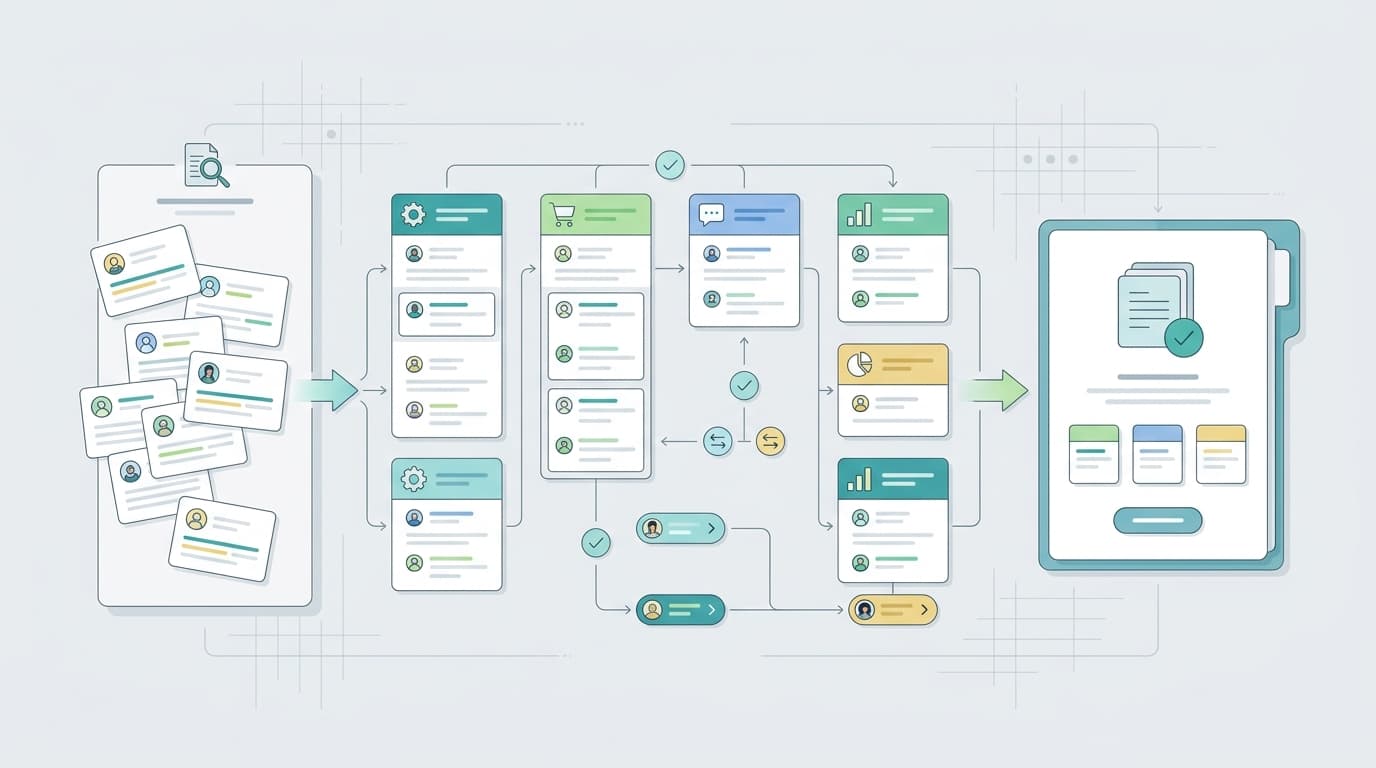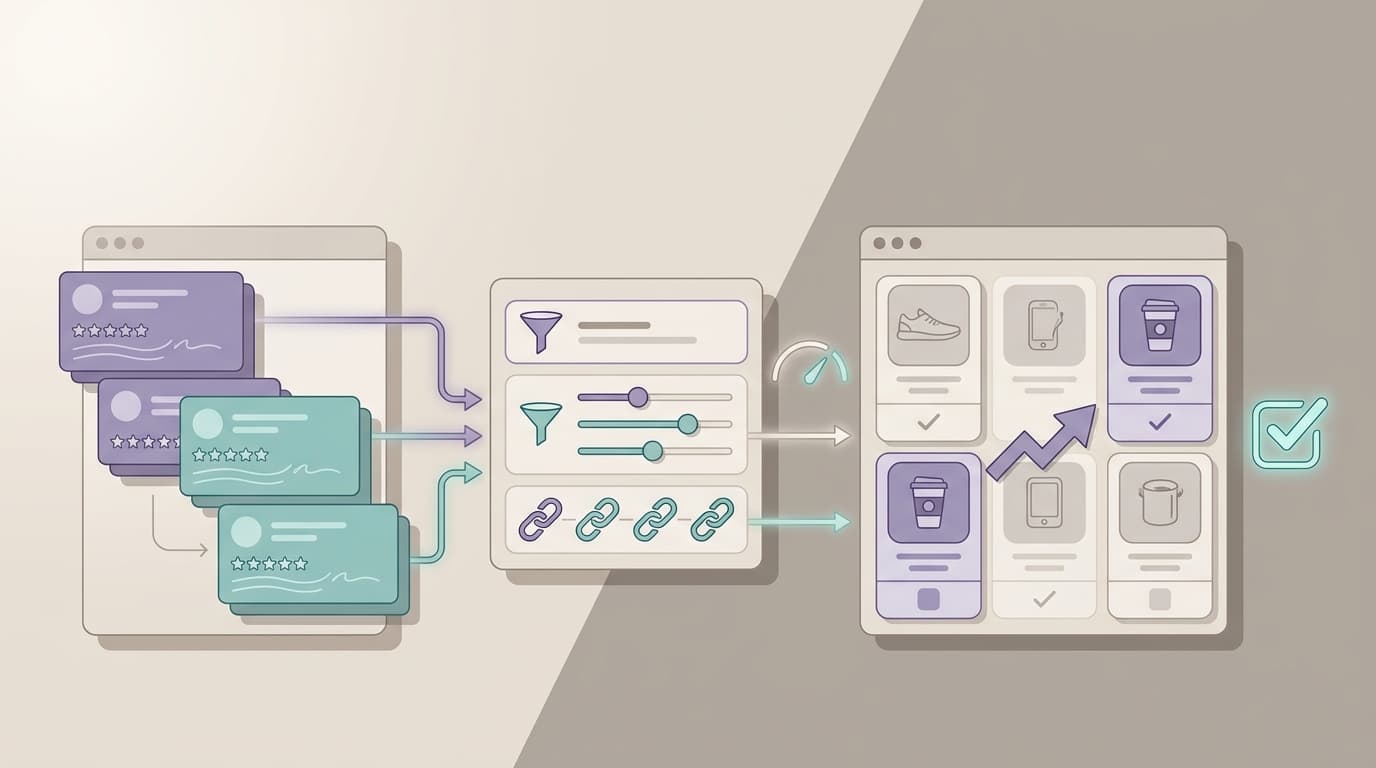
Review mining for customer success is not a shortcut to a churn score. It is a way to find recurring customer situations that deserve investigation before an account quietly disengages, renews with reservations, or leaves.
Customer success teams already have account-level signals: activation, feature usage, support volume, executive engagement, contract timing, and customer health scores. Reviews add something different. They preserve the customer’s own explanation of where expectations broke, which workaround became routine, why support felt difficult, or what finally made the product useful.
Used carefully, that language can improve onboarding, adoption plays, business reviews, renewal conversations, and escalation rules. Used carelessly, it can produce false confidence: a public review is not a representative sample, a complaint is not proof of churn risk, and a repeated phrase is not a root cause.
This guide shows how to turn review evidence into retention hypotheses, connect those hypotheses to account behavior, and build customer-success actions that remain traceable to the original evidence.
What review mining can—and cannot—tell customer success teams
Review mining can help a customer success team identify:
- onboarding moments that repeatedly confuse or delay customers;
- adoption barriers tied to roles, permissions, integrations, or workflow fit;
- expectation gaps between a promise and the delivered experience;
- support or recovery experiences that change customer confidence;
- workarounds that signal an unmet job;
- value moments customers describe in their own language;
- segment differences that deserve different success plays;
- hypotheses to test against usage, support, survey, and renewal data.
Review mining cannot establish:
- the churn probability of an individual account;
- the prevalence of a problem across the whole customer base;
- the cause of declining usage;
- the revenue impact of a theme without account and financial data;
- whether a requested feature will improve retention;
- whether a reviewer is representative of the target segment;
- whether a positive rating means the customer has adopted the product deeply.
Treat reviews as directional qualitative evidence. They help the team ask better retention questions. They do not replace account telemetry, customer conversations, support history, or commercial judgment.
The retention-signal model
A useful review-mining workflow separates five kinds of customer-success evidence.
| Signal group | What to look for in reviews | Customer-success question |
|---|---|---|
| Onboarding friction | Setup delays, unclear instructions, permission problems, failed imports | Which accounts encounter the same obstacle before first value? |
| Adoption barrier | Repeated workaround, unused capability, role mismatch, workflow interruption | Is the product failing to become part of the customer’s normal work? |
| Expectation gap | Promise-versus-experience language, comparison with an alternative, surprise | Did the buyer, user, and product start with different definitions of success? |
| Recovery breakdown | Repeated contact, slow resolution, unexplained handoffs, unresolved defect | Does the recovery experience reduce confidence after the original problem? |
| Value evidence | Specific outcome, saved step, avoided effort, trusted result, team habit | Which observable moment should the success plan help similar accounts reach? |
The model is deliberately broader than “positive versus negative.” A negative review can contain a strong value moment and one serious barrier. A positive review can reveal shallow usage, dependency on a workaround, or an expectation the product may not continue to meet.
A nine-step review-mining workflow for customer success
1. Start with a customer-success decision
Do not begin by asking an AI tool to summarize every review. Begin with the decision the team needs to improve.
Examples:
- Revise the first-30-day onboarding play.
- Identify accounts that need an integration-readiness check.
- Improve a renewal-risk review for a specific segment.
- Separate training problems from product limitations.
- Decide which support themes should trigger a proactive CSM follow-up.
- Define the value milestone for a new customer cohort.
Write the boundary before collecting evidence:
Decision:
Customer segment:
Lifecycle stage:
Product, plan, or workflow:
Market and language:
Review window:
Account signals available for validation:
What evidence would change the success play:
This keeps review mining tied to an operating decision instead of becoming a theme library nobody uses.
2. Define the evidence set
Record exactly what the analysis includes:
- source platform;
- product, plan, version, or marketplace listing;
- date range;
- language and market;
- rating distribution;
- inclusion and exclusion rules;
- total review count;
- sampling or deduplication method;
- available segment clues;
- known gaps and biases.
Keep review sources separate from support tickets, NPS comments, survey responses, call notes, and community posts. You can analyze them together later, but source identity matters because each channel has a different prompt, audience, and incentive.
Public reviewers are self-selected. Support tickets overrepresent customers who encountered a problem and chose to contact support. Survey respondents answer a specific prompt. Customer calls are shaped by recruitment and the relationship with the interviewer. The goal is not to pretend these sources are identical. The goal is to see where they agree, disagree, or expose a blind spot.
3. Convert reviews into customer-success evidence records
Do not reduce an entire review to one sentiment label. Split it into atomic events.
Use a record such as:
Source ID:
Date:
Rating or source signal:
Customer or segment clue:
Lifecycle stage:
Situation:
Customer goal:
Attempted action:
Observed event:
Customer interpretation:
Business or workflow consequence:
Workaround:
Support or recovery experience:
Value moment:
Requested change:
Evidence excerpt:
Confidence:
One review may produce several records. A customer can value the core result, struggle with setup, praise a support agent, and still decide that the ongoing workflow is too costly. Keeping those events separate prevents the rating from erasing the retention story.
4. Map each event to the customer lifecycle
Assign each evidence record to the stage where the customer experienced it:
- Expectation: What did the customer think they were buying?
- Setup: Could they connect data, configure access, or begin the workflow?
- First value: Did they reach a useful result quickly enough?
- Habit formation: Did the product become part of recurring work?
- Expansion: Could more teammates, use cases, or data sources adopt it?
- Recovery: What happened when the workflow failed?
- Renewal: What value, risk, or unresolved issue shaped the continue-or-leave decision?
This lifecycle view complements a broader customer journey friction map. The customer-success version adds account validation and an explicit play owner: what should the team observe, ask, test, or change before the next commercial milestone?
5. Build retention hypotheses, not churn declarations
Translate each recurring cluster into a falsifiable statement.
Weak statement:
Integration complaints cause churn.
Better hypothesis:
Mid-market accounts that cannot complete the primary integration during onboarding may take longer to reach first value and may rely on manual workarounds. We should test whether those accounts show lower activation, more setup-related support contacts, or weaker executive engagement before renewal.
A useful hypothesis includes:
Customer segment:
Lifecycle stage:
Observed review pattern:
Possible mechanism:
Expected account-level signal:
Alternative explanations:
Evidence needed:
Decision if supported:
Decision if rejected:
The phrase “may” matters. Reviews reveal an experience and an interpretation. They do not prove the downstream commercial effect.
6. Connect review clusters to account evidence
Now test whether the review pattern appears in the customer-success data available to the team.
| Review hypothesis | Validation evidence | Useful question |
|---|---|---|
| Setup permissions create delay | Time to first value, implementation notes, setup tickets | Which roles or account types get stuck? |
| Customers rely on exports as a workaround | Feature events, export frequency, call notes | Is export supporting collaboration or compensating for a missing workflow? |
| Reporting feels hard to trust | Result rechecks, repeated support questions, survey comments | Is the issue accuracy, explanation, data freshness, or presentation? |
| Support handoffs reduce confidence | Reopen rate, escalation path, resolution notes | Does the recovery process make the original issue feel larger? |
| One workflow creates visible value | Recurring usage, shared artifacts, stakeholder attendance | Can the onboarding play make this value moment easier to reach? |
Look for convergence, not forced confirmation. A review cluster may be important even if it is rare. A common cluster may have little relationship to retention. An account signal may reveal a different mechanism than the customer originally described.
7. Prioritize by decision risk and evidence strength
Avoid a single opaque “retention risk score.” Use a transparent investigation score instead.
Score each cluster from 1 to 3 on five dimensions:
- Consequence: How disruptive is the described outcome?
- Lifecycle proximity: How close is the event to first value, habit formation, or renewal?
- Segment relevance: How closely does the evidence match the target accounts?
- Cross-source support: Does the pattern appear in reviews plus another source?
- Actionability: Can the team test or change something within a defined period?
Investigation priority =
Consequence + Lifecycle proximity + Segment relevance
+ Cross-source support + Actionability
This score ranks questions for investigation. It does not calculate churn probability. Keep confidence separate so a severe but weakly supported pattern remains visible without being presented as fact.
8. Route the finding to the right customer-success play
Different evidence requires different action.
| Evidence pattern | First response | Likely owner |
|---|---|---|
| Expectation mismatch | Reconfirm desired outcome and success criteria | Sales, onboarding, CS |
| Setup obstacle | Add readiness check or implementation step | Onboarding, product, support |
| Adoption barrier | Run workflow coaching or role-based enablement | CS, education, product |
| Product limitation | Validate scope and route evidence to product | Product, CS |
| Recovery breakdown | Improve escalation and communication path | Support, CS operations |
| Strong value moment | Turn it into a milestone and repeatable play | CS, product marketing |
| Segment mismatch | Revisit qualification, packaging, or recommended use case | Sales, product, leadership |
Do not route every complaint to the product roadmap. Some problems belong to qualification, implementation, education, documentation, support recovery, account governance, or expectation setting.
For product decisions, connect the evidence to a reviews-to-roadmap feedback loop. For interview planning, use the separate workflow for review mining for user research.
9. Measure whether the play changed the customer experience
A customer-success action is not complete when the playbook is written.
Define a test window and compare:
- time to first value;
- completion of the targeted setup step;
- adoption of the intended recurring workflow;
- repeat contacts about the same issue;
- recovery time and escalation quality;
- customer language in calls, surveys, and reviews;
- renewal-stage objections;
- exceptions and unintended effects.
Keep the comparison bounded. If multiple product, pricing, support, and lifecycle changes occurred at the same time, do not attribute the result to the review-mining play alone.
Worked example: reporting complaints before renewal
Imagine a B2B software team finds a recurring review pattern:
- customers like the core analysis;
- several say reports are difficult to share with executives;
- some export results into slides or spreadsheets;
- a few describe the product as useful but “hard to operationalize.”
The wrong conclusion is: “Reporting causes churn.”
The team creates three competing hypotheses instead:
- The report format does not fit executive decision meetings.
- Customers do not trust the result without clearer source traceability.
- The product works, but the customer lacks a recurring internal review process.
The CS team then checks:
- whether affected accounts export frequently;
- whether reports are shared with other stakeholders;
- which questions appear in support and success calls;
- whether executive sponsors attend business reviews;
- whether accounts with a recurring evidence-review habit adopt more deeply.
The resulting plays are different:
- an executive-summary workflow for the first hypothesis;
- a traceability walkthrough for the second;
- a monthly evidence-review agenda for the third.
Review mining created the hypotheses. Account evidence selected the play.
Common mistakes in review mining for customer success
Treating reviews as an account health score
A review describes an experience at a point in time. It should not override current product usage, stakeholder engagement, support history, contract context, or direct customer communication.
Counting themes without preserving the denominator
“Twenty customers mentioned onboarding” means little without the evidence-set size, source mix, date range, segment, and deduplication method. Even then, the percentage describes the analyzed corpus—not the whole customer base.
Mixing lifecycle stages
An onboarding complaint, a mature-customer workflow limitation, and a renewal objection may use similar words but require different actions.
Confusing the requested feature with the underlying job
“Add a dashboard” may mean “help me explain this result to leadership.” Validate the job, audience, and decision before committing to the proposed solution.
Ignoring positive evidence
Customer success needs to know what value looks like, not only where customers struggle. Specific praise can reveal the milestone, habit, or proof point that a success play should reproduce.
Losing traceability during AI synthesis
AI can accelerate classification, clustering, and summarization. The team still needs access to the source record, coding rule, contradictory evidence, confidence, and validation status behind each recommendation.
Using reviews irresponsibly
Teams should understand how review platforms collect, moderate, display, and incentivize feedback. The US Federal Trade Commission publishes guidance on endorsements, influencers, and reviews and answers about the Consumer Reviews and Testimonials Rule. Public claims, testimonials, and review operations should follow applicable policies and law.
A reusable customer-success evidence canvas
Decision:
Target segment:
Lifecycle stage:
Commercial milestone:
Review evidence set:
Known biases and gaps:

Cluster:
Observed situation:
Customer goal:
Breakdown or value moment:
Consequence:
Workaround:
Contradictory evidence:

Retention hypothesis:
Possible mechanism:
Expected account signal:
Alternative explanation:
Validation source:
Confidence:

Customer-success play:
Owner:
Test cohort:
Success measure:
Review date:
Result:
Next action:
How VOC AI can support customer-success review mining
VOC AI helps teams analyze customer review language and organize recurring feedback across products and competitors. In a customer-success workflow, its useful role is to reduce a large review corpus into traceable situations, barriers, expectation gaps, workarounds, value moments, and questions for account validation.
Teams can use VOC AI’s Voice of Customer Analysis to structure review evidence, connect service themes through an AI customer service workflow, and share recurring findings in a customer feedback dashboard for product, support, and marketing.
The customer-success team should still own the decision boundary, account context, validation method, customer conversation, and commercial action. The goal is not to automate judgment. It is to make that judgment easier to inspect and improve.
Final takeaway
Review mining for customer success works when reviews become testable retention hypotheses—not labels attached to accounts.
The practical sequence is:
- define the customer-success decision;
- preserve the evidence set and source context;
- split reviews into atomic customer events;
- map those events to the lifecycle;
- write competing retention hypotheses;
- validate them against account behavior and conversations;
- route the evidence to the right success play;
- measure whether the customer experience changed.
Reviews tell you how customers explain a moment. Customer-success evidence tells you whether that moment is affecting adoption, confidence, and the path to renewal. The value comes from connecting the two without pretending they are the same thing.