Support teams already have more customer feedback than they can comfortably read. The problem is not collecting another stream of comments. The problem is turning scattered complaints into a consistent decision about what needs immediate attention, who owns the underlying issue, and how to prevent the next avoidable contact.
Ticket tags alone rarely solve this. Tags drift between agents, broad labels hide different causes, and the loudest escalation can dominate a week even when it represents an unusual edge case. Product analytics adds useful behavioral context, but it cannot explain what customers expected or why they believed the product failed them.
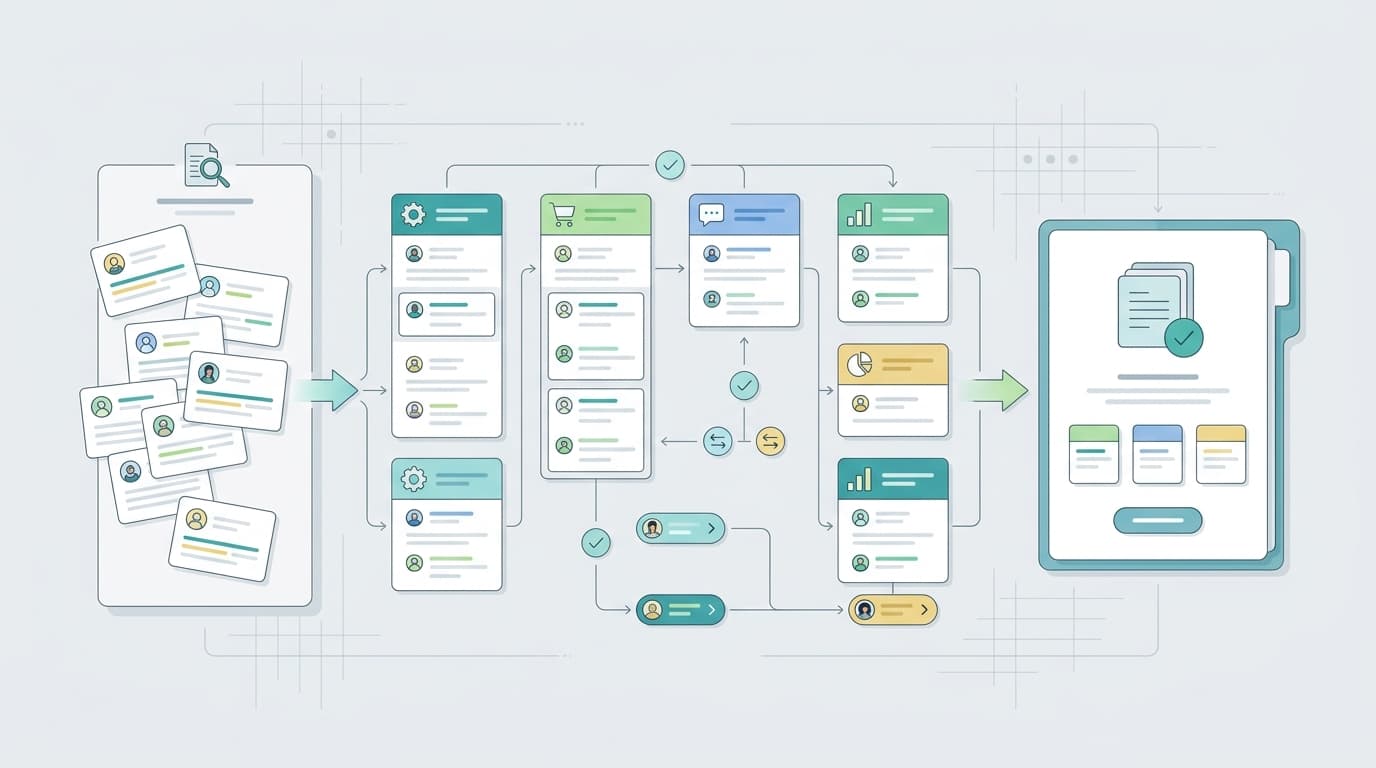
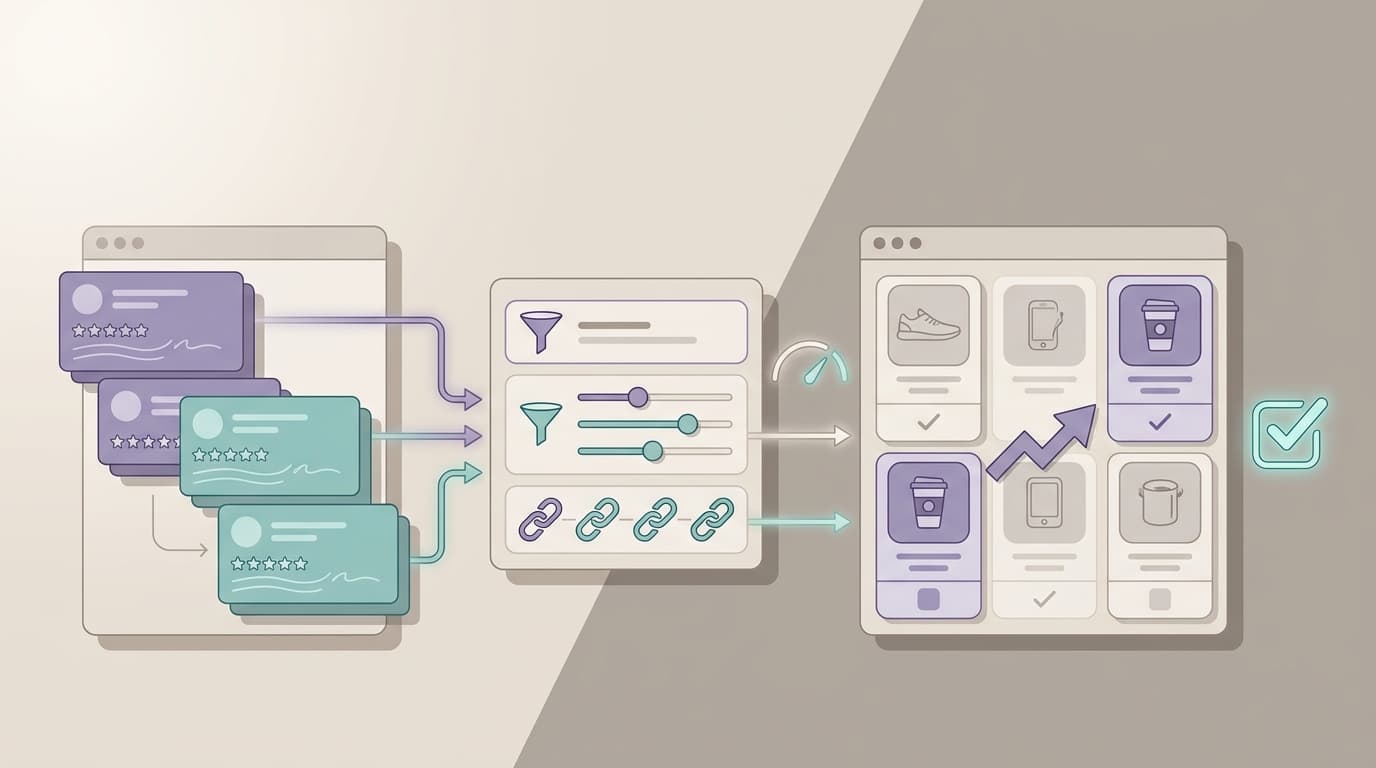
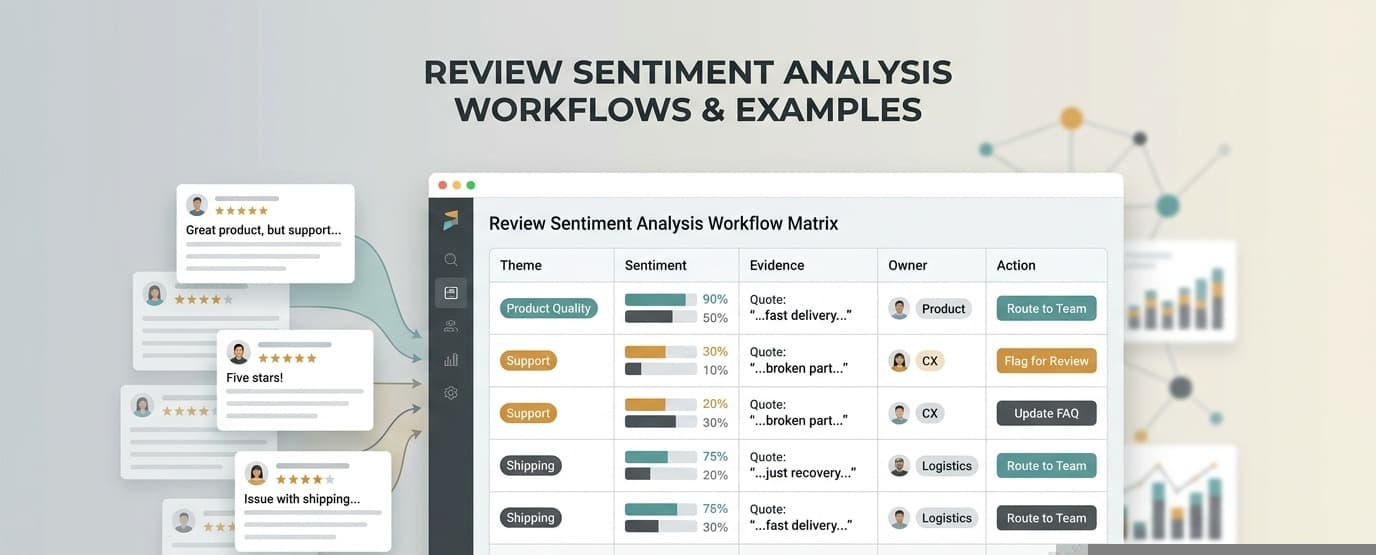
Review mining for support operations connects those pieces. It groups customer language from reviews, tickets, chat transcripts, cancellation notes, community posts, and surveys into evidence-backed support patterns. Teams can then use those patterns to improve triage, escalation, documentation, product fixes, proactive communication, and service recovery.
The goal is not to automate judgment or convert complaint counts into certainty. It is to give support, product, customer success, and operations teams a shared evidence record before they choose an intervention.
What review mining for support operations actually does
Review mining is the systematic analysis of qualitative customer language. In support operations, the useful output is not a generic theme such as “billing,” “setup,” or “performance.” It is a specific pattern that describes:
- the customer and situation;
- the event that triggered contact;
- what the customer expected;
- what they observed instead;
- the consequence they experienced;
- the recovery they attempted;
- the response or product change that may help;
- the evidence that would confirm or challenge the explanation.
A weak finding sounds like this:
Customers are unhappy with integrations.
A stronger finding sounds like this:
New workspace owners connecting a data source believe authorization has stalled because the interface gives no progress signal. They retry, create duplicate connections, and contact support before the first import finishes.
The stronger version gives the team a trigger, expectation gap, behavior, consequence, and possible verification path. It can be routed to the right owner and compared with connection logs, setup time, repeated attempts, help-center visits, and ticket outcomes.
What this method should not claim
Support data is operationally valuable, but it is not a representative census of all customers.
People who contact support have experienced a problem or uncertainty strong enough to request help. Public reviewers are self-selected. Chat transcripts may overrepresent issues that happen during staffed hours. Escalations concentrate complex, valuable, or frustrated accounts. Agent notes can vary in quality and terminology.
Therefore, review mining for support operations should not be used to:
- estimate the exact percentage of all customers affected by a complaint;
- treat ticket volume as a direct measure of severity;
- assume the most emotional language identifies the largest business risk;
- infer customer intent, sentiment, or account health without supporting evidence;
- label an agent, customer segment, or product area as the cause from text alone;
- claim that a proposed product fix will reduce contact volume before it is tested;
- use AI-generated categories without human sampling and correction.
The American Association for Public Opinion Research explains why conclusions from non-probability samples require care. Support records and public reviews are not probability samples. Use them to find mechanisms, questions, and operational risks—not to manufacture population estimates.
Start with the decision, not the topic model
Before analyzing thousands of comments, define the support decision the evidence must improve.
Useful decisions include:
- Which emerging issue needs a temporary incident workflow?
- Which ticket pattern should be escalated to product or engineering?
- Which answer belongs in self-service documentation?
- Which customer situation needs proactive outreach?
- Which policy or billing explanation creates avoidable repeat contacts?
- Which queue should receive a specialized routing rule?
- Which support macro is masking unresolved confusion?
- Which complaint cluster should be investigated in the next operating review?
Avoid starting with “find all themes.” That request usually produces a large taxonomy with weak ownership. Start with a decision window, such as the next weekly operations review, the first 72 hours after a release, or the next documentation sprint.
For a broader cross-functional system, use a customer feedback dashboard for product, support, and marketing. The dashboard should preserve definitions and evidence, while this workflow focuses on support triage and prevention.
Build a support evidence record
Create one structured record for each meaningful complaint pattern. Keep the raw evidence attached.
| Field | Question to answer |
|---|---|
| Pattern ID | What stable identifier will teams use? |
| Customer situation | Who was trying to do what, under what conditions? |
| Trigger | What event started the problem or contact? |
| Expected outcome | What did the customer believe would happen? |
| Observed outcome | What happened instead? |
| Consequence | What delay, rework, risk, or lost value followed? |
| Recovery attempt | What did the customer try before or during contact? |
| Current support response | How does the team handle it today? |
| Evidence links | Which tickets, reviews, transcripts, and logs support it? |
| Contradictory evidence | Which cases do not fit the pattern? |
| Source and time window | Where and when was the evidence collected? |
| Suspected owner | Support, product, engineering, billing, success, sales, or another team? |
| Verification check | What behavioral or operational data should be examined? |
| Next decision | Triage rule, incident response, documentation, product investigation, or no action? |
This record prevents a common failure: reducing a complaint to a keyword and losing the situation that made it important.
Normalize language before counting patterns
Customers describe the same operational problem in different ways. “It froze,” “nothing happened,” “still loading,” and “I clicked twice” may all describe missing progress feedback. At the same time, identical words can refer to different failures.
Normalize evidence in three layers:
- Customer phrase: preserve the original wording.
- Operational mechanism: describe the likely breakdown without blaming a person or system prematurely.
- Support action: record how the team currently diagnoses or resolves it.
For example:
| Customer language | Possible mechanism | Current support action |
|---|---|---|
| “The import is stuck” | Long-running process has no visible progress | Ask customer to wait and confirm status manually |
| “It charged me twice” | Renewal, authorization hold, duplicate invoice, or misunderstanding | Investigate payment and invoice records |
| “The report is wrong” | Source mismatch, configuration error, evidence gap, or interpretation problem | Request screenshots and rerun analysis |
| “I cannot log in” | Credential, identity provider, browser, invitation, or account-state issue | Follow authentication checklist |
Do not merge these rows until the evidence supports a shared mechanism. A clean taxonomy is less important than preserving diagnostic differences.
Separate contact frequency, severity, and preventability
Support teams often rank problems by ticket count. That is useful, but incomplete.
A frequent question may be low severity and easy to prevent with clearer copy. A rare issue may create data loss, compliance risk, or a failed renewal. A severe issue may be hard to prevent but require a faster escalation path. A highly preventable issue may deserve attention even if it never becomes an escalation.
Score the dimensions separately:
| Dimension | Practical question |
|---|---|
| Observed frequency | How often does this pattern appear in the defined source and time window? |
| Customer consequence | What happens when the issue occurs? |
| Operational effort | How much handling time, coordination, or rework does it create? |
| Recurrence | Does the same customer or account contact support again? |
| Detectability | Can the team identify the issue before the customer reports it? |
| Preventability | Could product, policy, documentation, or communication reduce it? |
| Evidence confidence | How consistently do the records support the same mechanism? |
| Strategic relevance | Does it affect a critical workflow, segment, release, or company priority? |
Keep the component scores visible. Do not collapse them into an opaque “priority score” that looks more precise than the evidence.
If the problem concerns broader product tradeoffs, connect the evidence to how to prioritize customer feedback. If it points to a durable product change, route it into review mining for product development.
Classify the intervention layer
The same complaint can require different responses. “I did not get the result I expected” might point to:
- Incident response: a current outage or broken workflow.
- Triage: the request is reaching the wrong queue or skill group.
- Diagnosis: agents need a clearer decision tree or better context.
- Communication: status, timing, limits, or next steps are unclear.
- Documentation: customers cannot find or apply the correct guidance.
- Product: the workflow, default, or error recovery needs improvement.
- Policy: billing, refund, access, or eligibility rules create confusion.
- Customer success: the account needs proactive adoption or change-management help.
- Expectation setting: sales or marketing language implies an outcome the product does not consistently provide.
Do not assign every recurring complaint to product. Support operations improves when the smallest effective intervention is visible. Sometimes the correct answer is a product fix. Sometimes it is a status message, a routing change, a better diagnostic question, or a proactive notice.
Use review mining for onboarding when the issue happens before first credible value. Use review mining for customer success when it concerns ongoing adoption, recovery, or renewal hypotheses.
Connect qualitative evidence to operational data
Review mining proposes an explanation. Operational data helps test whether the explanation appears in the workflow.
| Complaint hypothesis | Operational check |
|---|---|
| Customers retry because progress is invisible | Repeat actions, duplicate requests, time to completion, status-page views |
| Documentation does not resolve the issue | Help-center views followed by tickets, search refinements, article exits |
| Routing delays resolution | Queue transfers, reassignment count, first response, time to qualified owner |
| A macro closes the conversation too early | Reopen rate, repeat contact, low-resolution ratings, follow-up language |
| One release created a new failure mode | Contact rate by version, release date, feature exposure, error logs |
| Billing language creates distrust | Invoice views, dispute contacts, refund requests, plan or renewal events |
| Customers cannot verify an AI-generated result | Evidence-detail views, reruns, source changes, support contacts after output |
Do not force a match. If the operational pattern is absent, the qualitative cluster may be narrow, outdated, mislabeled, or concentrated in one channel. If the pattern appears, it still does not prove causation. It identifies a stronger candidate for investigation.
Design the weekly support-pattern review
A useful review should be small enough to finish and specific enough to change an operating decision.
Use this agenda:
- New patterns: Which complaint mechanisms appeared for the first time?
- Changed patterns: Which existing patterns became more frequent, severe, or concentrated?
- Contradictions: Which evidence challenges the current explanation?
- Current response: What are agents doing today, and where does that response fail?
- Verification: What logs, account evidence, surveys, or interviews are still missing?
- Owner: Which team can change the mechanism or reduce the consequence?
- Action: What is the smallest responsible intervention this week?
- Outcome: What signal will show whether the intervention helped?
Limit the meeting to a short list of patterns. Keep the remaining evidence searchable, but do not turn the operating review into a tour of every tag.
Measure outcomes at the intervention level
Different interventions require different success measures.
| Intervention | Useful outcome signals |
|---|---|
| Routing rule | Fewer transfers, faster arrival at qualified owner, lower handling time |
| Diagnostic playbook | Faster diagnosis, fewer escalations, fewer repeated questions |
| Documentation update | More successful self-service, fewer contacts after article view |
| Proactive communication | Fewer surprise contacts, higher message engagement, lower duplicate contact |
| Product fix | Lower exposure to failure, fewer related contacts, improved task completion |
| Policy clarification | Fewer disputes, fewer exception requests, clearer expectation language |
| Recovery workflow | Faster resolution, fewer reopens, improved post-resolution feedback |
Avoid promising that every support improvement will reduce ticket volume. Better detection can initially increase correctly classified contacts. A new product capability can create more questions while adoption grows. Measure whether the chosen intervention improves the targeted failure mode, not whether one top-line number moved immediately.
Add AI without removing accountability
AI can help cluster similar language, suggest labels, summarize evidence, identify contradictions, and route new records to an existing pattern. It can also merge distinct issues, infer unsupported causes, overlook minority contexts, or produce a confident summary from weak evidence.
The NIST AI Risk Management Framework emphasizes validity, reliability, transparency, explainability, privacy, and fairness. Applied to review mining for support operations, that means:
- preserve the original evidence and source link;
- document how records are selected and classified;
- sample AI-assigned labels for error;
- allow agents to correct categories and mechanisms;
- protect personal, account, payment, and security information;
- monitor whether a taxonomy disadvantages a language, market, plan, or customer group;
- keep a named human owner for escalation and intervention decisions.
The Federal Trade Commission’s Consumer Reviews and Testimonials Rule also makes evidence provenance important. Teams should not create, buy, suppress, or misrepresent reviews. Keep authentic customer language separate from generated summaries, internal test data, incentives, and synthetic examples.
VOC AI’s Voice of Customer Analysis can support the broader work of organizing feedback, identifying recurring customer language, and connecting review evidence to decisions. The operating team still owns source selection, validation, privacy, escalation, and intervention design.
A 14-day implementation plan
Days 1–2: Define the decision
- Choose one support decision, queue, product area, or release window.
- Write explicit inclusion and exclusion rules.
- Name the operational owner and review participants.
Days 3–5: Build the first evidence set
- Collect a bounded sample of tickets, reviews, chats, and relevant notes.
- Preserve source, date, market, customer situation, and resolution state.
- Remove or restrict sensitive data before analysis.
Days 6–7: Create pattern records
- Separate customer wording from the suspected mechanism.
- Record contradictory examples.
- Identify the current support response and likely intervention layer.
Days 8–10: Verify operationally
- Check logs, queue transfers, repeat contacts, help-center behavior, and release exposure.
- Interview a small number of agents who handle the issue.
- Refine or reject patterns that do not survive verification.
Days 11–12: Choose interventions
- Select the smallest responsible change for each priority pattern.
- Define an owner, deadline, and outcome signal.
- Avoid bundling unrelated mechanisms into one project.
Days 13–14: Launch and learn
- Apply the triage, documentation, communication, or product change.
- Sample new contacts for classification quality.
- Review the first outcomes and record what would falsify the current explanation.
Frequently asked questions
Is review mining the same as ticket tagging?
No. Ticket tagging assigns a label to a contact. Review mining preserves the customer situation, expectation, observed outcome, consequence, recovery attempt, contradictory evidence, and verification path. Tags can support the workflow, but they are not the final analysis.
Can review mining predict which customers will escalate?
Not from complaint text alone. It can identify language and situations associated with prior escalations, but predictions require validated account, behavioral, and operational data. Treat the result as an investigation hypothesis unless a properly evaluated model supports the claim.
Should support teams prioritize the most common complaint?
Not automatically. Frequency is one dimension. Severity, operational effort, recurrence, detectability, preventability, confidence, and strategic relevance should remain visible.
How many comments are needed?
There is no universal minimum. Use a bounded sample large enough to find repeated mechanisms and contradictory cases, then validate the most important patterns against operational data. Do not convert a convenience sample into a population estimate.
What should be automated first?
Automate low-risk assistance: duplicate detection, suggested labels, evidence retrieval, and draft summaries. Keep escalation, policy exceptions, sensitive classifications, and customer-impacting decisions under human ownership.
Turn complaint volume into an operating system
Support feedback becomes useful when it changes a decision.
The practical sequence is:
- define the support decision;
- preserve the customer situation and source evidence;
- normalize language without erasing diagnostic differences;
- separate frequency, severity, effort, and preventability;
- identify the smallest responsible intervention layer;
- verify the explanation with operational data;
- assign an owner and outcome signal;
- keep humans accountable for classification and action.
That is the value of review mining for support operations. It does not turn complaints into certainty. It turns scattered customer language into a traceable system for better triage, faster learning, and fewer preventable support failures.
Sources
- Federal Trade Commission, “The Consumer Reviews and Testimonials Rule: Questions and Answers”.
- Federal Trade Commission, “Federal Trade Commission Announces Final Rule Banning Fake Reviews and Testimonials”, August 14, 2024.
- National Institute of Standards and Technology, “AI Risk Management Framework”.
- American Association for Public Opinion Research, “Report of the AAPOR Task Force on Non-Probability Sampling”, 2013.