Most onboarding dashboards tell you where people stop. They rarely tell you what customers thought was happening when they stopped.
A funnel can show that users fail to connect a data source, abandon setup, or never share a first result. It cannot tell you whether the blocker was unclear terminology, a missing permission, a surprising limitation, weak sample data, fear of making an irreversible change, or a mismatch between the promise and the product.
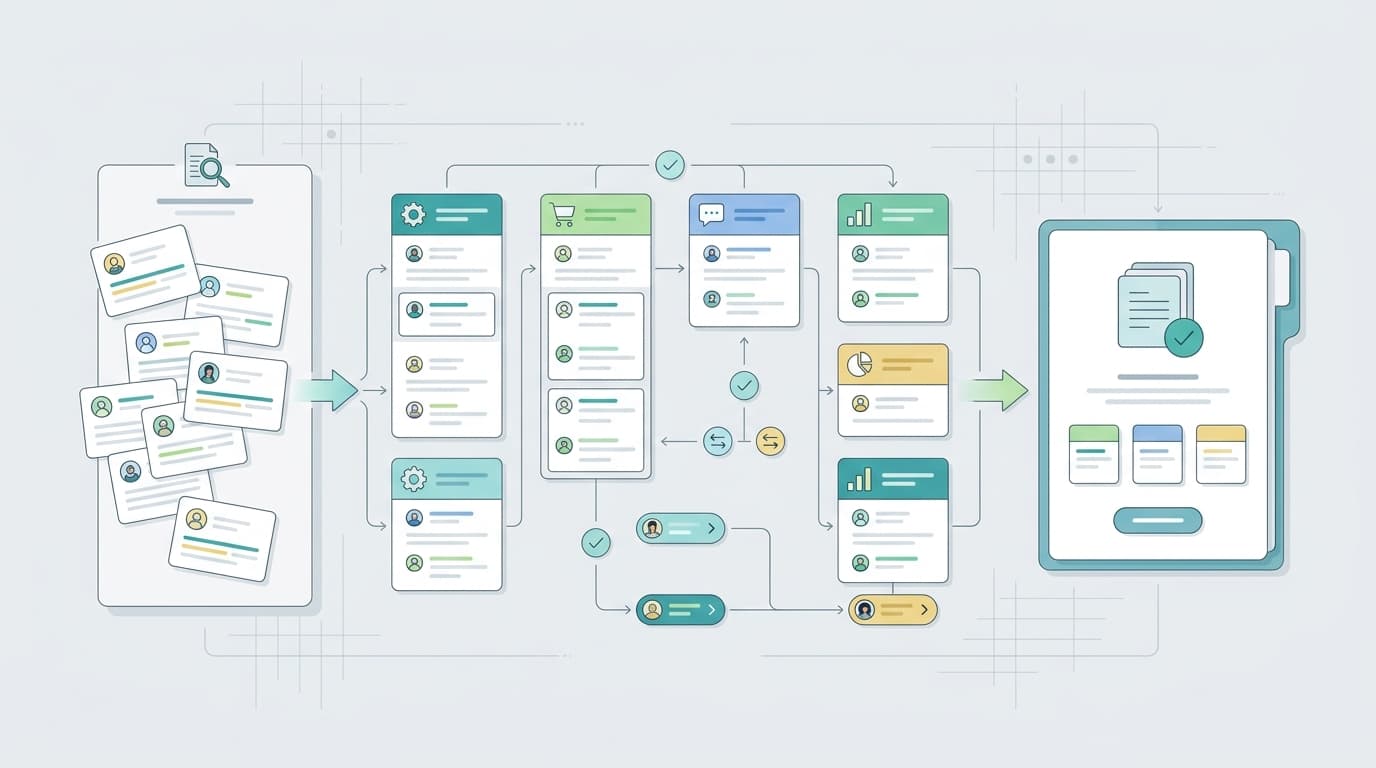
Review mining for onboarding fills that gap. It turns customer language from reviews, support tickets, cancellation notes, surveys, community posts, and sales handoffs into evidence about the moments that delay first value.
The goal is not to replace product analytics or user research. It is to make those methods sharper. Review mining helps you explain a behavioral drop, choose the next research question, and design a smaller onboarding experiment.
This guide gives product, growth, UX, support, and customer-success teams a practical workflow for finding activation friction without treating every complaint as a universal truth.
What review mining for onboarding actually does
Review mining for onboarding organizes qualitative feedback around the sequence a customer must complete before the product becomes useful.
For a feedback-analysis product, that sequence might be:
- Understand what the product will help with.
- Connect or upload a feedback source.
- Configure the analysis correctly.
- Receive a first credible result.
- Interpret what the result means.
- Share or apply the result in a real decision.
For another product, the steps will differ. The useful unit is not a generic “onboarding issue.” It is a specific breakdown between a customer’s expected progress and the evidence they received from the product.
A strong onboarding finding sounds like this:
New workspace owners trying to prepare a weekly product review hesitate at the integration-permission step because the interface does not explain what data will be read, what will be changed, or whether the connection is reversible.
A weak finding sounds like this:
Integrations are confusing.
The first statement gives a team a customer, a job, a moment, a barrier, and a testable explanation. The second only gives the team a theme label.
What this method should not claim
Customer feedback is valuable, but it has limits.
Public reviews and voluntary surveys are self-selected. Support tickets overrepresent customers who encountered a problem and chose to contact support. Cancellation notes arrive after the customer has already made a decision. Sales notes may reflect buyer expectations before hands-on use.
Therefore, review mining for onboarding should not be used to:
- estimate the percentage of all users affected by an issue;
- claim that one complaint caused churn or failed activation;
- infer sensitive personal characteristics;
- score an individual user as likely to fail;
- prioritize work by complaint count alone;
- replace usability testing, funnel analysis, interviews, or experiments.
Use review evidence to discover mechanisms and hypotheses. Use behavioral data to estimate exposure. Use research and experiments to test causes.
Start with an onboarding decision, not a pile of comments
Before collecting feedback, write down the decision the team needs to make.
Examples:
- Which setup step should we investigate this sprint?
- Why do connected accounts fail to reach a first report?
- Which expectation should the welcome flow correct?
- What prevents invited teammates from adopting the workspace?
- Which high-touch support question should become in-product guidance?
- Why do some customers reach an output but still say they received no value?
This decision defines the evidence window. If the question concerns setup permissions, collect comments near account creation, integration, and first import. If the question concerns first-value credibility, collect feedback about result quality, trust, interpretation, and next actions.
Without a decision boundary, teams often create a large topic model that mixes onboarding, mature-product usage, pricing, reliability, and feature requests. The summary looks comprehensive but cannot guide a specific change.
Build an onboarding evidence record
Do not begin by summarizing every comment into a theme. Preserve the context needed to audit the interpretation later.
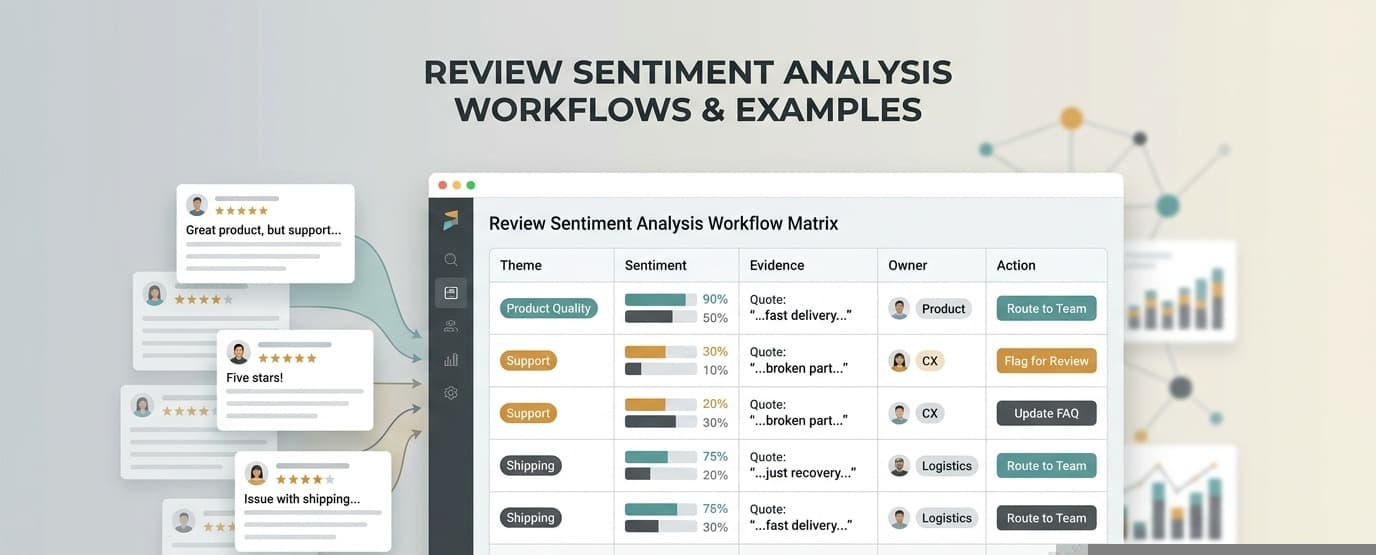
For each relevant piece of feedback, create an evidence record with these fields:
| Field | What to capture |
|---|---|
| Source | Review, ticket, interview, survey, cancellation note, sales note, or community post |
| Date | When the feedback was created |
| Customer context | Role, plan, lifecycle stage, use case, and relevant segment when known |
| Journey stage | Promise, setup, connection, configuration, first output, interpretation, sharing, or application |
| Trigger | What the customer was trying to do immediately before the friction |
| Verbatim evidence | The original quote or a tightly bounded excerpt |
| Observed barrier | What blocked, delayed, or weakened progress |
| Expected outcome | What the customer believed should happen |
| Workaround | What they tried instead |
| Result | Continued, asked for help, retried, abandoned, downgraded, or succeeded |
| Evidence link | A traceable reference to the source record |
| Analyst confidence | Low, medium, or high, with a reason |
This structure keeps review mining for onboarding tied to real events. It also separates what the customer said from what the analyst inferred.
If the source is public, preserve its URL and date. If the source is private, keep a governed internal reference rather than copying unnecessary personal information into a new system. The Federal Trade Commission’s consumer-review guidance is also a useful reminder that teams must consider review provenance and manipulation risk before treating a corpus as reliable evidence.
Map feedback to the activation journey
Next, place each evidence record at the moment it affects customer progress.
Use a journey that is specific enough to support action. “Onboarding” is too broad. A more useful map looks like this:
| Journey stage | Customer question | Common friction evidence | Behavioral evidence to inspect |
|---|---|---|---|
| Promise | “Is this for my problem?” | Expectations do not match the workflow | Landing-to-signup conversion, early exits, sales objections |
| Setup | “What do I need to prepare?” | Requirements appear late or feel excessive | Setup starts, setup completion, help-center visits |
| Connection | “Is this safe and reversible?” | Permission, privacy, or integration uncertainty | Connection attempts, authorization errors, disconnects |
| Configuration | “What should I choose?” | Defaults are unclear or terminology is unfamiliar | Field errors, repeated edits, skipped settings |
| First output | “Did it work?” | Empty, slow, generic, or untrustworthy output | Time to first result, retries, abandoned jobs |
| Interpretation | “What does this mean?” | Result lacks explanation, evidence, or confidence | Report views, evidence opens, repeated support questions |
| Application | “What should I do next?” | Insight is not connected to a decision or workflow | Exports, shares, task creation, return usage |
This map prevents a common mistake: treating every negative comment as a request for a new feature.
“I could not get started” may describe a setup requirement that was not disclosed. “The analysis was useless” may describe weak source coverage, an unexplained confidence level, or no obvious next action. “Too complicated” may mean the product exposed an expert configuration before the customer understood the simplest path.
Code the mechanism, not just the sentiment
Sentiment tells you that a customer was frustrated. It does not tell you why the onboarding failed.
For each evidence record, code one or more friction mechanisms:
- Expectation mismatch: the product behaves differently from the promise.
- Missing prerequisite: the customer lacks data, access, knowledge, or authority.
- Permission uncertainty: the customer cannot judge the safety of a connection or action.
- Terminology gap: internal product language does not match customer language.
- Choice overload: too many decisions appear before the customer has context.
- Weak default: the recommended path does not fit the common job.
- Invisible progress: the customer cannot tell whether the system is working.
- Credibility gap: the result lacks evidence, specificity, or a clear explanation.
- Handoff gap: one role completes setup but another role must use the output.
- Dead-end output: the customer receives information without a next step.
- Recovery failure: errors do not explain how to continue safely.
- Value-timing mismatch: the customer invests effort before seeing credible value.
Mechanism coding makes review mining for onboarding useful across channels. A one-star review, a support ticket, and an interview can describe the same permission uncertainty even when they use different words.
Separate friction from the customer’s workaround
Workarounds are often more actionable than complaints.
A customer who exports data to a spreadsheet may not be asking for “better exports.” They may be trying to verify the analysis, combine it with another source, create a format their manager trusts, or escape a collaboration limit.
A customer who contacts support during setup may be asking for reassurance, not instructions. A customer who restarts a workflow may be testing whether the previous action was saved. A customer who invites an expert colleague may be revealing that the product requires knowledge the intended user does not have.
Capture the workaround and ask:
- What uncertainty did the workaround resolve?
- What capability did the workaround add?
- What evidence did the product fail to provide?
- Did the workaround help the customer reach value?
- Could the successful part become a default, preview, checklist, or recovery path?
This step turns review mining from complaint counting into product diagnosis.
Create an onboarding friction card
Once related evidence records form a coherent pattern, summarize the pattern in an onboarding friction card.
Friction name:
Customer and job:
Journey stage:
Trigger:
Expected progress:
Observed barrier:
Customer language:
Common workaround:
Behavioral signal to inspect:
Counterevidence:
Confidence:
Potential intervention layer:
Smallest useful test:
Owner:
Review date:
The counterevidence field is mandatory.
Look for customers who reached value despite the same apparent barrier. They may reveal a clearer path, a useful prior skill, a successful support intervention, a better source type, or a different expectation. A pattern that disappears when context changes should not be treated as universal.
The card should link back to the underlying evidence. If a teammate cannot inspect the original records, the card is a claim without an audit trail.
Score investigation priority without inventing precision
Teams need a way to decide what to investigate first. They do not need a mysterious score that pretends qualitative evidence is more precise than it is.
Use separate scores for confidence and priority.
Confidence asks whether the pattern is well supported:
- Are there multiple traceable records?
- Do they describe the same mechanism?
- Does the pattern appear across sources or time periods?
- Is the customer context known?
- Is there meaningful counterevidence?
Priority asks whether solving the problem could matter:
- Does the friction block a critical activation step?
- How many eligible users reach this step?
- Is the affected segment strategically important?
- Does the issue delay value or only add minor inconvenience?
- Is there a low-risk test available?
- Could the change create harm for users who currently succeed?
A simple investigation score can be transparent:
Investigation priority =
  journey criticality
  × observed exposure
  × evidence confidence
  × strategic relevance
  × testability
Define each factor on a small scale and keep the component scores visible. The purpose is to structure a conversation, not to produce a scientific probability.
For a broader decision model, use how to prioritize customer feedback. For evidence that points beyond onboarding into the product itself, connect the finding to review mining for product development.
Corroborate the language with behavior
Review mining explains possible mechanisms. Product analytics shows where and how often related behavior appears.
For every friction card, define a behavioral check.
| Review-mining hypothesis | Behavioral evidence |
|---|---|
| Connection permissions feel unsafe | Authorization starts, completion rate, disconnects, permission-help views |
| Configuration choices lack context | Repeated edits, default overrides, validation errors, setup time |
| First output is not credible | Evidence-detail opens, reruns, source changes, report abandonment |
| Customers cannot interpret the result | Help views after output, support contacts, low share or export rate |
| The workspace handoff fails | Invite acceptance, second-user activation, shared-report opens |
| Value arrives too late | Time to first meaningful output, return rate before completion, session gaps |
Do not force a match. If the behavioral pattern does not appear, the qualitative theme may be narrow, outdated, or concentrated in a source that overrepresents one context.
If the pattern does appear, you still have a hypothesis—not proof of causation. Use usability testing, interviews, prototypes, or controlled experiments to evaluate the proposed mechanism.
Match the intervention to the friction layer
The same comment can point to different intervention layers.
“Setup takes too long” might require:
- Promise: disclose requirements before signup.
- Product: reduce mandatory steps or improve the integration.
- Default: preselect the most common configuration.
- Guidance: explain why a step matters at the moment of action.
- Proof: show what a successful first output looks like.
- Recovery: preserve progress and explain how to resume.
- Service: offer assisted setup for a high-complexity segment.
- Packaging: align setup effort with the value available on the plan.
Do not send every issue to the onboarding team. Review mining for onboarding should expose whether the real owner is product, growth, support, customer success, sales, security, data, or documentation.
If the language concerns ongoing retention rather than first value, move the evidence into review mining for churn analysis or review mining for customer success. If the barrier is primarily price-value perception, use review mining for pricing.
Write a falsifiable onboarding hypothesis
A useful hypothesis can fail.
Use this format:
For [customer context] trying to [job],
[friction mechanism] blocks or delays [activation milestone],
which appears in [customer language] and [behavioral signal].
If we change [intervention],
we expect [leading behavior] to improve without harming [guardrail].
Example:
For new workspace owners connecting a support-data source,
permission uncertainty delays the first import,
which appears in questions about access scope and abandoned authorization attempts.
If we show the exact read/write scope and a reversible preview before authorization,
we expect connection completion to increase without increasing immediate disconnects.
The guardrail matters. Faster completion is not a win if customers connect the wrong source, grant access they do not understand, receive lower-quality output, or create more support work later.
Run the smallest test that can reduce uncertainty
The right validation method depends on the claim.
| Claim | Suitable validation |
|---|---|
| Customers do not understand a term | Moderated usability test, comprehension test, copy experiment |
| Customers fear an integration permission | Interview, permission-screen prototype, authorization-funnel analysis |
| A default causes setup mistakes | Log analysis, prototype comparison, controlled default test |
| First output lacks credibility | Evidence-inspection study, result-quality interview, report interaction analysis |
| The handoff between roles fails | Multi-user workflow study, invite funnel, stakeholder interview |
| Guidance appears too late | Journey replay, contextual-help experiment, support-contact analysis |
Avoid redesigning the entire onboarding flow from a theme summary. Test the mechanism at the smallest meaningful point.
Maintain an onboarding evidence loop
Review mining for onboarding works best as a recurring operating practice, not a one-time audit.
Use a shared register with:
- friction card and journey stage;
- source records and evidence dates;
- affected context or segment;
- confidence and priority scores;
- behavioral corroboration status;
- experiment or research owner;
- decision and result;
- next review date;
- status: observing, investigating, testing, shipped, disproven, or monitoring.
A customer feedback dashboard for product, support, and marketing helps keep definitions, evidence links, ownership, and outcomes visible across teams.
Recheck the corpus after a change. Did the original language decline? Did a new workaround appear? Did the friction move to the next journey stage? Did the change help new users but hurt experienced ones?
The goal is not to eliminate every negative comment. It is to help more customers understand the path, reach a credible result, and know what to do next.
A 30-minute review mining for onboarding workshop
Use this agenda with product, growth, support, and customer-success partners:
- Five minutes: define one activation decision and one journey stage.
- Ten minutes: review 10–20 traceable evidence records without summarizing too early.
- Five minutes: group records by friction mechanism and customer context.
- Five minutes: write one friction card with counterevidence.
- Five minutes: choose one behavioral check and the smallest validation method.
End with an owner and a date. Do not end with a cloud of themes.
Use AI to organize evidence, not to erase uncertainty
AI can help classify large feedback sets, retrieve related records, surface recurring language, and compare patterns across sources. It can also collapse different contexts into one theme, overstate confidence, or produce a fluent explanation that is not supported by the underlying records.
The NIST AI Risk Management Framework emphasizes characteristics such as validity, reliability, transparency, explainability, privacy, and fairness. Applied to review mining for onboarding, that means preserving source links, making classification rules visible, sampling the results for error, protecting customer data, and keeping a human responsible for product decisions.
VOC AI’s Voice of Customer Analysis and product research workflows can support the broader work of organizing customer feedback, identifying recurring friction, and connecting customer language to product decisions. The team still needs to decide which evidence matters, what is missing, and what test could prove the current explanation wrong.
Review mining for onboarding is valuable because it connects two views that teams often keep separate: what users did and what customers said. When those views reinforce each other, the next onboarding decision becomes smaller, clearer, and easier to test.
Sources
- Federal Trade Commission, “The Consumer Reviews and Testimonials Rule: Questions and Answers”.
- Federal Trade Commission, “Federal Trade Commission Announces Final Rule Banning Fake Reviews and Testimonials”, August 14, 2024.
- National Institute of Standards and Technology, “AI Risk Management Framework”.
- American Association for Public Opinion Research, “Report of the AAPOR Task Force on Non-Probability Sampling”, 2013.