Social listening for ecommerce gets most useful when it helps operators act before a complaint theme hardens into a review problem. Reviews still matter most because they show what buyers actually experienced after purchase. But reviews are not always the earliest signal. TikTok comments, Instagram replies, Reddit threads, creator feedback, and public shopper questions often start repeating the same objection before Amazon review volume catches up.
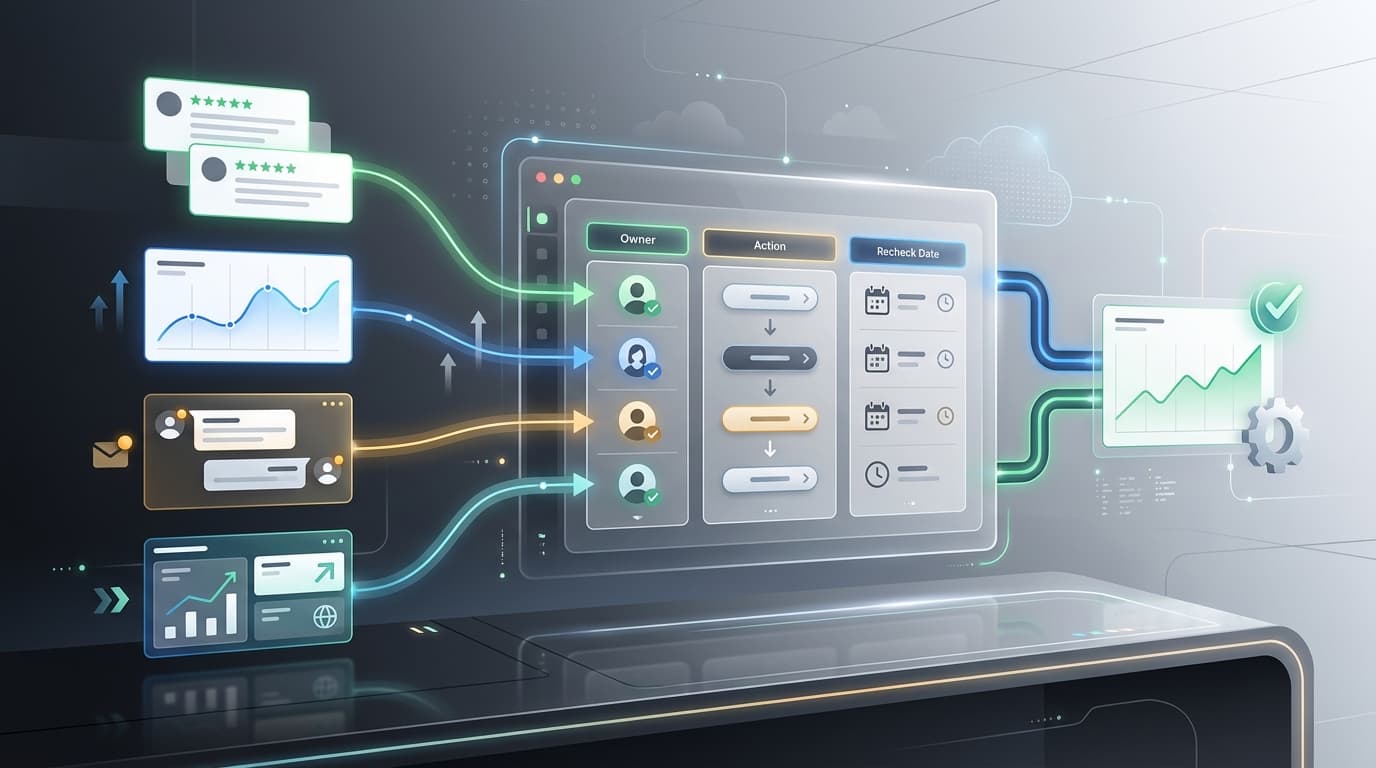
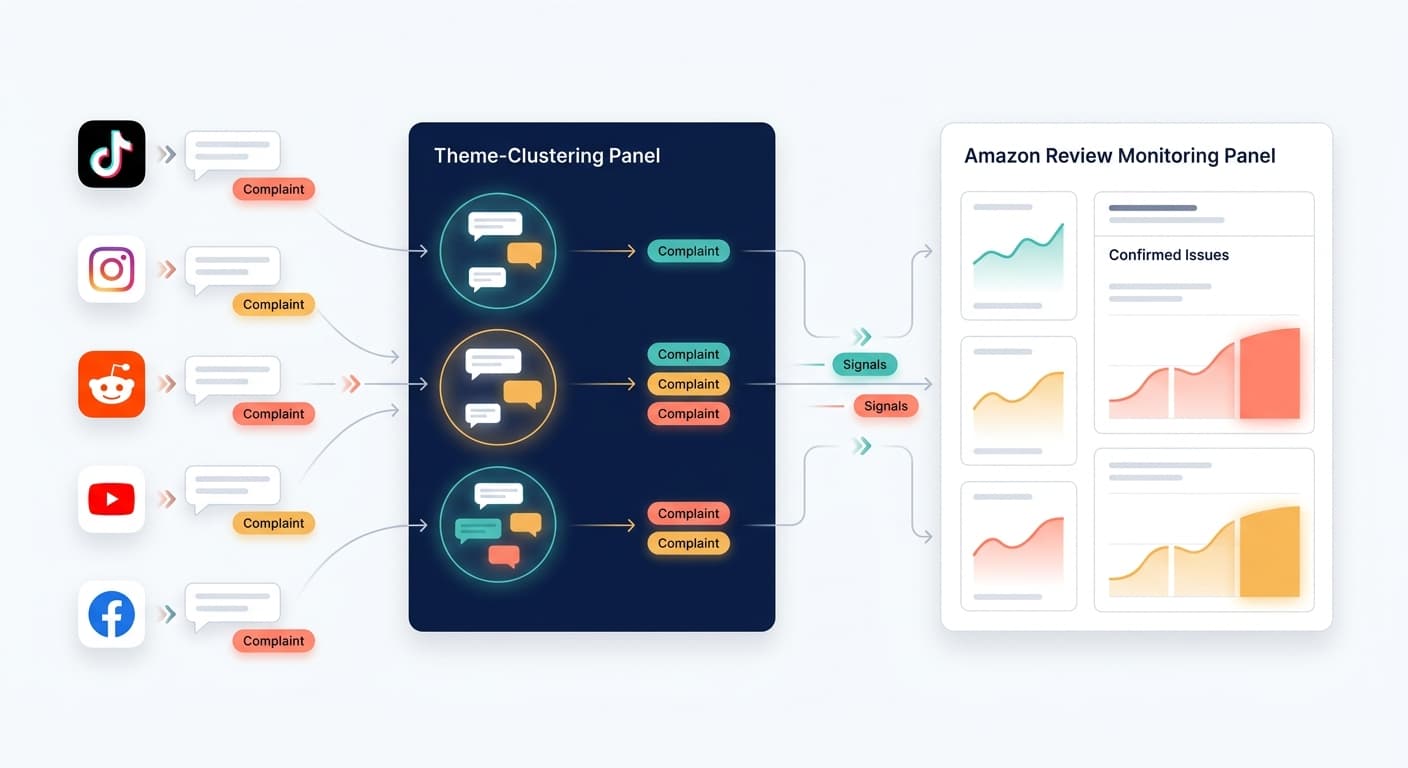
That is why social listening for ecommerce should not sit in a separate tab from review monitoring. The stronger workflow is simpler: use public comments as the early-warning layer, use Amazon review monitoring as the confirmation layer, and route both into listing, support, campaign, and product decisions.
For ecommerce teams, that sequence matters. By the time the same issue is obvious in Amazon reviews, the team may already have paid the delay cost in wasted traffic, weaker conversion, avoidable support load, or a growing rating problem.
Why review monitoring alone catches some problems too late
Amazon review monitoring is still a core workflow because it gives you stable post-purchase feedback. It shows what buyers keep praising, what they keep complaining about, and whether a theme is growing across an ASIN or variation. But Amazon review monitoring is a lagging signal. It depends on purchase volume, review behavior, and time.
That delay creates a blind spot for teams launching new creative, seeding creators, pushing seasonal promotions, or testing a new listing angle. Public reaction can move first. If multiple shoppers ask the same setup question in creator comments, complain about the same expectation mismatch under an ad, or repeat the same packaging concern in a Reddit thread, the team has a clue before the next review wave lands.
Social listening for ecommerce is useful because it helps teams watch those leading signals without pretending every comment spike deserves the same weight as a review pattern.
What social comments can tell you before Amazon review volume moves
The value of social listening for ecommerce is not that it replaces review intelligence. The value is that it shows where to pay attention sooner.
Public comments can reveal:
- repeated confusion about setup, sizing, or usage
- mismatch between creative claims and product reality
- packaging and unboxing issues that spread quickly
- missing-feature objections or compatibility questions
- delight themes that are strong enough to reinforce in copy and ads
When the same language starts appearing across multiple public surfaces, the signal becomes more useful. A one-off complaint may be noise. Ten variations of the same complaint across creator comments, Instagram replies, and community posts usually deserve a closer look.
Which public channels matter most
Not every channel matters equally for every product. Social listening for ecommerce works best when the team watches the channels most likely to surface product-specific reaction.
TikTok comments after creator demos
TikTok often surfaces immediate reaction to demos, before-and-after claims, and first-use friction. If viewers repeatedly ask whether a product works the way the creator showed it, that is not just engagement. It may be the start of an expectation problem that later becomes Amazon review complaints.
Instagram comment threads and replies
Instagram comments can surface aesthetic concerns, gifting fit, visual mismatch, or repeat questions that signal unclear merchandising. This is especially useful when the buying decision depends on presentation, lifestyle fit, or creator credibility.
Reddit and niche communities
Reddit threads often carry longer-form skepticism, comparison reasoning, and peer troubleshooting. That makes them useful for identifying objections that will not always show up in short comments but do affect conversion and later review themes.
YouTube review comments
YouTube comments can reveal more detailed setup, durability, and feature questions because viewers usually have more context. If a long-form review triggers the same objection over and over, the issue may be specific enough to route immediately.
Facebook groups and community discussions
Facebook groups can surface community-led warnings, advice, and workaround language. This is often where shoppers explain whether the product is worth it for a specific use case, not just whether they liked the content.
How to tell the difference between noise and a likely review theme
The risk with social listening for ecommerce is overreacting to loud but shallow signal. The answer is not to ignore social comments. The answer is to judge them with a repeatable filter.
Use four checks:
| Check | What to ask | Why it matters |
|---|---|---|
| Repetition | Are people saying the same thing in different words? | Repeated phrasing is more predictive than a single complaint |
| Cross-channel overlap | Does the same theme appear on more than one public channel? | Cross-channel repetition reduces the chance of isolated noise |
| Review baseline | Is the theme new, or does it already appear in Amazon reviews? | Separates early warning from already-established review debt |
| Actionability | Can a specific owner do something about it now? | Signal matters only if it can trigger a useful next move |
If the answer is no across all four checks, the theme probably stays on watch only. If the answer is yes across several checks, the team should treat it as a likely review-theme candidate.
The workflow: from public comment pattern to Amazon review watchlist
Social listening for ecommerce becomes operational when it feeds a simple review-monitoring loop instead of a vague sentiment dashboard.
1. Capture repeated public comments
Watch the channels where product-specific reaction shows up first: creator posts, ad comments, Reddit threads, YouTube comments, and community discussions. The goal is not to collect every mention. The goal is to capture repeated objection, praise, and question language.
2. Normalize the language into themes
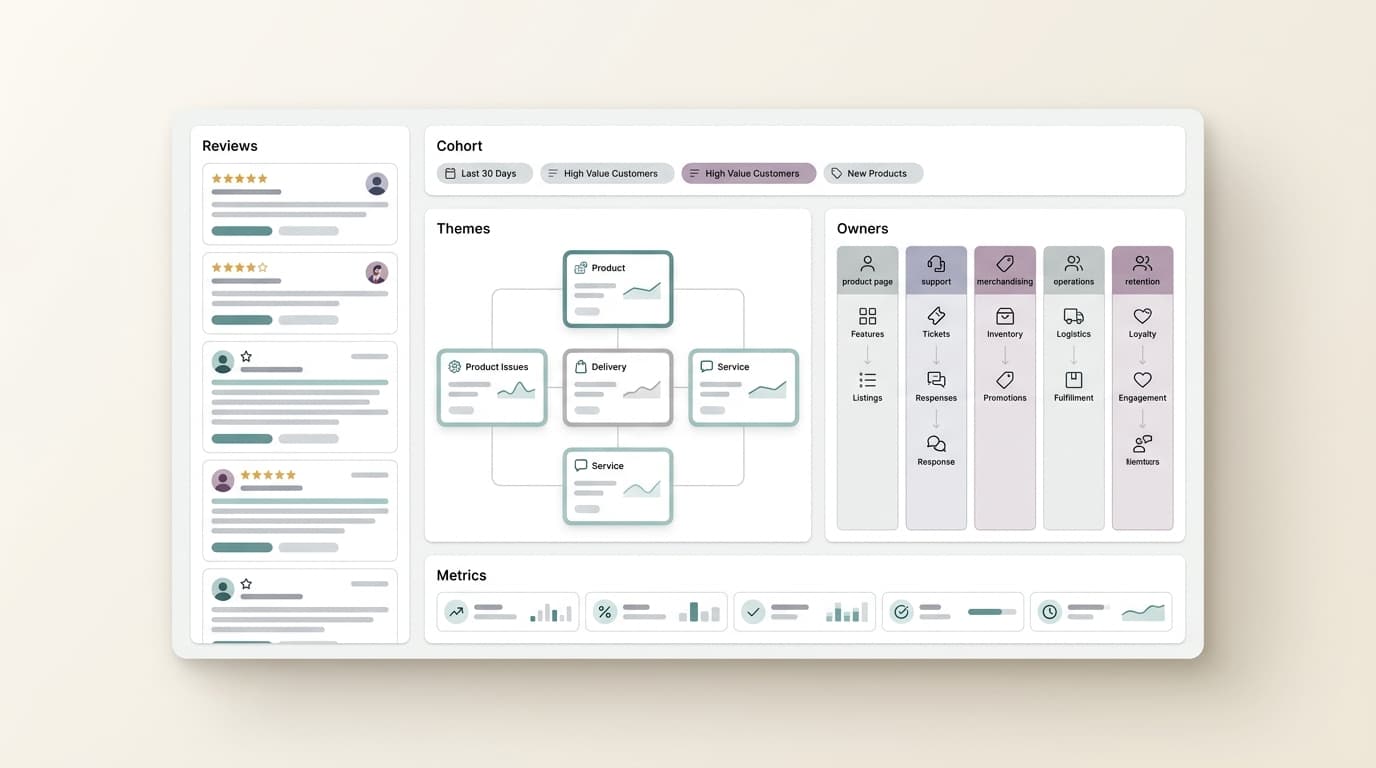
Group repeated wording into practical themes such as setup confusion, packaging damage, sizing mismatch, missing part, weak durability, unexpected delight, or feature praise. Teams need themes, not hundreds of raw comments.
3. Compare with the review baseline
Check whether the theme is already visible in Amazon reviews. If it is new in public comments but weak in reviews, that is a stronger early-warning case. If it is already dominant in reviews, the team is no longer early. The job becomes recovery and prioritization.
4. Build a review watchlist
Turn the likely themes into a watchlist by ASIN, variation, or campaign. This step is what connects social listening for ecommerce to Amazon review monitoring. Without it, the public signal never becomes a disciplined tracking workflow.
5. Route by owner
Assign the theme to the team that can act first. That might be listing, support, marketing, product, ops, or merchandising. The owner matters more than the dashboard.
6. Recheck Amazon reviews after action
After the team updates copy, support language, creative, packaging, or product details, review monitoring becomes the confirmation layer. This closes the loop and improves future judgment about which comment patterns deserve fast escalation.
How to route themes to listing, support, campaign, and product owners
Most teams do not fail because they missed one comment. They fail because the signal never reached the right owner in time.
| Theme type | Early source | Amazon review risk | Primary owner | Typical action |
|---|---|---|---|---|
| Setup confusion | TikTok, YouTube, Reddit | 2-star and 3-star "hard to use" reviews | Listing and support | Rewrite FAQ, add guidance, prepare support macros |
| Expectation mismatch | Paid social comments, creator replies | "Not what I expected" review cluster | Marketing and listing | Adjust claims, visuals, and PDP language |
| Packaging damage | Instagram, Reddit, unboxing comments | 1-star packaging and delivery complaints | Ops and support | Escalate packaging QA and response templates |
| Missing feature or weak accessory | Reddit, Facebook groups, review comments | Repeat product-fit complaints | Product and merchandising | Prioritize fix, bundle, or disclaimer |
| Positive delight theme | Creator replies, organic comments | Future 5-star proof cluster | Marketing and listing | Reuse buyer wording in copy and ads |
That routing logic is the real value of social listening for ecommerce. It turns scattered public reaction into owner-specific decisions instead of general awareness. Teams that already use a post-spike workflow can connect this earlier layer to 72-hour Amazon review monitoring after a traffic spike.
Examples of early signals that should trigger action
Some themes deserve action faster than others because they commonly spread from public comments into reviews.
Confusion about setup or sizing
If shoppers repeatedly ask how a product fits, installs, pairs, or turns on, the likely downstream risk is avoidable low-rating feedback. The listing and support teams can usually intervene first by rewriting bullets, adding visuals, clarifying fit, or preparing reply macros.
Packaging complaints
When creator or shopper comments mention damaged boxes, leaking seals, bent corners, or weak protective material, the issue may reach reviews quickly. That usually points to an ops or packaging fix, not just listing copy.
Expectation mismatch from creative
If comments repeatedly push back on a demo claim or visual impression, the marketing message may be too aggressive. This is one of the clearest places where social listening for ecommerce can outperform waiting for review fallout.
Durability or missing-feature objections
If public discussion shows the same concern around breakage, battery life, compatibility, or included accessories, the product and merchandising teams should get involved before the next review cycle compounds the issue.
Why reviews still need to stay at the center
Social listening for ecommerce works best when it expands outward from reviews, not when it tries to replace them.
Reviews still give the most stable product-feedback baseline because they come from actual buyers after use. They help confirm whether a public signal was temporary, exaggerated, or real. They also provide richer historical comparison by ASIN, variation, and time window.
That is why the strongest workflow is review-first and social-expanded:
- Use reviews to define normal complaint and praise patterns.
- Watch public comments for earlier or emerging versions of those themes.
- Route likely issues before review density grows.
- Use Amazon review monitoring to confirm whether the fix worked.
This is a safer and more useful framing than treating social listening for ecommerce as a complete real-time truth engine.
Where VOC AI fits the workflow
VOC AI publicly positions its social listening offer around tracking what shoppers and creators say across marketplaces and social channels alongside Amazon review data. It also positions its sentiment workflow around understanding the emotion behind reviews, ratings, and product feedback before it becomes a sales problem. That makes the product fit this article angle well.
In a practical workflow, VOC AI can help teams:
- keep Amazon review monitoring as the stable baseline
- compare repeated public themes with review themes
- group product feedback into usable sentiment and complaint patterns
- translate repeated customer language into listing, support, and product action
- avoid reading every comment and review manually
The claim-safe angle is decision support. The article should not promise perfect prediction or guaranteed outcome lift. The value is earlier signal detection, better routing discipline, and stronger feedback synthesis across public and review channels.
Social listening for ecommerce should lead to one shared watchlist
One of the biggest operational mistakes is giving social comments and review monitoring to different teams with no shared structure. Marketing sees public pushback. Support sees repeated questions. Marketplace teams see reviews later. Product sees fragments. Nobody owns the combined theme.
A shared watchlist fixes that. Instead of asking every team to monitor everything, the business agrees on a smaller set of high-risk themes:
- which issue is repeating now
- where it first appeared
- which ASIN or campaign it affects
- which owner acts first
- what evidence will confirm the issue
- when the team should recheck reviews
That is the operating system social listening for ecommerce actually needs. It also creates a better handoff into adjacent workflows like social listening vs. review monitoring, product research, competitor analysis, and broader voice of customer analysis.
FAQ
Can social comments predict Amazon reviews?
They can help predict likely review themes when the same objection repeats across public channels and connects to a clear product, listing, support, or expectation issue. They are best used as an early-warning layer, not a guaranteed forecast.
What is the difference between social listening and Amazon review monitoring?
Social listening surfaces public reaction from channels like TikTok, Instagram, Reddit, YouTube, Facebook groups, and other community sources. Amazon review monitoring focuses on post-purchase feedback inside the marketplace. Social comments can lead; reviews confirm. For a higher-level definition, teams can start with what social listening means for Amazon brands.
Which channels matter most before review volume builds?
The best channels are the ones that surface product-specific reaction early. For many ecommerce teams that means creator comments, ad replies, Reddit communities, YouTube review comments, and shopper discussion threads.
What should teams do when the same complaint appears in public comments?
Group the wording into a theme, compare it with the review baseline, assign an owner, add it to a review watchlist, and recheck reviews after the action ships. The value comes from routing, not just noticing.
Conclusion
Social listening for ecommerce becomes valuable when it helps teams catch review themes before they spread through Amazon ratings and complaints. Comments are not a replacement for review intelligence. They are the earlier layer that helps teams see what may be coming next.
The practical workflow is clear: capture repeated public comments, normalize them into themes, compare them against the review baseline, build a watchlist, route the issue to the right owner, and use Amazon review monitoring as the confirmation layer. Teams that connect those steps move faster than teams that wait for review debt to become obvious.
If your team already monitors reviews, the next improvement is not another disconnected dashboard. It is a shared workflow that treats public comments as early warning and reviews as proof.
Teams that want to operationalize that process can connect this workflow to Amazon review monitoring alerts and then evaluate the broader workflow inside VOC AI's pricing.