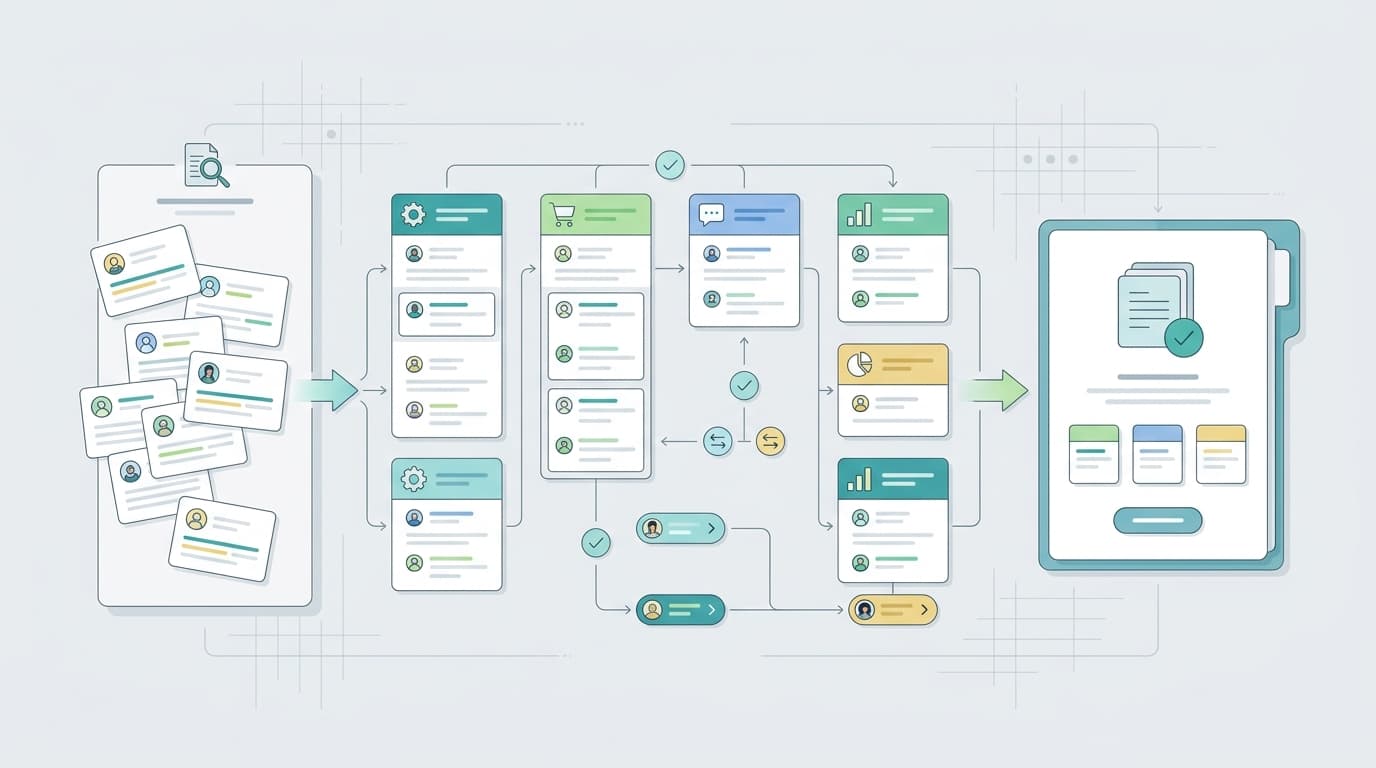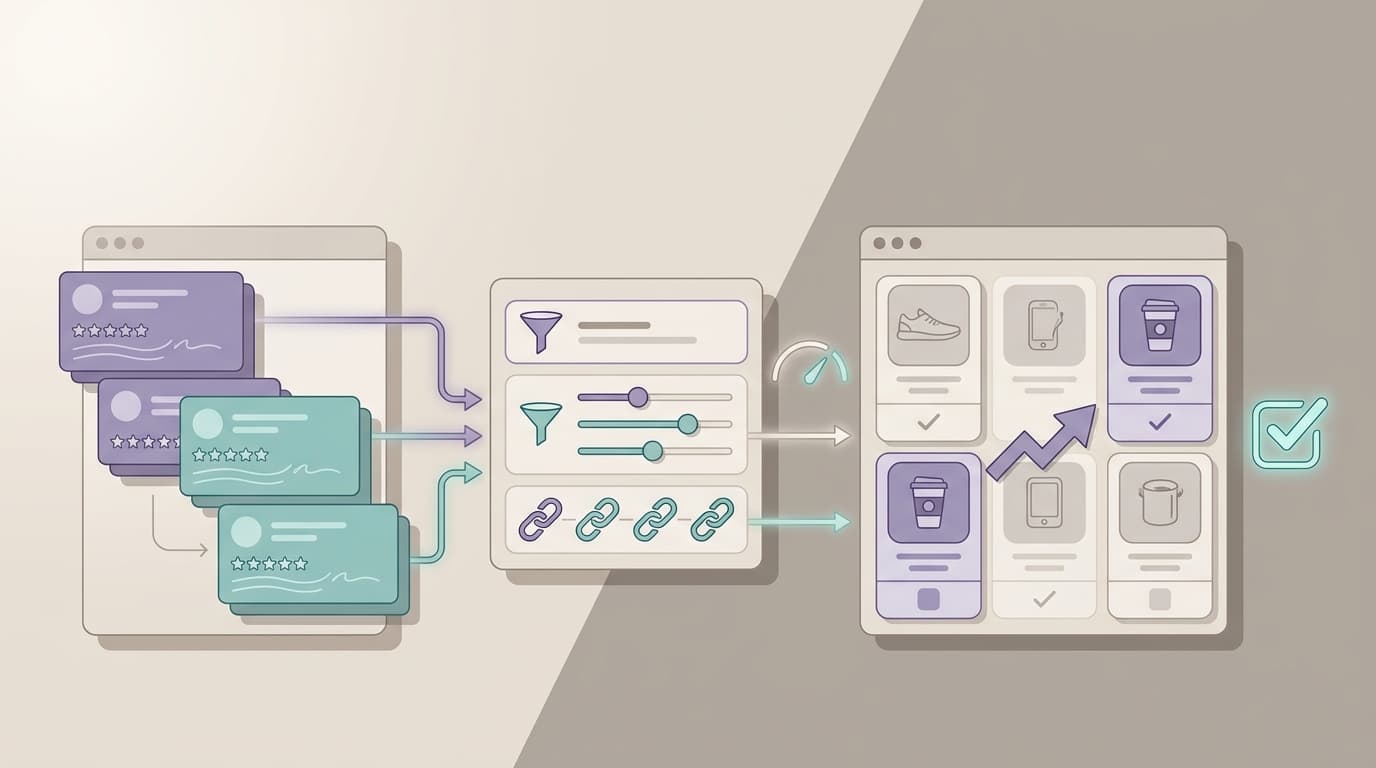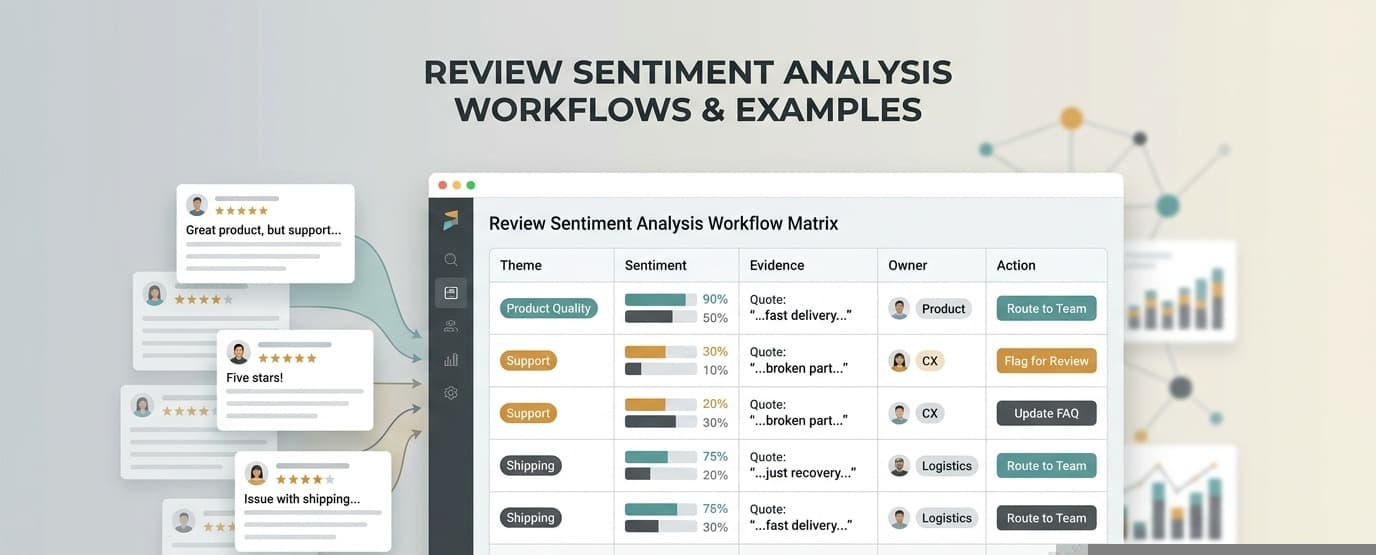
A VOC analysis can look polished and still be wrong.
The spreadsheet has tags. The dashboard has charts. The presentation has a confident sentence such as, “Customers want a simpler onboarding experience.” But when someone asks which customers, what “simpler” means, or which evidence supports the conclusion, the finding starts to fall apart.
That is a quality-control problem—not a formatting problem.
This guide gives beginners a practical VOC analysis checklist for the moment after you have drafted themes and before those themes influence a roadmap, campaign, listing, or service decision. Use it as a final gate: if a finding fails a test, improve the analysis or narrow the claim before the team acts.
If you are still learning the full process, start with the VOC analysis beginner guide. If you want a small practice dataset, use the VOC analysis beginner worksheet. This article starts where those workflows end: deciding whether your result is trustworthy enough to use.
The 12-Test VOC Analysis Checklist
| Test | Question | Red flag |
|---|---|---|
| 1. Decision fit | Does the evidence match the decision? | Broad dataset, narrow decision |
| 2. Sample fit | Does the sample represent the relevant users? | Convenient sample treated as universal |
| 3. Source context | Did you preserve channel and situation? | Reviews, tickets, and interviews flattened together |
| 4. Traceability | Can every finding link back to evidence? | Theme exists only in a summary |
| 5. Code clarity | Are labels defined consistently? | Same comment coded differently without explanation |
| 6. Theme specificity | Does the theme describe a customer situation? | Vague topic such as “onboarding” |
| 7. Contradictions | Did you inspect evidence that does not fit? | Only confirming quotes are shown |
| 8. Frequency discipline | Are counts interpreted in context? | Most common equals most important |
| 9. Claim precision | Is the wording no stronger than the evidence? | “All customers” from a small sample |
| 10. AI review | Did a person verify AI-assisted output? | Generated summary accepted as source truth |
| 11. Action boundary | Are observation and recommendation separated? | Suggested solution presented as customer demand |
| 12. Ownership | Is there a decision owner and review date? | Insight saved with no next step |
You do not need a perfect score. You do need to know which weaknesses remain and how they limit the conclusion.
1. Decision Fit: Is the Evidence Relevant to the Choice?
Start with the decision, not the dataset.
Suppose the question is whether to redesign first-time setup for new mid-market customers. A year of support tickets from every customer segment may contain useful material, but it does not automatically answer that question. Long-time enterprise users, billing complaints, and unrelated feature requests can create volume without improving decision quality.
A decision-fit statement should name:
- the decision being informed;
- the customer or buyer segment;
- the product, journey stage, or use case;
- the evidence window;
- the feedback sources included and excluded.
Pass example: “This analysis examines setup friction reported by first-time administrators at 50–500 employee SaaS companies during the first 14 days after signup.”
Fail example: “We analyzed customer feedback to understand onboarding.”
The pass statement is narrower, but that is the point. A precise scope prevents unrelated evidence from borrowing authority it has not earned.
2. Sample Fit: Who Is Missing?
VOC analysis does not become representative merely because the sample is large.
Review the sample against the people affected by the decision. Look for obvious imbalances:
- only highly satisfied or highly frustrated customers;
- only users who contacted support;
- only customers from one market, plan, device, or acquisition channel;
- only recent feedback when the decision concerns a long-term experience;
- multiple comments from the same loud account counted as separate demand signals.
Record the imbalance instead of hiding it. For example: “The sample overrepresents customers who opened support tickets, so it is useful for diagnosing friction but not for estimating how common the friction is across all users.”
That sentence protects the analysis from being used for a claim it cannot support.
3. Source Context: Did You Flatten Different Kinds of Evidence?
An interview, a support ticket, a product review, and a survey comment are not interchangeable.
Each source captures feedback under different conditions. A public review may summarize an overall product experience. A support ticket often records an urgent problem. An interview allows follow-up questions. A cancellation note may explain why a customer left but not why another customer stayed.
Keep these context fields attached to every evidence item:
- source and source URL or record ID;
- date;
- segment or account attributes that are safe and relevant;
- journey stage;
- product area or use case;
- sentiment or outcome;
- whether the statement was prompted or unprompted.
You can combine sources during synthesis, but you should still be able to separate them during review. If a theme appears only in support tickets, say so. If reviews and interviews tell different stories, investigate the difference instead of averaging it away.
Teams working with several channels can use the normalization approach in how to analyze ecommerce feedback across channels.
4. Traceability: Can You Reopen the Original Evidence?
A finding is not traceable when the only surviving evidence is an AI summary, a copied quote without context, or a chart with no underlying records.
For each theme, keep an evidence table with:
| Field | What to record |
|---|---|
| Evidence ID | Stable link or reference to the original item |
| Exact excerpt | The smallest useful piece of customer language |
| Context | Source, segment, product area, and situation |
| Code | The label assigned during analysis |
| Theme | The higher-level pattern the item supports |
| Interpretation note | Why the item belongs—and any ambiguity |
Then test traceability by selecting three claims at random and reopening their evidence. If a reviewer cannot reconstruct how the finding was formed, the evidence chain is too weak.
This is one reason a customer feedback dashboard should link metrics and themes back to customer records instead of displaying isolated counts.
5. Code Clarity: Would Two Reviewers Understand the Labels?
Codes are working labels, not decorative tags. A codebook should make each label understandable enough that another person can inspect your reasoning.
For every important code, define:
- what the code includes;
- what it excludes;
- one clear example;
- one borderline example;
- related codes that should not be merged automatically.
Consider the code setup difficulty. Does it include missing documentation? Permission errors? Slow data import? Confusing terminology? If the label contains four different problems, it is not yet useful for a decision.
Split codes when the causes or possible responses differ. Merge them only when the distinction does not matter to the decision.
The goal is not perfect agreement. Qualitative analysis involves judgment. The goal is visible judgment: reviewers should see how labels were applied and where ambiguity remains.
6. Theme Specificity: Does the Theme Explain a Situation?
Weak themes name a topic. Strong themes explain a recurring customer situation.
Compare these:
- Weak: Onboarding
-
Better: New administrators cannot tell which setup steps are required before inviting teammates
-
Weak: Reporting
-
Better: Weekly report exports require manual cleanup before managers can share them
-
Weak: Price
- Better: Small teams cannot predict the next bill when usage changes during a launch
A useful theme normally includes a user or segment, a context, a friction or goal, and a consequence. It should be specific enough that a product manager, marketer, or support leader knows what needs investigation.
Do not force customer statements into your org chart. Customers rarely experience “the analytics feature” or “the lifecycle campaign” as clean internal categories. Build themes around their situation.
7. Contradictions: What Evidence Does Not Fit?
Confirmation is easy. Quality comes from actively looking for disconfirming evidence.
For every major theme, ask:
- Which customers did not experience this problem?
- Did anyone describe the opposite preference?
- Does the pattern change by segment, plan, market, or use case?
- Is the apparent contradiction actually a different job to be done?
- What evidence would make us revise the theme?
Imagine that eight customers ask for more setup guidance, while five experienced administrators say the setup already feels too long. The conclusion is not simply “customers want more onboarding.” A better theme may be: “First-time administrators need clearer guidance, while experienced users need a faster path.”
Contradictions often reveal the segmentation that a broad theme was hiding.
8. Frequency Discipline: Common Does Not Always Mean Important
Counts are useful, but they are not self-interpreting.
A frequent complaint may be minor. A rare problem may block a high-value workflow, create a safety risk, or affect a strategically important segment. A review source may overproduce complaints because satisfied customers have less reason to write.
When you present frequency, include the denominator and source:
- “18 of 60 onboarding-related support tickets mentioned unclear permissions.”
- “7 of 22 interviewed administrators described the export cleanup step.”
- “The issue appeared in 4 of 130 public reviews, all from customers using the same integration.”
Avoid statements such as “This is the top customer pain point” unless the comparison set, sample, and scoring rule justify it.
For prioritization after the evidence is sound, use a transparent method such as the one in how to prioritize customer feedback.
9. Claim Precision: Is the Finding Stronger Than the Evidence?
VOC findings become unreliable when uncertainty disappears during editing.
Watch for these upgrades in certainty:
| Evidence supports | Overstated rewrite |
|---|---|
| Several support users reported confusion | Customers are confused |
| The issue appeared in one segment | The market wants this |
| Customers described a problem | Customers requested our proposed solution |
| The sample suggests a pattern | The analysis proves the cause |
| Negative reviews mention a feature | The feature causes churn |
Use bounded language when the evidence is bounded: “in this sample,” “among interviewed administrators,” “appeared repeatedly in recent support tickets,” or “suggests a hypothesis to test.”
Precision does not make a finding weak. It tells the decision maker exactly how much weight to place on it.
10. AI Review: Did a Human Verify the Output?
AI can help retrieve comments, propose labels, cluster similar language, summarize evidence, and draft theme descriptions. It can also erase context, merge distinct complaints, overstate patterns, or produce a smooth conclusion that no source actually supports.
Treat AI output as an analysis aid, not as original customer evidence.
At minimum, a human reviewer should:
- inspect a representative sample of source items;
- reopen evidence behind every high-impact finding;
- review low-confidence and contradictory items;
- check that quotes are exact and attributed to the correct context;
- compare generated summaries with the underlying comments;
- record where the model, prompt, taxonomy, or dataset changed.
The NIST AI Risk Management Framework emphasizes trustworthy and risk-aware use of AI systems. In a VOC workflow, the practical application is simple: keep the evidence available, make uncertainty visible, and increase human review as the consequence of a wrong conclusion increases.
11. Action Boundary: Did the Customer Describe the Problem or Your Solution?
A customer saying, “I cannot tell whether the import finished,” is evidence of an information gap. It is not evidence that the customer wants a progress bar, an email, a redesigned dashboard, or an AI assistant.
Separate the final output into three layers:
- Observation: What customers said or did.
- Interpretation: The pattern you believe explains the evidence.
- Recommendation: The test, change, or investigation the team proposes.
Example:
- Observation: New administrators repeatedly reopened the import page and contacted support before processing completed.
- Interpretation: The current experience does not provide enough progress visibility for users unfamiliar with typical processing time.
- Recommendation: Test clearer status messaging and estimated completion ranges before committing to a specific interface change.
This structure prevents the team’s favorite idea from being disguised as customer demand.
12. Ownership: What Happens After the Finding?
An insight without an owner becomes archive material.
Every decision-ready finding should end with:
- decision owner;
- decision or hypothesis affected;
- next action;
- evidence strength;
- unresolved questions;
- review or refresh date;
- success or learning signal.
The next action does not have to be “build it.” It may be to run five interviews, segment the evidence, inspect behavioral data, change support messaging, test listing copy, or monitor the theme for another month.
The owner is responsible for deciding how the evidence enters the workflow—not for treating every comment as a command.
Score Each Theme With a Stoplight Review
Use this simple quality score before sharing a theme:
- Green: The test passes and evidence is easy to inspect.
- Yellow: The test partly passes; the limitation is documented.
- Red: The test fails or cannot be verified.
| Outcome | Recommended use |
|---|---|
| 10–12 green, no red | Ready to inform a bounded decision |
| 7–9 green, no more than 2 red | Use as a hypothesis with visible caveats |
| Fewer than 7 green or 3+ red | Return to evidence before recommending action |
This is a review aid, not a scientific validity score. Some tests matter more than others. A red traceability result is more serious than a yellow ownership result because the first means you cannot verify the finding itself.
Worked Example: Audit a Weak VOC Theme
Initial theme: “Customers hate reporting.”
Run the checklist:
- Decision fit: Yellow. The team wants to improve weekly reporting, but the dataset also includes unrelated dashboard comments.
- Sample fit: Yellow. Most items came from support users; self-serve customers are underrepresented.
- Source context: Green. Tickets, reviews, and interviews remain labeled.
- Traceability: Green. Every item links to the original record.
- Code clarity: Red.
reporting problemcombines export failures, confusing metrics, slow loading, and formatting work. - Theme specificity: Red. “Customers hate reporting” does not describe a situation.
- Contradictions: Yellow. Some enterprise users praise the dashboard but still complain about exports.
- Frequency discipline: Green. Counts include source-specific denominators.
- Claim precision: Red. “Customers” and “hate” are stronger than the evidence.
- AI review: Green. A researcher checked the generated clusters against source records.
- Action boundary: Yellow. The draft jumps directly to rebuilding the dashboard.
- Ownership: Green. The reporting PM owns the follow-up.
Revised theme: “Operations managers export weekly reports into spreadsheets because the shared file requires formatting changes before leadership review.”
Bounded finding: “This pattern appeared across support tickets and six interviews with operations managers. It does not represent all reporting users, and the analysis does not yet show whether export formatting or dashboard sharing is the better intervention.”
The revised finding is less dramatic and far more useful.
A 20-Minute VOC Quality Review
When time is limited, run this sequence with the analyst and decision owner:
- Minutes 0–3: Restate the decision, segment, sources, and evidence window.
- Minutes 3–7: Open three random evidence items and one contradictory item.
- Minutes 7–11: Review the code and theme definitions.
- Minutes 11–14: Check denominators and sample limitations.
- Minutes 14–17: Rewrite any claim that is stronger than the evidence.
- Minutes 17–20: Separate observation, interpretation, and recommendation; assign the owner and refresh date.
If the team cannot complete the traceability step, stop the review and repair the evidence chain first.
When to Move From a Spreadsheet to VOC Analysis Software
A spreadsheet is enough for a narrow question, a manageable evidence set, and one owner. Software becomes more useful when the same quality checks must work across recurring, higher-volume feedback.
Look for capabilities that help you:
- retain source context and original records;
- apply and revise a shared taxonomy;
- compare themes across segments, products, competitors, or periods;
- retrieve contradictory and supporting evidence;
- expose the evidence behind summaries;
- route findings to decision owners;
- rerun analysis as new feedback arrives.
Use the VOC analysis software evaluation guide to test a tool against a real evidence set rather than a polished demo. VOC AI’s Voice of Customer Analysis workflow is designed to surface review-backed themes such as pain points, expectations, feature mentions, buyer language, and product strengths and weaknesses while keeping the analysis connected to customer evidence.
Frequently Asked Questions
What is a VOC analysis checklist?
A VOC analysis checklist is a set of quality tests used to review feedback findings before they influence a decision. It checks scope, sample fit, context, traceability, coding, themes, contradictions, counts, claim precision, AI review, action boundaries, and ownership.
Is VOC analysis statistically valid?
VOC analysis may use qualitative, quantitative, or mixed methods. Whether a conclusion can be generalized depends on the research design, sample, source, measurement, and analysis method. Do not treat a convenience sample of comments as a population estimate.
How many customer comments should support a theme?
There is no universal threshold. The right standard depends on the decision, evidence source, segment, recurrence, consequence, and diversity of the sample. Report the count and denominator, then describe the limitations.
Should two people code the same feedback?
A second reviewer can expose unclear definitions and hidden assumptions, especially for high-impact decisions. The goal is not to remove judgment from qualitative analysis. It is to make the reasoning inspectable and improve consistency where consistency matters.
Can AI replace manual VOC analysis review?
AI can accelerate parts of the workflow, but it should not replace evidence inspection for consequential findings. A human should verify source records, contradictions, summaries, and the boundary between customer evidence and the team’s recommendation.
Trust the Evidence, Not the Polish
The biggest VOC analysis risk is not a messy spreadsheet. It is a clean conclusion with an invisible evidence chain.
Before a theme reaches a roadmap, campaign, listing, or service plan, test it. Check that the sample fits the decision. Preserve source context. Reopen the evidence. Define the labels. Inspect contradictions. Keep counts honest. Narrow the language. Verify AI-assisted output. Separate the problem from the proposed solution. Give the finding an owner.
The result may sound less certain. It will be more trustworthy—and more useful to the person who has to decide what happens next.