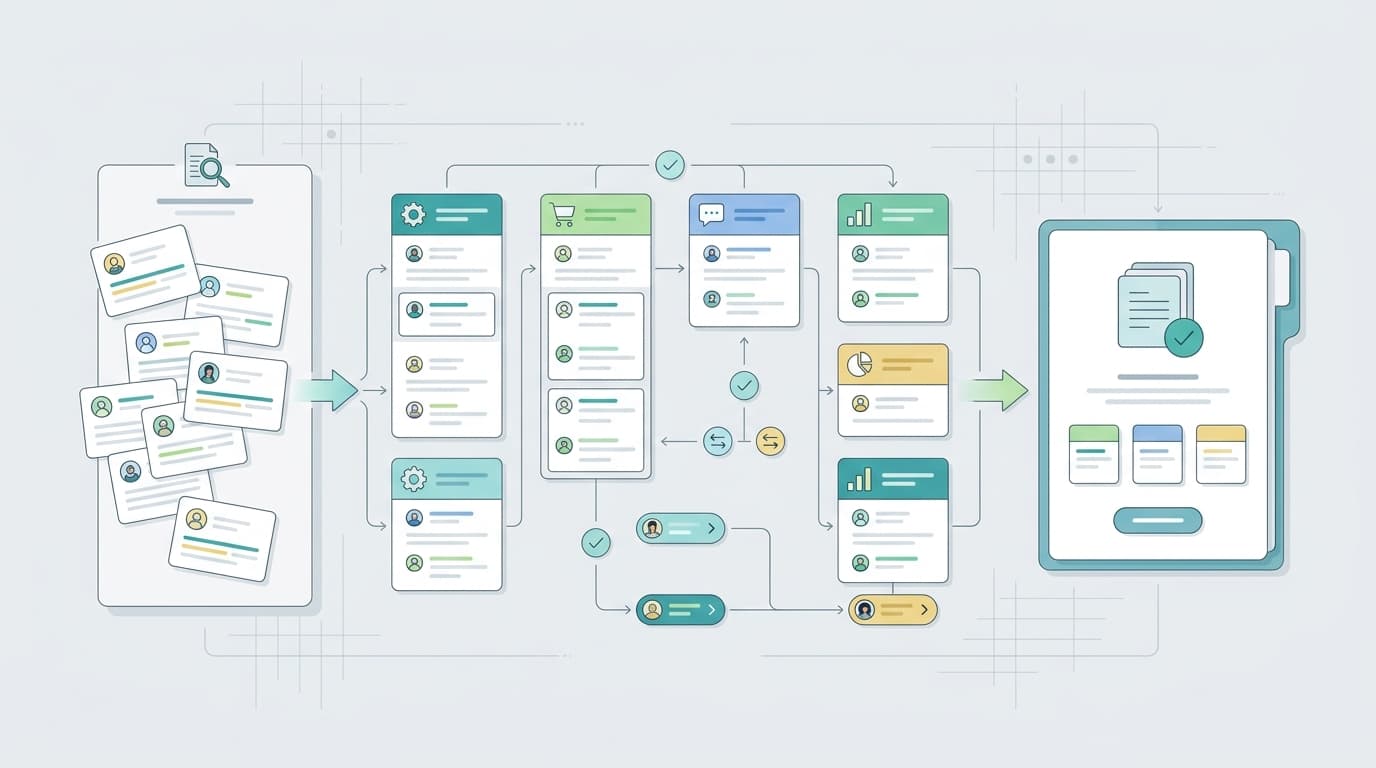
VOC analysis, or voice-of-customer analysis, is the process of collecting and interpreting customer feedback to find repeated needs, complaints, expectations, and purchase barriers. For Amazon sellers, it means using reviews, returns, Q&A, buyer messages, and support contacts to spot product issues, listing gaps, and competitor opportunities before they grow.
What VOC Analysis Means for Amazon Sellers
On Amazon, customer feedback is scattered across several places. Reviews show public buyer language, returns reveal post-purchase disappointment, Q&A exposes pre-purchase uncertainty, and buyer-seller messages often show confusion that never appears in a review.
Amazon uses the idea directly in Seller Central through its Voice of the Customer dashboard, which evaluates customer experience health across multiple feedback channels. That is the right mental model for sellers: VOC analysis should not be limited to skimming reviews or watching the average star rating.
The work is only useful when it changes something. A repeated complaint might trigger a supplier check, a repeated question might become a clearer image or bullet,and a phrase buyers use in positive reviews might belong in listing copy. The point is not to collect more comments; it is to understand what buyers are trying to tell you before the issue becomes harder to fix.
Field | Definition |
Term | VOC analysis, short for voice-of-customer analysis. |
Plain-English meaning | A structured way to understand what customers say, feel, expect, and complain about. |
Used by | Amazon sellers, product managers, listing teams, brand managers, support teams, and agencies. |
Main seller decision | What to fix, what to emphasize, what to stop promising, and where competitors are weak. |
Related metrics | Review volume, rating mix, sentiment themes, return reasons, NCX signals, complaint frequency, Q&A gaps. |
Why VOC Analysis Matters for Amazon Sellers
Amazon product pages are decision-heavy. A buyer may compare title claims, images, price, ratings, shipping, Q&A, and reviews in a short window. If the listing overpromises, a variation has a defect, or a competitor solves a pain point better, buyers often reveal the issue in their own language before the seller sees it in a formal report.
VOC analysis helps sellers answer questions that directly affect conversion, returns, and product strategy:
- Why are buyers returning the product?
- Which listing claim creates unrealistic expectations?
- What exact language do satisfied buyers use?
- Which feature causes confusion before or after purchase?
- Are recent reviews worse than older reviews?
- Does one size, color, bundle, or generation drive most complaints?
- Which competitor weakness could become a product advantage?
This matters because aggregate ratings do not explain root causes. A 4.3-star product can still have a growing issue in recent reviews. A small child ASIN can damage a parent listing. A single vague bullet can create return-driving confusion. VOC analysis gives sellers the text, timing, and context behind the numbers.
What Data Should Amazon Sellers Analyze?
Good VOC analysis uses more than one feedback source. Reviews are important, but they are only one part of the customer signal.
Start with product reviews because they show product strengths, complaints, use cases, and expectation gaps in the buyer's own words. Then add return reasons and refund comments to understand why people reject the product after purchase.
Q&A is useful for finding pre-purchase uncertainty. If buyers keep asking about size, compatibility, materials, setup, or use cases, the listing probably needs clearer bullets, image callouts, or comparison content.
Buyer-seller messages and customer service contacts show post-purchase friction. Repeated questions can point to weak instructions, confusing setup steps, missing inserts, or support macros that need to be improved.
Seller feedback and fulfillment-related comments should be reviewed separately from product feedback. A late delivery complaint is still important, but it should not automatically become a product quality issue.
Competitor reviews are useful when planning positioning or product improvements. Look for repeated complaints across rival ASINs, then decide whether your product can credibly solve that pain point.
For Amazon sellers, variation-level analysis is especially important. Do not mix all parent and child ASIN feedback if one color, size, bundle, or production generation has a different customer experience.
How to Do VOC Analysis Step by Step
A practical VOC analysis workflow has five steps: define the question, collect feedback, clean the data, cluster themes, and decide what deserves follow-up.
Step 1: Start With the Question
Start with the business question. Are you trying to reduce returns, rewrite a listing, compare competitors, investigate a quality issue, or plan the next product version?
Specific questions prevent vague analysis. "Why did negative reviews increase for the two-pack variation in May?" is more useful than "What are customers saying?"
Step 2: Collect the Right Feedback
Pull feedback from the channels that match the question. For a listing rewrite, product reviews, Q&A, competitor reviews, and support questions may be enough. For a product defect investigation, add return reasons, refund comments, and recent variation-level reviews.
Attach useful fields such as ASIN, variation, date, rating, channel, marketplace, and product generation. These details help separate old issues from current ones.
Step 3: Clean the Feedback
Remove duplicates, spam, irrelevant comments, and channel noise. Separate product issues from shipping issues when possible. If a complaint is about late delivery, it should not automatically become a product quality theme.
Cleaning is not glamorous, but it protects the team from false patterns. A messy dataset can make a minor issue look strategic or hide a real one under unrelated comments.
Step 4: Cluster Feedback Into Themes
Group similar comments even when buyers use different wording. For example, "lid pops open," "not for soup," "leaked in my lunch bag," and "seal is hard to align" may belong to one seal-reliability theme.
Good VOC themes preserve buyer language. Do not reduce everything to generic labels such as "quality" or "durability." A useful theme says what failed, where it happened, and why it matters.
Step 5: Decide What Deserves Follow-Up
Not every theme deserves the same response. Some are urgent. Some are useful but not immediate. Some are too isolated to act on yet.
For example, if recent 1-star and 2-star reviews say a container leaks in lunch bags, the team should inspect lid tolerance and review any "leakproof" claim. If Q&A and returns show that buyers misunderstand sizing, the listing probably needs clearer dimensions and a size comparison image.
If support messages repeat the same setup question, the fix may be a better insert, support macro, or post-purchase guide. If competitor reviews repeatedly complain that handles break, the product and marketing teams can decide whether a reinforced handle is a real advantage worth highlighting.
The output does not need to be complicated. It just needs to say what the pattern is, where the evidence came from, and what should happen next.
VOC Analysis Example for an Amazon Product
Imagine an Amazon seller with a reusable food container. The product still has strong overall ratings, but recent reviews are slipping. Manual reading shows scattered comments:
- "The lid pops open."
- "Not for soup."
- "It leaked in my lunch bag."
- "The seal is hard to align."
- "Great for dry snacks."
A basic sentiment report would label several comments as negative. VOC analysis goes further. The seller clusters the feedback into three themes:
- Seal reliability
- Use-case mismatch
- Cleaning or alignment difficulty
The listing team changes the claim from "leakproof for all meals" to a more precise use-case statement. The product team asks the supplier to inspect lid tolerance. The support team updates the insert with clearer alignment instructions. The brand team monitors recent reviews after the next inventory cycle to see whether leak complaints decline.
That is VOC analysis in practice: customer comments becoming something the team can actually use.
VOC Analysis vs Sentiment Analysis
Sentiment analysis and VOC analysis are related, but they are not the same.
Comparison point | Sentiment analysis | VOC analysis |
Main question | Is the feedback positive, negative, neutral, or mixed? | What is the customer trying to tell us, and what should we do? |
Output | Sentiment score, polarity, emotion, topic sentiment | Theme, evidence, root cause, likely next step |
Best use | Measuring emotional direction across feedback | Understanding what buyers are reacting to and why |
Seller example | Reviews are negative about durability | Buyers say the handle snaps after two weeks on the large size |
Limitation | Does not always explain root cause | Still requires someone to check the evidence |
Sentiment analysis is useful for Amazon sellers because it shows where buyer emotion concentrates. VOC analysis is the next layer. It explains why customers feel that way and what kind of follow-up makes sense.
For a review-specific workflow, see VOC AI's guide to Amazon review sentiment analysis.
Common VOC Analysis Mistakes
Using Only Star Ratings
Ratings show direction, but text explains causes. A rating trend without review language can hide product, listing, variation, and fulfillment problems.
Overreacting to One Quote
A memorable complaint can sound urgent, especially if it is emotional. Confirm that the theme appears across multiple reviews, returns, messages, or support contacts before turning it into a roadmap item.
Mixing Variations
One defective color, size, bundle, or product generation can distort the view of the full parent ASIN. Segment feedback when variations differ meaningfully.
Ignoring Recent Shifts
Old praise should not bury new complaints after a supplier, packaging, or listing change. Always check whether the feedback reflects current inventory and current customer expectations.
Stopping at Themes
A theme without a follow-up path is unfinished work. Each meaningful pattern should have evidence, priority, and a simple way to check whether anything improves.
How to Make VOC Analysis Reliable Without Overcomplicating It
Reliable VOC analysis depends on four checks: repeatability, recency, relevance, and follow-up. That sounds formal, but the idea is simple.
Repeatability means the theme appears in more than one feedback item. This protects the team from overreacting to a single loud review.
Recency means the theme reflects current inventory, current listing copy, and current customer expectations. Old reviews can still be useful, but they should not outweigh new complaints after a supplier, packaging, or listing change.
Relevance means the theme is tied to something the seller can influence. Some buyer preferences are real but not actionable.
Follow-up means someone knows what to inspect, fix, test, or monitor. Without that, the analysis is easy to admire and easy to ignore.
Keep raw examples behind every major theme. If a theme cannot be supported with actual customer language, mark it as a hypothesis rather than a finding.
In a team meeting, avoid vague summaries like "sentiment is down and customers mention quality." A better version is: "Leak complaints increased in recent reviews on the two-pack variation. The examples mention lunch bags and transport, so we should check packaging and review the leakproof claim." That sentence is useful because it names the issue, the source, and the next move.
How VOC AI Helps Sellers Act Faster
VOC AI helps Amazon sellers read large volumes of reviews faster, group recurring buyer themes, and compare competitor ASINs without relying on manual skimming.
This is especially useful when review volume is too large for manual reading. AI can identify repeated complaints, summarize positive and negative themes, compare sentiment across competitors, and surface buyer language that should appear in listing copy.
Use AI as an acceleration layer, not a replacement for judgment. Before changing a product spec, listing claim, or customer policy, inspect the supporting examples and make sure the pattern is real.
For a practical review workflow, read VOC AI's guide to Amazon review analysis.
FAQ
What does VOC analysis mean?
VOC analysis means analyzing voice-of-customer feedback so a business can understand buyer needs, pain points, expectations, objections, and repeated requests. In ecommerce, it often starts with reviews, but it should also include returns, messages, Q&A, support feedback, and competitor reviews.
What data is used in VOC analysis?
Common VOC data includes product reviews, return reasons, refund comments, customer service contacts, buyer-seller messages, seller feedback, Q&A, surveys, social comments, and support tickets. The best mix depends on what the seller is trying to understand.
How is VOC analysis different from sentiment analysis?
Sentiment analysis labels emotional tone. VOC analysis interprets the customer need behind that tone. Sentiment might show negative reviews about durability; VOC analysis looks for the failing component, affected variation, and buyer use case.
Why does VOC analysis matter for Amazon sellers?
Amazon sellers compete on trust, listing clarity, review quality, and product fit. VOC analysis shows where a product meets expectations, where it disappoints, which listing claims create confusion, and where competitors leave gaps.
Can AI automate VOC analysis?
AI can automate theme clustering, summarization, sentiment detection, and competitor comparison. Sellers should still review supporting examples before changing product specs, listing claims, packaging, support workflows, or customer policies.
How often should Amazon sellers run VOC analysis?
Run VOC analysis after major listing, supplier, packaging, or product changes. For active ASINs, review recent feedback at least monthly. For high-volume or problem ASINs, monitor complaint velocity weekly so emerging issues do not wait for a quarterly review.