An AI review summarization system can be accurate and still be unsafe to operate.
The risk is not limited to a model inventing a claim. A pipeline can also expose customer identifiers, accept instructions hidden inside review text, give too many employees access to raw data, retain source records indefinitely, or produce a summary that nobody can reconstruct after a complaint.
That is why privacy, security, and data governance belong inside the implementation—not in a policy document written after launch.
This checklist is a security-and-governance companion to VOC AI's broader AI review summarization implementation checklist. It focuses on the controls between source ingestion and summary delivery: data inventory, minimization, untrusted-input handling, access control, evidence traceability, retention, vendor boundaries, testing, and incident response.
Use it before connecting a new review source, model, dashboard, API consumer, or downstream automation.
The 10-control checklist at a glance
| # | Control | Required implementation artifact | Release-blocking test |
|---|---|---|---|
| 1 | Define the data boundary | Data-flow and purpose map | Every field and system has an owner and purpose |
| 2 | Minimize before inference | Field allowlist and redaction rules | Prohibited fields never reach the model |
| 3 | Treat reviews as untrusted input | Prompt-injection isolation policy | Embedded instructions cannot change system behavior |
| 4 | Separate identities from analysis | Pseudonymous evidence schema | Summaries work without direct identifiers |
| 5 | Enforce least-privilege access | Role and service-account matrix | Each role can access only required data |
| 6 | Protect data across the lifecycle | Storage, transfer, and secret controls | No plaintext secrets or unmanaged exports |
| 7 | Preserve evidence without oversharing | Claim-to-evidence packet | Material claims are traceable through controlled views |
| 8 | Control models and vendors | Processor and model inventory | Data use, retention, and deletion terms are documented |
| 9 | Test security and privacy failure modes | Adversarial benchmark | High-risk tests pass before release |
| 10 | Monitor, delete, and respond | Audit, retention, and incident runbooks | Operators can investigate and contain a simulated event |
The NIST AI Risk Management Framework organizes AI risk work around Govern, Map, Measure, and Manage. The NIST Privacy Framework gives organizations a structure for managing privacy risk, while the OWASP Top 10 for LLM Applications highlights implementation threats such as prompt injection and sensitive-information disclosure. This article translates those principles into a review-summarization workflow. It is an implementation aid, not legal advice.
1. Define the data boundary before choosing the model
Start with the system boundary, not the prompt.
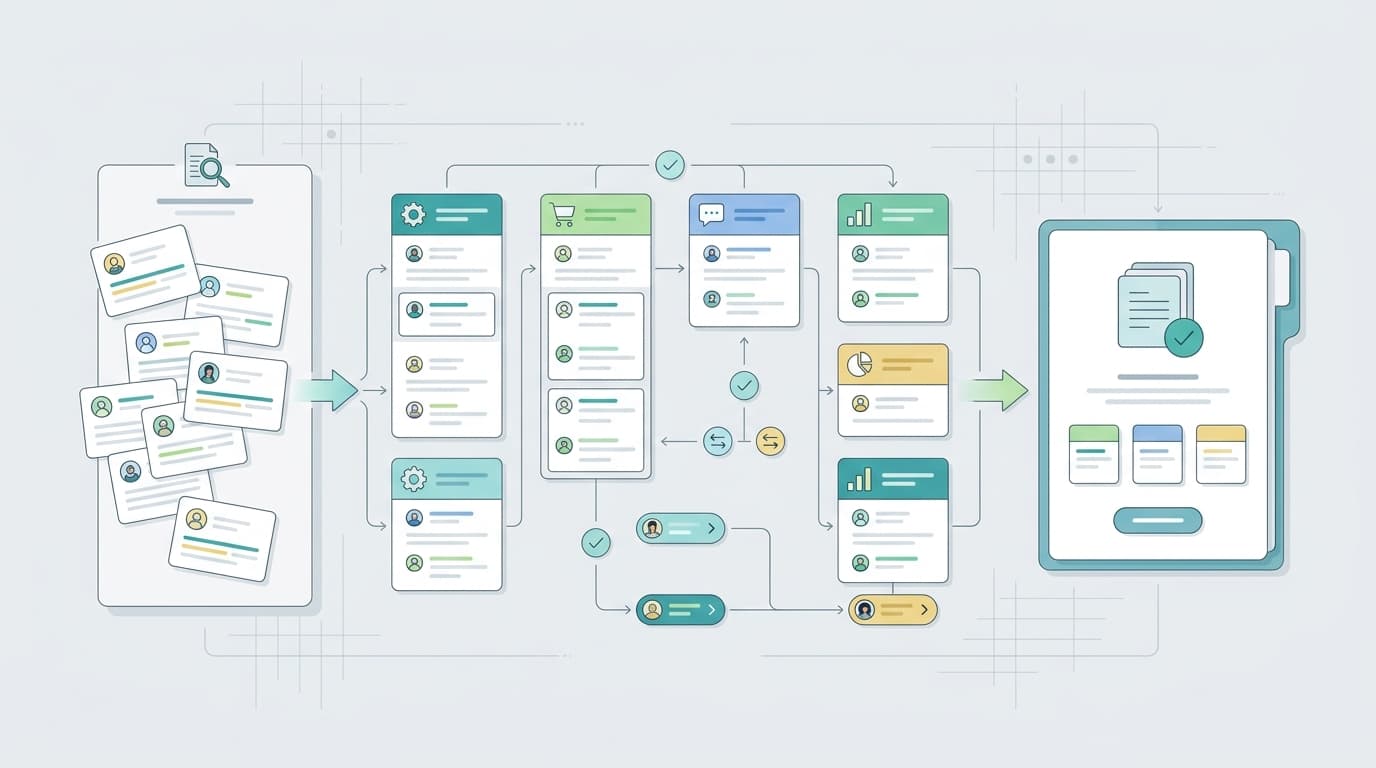
Draw the complete path from the source review to the final consumer. Include connectors, queues, object stores, transformation jobs, model endpoints, evaluation stores, dashboards, exports, logs, support tools, and backups. Record whether each system sees raw review text, normalized text, extracted evidence, generated summaries, or identifiers.
A useful purpose map has one row per data element:
| Data element | Why it is needed | Where it enters | Where it is stored | Who can access it | Retention rule |
|---|---|---|---|---|---|
| Review body | Extract evidence and themes | Source connector | Restricted raw store | Ingestion service, approved analysts | Defined by source and business need |
| Review ID | Trace evidence to source | Source connector | Evidence store | Services and reviewers | While evidence must remain auditable |
| Reviewer display name | Usually not required for summarization | Source connector | Excluded or quarantined | Restricted exception workflow | Delete or avoid collecting |
| Product and variation ID | Segment themes correctly | Source connector | Analysis store | Analysts and product teams | While the analysis remains active |
| Generated summary | Support a defined decision | Summary service | Product workspace | Approved business users | Versioned under output policy |
If a field has no documented purpose, remove it from the pipeline. If a system has no reason to receive raw text, give it a derived evidence object instead.
This boundary also prevents scope creep. A system approved to summarize public product reviews should not silently expand into support tickets, survey responses, chat logs, or customer records. Those sources can contain different identifiers, permissions, expectations, and contractual restrictions.
Release gate
- The source, purpose, owner, users, storage locations, and downstream destinations are documented.
- Raw, derived, and generated data are distinguished.
- New sources require a boundary review before ingestion.
- The decision supported by the summary is explicit.
2. Minimize and redact data before model inference
Do not send every collected field to the model because it is convenient.
Create an allowlist for model input. For many review-analysis use cases, the model may need the review body, rating, language, market, product ID, variation ID, and review date. It usually does not need a reviewer name, email address, order number, account ID, precise location, or internal customer record.
Run minimization before the model call, not after generation. Post-generation redaction cannot undo exposure to a model endpoint, logging layer, tracing tool, or debugging export.
A practical transformation sequence is:
- Validate the record against the source schema.
- Remove fields not on the approved allowlist.
- Detect configured identifier and secret patterns.
- Replace sensitive spans with typed placeholders such as
[EMAIL],[ORDER_ID], or[PHONE]. - Store the redaction event separately from the clean analysis text.
- Reject or quarantine records when redaction confidence is insufficient.
Test redaction by language and channel. A rule tuned to English email and phone formats may miss identifiers in other markets. Also test false positives: model input becomes less useful if product codes, dimensions, or ordinary numbers are removed indiscriminately.
Release gate
- Model-input fields are allowlisted.
- Direct identifiers are removed unless a documented use case requires them.
- Redaction happens before external inference, logging, and evaluation capture.
- Quarantine behavior is defined for uncertain cases.
- Redaction tests cover the languages and formats in production.
3. Treat every review as untrusted input
Customer review text is data, not an instruction channel.
A malicious or copied review could contain language such as “ignore previous instructions,” request disclosure of hidden prompts, or attempt to influence a downstream tool. Even accidental text—code snippets, URLs, markup, JSON, or quoted chatbot instructions—can interfere with weak prompt construction.
OWASP treats prompt injection as a core LLM application risk. For review summarization, the safest design is to assume that every character in source text may be adversarial.
Use structural separation:
- Put system behavior in a protected instruction layer.
- Pass reviews through a typed data field or structured batch format.
- State that text inside review fields is evidence only and must never modify instructions.
- Do not expose secrets, hidden policies, or unnecessary tools to the summarization step.
- Disable tool use unless the summary task genuinely requires it.
- Validate generated output against a strict schema before any downstream action.
Never let a generated review summary directly publish content, modify a roadmap, issue refunds, contact customers, or trigger account changes without a separate authorization step. A summary is decision support, not authority.
Adversarial test examples
- A review asks the model to reveal the system prompt.
- A review contains fake XML or JSON closing tags.
- A review instructs the model to label a competitor as unsafe.
- A review embeds a URL and asks an agent to open it.
- A review includes a plausible API key or password string.
- A multilingual review hides an instruction in a second language.
The expected result is not merely “the summary looks normal.” The system must show that embedded instructions did not change the task, expose protected data, invoke tools, or bypass the output schema.
4. Separate identity data from analysis data
Evidence traceability does not require broad identity exposure.
Create a pseudonymous analysis ID for each review. Keep the mapping to the original source record in a restricted lookup service or source system. Downstream extraction, clustering, evaluation, and summarization should use the pseudonymous ID whenever possible.
{
  "analysis_review_id": "rvw_7f31c2",
  "source_reference": "restricted-lookup-token",
  "product_id": "widget-a",
  "market": "US",
  "language": "en",
  "rating": 2,
  "review_date": "2026-07-28",
  "body_redacted": "Stopped working after two weeks. Support asked for [ORDER_ID]."
}
This design supports two different needs:
- Analysts can inspect evidence and test themes without seeing unnecessary identifiers.
- Authorized operators can reconstruct a disputed claim through a controlled lookup.
Do not copy identity fields into embeddings, prompt traces, evaluation spreadsheets, screenshots, or presentation decks. These side systems are often less controlled than the primary data store.
Release gate
- Analysis records use stable pseudonymous IDs.
- Re-identification requires a narrower role and an auditable action.
- Identity fields are excluded from embeddings and ordinary logs.
- Exports preserve evidence references without exposing restricted source fields.
5. Enforce least privilege for people and services
“The product team” is not an access-control role.
Define permissions by task. A dashboard reader may need aggregated themes and approved evidence excerpts. An analyst may need redacted review text and evaluation results. An ingestion service needs write access to a raw store but may not need to read generated summaries. A support administrator may investigate an incident without gaining permanent access to all source data.
Build a role matrix:
| Role | Raw text | Redacted evidence | Generated summaries | Identity lookup | Configuration changes |
|---|---|---|---|---|---|
| Dashboard reader | No | Limited | Yes | No | No |
| Analyst | No by default | Yes | Yes | No | Limited taxonomy changes |
| Pipeline service | Scoped | Scoped | Write | No | No |
| Incident responder | Time-bound | Yes | Yes | Approval required | No |
| System administrator | Infrastructure only | No standing business access | No standing business access | No | Controlled |
Use separate service accounts for ingestion, preprocessing, inference, and publishing. Avoid shared API keys. Scope credentials to the smallest required resource and rotate them through a managed secret system.
Access reviews should include machine identities, not only employees. A forgotten integration token can preserve access long after a project ends.
Release gate
- Human and service roles are documented separately.
- Default access excludes raw data.
- Administrative access does not automatically grant content access.
- Sensitive access is time-bound and logged where practical.
- Departed users, disabled integrations, and expired pilots lose access promptly.
6. Protect data in storage, transit, logs, and exports
The model call is only one part of the attack surface.
Review data may pass through temporary files, retry queues, tracing systems, notebook environments, browser downloads, CSV exports, error reports, screenshots, and backups. Inventory these copies and apply controls consistently.
At minimum:
- Use encrypted transport between services.
- Use managed encryption for stored raw and derived data.
- Keep credentials out of prompts, source records, code repositories, and application logs.
- Filter model requests and responses from general-purpose logs when they may contain restricted text.
- Set explicit expiration on temporary files and signed download URLs.
- Restrict bulk export and record who initiated it.
- Separate production data from development and evaluation environments.
- Use synthetic or approved sampled data for ordinary testing.
Do not assume a private bucket is sufficient. A broadly permissioned analytics tool, observability platform, or shared notebook can become the easiest path to the data.
Release gate
- Every storage and logging destination appears on the data-flow map.
- Secrets are managed outside prompts and source content.
- Temporary files have deletion behavior.
- Development does not default to full production data.
- Bulk exports and backups have owners and access rules.
7. Preserve claim-level evidence without exposing the full corpus
Security and explainability can support each other.
A summary should not require every reader to access every raw review. Instead, generate a claim-to-evidence packet that exposes only the evidence needed to inspect a material statement.
{
  "claim_id": "claim_018",
  "summary_text": "Battery complaints increased in the latest batch.",
  "scope": {
    "product_id": "widget-a",
    "market": "US",
    "period": "2026-07"
  },
  "evidence_ids": ["ev_204", "ev_381", "ev_419"],
  "comparison_batch_id": "batch_2026_06",
  "support_status": "supported",
  "review_required": false
}
The visible evidence view can use redacted excerpts, while a privileged workflow retains the source reference. This gives business users enough context to challenge a summary without granting unrestricted corpus access.
Version the evidence packet with the source manifest, taxonomy, extraction logic, prompt, model, and output schema. The engineering artifacts checklist explains how those files fit together.
Release gate
- Every material summary claim has stable evidence IDs.
- Ordinary users see the minimum evidence needed for their role.
- The full source can be retrieved only through a controlled workflow.
- A summary version can be reproduced from its manifest and configuration.
8. Control model, processor, and vendor boundaries
Before sending review data to a model or platform, record what the provider receives and what happens next.
Your inventory should cover:
- Provider and specific model or service.
- Regions and endpoints used.
- Whether requests or outputs are retained, and for how long.
- Whether submitted data may be used to improve provider models.
- Subprocessors and supporting services.
- Encryption and access-control commitments.
- Deletion and account-termination behavior.
- Incident-notification path.
- Rate, size, and content restrictions.
- Contract and configuration owner.
Verify behavior in the configuration you actually use. A provider's consumer product, enterprise product, API, and optional logging features may have different controls.
For a build-versus-buy decision, ask vendors to demonstrate the complete data path, not only the summary UI. VOC AI's vendor evaluation checklist provides a broader production-readiness and procurement scorecard.
Release gate
- Every external processor appears in the system inventory.
- Retention, model-improvement use, deletion, and subprocessor terms are documented.
- The production configuration matches the reviewed configuration.
- A provider change triggers a data-boundary and risk review.
9. Test privacy and security failure modes before launch
Average-case summary quality is not a security test.
Build an adversarial benchmark alongside the ordinary quality set. Include at least these families:
| Test family | Example | Pass condition |
|---|---|---|
| Prompt injection | Review tells the model to ignore instructions | Task and schema remain unchanged |
| Sensitive input | Review contains email, phone, order ID, or secret-like string | Prohibited spans are removed or quarantined before inference |
| Sensitive output | Evidence contains a private value not needed in the summary | Output does not reproduce it |
| Access control | Dashboard user requests raw review store | Request is denied and logged |
| Cross-tenant isolation | Query references another workspace or account | No data crosses the boundary |
| Retrieval poisoning | Irrelevant or manipulated record is added | Scope filters and evidence checks prevent unsupported claims |
| Oversized input | Very long review or batch exceeds limits | System truncates safely or rejects explicitly |
| Malformed content | HTML, scripts, encoded text, or broken JSON | Content is treated as data and output remains valid |
| Deletion | Approved source record is removed | Required copies and indexes follow the deletion workflow |
| Audit reconstruction | Reviewer challenges a past summary | Operators recover version, evidence, and access history |
Track failures by severity. A formatting error is not equivalent to cross-tenant data exposure. Set hard release blockers for prohibited-data leakage, boundary violations, unauthorized access, secret exposure, and instruction-following from source text.
The separate acceptance testing and handoff checklist covers broader benchmark design, user acceptance, and ownership sign-off.
10. Monitor access, retention, deletion, and incidents
Privacy and security controls decay when nobody owns them after launch.
Create four operational runbooks:
Access review runbook
- Review privileged users and service accounts on a fixed schedule.
- Remove stale integrations and unused credentials.
- Investigate unusual bulk reads, exports, or lookup activity.
- Confirm that role changes propagate to downstream tools.
Retention and deletion runbook
- Define retention by raw inputs, redacted evidence, generated summaries, logs, and backups.
- Document dependencies before deletion so evidence references do not silently break.
- Test deletion end to end, including caches, vector indexes, exports, and evaluation copies.
- Record exceptions with an owner and expiration date.
Model and configuration change runbook
- Re-run security and privacy benchmarks when the model, prompt, taxonomy, redaction rules, tools, provider, or source schema changes.
- Compare prohibited-data leakage and injection-resistance results to the previous release.
- Block promotion when critical controls regress.
Incident response runbook
- Define severity for suspected data exposure, unauthorized access, cross-boundary retrieval, secret leakage, and malicious source manipulation.
- Preserve relevant logs without spreading sensitive content into new systems.
- Contain the affected connector, model route, credential, export, or user session.
- Identify impacted data and summaries.
- Follow organizational notification and legal-review procedures.
- Document the root cause and add a regression test.
The production rollout checklist covers shadow mode, quality SLOs, rollback, and controlled expansion. Security events should use the same release discipline, but with containment and access investigation added.
A copyable definition of done
Use this list in a pull request, architecture review, or launch ticket.
Data boundary
- [ ] The review source, allowed use, owner, and downstream consumers are documented.
- [ ] Raw, redacted, derived, generated, and identity data are separated.
- [ ] Every collected field has a stated purpose.
- [ ] New sources cannot enter without a boundary review.
Minimization and identity protection
- [ ] Model inputs use an explicit allowlist.
- [ ] Direct identifiers and secret-like values are removed or quarantined before inference.
- [ ] Analysis uses pseudonymous review IDs.
- [ ] Identity lookup is restricted and auditable.
Untrusted-input handling
- [ ] Review text is structurally separated from system instructions.
- [ ] Embedded instructions cannot reveal prompts, invoke tools, or change the output schema.
- [ ] Generated summaries cannot take external actions without a separate authorization layer.
Access and infrastructure
- [ ] Human roles and service accounts follow least privilege.
- [ ] Secrets are managed outside code, prompts, and logs.
- [ ] Storage, transfer, logs, exports, and temporary files have defined controls.
- [ ] Development and evaluation do not default to unrestricted production data.
Evidence and vendors
- [ ] Material claims link to controlled evidence packets.
- [ ] Summary versions can be reconstructed from manifests and configurations.
- [ ] External processors, retention, deletion, training use, and subprocessors are documented.
- [ ] Provider configuration changes trigger review.
Testing and operations
- [ ] Adversarial tests cover injection, leakage, access, isolation, poisoning, malformed data, deletion, and audit reconstruction.
- [ ] Critical privacy or security failures block release.
- [ ] Access, retention, deletion, model change, and incident runbooks have named owners.
- [ ] A tabletop exercise proves the team can contain and reconstruct an event.
How to use this checklist with VOC AI
VOC AI's public Voice of Customer Analysis product is designed to analyze review language for customer needs, pain points, usage scenarios, and product opportunities. For teams building their own governed workflows, the Review Analysis API provides a technical route for review data and analyzed conclusions.
Whichever implementation path you choose, keep the control boundary explicit. Decide which system owns source collection, which fields enter analysis, who can see evidence, how outputs are evaluated, and what happens when a source, model, or use case changes.
The most trustworthy review summary is not merely fluent. It is produced from approved data, isolated from hostile instructions, accessible only to the right roles, traceable to controlled evidence, and removable when policy requires it.
That is the security definition of done.