Let’s be honest: The "Golden Era" of throwing a random product on Amazon and becoming a millionaire is over. In 2026, the market is saturated, and competition is fierce.
Most sellers fail not because they can't sell, but because they choose the wrong product. They rely on "gut feeling" or outdated lists.
This is why you need advanced Amazon product research tools. In 2026, these tools have evolved from simple sales estimators into AI-driven powerhouses that analyze customer sentiment, predict trends, and spy on competitors with terrifying accuracy.
In this blog, I curated the 7 best Amazon product research tools after running real campaigns and analyzing data accuracy.
They help you validate demand, calculate profitability, and understand exactly why customers buy—so you don't launch a flop.
TL;DR: What are the Best Amazon Product Research Tools?
The best strategy isn't relying on one tool, but using a stack. You need raw data (Jungle Scout/Helium 10), price history context (Keepa), and deep customer insight (VOC AI).
If you are in a hurry, have a look at the quick breakdown of my top picks.
Product | Best for | Key strength |
Helium 10 | SEO & Keyword-Driven Research | "Cerebro" reverse ASIN lookup for keyword gaps. |
VOC.AI | Customer Insight & Review Analysis | AI analysis of why people buy (Voice of Customer). |
SellerAmp | Arbitrage & Quick Scanning | Mobile-first scanning with instant ROI calculations. |
AMZScout | Budget-Friendly Research | Affordable lifetime options and solid PRO extension. |
Keepa | Price History & Data Accuracy | Tracking historical price drops and sales rank spikes. |
Jungle Scout | Overall Product Validation | High data accuracy and "Opportunity Finder." |
SmartScout | Wholesale & Brand Scouting | Visualizing market share and finding unoptimized brands. |
VOC.AI: Best for Customer Insight and Sentiment Analysis

Best for: Established brands, R&D teams, and product managers who need to understand why customers are buying (or returning) products.
Why I Pick It: VOC.AI is the "Intelligence Engine" of my stack. While other tools might just give you a word cloud of reviews, VOC.AI acts as a semantic analyst.
I specifically use it during the product development phase. For example, when I analyzed a competitor's headphones, VOC.AI didn't just say "bad quality." It grouped hundreds of reviews to reveal a specific root cause: "The charging port loosens after 3 months."
This allows me to fix issues my competitors are ignoring before I even manufacture my first unit. It automates the "reading" of thousands of reviews, turning messy feedback into a clear R&D roadmap.
Core Functionalities:
- Customer Profile & Usage Scenarios: It doesn't just read reviews; it builds a profile. It extracts demographics, usage contexts (e.g., "using at the gym" vs. "commuting"), and behavioral patterns directly from the text so you know exactly who you are designing for.
- Rating Optimization (The 4-Quadrant Model): A strategic visualizer that plots "Mention Frequency" against "Star Rating." It instantly separates critical threats (High Mention × Low Rating) from your key selling points (High Mention × High Rating), helping you prioritize fixes that actually save your score.
- Dimension-Based Pros & Cons: Automatically buckets messy feedback into specific technical dimensions—like "Sound Quality," "Battery Life," "Comfort," or "Workmanship"—with specific sentiment scoring for each.
- Purchase Motivation & Unmet Needs: Digs deeper to reveal the psychology of the sale—identifying the real reason users bought (e.g., "Cost-effectiveness" vs. "Brand Trust") and spotting the "gap" trends they are still asking for.
Limitations:
- Requires a sufficient volume of reviews (100+) to generate the deepest insights for the persona modeling.
- Highly specialized; it is an analytics tool, not a keyword ranking tracker.
Pricing:
- Free Plan: Basic access to AI review analysis features, ideal for beginners testing the waters.
- Pro Plan ($99/mo): For advanced product research. Includes 600 review analysis reports per month, market insights, and access to 10+ AI seller tools.
- Enterprise Plan (Custom): For large-scale businesses. Offers unlimited reports, API access for review analysis, and advanced AI listing optimization features.
Helium 10: Best for SEO & Keyword-Driven Research
Best for: Power users who want to dominate search rankings and reverse-engineer competitors.
Why I Pick It: If Jungle Scout is for finding the product, Helium 10 is for ensuring it ranks. My favorite tool in their suite is Cerebro.
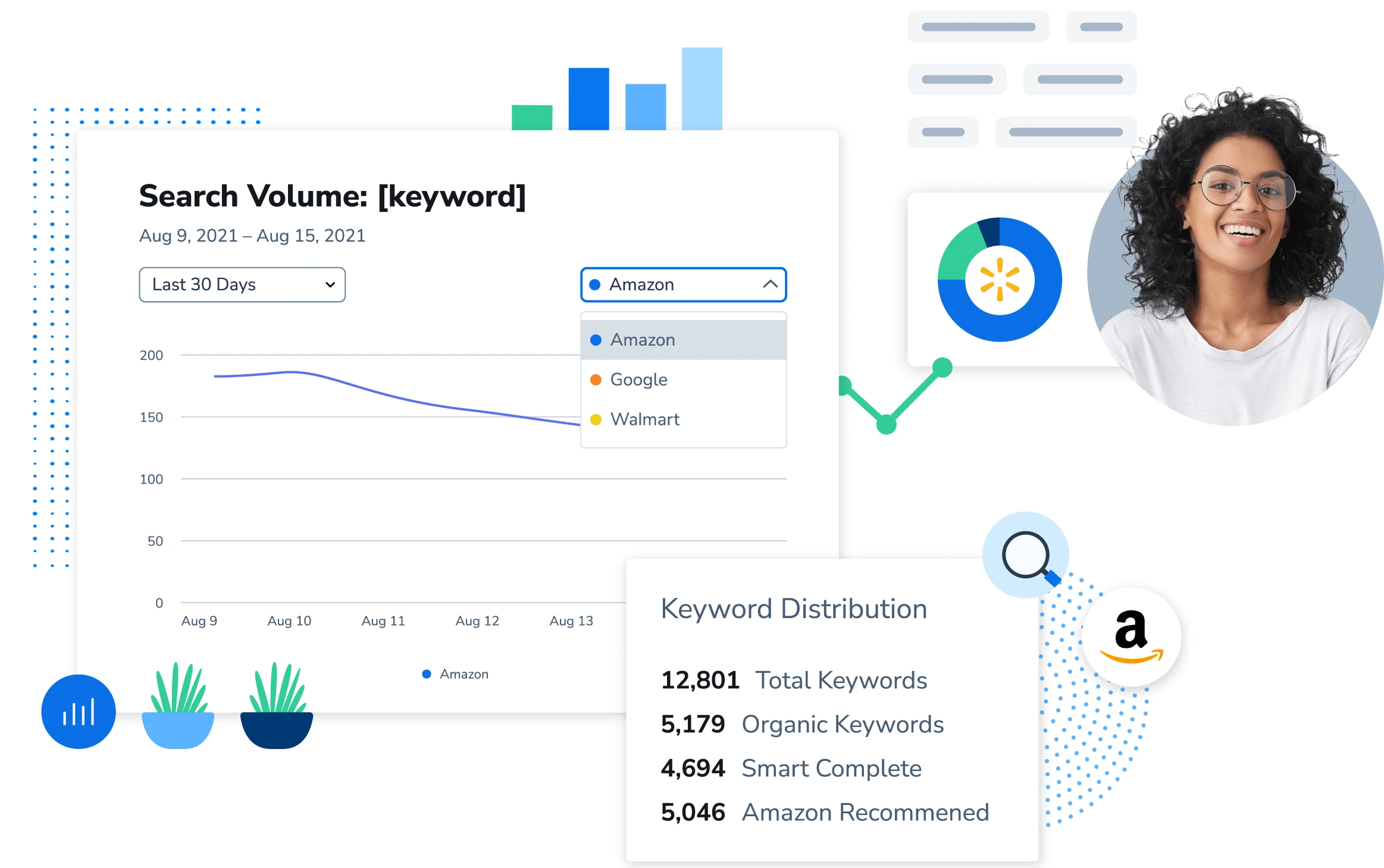
I simply paste a competitor's ASIN, and Cerebro reveals every single keyword they rank for, including their organic rank and sponsored rank. This allows me to see exactly where their traffic is coming from.
It’s an absolute beast for data. The "Black Box" tool is similar to Jungle Scout's database but offers granular filters like "Title Density" (how many competitors are actually using the keyword in their title), which is a secret weapon for finding low-competition keywords.
Core Functionalities:
- Cerebro: Reverse ASIN lookup to spy on competitor keywords.
- Magnet: Finds thousands of relevant keyword variations.
- Xray: Their Chrome extension for instant market validation.
- Adtomic: Built-in PPC management (for higher tiers).
Limitations:
- The learning curve is steep. It has so many tools that it can be overwhelming for day 1 beginners.
- The interface can feel a bit "cluttered" compared to the modern design of VOC tools.
Pricing:
- Free Plan: Good for testing basic features like Xray.
- Platinum Plan($129/mo): The standard for most sellers; includes all core research tools and AI advertising.
- Diamond Plan($359/mo): For experts scaling up; adds Walmart data and unlimited TikTok search.
SellerAmp SAS: Best for Arbitrage and Quick Scanning

Best for: Retail Arbitrage (RA) and Online Arbitrage (OA) sellers who need speed.
Why I Pick It: When you're scanning items in a store or browsing online retailers, you don't have time for deep data dives. You need a "Buy or Pass" decision in seconds.
SellerAmp lives on my phone. I scan a barcode, and it instantly tells me:
- Is it gated (am I allowed to sell it)?
- What's the ROI after fees?
- Does the brand file IP complaints?
It saves me hours of manual calculation. The "Storefront Search" feature lets me spy on other successful arbitrage sellers to see what they are restocking.
Core Functionalities:
- Mobile App: Powerful scanner for in-store sourcing.
- Chrome Extension: Sidebar view that doesn't block the page.
- Profit Calculator: Automatically factors in FBA fees and shipping.
- Restriction Check: Alerts you if you need approval to sell.
Limitations:
- Solely focused on reselling existing products. Not for creating new ones.
Pricing:
- Getting Started: $19.95/month.
- Getting Serious: $29.95/month.
AMZScout: Best for Budget-Friendly Research
Best for: New sellers on a budget who want reliable data without a massive monthly subscription.
Why I Pick It: AMZScout offers a "Lifetime" deal that pops up occasionally, which is a game-changer for bootstrapped sellers.
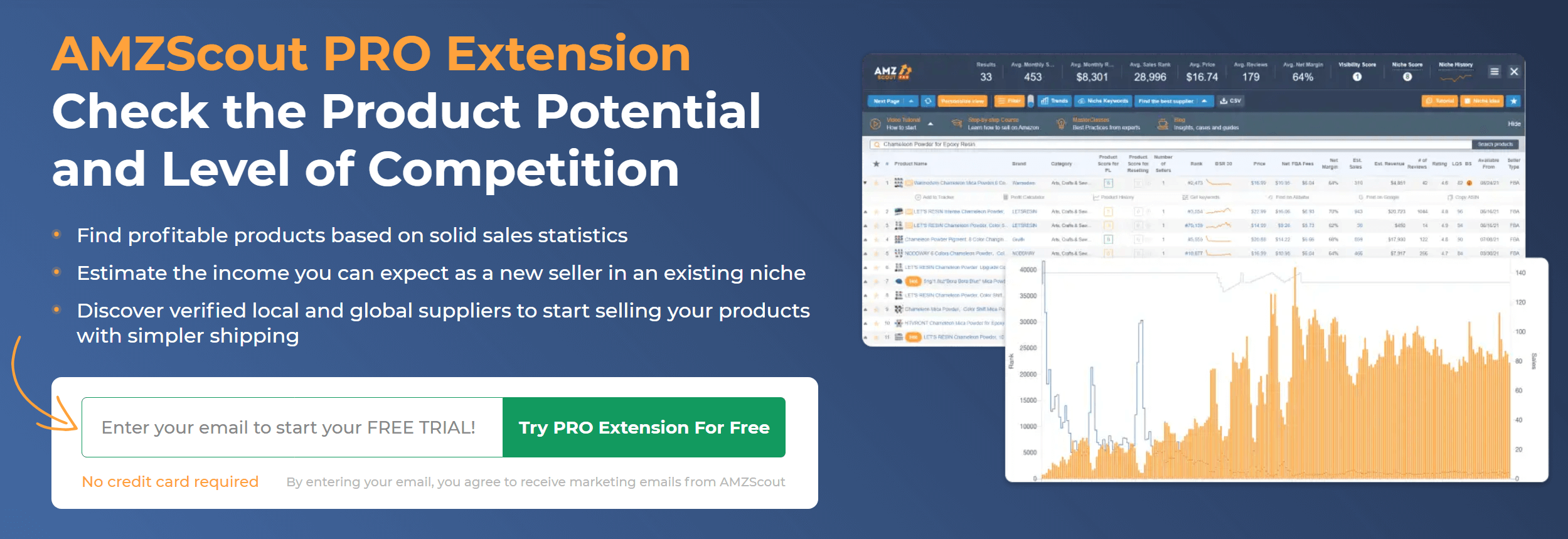
Even without that, their PRO Extension is a solid alternative to Jungle Scout. It’s lightweight, fast, and gives you all the essential metrics: estimated sales, revenue, reviews, and listing quality score.
I often recommend this to students who can't afford the $100+/mo suites yet. It gets the job done without the enterprise bloat.
Core Functionalities:
- PRO Extension: Quick snapshot of niche profitability.
- Keyword Search: Good volume data.
- Product Database: Similar filtering to the big players.
- Stock Stats: Spy on competitor inventory levels.
Limitations:
- Data accuracy is slightly lower than Jungle Scout/Helium 10 in some niche categories.
- Fewer advanced features like PPC automation.
Pricing:
- Monthly Plan($59.99/mo): Flexible access to the full AMZScout AI Bundle.
- Yearly Plan($399.99/year): The "Best Value" choice; includes 3 months free, a personal mentor call, and exclusive product ideas.
Keepa: Best for Price History and Data Accuracy
Best for: Data nerds and anyone who hates losing money on seasonal fads.
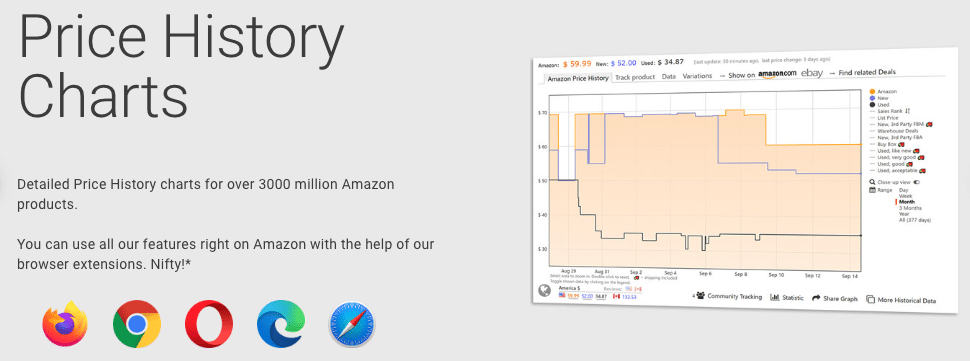
Why I Pick It: Keepa is the ugliest tool on this list, and I love it.
While other tools give you a snapshot of right now, Keepa shows the history.
I once almost launched a "popular" pet toy because Jungle Scout said it was making $30,000/month. Then I checked Keepa. The price had just dropped 50% for Prime Day, artificially spiking the sales rank. Without Keepa, I would have launched at the wrong price point and failed.
Core Functionalities:
- Price History Charts: See every price change for years.
- Sales Rank History: Understand true demand velocity.
- Buy Box Statistics: See who is actually winning the Buy Box (Amazon vs. 3rd Party).
- Product Finder: A brutally efficient database search.
Limitations:
- The UI looks like it's from 2005. Seriously.
- Zero marketing fluff or hand-holding—you need to know what you're looking for.
Pricing:
- Free: Basic price tracking (limited).
- Keepa Pro: Full data access.
Jungle Scout: Best for Overall Product Validation
Best for: Beginners and pros alike who need the industry standard for sales estimation.
Why I Pick It: Jungle Scout is the tool that started it all, and it remains the most user-friendly.
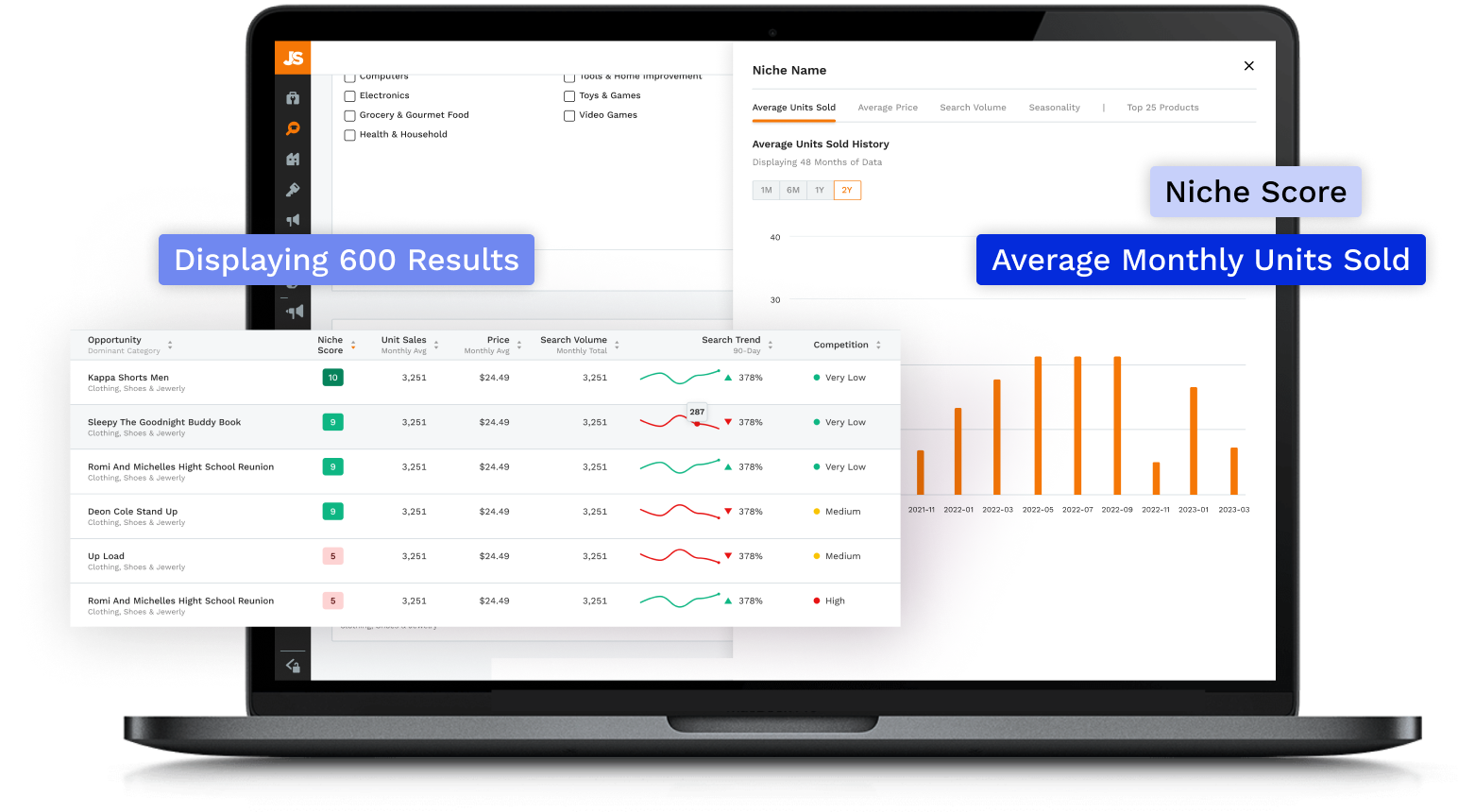
I specifically rely on their Opportunity Finder. I can set filters like "High Demand," "Low Competition," and "Poor Listing Quality" to uncover niches I never would have thought of (like "inflatable kayak accessories").
Their data accuracy is consistently top-tier. When I check my own products on Jungle Scout, their revenue estimates are usually within a 10-15% margin of error, which is impressive for an algorithm.
Core Functionalities:
- Product Database: A massive catalog of Amazon products filterable by practically any metric.
- Cobalt: Enterprise-level data for bigger brands.
- Supplier Database: Helps you find the factory that makes the competitor's product.
- AI Assist: Helps write listing copy based on top keywords.
Limitations:
- Can be pricey for new sellers just starting out.
- The Chrome extension is sold separately in some legacy plans (now mostly bundled).
Pricing:
- Starter Plan($29/mo): Best for launching with industry-leading product and keyword research tools.
- Growth Accelerator($49/mo): Adds advanced research functionality and tools for growing sellers.
- Brand Owner($129/mo): The ultimate tier with unrivaled unlimited functionality and all Competitive Intelligence features.
SmartScout: Best for Wholesale and Brand Scouting
Best for: Wholesale sellers and those looking for unoptimized brands to resell.
Why I Pick It: SmartScout is built by a top Amazon seller (Scott Needham) specifically for finding brands, not just products.
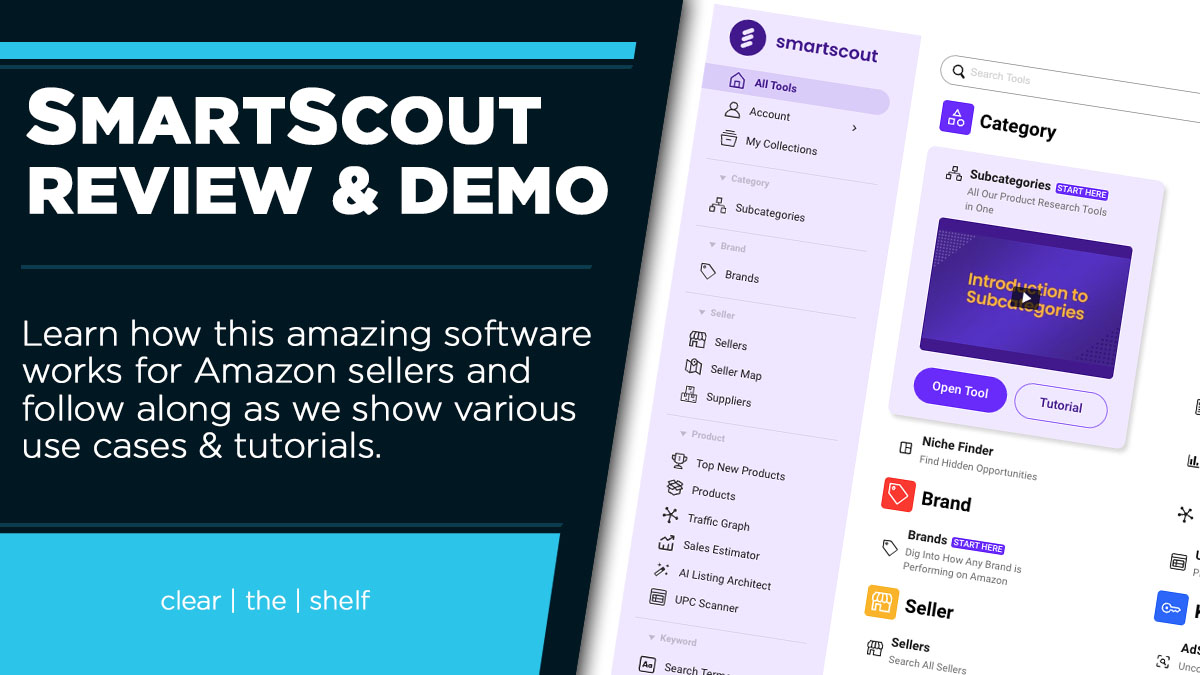
Its "Sub-Category Map" is genius. Instead of a list, it shows you a visual heatmap of every category on Amazon, highlighting where the money is flowing and where the competition is weak.
I use it to find brands that are selling well but have terrible listings (bad photos, no A+ content). Then I contact them to open a wholesale account and fix their listings.
Core Functionalities:
- Brand Search: Filter by "Percentage of Amazon as Seller" to avoid competing with Amazon.
- Traffic Graph: Visualize which ASINs drive traffic to others.
- FBA Calculator: Built-in profitability check.
- UPC Scanner: Upload a supplier catalog to instantly find profitable items.
Limitations:
- Designed primarily for wholesale/arbitrage, less useful for Private Label product creation.
Pricing:
- Basic Plan($29/mo): Simple and reliable tools for finding profitable opportunities, including full access to the Brands and Products databases.
- Essentials Plan($97/mo): Adds advanced operations tools like the Seller Map and Keyword Rank Tracking for faster scaling.
- Business Plan($187/mo): The "Most Popular" tier for dominating a category; unlocks the critical Customer Traffic Networks (Traffic Graph) and Subcategories Database.
- Custom($399/mo): For enterprise research needing historical brand reports, competitor ad data, and Data Lake access.
FAQ
What is the most accurate Amazon product research tool?
In my testing for 2026, Jungle Scout and Keepa consistently show the most accurate sales velocity and price history data. However, VOC.AI is the most accurate for qualitative data (customer sentiment).
Can I do product research for free?
Technically, yes, using the Amazon search bar and counting reviews manually. But in 2026, you will be competing against AI-armed sellers. Tools like Keepa (free version) and Helium 10 (Xray free trial) offer limited access to get started.
Why is VOC (Voice of Customer) important?
Because data tells you what is selling, but VOC tells you why. If you launch a product based only on numbers, you might copy a product that customers hate (and return). Tools like VOC.AI help you fix product flaws before you even manufacture your first unit.