How to Use Amazon Review Analysis to Validate Category Trends
Category trend data can show where demand appears to be moving. It cannot, by itself, explain why buyers choose one product, tolerate another, return a third, or keep searching for a better option.
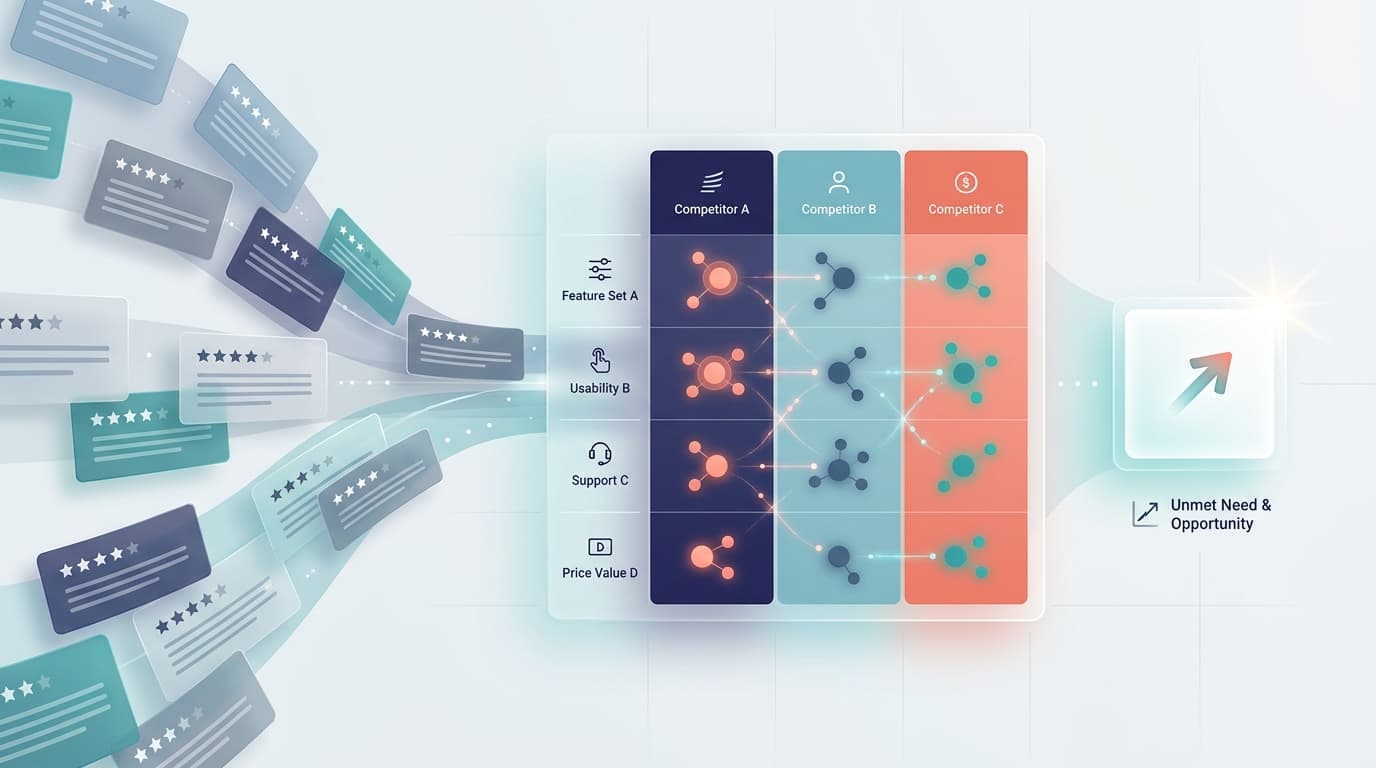
That is where Amazon review analysis becomes useful. Before committing to samples, purchase orders, or launch inventory, teams can compare market signals with patterns in buyer language. The goal is not to predict demand from reviews. It is to test whether a promising category contains a recurring customer problem that your team can solve and support profitably.
This workflow complements the broader Amazon market research framework. Use market data to identify a possible opportunity, then use review evidence to decide whether the opportunity is clear enough to advance.
Why category trends need a buyer-evidence layer
An attractive trend chart can hide important differences between categories.
Demand may be rising because of seasonality, a temporary event, a new use case, aggressive discounting, or genuine long-term adoption. A category may also look open while its buyers are satisfied with the current tradeoffs. Conversely, a crowded category may still contain a valuable opening if customers repeatedly struggle with a specific use case that incumbents do not serve well.
A practical decision therefore needs two layers:
| Decision layer | Questions it should answer | Typical evidence |
|---|---|---|
| Market layer | Is interest durable? How seasonal is it? How concentrated is competition? What price and review barriers exist? | Trend direction, seasonality, pricing, BSR context, review counts, incumbent movement, category structure |
| Buyer-evidence layer | Why do people buy? What fails? Which compromises do they accept? What remains unresolved? | Review themes, motivations, usage scenarios, expectation gaps, product-version context, recurring tradeoffs |
Amazon's Product Opportunity Explorer, for example, describes niche research using information that includes searches, purchases, reviews, pricing, and other marketplace signals. The important lesson is not to choose one data type over another. It is to connect market behavior with customer evidence before making an inventory decision.
If you are still screening broad demand and competitive movement, start with an Amazon category trend analysis. Once a category passes that first screen, use the workflow below to pressure-test the opportunity.
Step 1: Write a falsifiable trend hypothesis
Do not begin by downloading thousands of reviews. Begin with a statement that can be challenged.
A useful hypothesis names:
- The customer segment.
- The use case or desired outcome.
- The apparent category movement.
- The suspected unmet need.
- The business constraint that could invalidate the idea.
For example:
We believe demand is growing among apartment dwellers who want a compact version of this product, but current options create repeated storage and cleaning problems. We should not enter if those complaints are limited to old models, rare misuse, or features that would make the product uneconomical to manufacture.
This is stronger than “the category is trending.” It tells the analyst what evidence to seek, what would count against the idea, and which assumption matters most.
Step 2: Build a representative competitor cohort
One product is not a category. A single bestseller can overrepresent one brand, price point, design choice, or buyer segment.
Build a cohort that reflects the decision you are evaluating. Depending on the category, include:
- Market leaders: High-visibility products that define buyer expectations.
- Fast movers: Newer or rapidly gaining products that may reveal an emerging use case.
- Price tiers: Budget, mid-range, and premium options where tradeoffs differ.
- Design approaches: Products solving the same job with different materials, formats, or feature sets.
- Relevant variants: Sizes, bundles, generations, or models that meaningfully change the experience.
- Weak but informative competitors: Products with lower ratings or concentrated complaints that expose category failure modes.
Use Amazon competitor analysis to organize the cohort around comparable products rather than simply selecting the first results on a keyword page.
Avoid mixing incompatible evidence
Review analysis becomes misleading when analysts combine evidence from products that serve different jobs. A travel version, professional version, and entry-level home version may share a keyword but attract buyers with different expectations.
Record the product's intended segment, price band, variant, model generation, and observation period. If the listing changed substantially, separate older and newer reviews when possible.
Step 3: Extract five types of buyer evidence
A useful Amazon review analysis goes beyond positive-versus-negative sentiment. It identifies the structure behind the feedback.
1. Pain points
What repeatedly creates frustration, failure, return risk, or extra work? Separate product defects from packaging, fulfillment, seller service, and expectation-setting problems because each requires a different response.
2. Purchase motivations
What outcome caused the buyer to choose the product? Motivations may include convenience, portability, durability, appearance, compatibility, speed, safety, gifting, or a specific situational need.
3. Usage scenarios
Where, when, and how is the product used? Scenario evidence often reveals opportunities that broad category labels miss: small spaces, travel, outdoor use, shared households, professional workflows, elderly users, or frequent cleaning.
4. Tradeoffs
What compromise does the buyer knowingly accept? Customers may tolerate higher weight for durability, lower capacity for portability, or a higher price for easier maintenance. A product opportunity is stronger when the team understands which tradeoffs are acceptable and which are purchase blockers.
5. Expectation gaps
What did the listing, image, category convention, or price imply that the experience did not deliver? Expectation gaps can sometimes be fixed through product design. Others are better solved through clearer positioning, instructions, or packaging.
VOC AI's voice-of-customer analysis is designed to help teams structure customer language into themes such as motivations, scenarios, strengths, weaknesses, and unmet needs. Whatever tool you use, preserve enough product and time context to trace a theme back to its evidence.
Step 4: Test each theme for recurrence, recency, spread, and solvability
Finding a complaint is easy. Deciding whether it supports a category opportunity is harder.
Use four tests for every high-priority theme:
| Test | Question | Stronger signal | Warning sign |
|---|---|---|---|
| Recurrence | Does the issue appear repeatedly within the relevant review set? | The same outcome appears in multiple independently written reviews | One memorable complaint dominates the discussion |
| Recency | Is the issue still present in recent products and reviews? | The theme continues after recent model or listing updates | Complaints mainly refer to an old version or resolved defect |
| Spread | Does the issue appear across several comparable competitors? | Multiple brands or design approaches produce the same unmet outcome | The issue is isolated to one seller, shipment, or product |
| Solvability | Can your team address it without breaking cost, safety, usability, or lead-time constraints? | A clear product, packaging, instruction, or positioning response exists | The desired fix conflicts with economics or creates a worse tradeoff |
These tests are editorial decision aids, not universal statistical thresholds. The required evidence should increase with the cost and reversibility of the decision. A small prototype test can proceed with more uncertainty than a large inventory commitment.
Step 5: Look for disconfirming evidence
Confirmation bias is especially dangerous after a team finds an exciting trend.
Assign someone to make the case against the opportunity. Search for evidence that:
- The complaint is concentrated in an older product generation.
- Buyers caused the problem through an unusual or unsupported use case.
- Positive reviewers explicitly prefer the current tradeoff.
- A leading competitor has already fixed the issue.
- The apparent need belongs to a small segment that cannot support the economics.
- The fix would increase size, cost, complexity, support burden, or failure risk.
- Reviews describe frustration, but not enough purchase motivation to switch.
- The category movement is mostly seasonal or promotional rather than durable.
Disconfirming evidence does not automatically kill an idea. It makes the decision more precise. You may discover that the opportunity belongs to a narrower segment, a different price tier, a clearer listing promise, or a later launch window.
Step 6: Connect review themes to feasibility
A recurring customer problem is not yet a product opportunity. Convert the theme into a testable response and evaluate the operational consequences.
For each theme, document:
| Field | What to record |
|---|---|
| Customer outcome | The job the buyer is trying to complete |
| Evidence | Products, review period, variants, and paraphrased theme |
| Proposed response | Product, packaging, instruction, service, or positioning change |
| Benefit hypothesis | Why the change could improve the buyer outcome |
| Tradeoff introduced | Added cost, weight, complexity, lead time, or new failure mode |
| Validation test | Prototype, supplier check, usability test, pricing test, or concept test |
| Stop condition | Evidence that would make the team reject or redesign the response |
After a category passes this stage, the next step is to turn competitor complaints into product requirements. Keeping the category-validation gate separate from specification work prevents teams from designing a solution before confirming that the underlying problem is broad, current, and strategically relevant.
Step 7: Use a red, yellow, or green inventory gate
Summarize the evidence in a decision table that forces assumptions into the open.
Green: advance to controlled validation
Use green when:
- Market evidence suggests durable or strategically timed demand.
- The buyer problem recurs across a relevant competitor cohort.
- Recent evidence shows the problem remains unresolved.
- The theme matters to a clearly defined customer segment and use case.
- The proposed response appears feasible within target economics.
- Major disconfirming evidence has been investigated.
Green should lead to the next controlled test, not an automatic full purchase order. Examples include supplier feasibility checks, prototypes, concept tests, small-batch validation, or pricing research.
Yellow: gather targeted evidence
Use yellow when the opportunity is plausible but one or more critical assumptions remain weak. Common reasons include limited recent evidence, unclear segment size, mixed tradeoff preferences, variant confusion, or uncertain manufacturing cost.
A yellow decision must include an owner, a next test, and a deadline. Otherwise, it becomes a parking lot for attractive but unverified ideas.
Red: stop or redefine the opportunity
Use red when the trend is weak or temporary, the problem is isolated, the need has already been solved, the customer segment is strategically irrelevant, or the fix cannot meet business constraints.
Red is a useful outcome. It prevents more expensive learning after inventory has been committed.
A synthetic example: compact countertop appliances
The following example is synthetic and illustrates the method. It does not describe a specific Amazon category or actual customer quotes.
A team sees growing interest in compact countertop appliances for small apartments. It selects eight comparable products across three price tiers and separates current models from discontinued versions.
The review analysis identifies three candidate themes:
| Theme | Recurrence | Recency | Spread | Solvability | Initial gate |
|---|---|---|---|---|---|
| Difficult cleaning after everyday use | Repeated | Current | Multiple designs | Potentially addressable with removable components | Green for prototype investigation |
| Capacity feels too small | Repeated | Current | Broad | Fix may undermine compact positioning | Yellow; segment and tradeoff test needed |
| Control labels wear off | Occasional | Mostly older reviews | Two products | Straightforward material or printing change | Yellow; verify current models first |
The market trend remains promising, but the review evidence changes the product thesis. The opportunity is not simply “make a smaller appliance.” It may be “make a compact appliance that is easier to clean without increasing storage footprint.”
The capacity complaint requires more caution. Some buyers may knowingly accept lower capacity to gain portability and storage convenience. Increasing size could remove the reason the target segment buys the product. The team should test the tradeoff before treating frequency as proof of a feature requirement.
Review-analysis mistakes that create false confidence
Treating review frequency as market size
A recurring theme shows that an issue exists in the observed review set. It does not reveal total addressable market or future unit demand. Keep demand estimation in the market layer.
Using only low-star reviews
Critical reviews expose failure modes, but positive and neutral reviews reveal motivations, acceptable compromises, and successful scenarios. Analyze the full experience.
Ignoring version and variant changes
An old defect can survive in the review history long after a product changes. Separate evidence by model, variant, and time window whenever those differences affect the customer experience.
Comparing only bestsellers
Leaders define expectations, but they may not reveal emerging segments or alternative designs. Include fast movers, price tiers, and contrasting approaches.
Inventing precision
Do not convert an unstructured sample into a universal benchmark. Record the review set, selection method, time period, exclusions, and uncertainty.
Choosing a tool based only on summaries
An Amazon review analysis tool should help you preserve context, compare products, organize recurring themes, and move from evidence to a decision. A fluent summary without cohort, source, recency, or variant context can hide the exact uncertainty you need to manage. This customer review analysis tool guide explains the criteria in more detail.
A copyable category-validation worksheet
Use this structure for each category hypothesis:
| Decision field | Team entry |
|---|---|
| Trend hypothesis | Which segment, use case, and market movement are we testing? |
| Competitor cohort | Which products, price tiers, designs, variants, and periods are included? |
| Strongest buyer motivation | Why do relevant buyers choose current products? |
| Highest-priority pain | Which repeated outcome creates meaningful friction or failure? |
| Recurrence evidence | How consistently does the theme appear in the relevant set? |
| Recency evidence | Does it remain visible in current models and recent reviews? |
| Spread evidence | Does it cross brands and design approaches? |
| Disconfirming evidence | What argues against the opportunity? |
| Proposed response | What product, packaging, instruction, or positioning change could help? |
| Feasibility risk | What cost, safety, support, quality, or lead-time constraint could block it? |
| Next test | What is the cheapest reliable way to reduce uncertainty? |
| Inventory gate | Red, yellow, or green—and why? |
Turn a promising trend into a defensible decision
Amazon product research works best when market signals and buyer evidence challenge each other.
Use trend, seasonality, price, competition, and marketplace data to identify where an opportunity may exist. Then use review analysis across a representative competitor cohort to understand the customer outcome, recurring problem, accepted tradeoff, and unresolved expectation gap. Finally, test whether your team can solve the problem within real operational constraints.
VOC AI helps ecommerce teams move between market insight, review evidence, competitor context, and product research. The objective is not to manufacture certainty. It is to make the next inventory decision more traceable, testable, and difficult to fool with one attractive chart or one memorable complaint.
Validate trend data with review language before buying inventory.