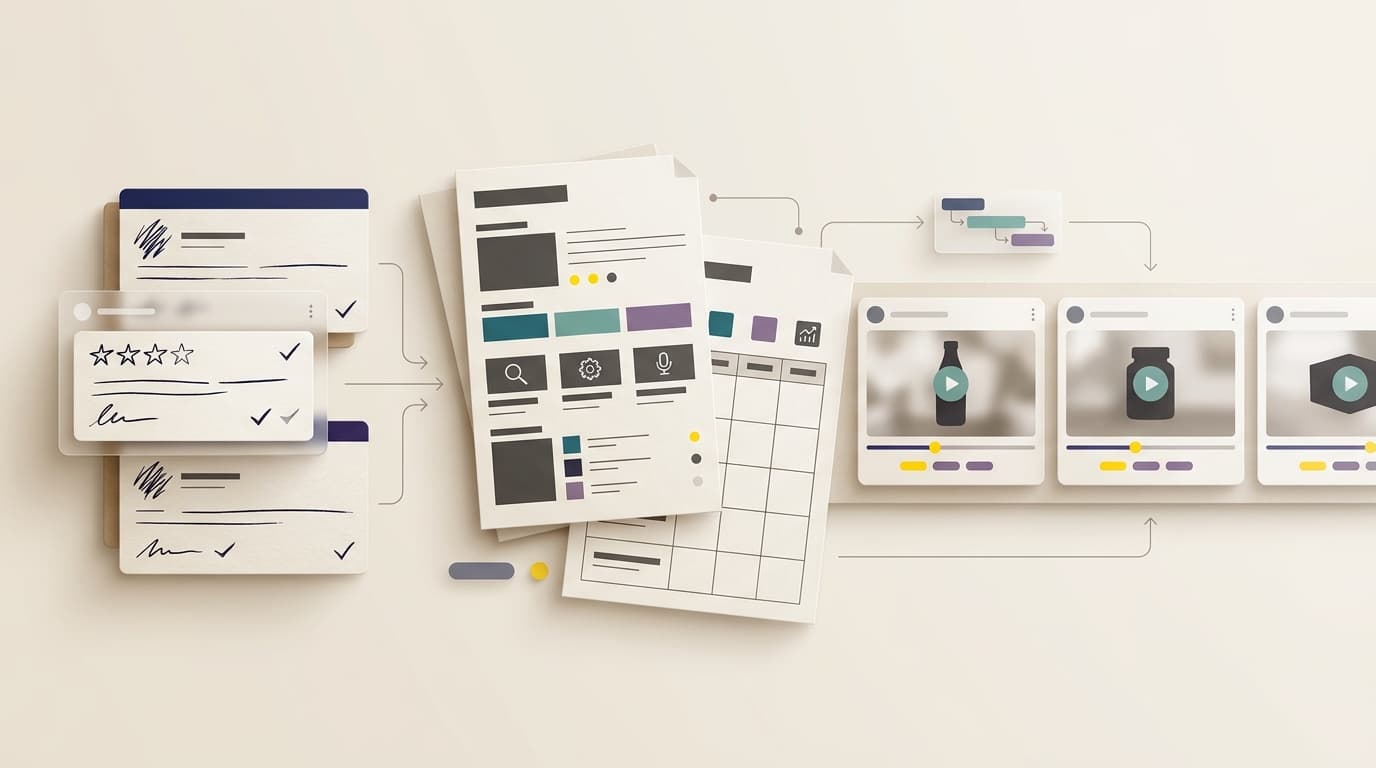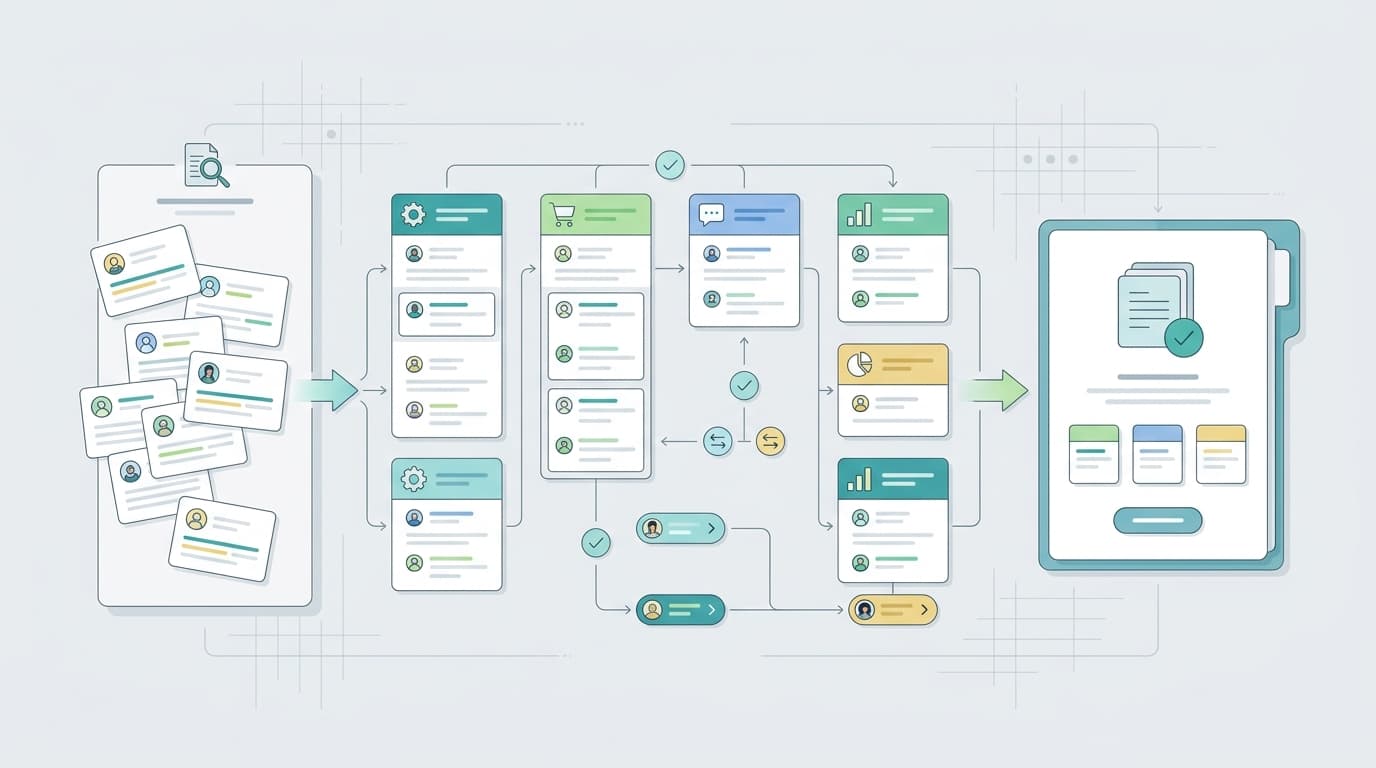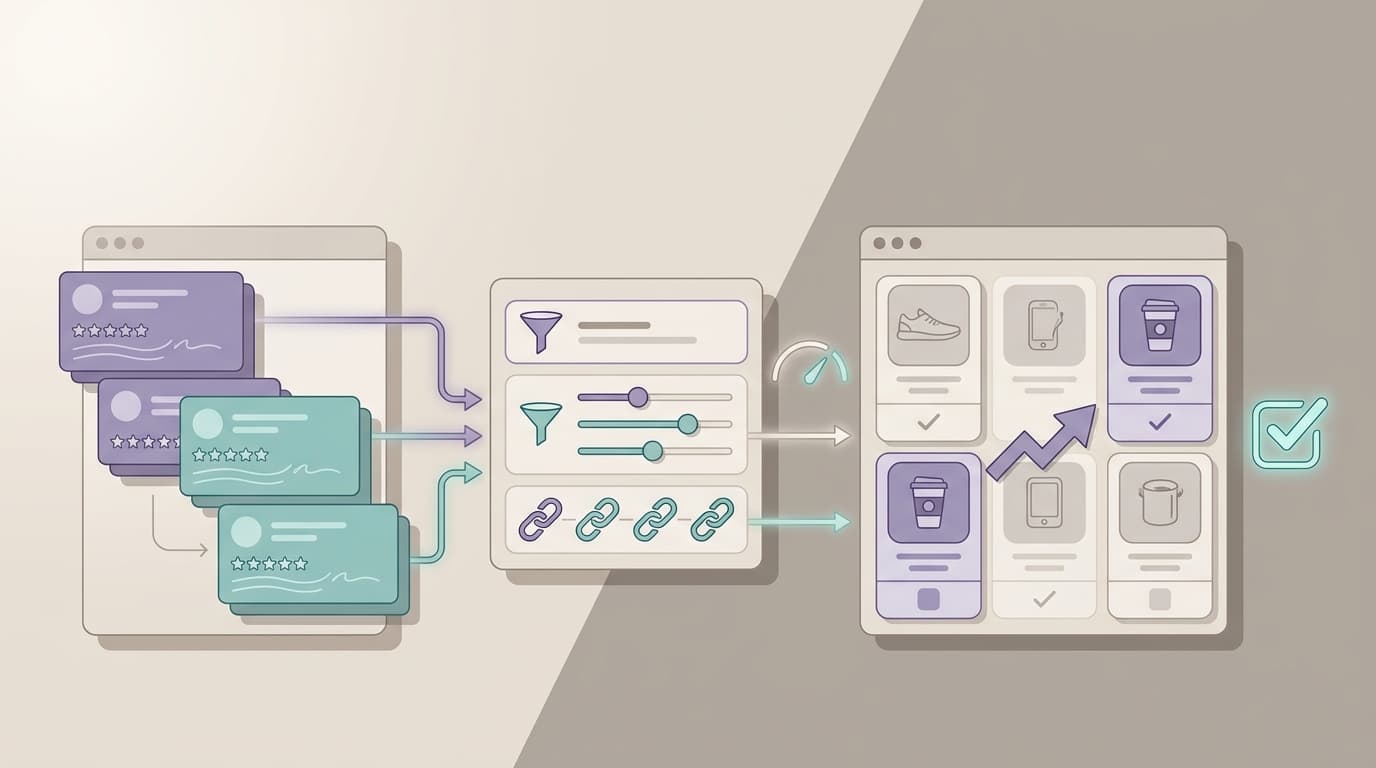
Ecommerce teams rarely lack customer feedback. They lack a reliable way to connect it.
Product reviews reveal defects, unmet needs, buyer language, and usage scenarios. Customer support conversations expose setup friction, expectation gaps, and urgent problems. Social comments show emerging reactions, questions, and public sentiment. Each source has a different context, and specialist tools can be excellent at managing it.
The problem appears when product, CX, and growth need to make one decision from evidence stored across several systems. Themes are labeled differently. Reports use different time windows. Customer quotes lose their source context. Analysts spend more time reconciling summaries than evaluating what the business should do.
That is the real choice behind customer feedback analysis software for ecommerce: not simply one tool versus many, but whether your feedback stack helps teams preserve specialist depth while reducing coordination cost.
This guide compares three practical models—separate specialist tools, a shared feedback-analysis layer, and a hybrid stack—and gives you a scorecard and 30-day pilot to choose among them.
The Short Verdict: Choose the Stack That Reduces Decision Friction
There is no universal winner.
- Choose separate specialist tools when one team owns each source, decisions rarely overlap, and channel-native execution matters more than cross-functional analysis.
- Choose a shared analysis layer when several teams repeatedly interpret the same customer themes and manual synthesis has become a recurring bottleneck.
- Choose a hybrid stack when you need specialist systems for case management, replies, publishing, or source operations, but also need one coordinated evidence layer for product, CX, and growth decisions.
For established ecommerce teams, the hybrid model is often the most practical starting point. It avoids the false choice between replacing every system and accepting permanent fragmentation. Specialist tools can remain systems of record and execution, while a shared layer helps normalize themes, preserve evidence, and support a common decision cadence.
The important test is not whether the new layer creates another dashboard. It is whether the team spends less time merging reports and more time making traceable decisions.
What Customer Feedback Analysis Software for Ecommerce Actually Does
Customer feedback analysis software for ecommerce helps teams collect or ingest customer evidence, identify recurring themes, preserve source context, compare changes, and route insights into product, CX, and growth workflows.
For a broader category-selection framework, see this guide to customer feedback analysis software for ecommerce teams.
That definition separates analysis from adjacent jobs.
| Job | What it manages | Typical examples |
|---|---|---|
| System of record | Original source history and operational context | Reviews, tickets, CRM records, social conversations, survey responses |
| System of execution | Actions taken in a channel or business workflow | Replying, closing cases, publishing content, updating a roadmap, changing a listing |
| System of analysis | Cross-source themes, evidence, comparisons, priorities, and decisions | Shared taxonomy, trend review, evidence traceability, decision logs |
A support platform may be the right place to manage a case. A social platform may be the right place to publish or reply. A review-management tool may be the right place to monitor ratings or marketplace activity. None of that automatically gives product, CX, and growth a shared way to interpret overlapping customer problems.
If your team is still building the basic workflow, start by learning how to analyze ecommerce feedback across reviews, support, and social. The comparison here begins when those sources already exist but the handoffs between them are costly.
Why Separate Review, CX, and Social Tools Become Hard to Coordinate
Separate tools are not inherently a problem. Fragmented interpretation is.
Imagine a kitchen appliance receiving reviews that mention “hard to clean.” Support tickets describe residue under a removable part. Social comments ask whether the product is dishwasher-safe. These signals may belong to one underlying theme, but each system may label and report it differently.
Product might call it a design-maintenance issue. CX may classify it as a cleaning-instructions question. Growth may see a product-page information gap. If the three teams never compare evidence, they may create three partial responses:
- Product investigates a redesign without knowing that clearer instructions resolve many cases.
- CX writes a new help article without seeing that complaints persist after correct use.
- Growth adds a dishwasher-safe claim without checking the limits of the product design.
The cost is not only duplicate analysis. It is the risk of conflicting action.
Taxonomy drift
Each team develops labels that match its own workflow. “Cleaning difficulty,” “residue issue,” “maintenance question,” and “dishwasher objection” may describe the same customer experience. When the labels do not map to a shared theme, counts cannot be compared and trend changes become ambiguous.
Lost evidence context
Summaries often travel farther than the original evidence. A slide may say “customers dislike cleaning,” but omit the product variant, usage scenario, rating, ticket outcome, market, date range, or representative wording. The receiving team cannot tell whether the signal is broad, recent, severe, or solvable.
Duplicate reporting
Three teams may each collect examples, summarize the theme, and build a weekly report. The company pays for the same synthesis several times while still lacking one record of the decision.
Slow ownership
When a theme crosses functions, the meeting can become a debate about whose data is correct. Nobody is assigned until the evidence is reconciled, so time from signal detection to named owner expands.
Inconsistent rechecks
One team may consider the issue closed after shipping a help article. Another may continue seeing negative reviews. Without a shared recheck date and evidence window, the organization cannot learn whether the response worked.
Three Feedback-Stack Models Compared
The best model depends on how often sources overlap, how much execution depth each team needs, and how expensive coordination has become.
| Decision factor | Separate specialist tools | Shared analysis layer | Hybrid stack |
|---|---|---|---|
| Channel-native execution | Strong | Usually limited | Strong through retained specialist systems |
| Cross-source theme comparison | Manual or inconsistent | Central capability | Central capability |
| Shared taxonomy | Requires governance across tools | Easier to manage in one layer | Shared themes with source-specific fields |
| Evidence traceability | Varies by report and export | Can be designed into the analysis record | Preserved through links, exports, or integrations |
| Replacement risk | Low | Higher if treated as an all-in-one migration | Lower because execution systems remain |
| Coordination effort | Can become high | Lower when adoption is strong | Moderate setup, lower recurring synthesis |
| Best fit | Independent workflows | Analysis-heavy teams with manageable source coverage | Established teams balancing depth and coordination |
Model 1: separate specialist tools
This model works when source ownership and decisions are mostly independent. Support handles service issues, social manages public channels, and product research examines reviews. Each team uses software optimized for its job.
Keep this model when:
- Cross-team decisions are infrequent.
- Source volume is manageable.
- Teams already use compatible labels and exports.
- Channel-native workflows are more valuable than central analysis.
- Governance or integration cost would exceed the benefit of consolidation.
Do not consolidate merely because multiple tools exist. Tool count is a weak measure. The better question is whether separate systems create repeated synthesis, inconsistent evidence, or delayed decisions.
Model 2: one shared feedback-analysis layer
A shared layer creates a common place for themes, evidence, comparisons, and actions. It can help teams separate source collection from decision-oriented analysis.
This model fits when:
- Multiple teams examine the same products or customer journeys.
- Reports repeatedly merge reviews, support, surveys, or social signals.
- Taxonomy drift makes comparisons unreliable.
- Leaders need evidence behind summaries and recommendations.
- The business can define clear source coverage, permissions, and ownership.
The risk is expecting the analysis layer to replace every operational system. If the platform does not manage support cases, publish social content, or maintain CRM history, those workflows still need their specialist tools. Treat the layer as a place to interpret evidence, not as an automatic system-of-record replacement.
Model 3: a hybrid feedback stack
The hybrid model retains specialist systems and adds a shared analysis operating layer. It is designed around integration of decisions rather than universal replacement.
For example:
- Support conversations remain in the helpdesk.
- Social interactions remain in the social-management environment.
- Marketplace and review evidence remain linked to their source context.
- A shared layer normalizes themes, preserves representative evidence, compares movement, and records decisions.
This model is especially useful when different teams need deep execution but the company repeatedly makes cross-functional decisions about product quality, positioning, instructions, listings, launches, or retention.
Use a Coordination-Cost Scorecard Before Changing Tools
Before buying or consolidating software, score the current workflow. Use a 1-to-5 scale, where 1 means low cost and 5 means severe recurring friction.
| Dimension | Question to score | Warning sign |
|---|---|---|
| Duplicate synthesis | How many teams summarize the same feedback separately? | Similar themes appear in several reports with different wording |
| Taxonomy drift | How hard is it to compare labels across sources? | Teams debate definitions before discussing action |
| Evidence traceability | Can a decision-maker reach representative source evidence quickly? | Recommendations circulate without product, date, segment, or verbatim context |
| Time to owner | How long does a material signal wait for an accountable owner? | Themes remain “under discussion” across several meetings |
| Decision overlap | How often do product, CX, and growth respond to the same issue? | Teams launch conflicting or duplicative fixes |
| Recheck discipline | Does every material action have a date and comparison scope? | Teams mark work complete without measuring signal change |
| Integration effort | How difficult is it to move or connect usable evidence? | Analysts rely on fragile spreadsheets and repeated manual exports |
| Governance risk | Are permissions, retention, and regional requirements clear? | Teams copy sensitive or restricted data into uncontrolled reports |
Add the scores. A high total does not prove that one platform is the answer, but it shows where the operating cost lives. The pattern matters more than the number:
- High execution needs and low coordination cost favor specialist tools.
- High coordination cost and straightforward source coverage favor a shared layer.
- High execution needs plus high coordination cost favor a hybrid stack.
If prioritization itself is the bottleneck, use a consistent method to prioritize customer feedback without letting the loudest voice win.
What to Compare in Customer Feedback Analysis Software
A useful evaluation should move beyond feature checklists. Compare how each option supports the evidence-to-decision workflow.
1. Source coverage and boundaries
Ask which sources the software can analyze directly, import, connect, or accept through structured files or APIs. Then document what remains outside the layer. A precise boundary is safer than assuming every source is supported.
2. Evidence traceability
Every important theme should retain enough context for a reviewer to inspect it. Useful fields may include source, date, product or ASIN, market, segment, usage scenario, rating or sentiment context, ticket status, representative wording, and confidence.
3. Shared taxonomy with channel context
Reviews and social comments can use the same high-level theme—such as “cleaning difficulty”—without becoming identical records. Keep source-specific context, including ratings, ticket outcomes, channel engagement, product variants, and time windows.
4. Comparison and movement
Static summaries become stale. Look for a workflow that supports comparisons across periods, products, competitors, segments, or markets. The goal is not merely to know that a theme exists, but to see whether it is spreading, receding, or changing form.
5. Decision and ownership workflow
Analysis should lead to a named action, owner, due date, and recheck date. If the platform ends at visualization, decide where the decision log will live and how evidence will remain linked.
6. Exports, integrations, and API paths
Teams should understand how analyzed evidence can move into their existing workflows. Technical teams evaluating review data can explore a Review Analysis API path, while other teams may prefer structured exports and recurring reports.
7. Permissions, retention, and regional controls
Before connecting customer conversations, ask what data is stored, where it is processed, who can access it, how long it is retained, and whether teams can restrict source or market access. A proof-of-concept should not bypass normal security and privacy review.
8. Total operating effort
Include analyst time, taxonomy maintenance, report preparation, integration work, training, duplicate tools, and meeting time. A cheaper license can still produce an expensive workflow if coordination remains manual.
Where VOC AI Fits in the Comparison
VOC AI should be evaluated as a candidate analysis and insight layer for selected ecommerce feedback workflows—not as a blanket replacement for every helpdesk, CRM, social publishing, or review-management system.
VOC AI’s Voice of Customer Analysis is designed around review-derived customer understanding, including customer language, motivations, usage scenarios, product strengths, weaknesses, and sentiment-oriented analysis. Adjacent VOC AI workflows support product research and competitor analysis, while the Review Analysis API provides a technical path for structured review-analysis outputs.
That positioning can be useful when reviews are a major evidence source and teams want to connect customer language with product, listing, competitor, or market decisions. The evaluation still needs to answer practical questions about the specific sources in scope, import or integration method, permissions, taxonomy ownership, and where execution will occur.
For social evidence, use a review-first approach to social listening for ecommerce: begin with recurring review themes, then inspect public conversations for earlier signals, new language, or changing context. Do not flatten public engagement and verified product experience into one undifferentiated score.
For reporting, you can also structure one customer feedback dashboard for product, support, and marketing. The dashboard should preserve evidence and decisions rather than presenting disconnected metrics.
Run a 30-Day Pilot Before Consolidating the Stack
Do not begin with a company-wide migration. Test one product line, one decision, and two or three sources.
Week 1: define the decision and baseline
Choose a real decision such as whether to revise onboarding, update a listing claim, investigate a product defect, or change packaging instructions. Record the current process:
- Which teams collect evidence?
- How many reports are created?
- How many analyst hours are spent collecting and reconciling it?
- How long does it take to assign an owner?
- Can decision-makers reach representative evidence?
- Does the team set a recheck date?
Week 2: normalize themes and preserve evidence
Create a shared theme table for the pilot. Include source, date, product, customer wording, context, confidence, and any source-specific fields. Map similar labels without erasing their original meaning.
The objective is not perfect automation. It is a usable evidence record that allows two teams to inspect the same theme without rebuilding it.
Week 3: run one cross-functional review
Bring product, CX, and growth together for a focused review. For each priority theme, answer:
- What does the evidence show?
- Where do source contexts agree or differ?
- What decision is required?
- Who owns the next action?
- What evidence will be rechecked, and when?
Limit actions. A good pilot demonstrates a repeatable decision workflow, not the number of themes a dashboard can display.
Week 4: compare the pilot with the old workflow
Measure operational outcomes first:
- Analyst synthesis time.
- Number of duplicate reports reduced or retired.
- Percentage of priority themes with traceable evidence.
- Time from signal detection to named owner.
- Percentage of themes using the shared taxonomy.
- Number of decisions with a recheck date.
- Adoption across product, CX, and growth.
Do not promise revenue impact from a short pilot. First prove that the team can make faster, more traceable decisions with less repeated synthesis. Business impact can be evaluated after the operating model has a credible baseline.
Final Decision Checklist
Choose separate specialist tools if most of these are true:
- One team owns each source and decision.
- Cross-functional overlap is limited.
- Channel-native execution is the dominant requirement.
- Reports are already consistent and traceable.
- The cost of a shared layer would exceed coordination savings.
Choose a shared analysis layer if most of these are true:
- Several teams repeatedly interpret the same themes.
- Manual report merging consumes meaningful time.
- Taxonomy drift prevents reliable comparison.
- Recommendations frequently lose supporting evidence.
- The team can define source coverage and governance clearly.
Choose a hybrid stack if most of these are true:
- Specialist execution systems remain essential.
- Cross-source decisions are frequent.
- Product, CX, and growth need one evidence and decision cadence.
- The organization wants coordination without a disruptive all-in-one migration.
- A shared layer can reduce synthesis effort while preserving source context.
The right customer feedback tool stack should make responsibility clearer, not blur it. Keep systems of record where they belong, keep execution close to the teams doing the work, and create one analysis workflow when repeated handoffs are slowing decisions.
If reviews are central to your ecommerce feedback strategy, explore how to reduce feedback-analysis handoffs with VOC AI and test the workflow on one product line before changing the wider stack.
Frequently Asked Questions
Is VOC AI a replacement for customer support or social media management software?
Not necessarily. Evaluate VOC AI as an analysis and insight layer for the selected ecommerce feedback workflow. Keep specialist systems where teams need case handling, replies, social publishing, CRM history, or other channel-native execution.
Can review data and social listening data use the same taxonomy?
Yes, at a shared theme level, but the records should retain source-specific context. A theme such as “cleaning difficulty” can span reviews, tickets, and social comments while still preserving rating, ticket status, channel, engagement, product, market, and date information.
When are separate customer feedback tools better?
Separate tools are better when one team owns each source, decisions rarely overlap, specialist execution depth is essential, or integration and governance costs outweigh the savings from shared analysis.
What should an ecommerce team compare before consolidating feedback analysis?
Compare source coverage, evidence traceability, taxonomy controls, movement and comparison workflows, exports or integrations, permissions, retention, execution boundaries, adoption, and total operating effort.
How do you measure the ROI of a shared feedback-analysis layer?
Start with operational measures: analyst time, duplicate reporting, evidence traceability, time to owner, taxonomy adoption, and decision recheck cadence. Connect those improvements to business results only after the team has a credible baseline and enough time to observe outcomes.
What is the safest way to test customer feedback analysis software for ecommerce?
Run a 30-day pilot on one product line, one material decision, and two or three sources. Compare the new workflow with the existing process before expanding source coverage or replacing tools.