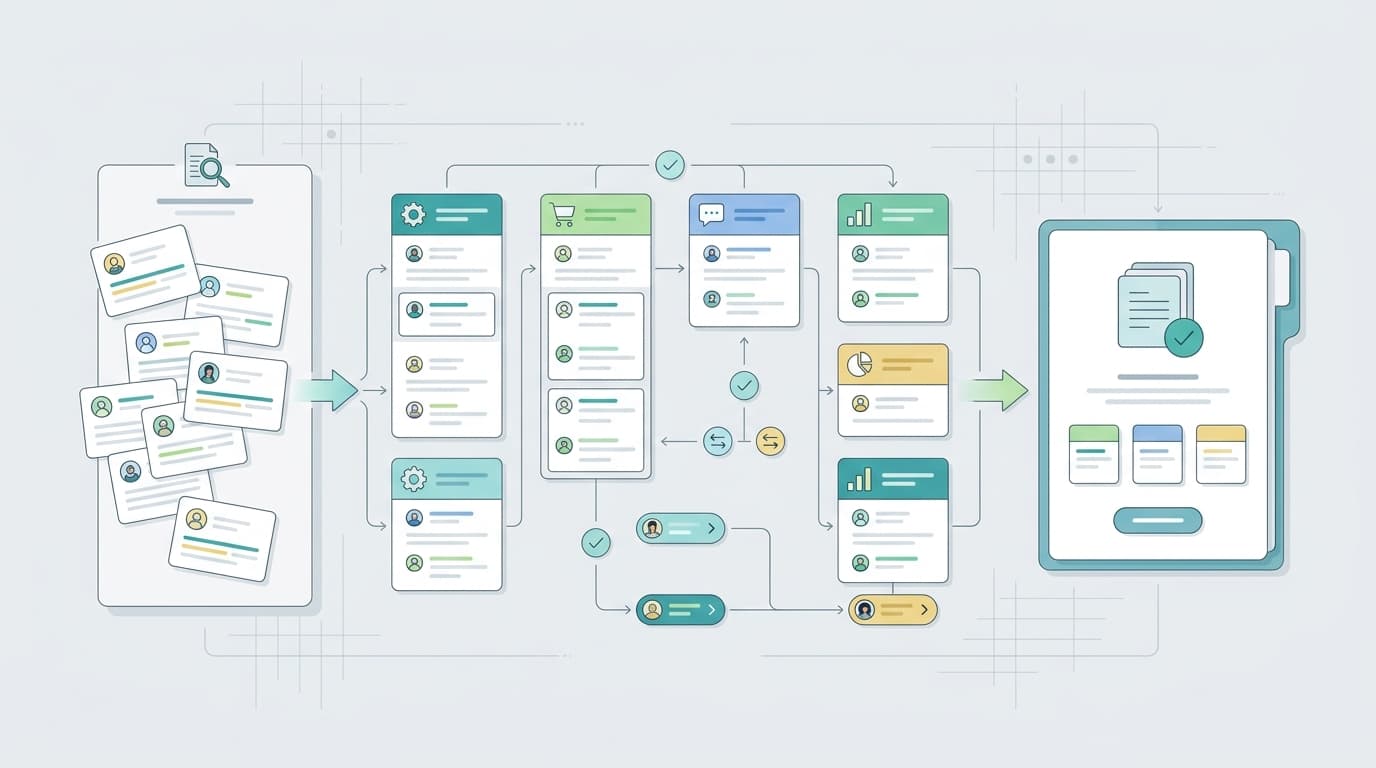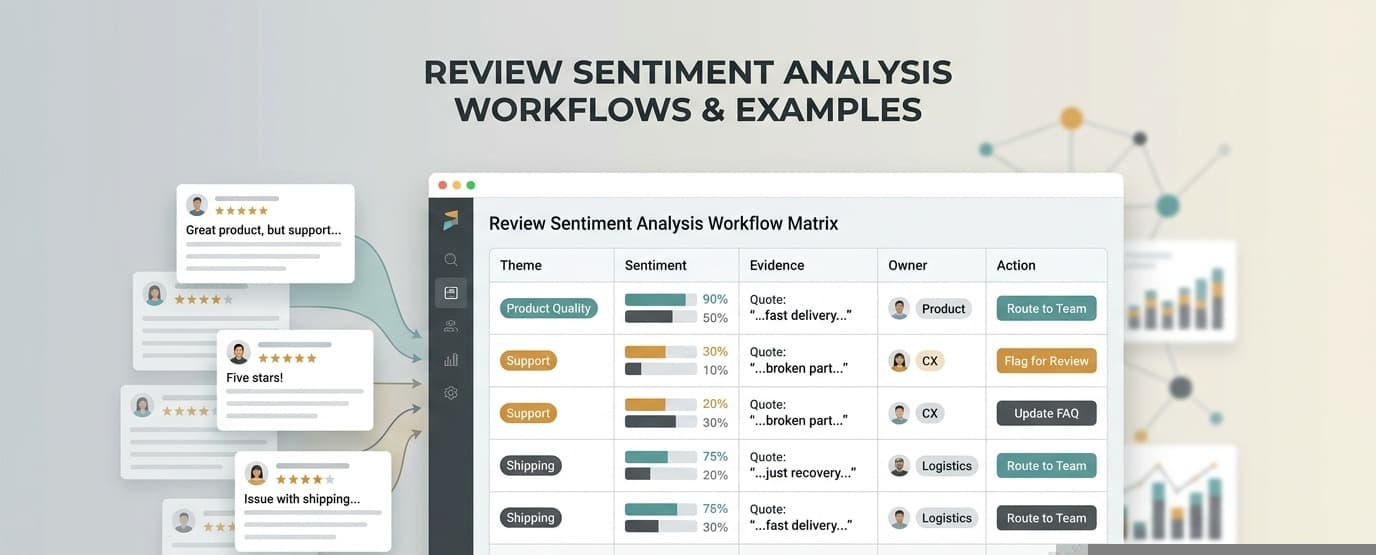
Customer segmentation often starts with fields that are easy to count: company size, plan, industry, geography, order value, or lifecycle stage. Those fields are useful, but they rarely explain why two customers who look identical in a CRM behave differently.
One may be trying to replace a spreadsheet. Another may need evidence for an executive review. A third may be managing a recurring operational problem under a strict time limit. Their accounts look similar. Their jobs, constraints, and definitions of success do not.
Review mining for customer segmentation adds that missing layer. It groups customer language by the situation people are in, the progress they are trying to make, the barriers they encounter, and the tradeoffs they accept.
The output is not a set of catchy personas. It is a small number of evidence-backed segments that help a team decide what to investigate, build, message, or support differently.
The method has an important boundary: public reviews are self-selected feedback, not a representative sample of every customer or buyer. Use them to discover meaningful patterns and form testable segment hypotheses—not to estimate market share or label individual people with false certainty.
What review-based segmentation is—and is not
Review-based segmentation is the practice of clustering feedback records around recurring customer contexts and needs.
A useful segment might be:
- teams replacing a manual weekly reporting workflow;
- first-time buyers who need setup confidence more than advanced controls;
- experienced operators who tolerate complexity in exchange for configurability;
- customers under a hard deadline who value speed and predictability;
- budget-constrained buyers whose complaints are about hidden operating cost, not sticker price.
These are behavioral and situational hypotheses. They describe a pattern in the evidence. They do not claim that every customer in a demographic, firmographic, or account category behaves the same way.
Review-based segmentation is not:
- dividing customers by star rating alone;
- generating personas from a summary model and treating them as facts;
- inferring sensitive traits that customers did not provide for the analysis;
- assigning a permanent label to an individual account from one comment;
- counting review themes and calling the result market sizing;
- replacing interviews, product analytics, CRM data, or experimental validation.
If your team needs better research questions, start with review mining for user research. If you need to compare why customers choose or reject alternatives, use review mining for competitive analysis. Segmentation sits between those workflows: it identifies recurring contexts that deserve different treatment.
Why ordinary segmentation misses the reason behind behavior
Traditional customer fields describe what the organization knows about an account. They do not always capture the mechanism behind a decision.
Consider three customers on the same plan:
| Customer context | Visible account data | What the feedback reveals |
|---|---|---|
| Operations lead | Mid-market, annual plan | Needs repeatable weekly reporting with minimal cleanup |
| Product manager | Mid-market, annual plan | Needs traceable evidence to defend prioritization decisions |
| Support leader | Mid-market, annual plan | Needs recurring complaint themes routed before escalation |
The account data is nearly identical. The desired outcomes are not.
That distinction matters because a team might otherwise average their needs into a generic feature request such as “better reporting.” Review mining preserves the context around the request:
- who was doing the work;
- what triggered the need;
- what they tried first;
- where the workflow broke;
- what consequence followed;
- what alternative they compared;
- what “good enough” meant in that situation.
Segmentation becomes more useful when it is built from these mechanisms rather than surface attributes.
The evidence record: preserve context before clustering
Do not begin by asking an AI tool to “find customer segments.” Begin by turning each useful review, support conversation, survey response, or interview excerpt into a traceable evidence record.
Use a structure like this:
| Field | Question |
|---|---|
| Source | Where did this feedback come from? |
| Source date | When was it created? |
| Product or plan | Which experience does it describe? |
| Role or task | Who appears to be doing the work? |
| Trigger | What event caused the customer to act? |
| Desired progress | What were they trying to accomplish? |
| Current approach | What process or alternative were they using? |
| Friction | Where did the process fail or slow down? |
| Consequence | What happened because of the friction? |
| Tradeoff | What inconvenience or cost would they accept? |
| Outcome | What result did they report? |
| Evidence quote | What exact customer language supports the interpretation? |
| Confidence | Is the interpretation explicit, implied, or uncertain? |
Keep the source text attached. A theme without its original evidence becomes difficult to challenge, reclassify, or interpret later.
Also keep contradictory records. If most customers in a proposed segment want simplicity but several experienced users explicitly reject simplified controls, that disagreement may reveal two segments—or show that the original cluster is too broad.
A seven-step workflow for review mining for customer segmentation
1. Define the decision the segments must improve
Segmentation without a decision becomes taxonomy work.
Choose one decision, such as:
- which onboarding path to test;
- which use case deserves a dedicated landing page;
- which complaint pattern needs a product intervention;
- which accounts need different customer-success guidance;
- which pricing objection needs separate validation;
- which feature should be default, optional, or advanced.
Write the decision at the top of the project. Then define what evidence would change it.
For example:
We need to decide whether new customers should enter one onboarding flow or choose between a fast-start path and an advanced-configuration path.
That statement gives the analysis a boundary. You are looking for differences that affect onboarding—not every difference that appears in the data.
2. Collect feedback from more than one channel
Public reviews are valuable because they contain unsolicited language and comparisons. They are also selective. People who post reviews may differ from customers who remain silent.
Use a mixed source set when possible:
- product and marketplace reviews;
- support tickets and chat transcripts;
- cancellation or return reasons;
- sales objections and win-loss notes;
- survey responses;
- interview transcripts;
- community discussions;
- product-behavior and account data used for corroboration.
Do not merge everything into one undifferentiated corpus. Preserve the source channel because channel context changes interpretation. A public complaint, a support request, and a prompted survey response are different kinds of evidence.
Review integrity matters too. The Federal Trade Commission’s Consumer Reviews and Testimonials Rule addresses deceptive practices involving fake or false reviews, sentiment-conditioned incentives, undisclosed insider reviews, review suppression, and related conduct. Treat provenance and authenticity as part of data quality, not as an afterthought.
3. Code the situation before the sentiment
Positive, negative, and neutral labels are too coarse for segmentation.
Code each record using four primary dimensions:
- Situation: What was happening when the need appeared?
- Desired progress: What outcome was the customer pursuing?
- Constraint: What limited the available options?
- Decision criterion: What made an option acceptable or unacceptable?
Then add supporting dimensions:
- role or responsibility;
- experience level;
- lifecycle stage;
- frequency of the task;
- urgency;
- current workaround;
- switching trigger;
- tolerance for complexity;
- price or total-cost concern;
- required proof or confidence.
Sentiment can still help prioritize records, but it should not define the segment. Two negative reviews may come from completely different contexts. Two positive reviews may describe different definitions of value.
4. Build candidate clusters from repeated mechanisms
Now group records that share a mechanism—not merely a word.
Suppose many reviews mention “templates.” That does not automatically create a template segment. Inspect why templates matter:
- beginners may need a safe starting point;
- managers may need consistency across a team;
- agencies may need reusable client workflows;
- advanced users may dislike templates that restrict customization.
The same feature can support multiple segments because the underlying job differs.
Name each candidate cluster as a compact causal hypothesis:
When [situation], customers need to [make progress], but [constraint] makes the current approach fail, so they choose based on [decision criterion].
Example:
When a product manager must defend a roadmap decision, they need traceable customer evidence, but scattered source data makes synthesis hard, so they choose based on auditability and speed of retrieval.
That is more useful than “data-driven PM persona.” It describes when the segment becomes relevant and what decision criterion may change behavior.
5. Create a segment evidence card
Give every candidate segment a reviewable card.
| Segment evidence card | Required content |
|---|---|
| Working name | Plain-language label, not a slogan |
| Decision served | The product, research, marketing, or service decision this segment informs |
| Trigger situation | The event or condition that activates the need |
| Desired progress | The outcome the customer is pursuing |
| Primary constraint | The limitation shaping the choice |
| Decision criteria | What customers compare or prioritize |
| Repeated behaviors | Actions, workarounds, or sequences seen in the evidence |
| Evidence sources | Reviews, support, interviews, analytics, or other channels |
| Supporting records | Traceable examples, including source dates |
| Counterevidence | Records that conflict with the pattern |
| Coverage gaps | Customers or channels missing from the dataset |
| Confidence | Low, medium, or high, with a written rationale |
| Next validation | The smallest test that could confirm or disprove the segment |
The counterevidence and coverage-gap fields are not optional. They prevent a coherent story from being mistaken for a complete picture.
6. Score evidence quality separately from business priority
A segment can be strategically important but weakly evidenced. Another can be strongly evidenced but irrelevant to the current decision.
Use two separate scores.
Evidence confidence can consider:
- number of information-rich records;
- diversity of source channels;
- consistency of the mechanism;
- recency;
- quality of source context;
- presence of contradictory evidence;
- corroboration with observed behavior.
Decision priority can consider:
- relevance to the current decision;
- severity of the unresolved problem;
- frequency within the observed dataset;
- strategic fit;
- cost of serving the segment differently;
- reversibility of the proposed intervention;
- risk if the hypothesis is wrong.
Do not multiply the scores into a false scientific number. A simple matrix is easier to challenge:
| Lower decision priority | Higher decision priority | |
|---|---|---|
| Higher evidence confidence | Monitor or reuse later | Test a differentiated treatment |
| Lower evidence confidence | Archive | Research before acting |
This keeps urgency from masquerading as certainty.
7. Validate with behavior, direct research, and controlled treatment
A cluster in review text is a hypothesis until it survives another method.
Choose validation based on the decision:
- Interviews: Test whether the situation and decision criteria are described accurately.
- Survey: Estimate how widely a validated need appears in a defined audience.
- Product analytics: Check whether the proposed segment behaves differently in relevant workflows.
- CRM or account analysis: Compare lifecycle, plan, industry, or retention patterns without assuming causation.
- Usability test: Observe whether a segment-specific workflow removes the expected friction.
- Message test: Compare response to language based on different situations or desired outcomes.
- Onboarding experiment: Test whether differentiated guidance improves a defined activation behavior.
- Customer-success pilot: Try a segment-specific play with a small, monitored group.
For pricing-related segments, use the workflow in review mining for pricing and validate willingness to pay with an appropriate pricing method. For retention-related segments, connect the evidence to review mining for customer success and review mining for churn analysis rather than treating complaint frequency as churn prediction.
Example: segmenting “reporting” complaints without flattening them
Imagine a feedback set with repeated complaints about reporting. A keyword summary might produce one theme: “Reporting needs improvement.”
Contextual coding could reveal four candidate segments:
Fast-answer operators
- Situation: A recurring operational question must be answered quickly.
- Progress: Get a reliable answer without building a custom analysis.
- Constraint: Limited time and analytical capacity.
- Decision criterion: Speed and clarity.
Evidence-building product teams
- Situation: A prioritization decision needs customer support.
- Progress: Trace a conclusion back to source evidence.
- Constraint: Feedback is spread across tools and channels.
- Decision criterion: Auditability and retrieval.
Executive communicators
- Situation: A cross-functional review needs a concise narrative.
- Progress: Explain what changed, why it matters, and what to do next.
- Constraint: Stakeholders will not inspect raw feedback.
- Decision criterion: Summarization quality and decision relevance.
Advanced analysts
- Situation: A specialist needs to test a custom question.
- Progress: Control filters, definitions, and exports.
- Constraint: Standard views hide important distinctions.
- Decision criterion: Flexibility and transparency.
One reporting feature cannot automatically satisfy all four. The segmentation suggests different interventions: a fast default answer, traceable evidence links, an executive summary format, and advanced controls.
The important result is not the segment names. It is the differentiated decision logic.
Common mistakes that make review segments unreliable
Treating the loudest reviewers as the largest segment
Review volume reflects who chose to post, where the data came from, and what motivated response. It does not directly reveal the size of a segment in the customer base or market.
Use review frequency as an observed-data signal. Estimate prevalence with a method designed for that purpose.
Clustering by vocabulary without preserving meaning
Customers can use the same word for different jobs. They can also use different words for the same mechanism. Inspect full records and context before naming a cluster.
Using demographics as a shortcut for needs
Demographics and firmographics may be useful descriptors after a segment is validated. They should not substitute for the situation, constraint, behavior, and decision criterion that make the segment actionable.
Avoid inferring sensitive traits from text. Collect only what the decision requires, document why it is needed, and apply appropriate privacy controls.
Forcing every customer into one segment
Segments are decision tools, not permanent identities. The same customer may enter different situations over time. A new user can begin in a fast-start segment and later behave like an advanced analyst.
Store evidence about contexts and observed behaviors. Do not turn a flexible hypothesis into an immutable profile.
Letting generated summaries replace evaluation
Automation can accelerate retrieval, coding, and comparison. It can also create plausible clusters that are poorly supported.
NIST’s AI Risk Management Framework emphasizes managing risks across the design, use, and evaluation of AI systems, including considerations such as validity, reliability, transparency, explainability, privacy, and harmful bias. Applied here, that means keeping the source evidence, documenting the coding logic, testing performance on held-out records, reviewing edge cases, and monitoring whether segment assignments remain useful as the customer base changes.
Measuring the segment instead of the decision outcome
The goal is not to maximize assignment accuracy to a label invented by the team. The goal is to improve a real decision.
Measure outcomes such as:
- reduced time to first useful result;
- increased completion of a target workflow;
- fewer repeated support contacts for the same issue;
- better recall of key product value;
- higher-quality research recruitment;
- faster retrieval of decision evidence;
- improved response to a segment-specific intervention.
Choose the metric before running the test.
How to operationalize review-based segments
Once a segment passes validation, connect it to the systems where decisions happen.
Product
- prioritize different defaults, controls, or workflows;
- maintain segment-specific acceptance criteria;
- compare feature adoption by validated context;
- preserve evidence links in roadmap decisions.
User research
- recruit contrasting situations rather than generic job titles;
- test the weakest part of each segment hypothesis;
- include counterexamples deliberately;
- update the evidence card after each study.
Marketing
- build use-case pages around situations and desired progress;
- separate messages that appeal to different decision criteria;
- use customer language without presenting isolated quotes as universal truth;
- connect claims to a relevant proof path.
Customer success and support
- route customers to guidance based on the problem they are solving;
- monitor when a customer’s context changes;
- test plays on a bounded group before standardizing them;
- return new evidence to the shared repository.
A customer feedback dashboard for product, support, and marketing can help teams maintain shared definitions, source links, owners, and validation status. The dashboard should make uncertainty visible rather than hiding it behind a polished segment name.
A monthly segmentation review agenda
Segments decay when products, markets, channels, and customer expectations change.
Use a recurring review:
- Inspect new records and changed source coverage.
- Review evidence added to each active segment.
- Examine counterevidence and unassigned records.
- Split clusters that contain conflicting mechanisms.
- Merge clusters that lead to the same decision and treatment.
- Re-score confidence and priority separately.
- Record validation results.
- Retire segments that no longer improve a decision.
- Assign one next test to every high-priority, low-confidence segment.
The goal is not to preserve the taxonomy. It is to preserve decision quality.
Frequently asked questions
Can customer reviews be used for customer segmentation?
Yes. Reviews can reveal recurring situations, desired outcomes, constraints, workarounds, and decision criteria. Use those patterns to create segment hypotheses, then validate them with other feedback sources, direct research, customer data, or experiments.
How many reviews do you need to build segments?
There is no universal threshold. The required evidence depends on the decision, source diversity, customer coverage, theme complexity, and cost of being wrong. Start with information-rich records, preserve counterexamples, and collect more data until new evidence stops materially changing the candidate segments.
Are review-based segments representative of the whole market?
Not automatically. Reviewers are self-selected, platforms have different audiences and policies, and ratings can have biased distributions. Use reviews for discovery and hypothesis formation. Use an appropriate sampling or measurement method when you need prevalence or market-size estimates.
Should AI assign every customer to a segment?
Not by default. Begin with evidence clustering and decision support. If automated assignment is necessary, define the purpose, required data, error costs, privacy controls, human review, monitoring, and an “unknown” option. Do not infer sensitive traits or force weak evidence into a confident label.
How often should customer segments be updated?
Review them when the product, pricing, audience, acquisition channel, or customer workflow changes. A monthly evidence review and a deeper quarterly validation cycle is a practical starting point for many teams, but the cadence should match the speed and risk of the decision.
Build segments around progress, not stereotypes
The most useful customer segments explain why a different treatment may be necessary.
Review mining helps by preserving the language customers use when they describe a trigger, desired outcome, failed workaround, constraint, and decision criterion. The workflow is disciplined:
- define the decision;
- preserve source context;
- code situations before sentiment;
- cluster repeated mechanisms;
- document counterevidence;
- separate confidence from priority;
- validate with another method;
- measure whether the differentiated treatment improves the decision outcome.
That produces segments a team can challenge, test, and retire—not personas it has to believe.
VOC AI’s Voice of Customer Analysis and product research workflows can support the broader process of organizing review evidence, identifying recurring needs, and connecting customer language to product decisions. The responsible next step is still human: decide which hypothesis matters, what evidence is missing, and what test could prove the team wrong.
Sources
- Federal Trade Commission, “Federal Trade Commission Announces Final Rule Banning Fake Reviews and Testimonials”, August 14, 2024.
- Federal Trade Commission, “The Consumer Reviews and Testimonials Rule: Questions and Answers”.
- National Institute of Standards and Technology, “AI Risk Management Framework”.
- Nan Hu, Paul A. Pavlou, and Jie Zhang, “Overcoming the J-Shaped Distribution of Product Reviews”, Communications of the ACM, 2009.
- American Association for Public Opinion Research, “Report of the AAPOR Task Force on Non-Probability Sampling”, 2013.