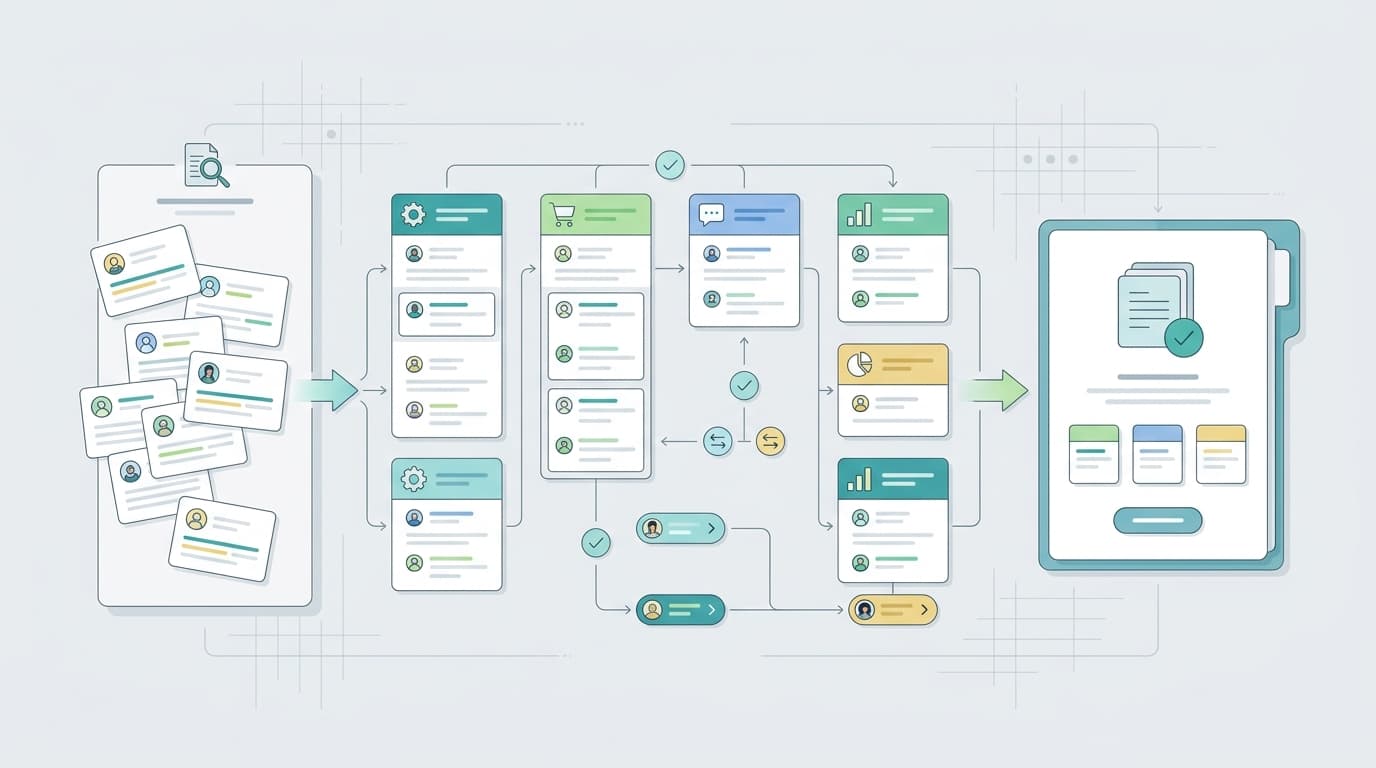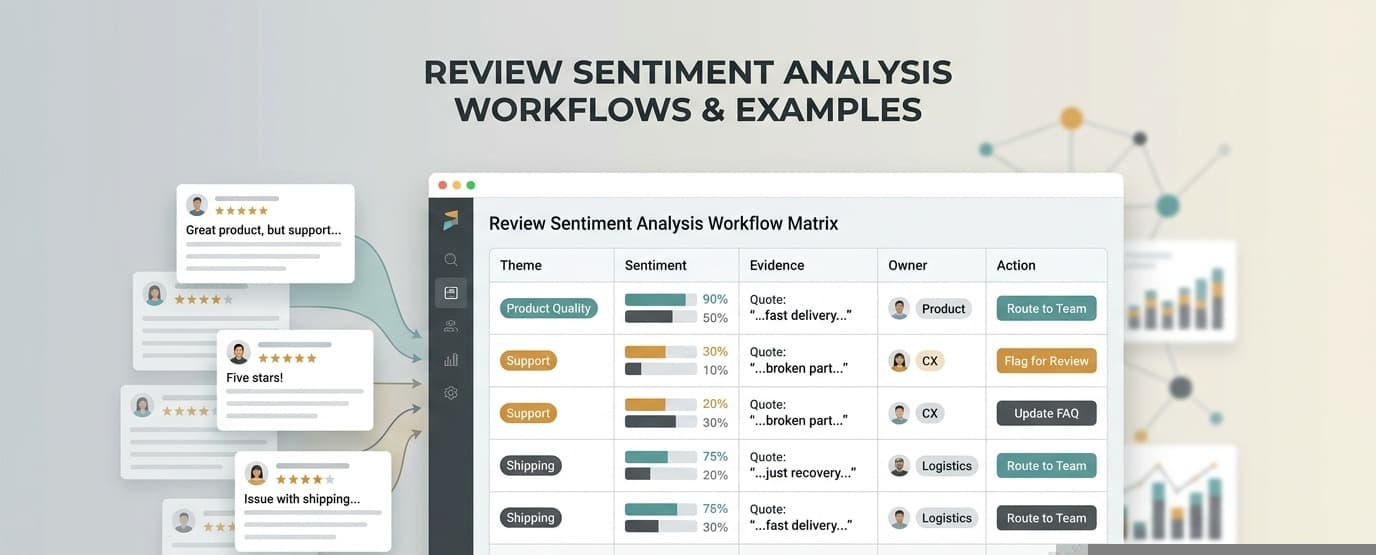
Voice of Customer analysis sounds simple: collect what customers say, group the comments, and decide what to fix.
In practice, beginners usually get stuck between collection and action. They have survey answers, interview notes, support conversations, reviews, and sales feedback—but no consistent way to turn that material into evidence a product team can use.
This VOC analysis beginner guide gives you a lightweight VOC analysis workflow you can run with a spreadsheet, a research repository, or a dedicated feedback-analysis tool. It includes a starter template, a worked example, a prioritization method, a 60-minute first-analysis sprint, a setup decision tree, a seven-day plan, and a practical way to decide when manual analysis is no longer enough.
It also includes a beginner operating kit: a one-page scope contract, a first-pass evidence worksheet, an evidence coverage matrix, a coding calibration exercise, confidence labels, and a 30-minute decision-review agenda. These guardrails solve the most common first-project problem: producing themes that sound plausible but cannot survive basic questions about scope, evidence, or ownership.
Use this VOC analysis beginner guide when you need to move from raw feedback to one inspectable decision, not when you need a broad research-operations redesign. If this is your first project, the goal is not to build a perfect customer-insight system. The goal is to produce one finding that a decision owner can inspect, challenge, and use.
Updated August 11, 2026: this refresh adds a first-pass evidence worksheet for beginners who need to analyze the first 12 records before scaling the VOC analysis workflow to a larger dataset.
How to Use This VOC Analysis Beginner Guide
Read this VOC analysis beginner guide in the order you would run the work. First, define the decision and evidence boundary. Then preserve source context, code a small sample, build themes, score confidence, and hand the finding to a decision owner.
If you are evaluating a process or tool, skip ahead to the setup decision tree after you understand the eight-step workflow. That section helps you decide whether a spreadsheet, research repository, dashboard, or VOC platform fits your current volume and governance needs.
The article is intentionally practical. You can copy the scope contract, first-pass worksheet, evidence fields, theme template, decision log, review agenda, and seven-day plan into your own operating process.
Run the First-Pass VOC Evidence Worksheet
Before you code 100 comments, run a first pass on 12 records. This small worksheet is the fastest way for a beginner to learn whether the VOC analysis question, source context, and code labels are specific enough to survive a larger pass.
The point is not statistical confidence. The point is to expose interpretation problems while the work is still easy to correct.
| Worksheet step | What to do with 12 records | Output |
|---|---|---|
| 1. Freeze the question | Write the decision question at the top of the sheet and reject records that do not answer it | One bounded VOC analysis question |
| 2. Preserve source context | Add source, date, customer situation, lifecycle stage, and original wording for each record | 12 traceable evidence rows |
| 3. Mark the customer job | Write what the customer was trying to accomplish before you label the problem | A job or situation note for every row |
| 4. Add one plain-language code | Use a short code that explains the situation, not just a feature area | A draft code column |
| 5. Flag ambiguity | Mark each row as clear, unclear, adjacent, or contradiction | A confidence note beside the code |
| 6. Group into two candidate themes | Combine codes only when the customer situation and consequence are similar | Two tentative theme cards |
| 7. Write the smallest decision implication | State what the finding could change, test, monitor, or decline | One decision-ready next step |
This first-pass worksheet gives this VOC analysis beginner guide a practical stop point. If the 12-row pass is messy, the full project will be messier. Fix the scope, source fields, and code definitions before adding more data.
A copyable 12-record worksheet
Use these columns in a spreadsheet, Airtable base, research repository, or VOC platform export:
Record ID:
Decision question:
Source:
Date:
Customer segment:
Lifecycle stage:
Original feedback:
Customer job:
Situation:
Draft code:
Theme candidate:
Contradiction or ambiguity:
Confidence note:
Possible decision:
Owner:
Do not skip the original feedback field. A theme is only useful when another person can inspect the exact customer language or the permitted source reference behind it.
How to read the first 12 records
Read the first 12 records twice.
On the first read, do not code. Write only the customer job and situation. This prevents a common beginner mistake: applying a familiar label before understanding what the customer was trying to do.
On the second read, add draft codes and confidence notes. Use an unclear label when the record lacks enough context. Use an adjacent label when the record is interesting but outside the decision question. Use a contradiction label when the record weakens or narrows the expected theme.
| First-pass signal | What it means | What to do before scaling |
|---|---|---|
Most rows need unclear | The source data lacks context or the question is too broad | Add context fields or narrow the evidence set |
Many rows are adjacent | The dataset contains several decisions mixed together | Split the project into separate VOC analysis questions |
| Codes describe product areas only | The analysis is naming locations, not explaining customer situations | Rewrite codes around jobs, friction, and consequences |
| No contradictions appear | The sample may be too narrow or the analyst is only confirming expectations | Search for counterexamples before writing a finding |
| One theme has evidence but no owner | The finding may be true but not actionable yet | Find a decision owner or park the theme |
This exercise works even if you later use AI assistance. Run the 12-record pass manually first, then compare the model's labels against your benchmark. If the model loses customer jobs, merges different situations, or ignores contradictions, treat those failures as review rules for the larger analysis.
The 12-record pass/fix/scale rule
After the first-pass worksheet, choose one of three paths:
| Outcome | Use it when | Next step |
|---|---|---|
| Pass | The question is bounded, source context is present, codes are specific, and at least one contradiction check exists | Expand to the full scoped evidence set |
| Fix | The theme is plausible, but source fields, code definitions, or boundaries are weak | Revise the worksheet and rerun another 12 records |
| Scale down | The evidence does not support the decision question or no owner can act on it | Choose a narrower question or park the project |
For beginners, fix is often the best outcome. It prevents the team from spending a week producing a clean-looking VOC analysis that still cannot explain its evidence boundary.
Before You Start: Pick the Right VOC Analysis Question
The fastest way to make a beginner VOC analysis project fail is to choose a question that is too broad. "What do customers think of the product?" sounds useful, but it gives the analyst no boundary, no owner, and no clear stopping point.
Use this selector before the 60-minute sprint. Pick one row, one owner, one evidence window, and one decision you are willing to make or defer.
| If you need to decide... | Ask this VOC analysis question | Evidence to include first | Output to create |
|---|---|---|---|
| Which onboarding issue deserves discovery | Where do new users hesitate before their first successful outcome? | Activation survey comments, setup tickets, five recent onboarding calls | One friction theme with affected segment and next discovery step |
| Which support topic should become self-service content | Which repeated support request is caused by unclear product language or workflow design? | Support conversations, help-center searches, failed self-service sessions | One issue brief for product, support, or documentation |
| Which feature request is worth investigating | What job are customers trying to complete when they ask for this feature? | Feature-request comments, sales notes, interviews, usage context | One job statement with supporting and contradictory evidence |
| Which review theme should influence messaging | What expectation gap appears before purchase or after first use? | Reviews, survey comments, sales objections, competitor review snippets | One messaging or product-positioning hypothesis |
| Which churn or downgrade signal needs follow-up | What repeated friction appears before cancellation, downgrade, or non-renewal? | Cancellation notes, support tickets, customer-success notes, interviews | One retention-risk theme with confidence and next action |
For a VOC analysis beginner guide, this selector matters because it prevents the first project from becoming a general feedback audit. A beginner project should change one decision or expose exactly why the evidence is not strong enough yet.
A five-point readiness check
Before coding any feedback, answer these five questions:
- Who owns the decision? If nobody can act on the finding, the project is not ready.
- Which customer situation is in scope? Define the segment, lifecycle stage, product area, or journey moment.
- What evidence window will you use? Pick a date range or event boundary so old and new feedback do not blur together.
- What would count as a contradiction? Decide what evidence would weaken the expected theme before you look for confirmation.
- What will happen after review? Choose the possible outcomes: act, investigate, test, monitor, or decline.
If you cannot answer all five, shrink the project. A narrow VOC analysis question with inspectable evidence is more useful than a large theme map that nobody can challenge or use.
Good and weak first-project questions
| Weak beginner question | Better first VOC analysis question | Why the better version works |
|---|---|---|
| What do users dislike? | Which setup step blocks new administrators in the first 14 days? | It defines audience, journey stage, and decision context |
| Why are customers unhappy? | Which repeated support issue creates preventable work for both customers and agents? | It separates severity from general sentiment |
| What features should we build? | Which requested feature reflects a repeated customer job rather than a one-off preference? | It asks for evidence of the underlying job |
| What should marketing say? | Which review language shows a promise customers expected before purchase? | It connects customer language to positioning decisions |
| Why do people churn? | Which cancellation comments point to a product friction we can test within one month? | It limits the analysis to actionable retention evidence |
Beginners should not avoid big questions forever. They should earn the right to answer them by first proving that one smaller VOC analysis can preserve evidence, handle contradictions, and change a decision.
What Is VOC Analysis?
VOC analysis is the process of turning customer statements and observed feedback into structured themes, evidence-backed findings, and decisions.
The important word is analysis. Collecting feedback is not the same as analyzing it.
- Collection gives you raw inputs: interview transcripts, survey responses, support tickets, reviews, call notes, social comments, and behavioral context.
- Analysis identifies patterns, differences, causes, affected segments, and decision implications.
- Action turns a validated finding into a product, messaging, service, research, or operational experiment.
A useful VOC finding should answer four questions:
- What are customers trying to accomplish?
- Where does the experience help or block them?
- Which customers and situations does the pattern affect?
- What decision could change because of this evidence?
VOC analysis is therefore broader than sentiment analysis. Sentiment can help you scan a large dataset, but “negative” is not a product requirement. You still need to understand the customer’s situation, expected outcome, friction, and evidence strength.
A Simple VOC Analysis Example
Imagine a project-management product receives these comments:
- “I can create a template, but new teammates still set projects up differently.”
- “The onboarding video shows the ideal workflow, not the messy one we inherited.”
- “I wish the app warned me before I changed a field used by every team.”
A weak analysis labels all three comments as negative onboarding feedback.
A stronger analysis separates them:
| Evidence | Theme | Underlying need | Possible decision |
|---|---|---|---|
| Teams configure projects inconsistently | Standardization | Make the preferred workflow repeatable | Test enforced template rules |
| Training ignores inherited setups | Migration onboarding | Help established teams adopt the product | Add an “existing workflow” onboarding path |
| Shared changes create unexpected effects | Change safety | Understand dependencies before editing | Add impact warnings or permissions |
The stronger version preserves the difference between three problems. That prevents the team from shipping one generic onboarding improvement and assuming the job is done.
Your First VOC Analysis in 60 Minutes
You do not need to wait for a complete feedback repository to practice the method. A focused one-hour sprint can produce a useful first finding and expose where your evidence is weak.
Use 20 to 30 feedback items connected to one decision. Good starter sources include one month of onboarding survey comments, recent support conversations about a specific workflow, or reviews for one product category. Do not mix every customer, channel, and product area simply to make the dataset look larger.
| Time | Activity | Output |
|---|---|---|
| 0–5 minutes | Write one decision question and define the included customer, journey stage, and date range | A one-sentence scope |
| 5–15 minutes | Put each feedback item in a row with its source, date, segment, and original text | A traceable evidence table |
| 15–25 minutes | Read all items once without coding; note repeated situations, outcomes, and contradictions | A short observation list |
| 25–40 minutes | Apply a small code set to each item; allow multiple codes and an unclear label | A coded evidence set |
| 40–50 minutes | Group related codes into two or three themes and write one sentence explaining each pattern | Draft theme statements |
| 50–57 minutes | Choose the strongest theme and write a finding with evidence, boundary, confidence, and implication | One traceable finding |
| 57–60 minutes | Assign an owner and the next action: investigate, test, monitor, or decline | A decision-log entry |
For example, suppose 9 of 25 onboarding comments mention setup confusion. Do not stop at “36% of comments are about onboarding.” Ask what kind of setup is failing, who experiences it, what outcome they expected, and whether the remaining comments contradict the pattern.
A useful first finding might read:
New workspace administrators at smaller teams can complete basic setup, but they hesitate when a configuration change affects other users. The evidence is directional because it appears in support and survey comments but has not been tested with enterprise administrators. The product team should investigate dependency warnings before changing the general onboarding flow.
The sprint is successful if another person can inspect the source comments, understand how you reached the finding, and see what happens next. It is not successful merely because you created a chart or a polished list of topics.
What to prepare before the hour starts
- A completed 12-record first-pass worksheet or a similarly small benchmark sample.
- One decision owner who agrees to review the result.
- One clearly bounded evidence set in a spreadsheet or repository.
- Columns for source, date, segment, journey stage, original text, codes, theme, and notes.
- A short code list based on customer situations and desired outcomes, not just product features.
- A place to record contradictions and ambiguous evidence.
If you want a ready-made practice format, use the VOC analysis beginner worksheet before applying the workflow to a live product decision.
Before You Analyze: Write a One-Page VOC Scope Contract
Most beginner projects become difficult before coding starts. The team quietly combines different customers, time periods, products, and decisions into one dataset. The resulting themes may be accurate in a broad sense but useless for the decision at hand.
Prevent that by writing a short scope contract before collecting evidence.
| Scope field | Question to answer | Example |
|---|---|---|
| Decision | What decision should this analysis inform? | Which onboarding problem should enter discovery next? |
| Owner | Who can act on the finding? | Activation product manager |
| Audience | Which customers are included? | New workspace administrators at companies with 20–200 employees |
| Journey or product area | Where does the problem occur? | First 14 days after workspace creation |
| Evidence window | Which dates are included? | Feedback created in the last 90 days |
| Sources | Which channels are in scope? | Onboarding survey, support conversations, and five interviews |
| Exclusions | What will not be treated as evidence? | Sales requests from prospects who never started a trial |
| Output | What will be delivered? | Three traceable findings and one recommended investigation |
| Review date | When will the team revisit the conclusion? | Four weeks after the selected experiment begins |
This contract is not bureaucracy. It gives reviewers a fair way to challenge the work. If a finding falls outside the defined audience or evidence window, label it as an adjacent signal rather than quietly blending it into the conclusion.
Use an evidence coverage matrix before counting themes
A dataset can look large while representing only one type of customer or one high-friction channel. A support-ticket dataset, for example, naturally overrepresents customers who experienced a problem and chose to contact support.
Create a simple coverage matrix before analysis:
| Segment or situation | Survey | Support | Interviews | Reviews | Coverage note |
|---|---|---|---|---|---|
| New administrators | 42 | 18 | 3 | 0 | Strongest coverage |
| Invited teammates | 11 | 4 | 1 | 0 | Limited depth |
| Experienced administrators | 7 | 3 | 1 | 0 | Useful contradiction group |
| Churned trials | 0 | 2 | 0 | 0 | Too weak for a conclusion |
The matrix does not need statistically representative counts. Its purpose is to make blind spots visible. Add a coverage note to every final finding, especially when one channel or customer segment dominates the evidence.
The Three Outputs Every Beginner Project Needs
A useful first VOC analysis does not need a large dashboard or a complicated taxonomy. It needs three connected outputs.
| Output | What it contains | Why it matters |
|---|---|---|
| Evidence table | Source, customer context, quote or observation, date, and code | Lets reviewers verify what customers actually said |
| Theme card | Pattern, affected segment, supporting and contradictory evidence, confidence | Converts labels into an explainable finding |
| Decision record | Owner, decision, next test, due date, and result | Prevents the analysis from becoming a static report |
These outputs form a simple chain:
Evidence → theme → decision → outcome review
If a theme cannot be traced back to evidence, it is not ready. If a theme has no decision owner, it is not yet useful. If nobody checks what happened after the decision, the team cannot learn whether its interpretation was correct.
For a guided practice run, use the VOC analysis beginner worksheet to turn a small set of comments into one decision.
Turn the First VOC Analysis Finding Into a Decision-Review Packet
A beginner VOC analysis project is not finished when the analyst names a theme. It is finished when a decision owner can inspect the evidence, understand the boundary, challenge the interpretation, and choose the next action.
Use this decision-review packet after the 60-minute sprint or after the eight-step workflow below. It keeps the final handoff small enough for a product manager, support lead, founder, or UX researcher to review in one meeting.
| Packet field | What to write | Beginner mistake it prevents |
|---|---|---|
| Decision question | The exact decision this VOC analysis was meant to inform | Turning a narrow analysis into a general feedback report |
| Finding | One sentence that names the pattern, affected customer, situation, and implication | Reporting a topic label instead of an explainable finding |
| Evidence count | The number of supporting, contradictory, and unclear records | Hiding thin evidence behind confident language |
| Strongest evidence | Two or three short excerpts or source references that best represent the pattern | Cherry-picking one dramatic quote |
| Boundary | Where the finding does and does not apply | Letting reviewers assume the theme applies to all users |
| Confidence label | High, medium, low, or directional, with the reason | Treating all themes as equally proven |
| Decision options | Act, investigate, test, monitor, or decline | Ending the analysis without a next step |
| Owner and review date | The person responsible and when the outcome will be checked | Letting the finding disappear after the meeting |
This packet also helps teams use this VOC analysis beginner guide without overbuilding process. You do not need a mature research repository to produce a reviewable packet. You need a bounded question, source context, honest confidence, and a visible decision.
A beginner decision-review packet example
Imagine the 60-minute sprint produced this draft theme: “setup permissions are confusing.” That phrase is too vague for a decision review. Turn it into a packet like this:
| Field | Example entry |
|---|---|
| Decision question | Which onboarding friction should the activation team investigate next? |
| Finding | New workspace administrators hesitate before inviting teammates because they cannot tell which setup changes affect other users. |
| Evidence count | 9 supporting comments, 3 adjacent setup comments, 2 contradictory comments from experienced administrators, 11 unrelated comments |
| Strongest evidence | Support ticket about accidental workspace-wide change; survey comment about being afraid to invite teammates; onboarding-call note about missing dependency warnings |
| Boundary | Applies to new administrators in the first 14 days; not enough evidence for experienced administrators or enterprise permission models |
| Confidence label | Medium: the pattern appears in support and survey evidence, but the sample is small and has not been checked against product behavior |
| Decision options | Investigate dependency-warning concepts; test onboarding copy; monitor until more evidence appears; decline if analytics show low exposure |
| Owner and review date | Activation PM; review four weeks after concept test or after 25 more scoped records |
The important move is the boundary. A beginner might be tempted to recommend “improve onboarding.” The packet makes the decision smaller: investigate dependency warnings for new administrators before rewriting the whole onboarding flow.
Use pass, revise, or park during review
Decision reviews work better when the owner has more choices than “agree” or “disagree.” Use three outcomes:
| Review outcome | Use it when... | What happens next |
|---|---|---|
| Pass | The evidence is traceable, the boundary is clear, and the decision is proportional to confidence | Assign the action, owner, due date, and outcome metric |
| Revise | The theme is plausible but the evidence, segment, contradiction check, or implication is incomplete | Add the missing evidence or narrow the claim before deciding |
| Park | The finding is interesting but not connected to a near-term decision | Save it as an adjacent signal with the source context intact |
This is where beginners often improve fastest. They learn that a parked finding is not a failure. It is a signal that the evidence may matter later, but it should not compete with decision-ready work today.
A five-minute packet quality check
Before you bring the finding to an owner, run this check:
- Can a reviewer trace every claim back to source evidence?
- Does the finding say which customer, situation, and outcome it applies to?
- Have you included at least one contradiction or stated that none appeared in scope?
- Is the confidence label based on evidence coverage rather than personal certainty?
- Is the recommended action small enough for the evidence strength?
- Is there a date to review whether the decision helped?
If the packet fails one of these questions, fix the packet before you debate the decision. The point of beginner VOC analysis is not to sound certain. The point is to make customer evidence clear enough that the team can decide responsibly. In this VOC analysis beginner guide, that means every workflow step should end in a reviewable decision packet, not a loose list of themes.
The Beginner VOC Analysis Workflow
Use the following eight-step workflow for a first project. Keep the scope small enough to finish in one or two weeks.
Step 1: Start With a Decision Question
Do not begin with “analyze all customer feedback.” Begin with a decision the team expects to make.
Good beginner questions include:
- Which onboarding problem should we investigate next?
- Why do trial users fail to reach the activation milestone?
- Which recurring support issue should become self-service content?
- What expectation gap appears most often in customer reviews?
- Which feature request reflects a repeated job rather than a loud individual preference?
A decision question defines the relevant product area, customer segment, time window, and source set. It also gives your analysis a stopping point.
Write the question at the top of your analysis sheet. If a comment does not help answer it, keep the comment for another project instead of forcing it into the current taxonomy.
Step 2: Choose a Focused Evidence Set
Start with two or three complementary sources, not every source your company owns.
| Source | What it is good at revealing | Common limitation |
|---|---|---|
| Customer interviews | Motivations, context, workarounds, language | Small sample and interviewer effects |
| Open-text surveys | Broader directional patterns | Short answers and self-selection |
| Support conversations | Repeated friction and urgency | Overrepresents customers who ask for help |
| Reviews | Post-purchase expectations and outcomes | Limited customer and account context |
| Sales or success notes | Objections, adoption barriers, renewal risk | Filtered through an employee’s interpretation |
| Social comments | Emerging questions and public language | Noisy identity and usage context |
| Product analytics | What users did and where they stopped | Usually cannot explain why |
Pairing sources helps you avoid treating one channel as the whole customer truth. For example, interviews can explain a pattern observed in support volume, while analytics can test whether the reported friction appears in behavior.
For a first pass, 30 to 100 relevant qualitative records are often more useful than an enormous unfiltered export. The goal is to learn the method and produce a decision, not to maximize row count.
Step 3: Preserve a Minimum Evidence Record
Every feedback item should retain enough context for another person to understand and verify it.
Use these starter fields:
| Field | What to record |
|---|---|
| Evidence ID | A stable reference to the source item |
| Date | When the feedback was created or observed |
| Source | Interview, survey, support, review, sales, social, or another channel |
| Customer context | Segment, role, plan, lifecycle stage, market, or product variant when known |
| Verbatim evidence | The relevant customer statement or faithful excerpt |
| Situation | What the customer was trying to do |
| Initial code | A short description of what the evidence concerns |
| Confidence note | Missing context, ambiguity, or contradiction |
| Source link | A permitted route back to the original record |
Do not paste sensitive personal data into a shared analysis file unless your policies allow it. Use access-controlled source links and anonymized customer context where appropriate.
Step 4: Read Before You Automate
Read a representative sample before creating categories or prompting an AI system to summarize the dataset.
This first read helps you notice:
- repeated customer vocabulary;
- different situations hidden behind similar words;
- contradictions between segments;
- important neutral or positive evidence;
- missing context that affects interpretation;
- assumptions your team brought into the project.
The UK Government Service Manual recommends analyzing research soon after sessions so the team can capture observations, discuss surprises, and avoid losing context. That principle applies beyond interviews: analysis improves when evidence is still close to the people who collected or handled it.
Run a 20-item coding calibration
If two or more people will code feedback—or if AI will assign first-pass labels—calibrate before processing the full dataset.
- Select 20 varied items, including clear examples, ambiguous examples, positive evidence, and contradictions.
- Have each reviewer code the items independently using the draft codebook.
- Compare disagreements item by item instead of reducing the exercise to one agreement score.
- Clarify code definitions, inclusion rules, exclusion rules, and examples.
- Repeat with another small sample until disagreements reflect genuine interpretation rather than vague labels.
For an AI-assisted workflow, treat the model as another coder. Review where it merges different jobs, loses the customer situation, invents specificity, or applies a code because of one keyword. Save those failure patterns as acceptance tests for later runs.
Calibration does not make qualitative analysis perfectly objective. It makes the interpretation rules visible and repeatable enough for the current decision.
Step 5: Code the Evidence
A code is a short label that describes something meaningful in one feedback item.
Beginners often make codes too broad. “Usability,” “pricing,” and “onboarding” are folders, not explanations. Prefer labels that preserve the customer’s situation and friction.
Compare these examples:
| Broad code | More useful code |
|---|---|
| Onboarding | Cannot map existing workflow to setup wizard |
| Collaboration | Unclear owner after handoff |
| Reporting | Must export data to answer leadership questions |
| Integrations | Sync failure creates duplicate manual work |
| Pricing | Value is unclear for occasional collaborators |
One evidence item can have more than one code. Keep the codebook lightweight at first: code name, short definition, inclusion rule, exclusion rule, and one example.
If multiple people code the data, review disagreements. The goal is not perfect mechanical agreement; it is a shared understanding of what each code means and when the distinction matters.
Step 6: Turn Codes Into Themes
Codes describe pieces of evidence. Themes explain a meaningful pattern across those pieces.
For example:
- Codes: “cannot import existing structure,” “setup assumes a blank workspace,” and “migration requires manual recreation.”
- Theme: New-customer onboarding is designed for greenfield teams, not teams migrating established processes.
A useful theme statement includes:
- Customer or situation — who experiences the pattern and when.
- Need or expected outcome — what they are trying to accomplish.
- Friction or enabling factor — what blocks or helps them.
- Consequence — what happens next.
Theme development is iterative. Braun and Clarke’s guidance on reflexive thematic analysis describes movement between familiarization, coding, constructing themes, reviewing them, defining them, and writing the analysis. You do not have to use that academic method exactly, but the core lesson is useful: themes are developed and tested, not automatically discovered as final truth.
Step 7: Score the Signal Without Hiding Judgment
Frequency matters, but the most frequent theme is not always the most important.
Use a transparent scorecard instead of a single “AI priority” number:
| Dimension | Beginner question | Score |
|---|---|---|
| Recurrence | How often does the pattern appear in the scoped evidence? | 1–5 |
| Severity | How much does it block the customer’s goal? | 1–5 |
| Segment importance | Does it affect the audience tied to the decision? | 1–5 |
| Evidence diversity | Does it appear across more than one source or context? | 1–5 |
| Recency | Is the evidence likely to reflect the current experience? | 1–5 |
| Confidence | How complete and consistent is the supporting context? | 1–5 |
Keep the individual dimension scores visible. A theme with high severity but low recurrence should not look identical to one with moderate severity and very high recurrence.
Then add three qualitative checks:
- Contradictory evidence: Who does not experience the problem?
- Alternative explanation: What else could produce the pattern?
- Decision fit: Can the team realistically change or test something?
For a fuller prioritization workflow, see how to prioritize customer feedback.
Add a confidence label to every scored theme
Priority and confidence answer different questions. A theme can be urgent but weakly evidenced, or well evidenced but strategically unimportant.
Use a simple confidence ladder:
| Confidence | Use when | Appropriate next move |
|---|---|---|
| Exploratory | The signal is narrow, source-skewed, or based on a small number of items | Gather targeted evidence; do not present it as a general customer truth |
| Directional | The pattern repeats, but coverage or causal explanation is incomplete | Run discovery, prototype testing, or a reversible experiment |
| Decision-ready | The pattern appears across relevant sources or segments, contradictions are understood, and the decision owner accepts the remaining uncertainty | Make the scoped decision and schedule an outcome review |
Do not promote a finding to decision-ready because the comment count is large. Confidence should reflect evidence relevance, source diversity, contextual detail, consistency, contradictory cases, and the cost of being wrong.
For high-cost or hard-to-reverse decisions, raise the evidence bar. A copy test can proceed with directional evidence. A pricing change, account migration, or major roadmap commitment usually requires broader validation.
Step 8: Write a Finding That Can Change a Decision
Do not end with a theme list. Convert the strongest themes into decision-ready findings.
Use this structure:
Finding: [Customer or segment] struggles to [job] when [situation] because [friction]. This leads to [consequence]. The pattern appears in [sources or contexts], with [important contradiction or confidence note]. The team should test or investigate [next action].
Example:
Finding: Administrators migrating an established workflow struggle to configure onboarding because the setup path assumes a blank workspace. This leads to manual recreation and inconsistent team adoption. The pattern appears in interviews and support conversations, but not in feedback from brand-new teams. The product team should test a migration-specific setup path before redesigning onboarding for everyone.
Attach representative evidence and the scorecard. A decision-maker should be able to inspect why the finding exists instead of trusting a detached summary.
A Copyable VOC Analysis Template
Use one row per evidence item in the first sheet. If you are starting from scratch, fill the 12-record worksheet first, then expand this evidence table only after the pass/fix/scale rule is clear:
Evidence ID:
Date:
Source:
Customer context:
Verbatim evidence:
Situation or job:
Code 1:
Code 2:
Confidence note:
Source link:
Use one row per theme in the second sheet:
Theme name:
Theme statement:
Affected customer or situation:
Supporting evidence IDs:
Contradictory evidence IDs:
Recurrence score (1-5):
Severity score (1-5):
Segment importance score (1-5):
Evidence diversity score (1-5):
Recency score (1-5):
Confidence score (1-5):
Decision owner:
Recommended test or investigation:
Review date:
This structure works in a spreadsheet. As volume grows, a shared customer feedback dashboard can help teams keep evidence, themes, owners, and decisions connected.
Common VOC Analysis Mistakes
Mistake 1: Treating sentiment as the finding
“Customers are 63% negative about onboarding” does not explain the blocked job, affected segment, cause, or next decision. Use sentiment as a filter, then inspect the evidence.
Mistake 2: Counting comments without context
Ten comments from one incident may be less generalizable than a smaller pattern repeated across customer types and sources. Preserve date, segment, product area, and source.
Mistake 3: Turning every request into a requirement
Feature requests are proposed solutions. Analyze the job, current workaround, trigger, and consequence before committing to the requested feature.
Mistake 4: Ignoring positive and neutral evidence
Positive feedback reveals what customers value and what a redesign must preserve. Neutral questions expose expectation gaps and missing information.
Mistake 5: Hiding contradictions
A theme may be strong for one segment and irrelevant for another. Contradictions sharpen the finding and reduce overgeneralization.
Mistake 6: Letting AI erase traceability
AI can help label, cluster, search, and summarize large feedback sets. It should not remove the evidence trail. Keep source references, review samples, inspect outliers, and make the final decision owner explicit.
Mistake 7: Building a repository with no decision rhythm
An analysis that nobody reviews becomes storage. Assign an owner, decision date, and next test. Revisit whether the evidence changed the roadmap, content, service process, or research plan.
Choose the Right First VOC Analysis Setup
Beginners often ask which tool to use before they have defined the work. Reverse the order. Choose the smallest setup that can preserve evidence, make interpretation visible, and hand a decision owner a finding they can inspect.
Use this decision tree before you move from a spreadsheet to a repository or a VOC platform.
| If your situation looks like this | Use this setup first | Do not upgrade until |
|---|---|---|
| One product area, one decision owner, fewer than 100 feedback items | Spreadsheet with evidence, code, theme, and decision-log sheets | Taxonomy drift or manual updates start changing the conclusion |
| Repeated interviews, research notes, clips, or moderated studies | Research repository with tagged evidence and finding summaries | Operational feedback sources need to be analyzed alongside research data |
| Recurring reviews, tickets, surveys, social comments, or multi-market feedback | VOC analysis platform with ingestion, filtering, review, and refresh workflows | You have a benchmark sample and a correction process for automated labels |
| Executive reporting across product, support, marketing, and success | Shared dashboard connected to evidence records and owners | The dashboard can show source evidence, not just theme counts |
For a VOC analysis beginner guide, the point is not to stay manual forever. The point is to avoid automating a vague process. If the spreadsheet version cannot explain where a theme came from, a larger tool will usually make the same weakness faster and harder to challenge.
Minimum operating standard for any setup
Whatever system you choose, require five behaviors before trusting the result:
- Inspectable evidence: every finding links back to source comments, tickets, clips, reviews, or survey answers.
- Visible scope: the reader can see the included audience, source window, channels, and exclusions.
- Editable interpretation: a human can correct codes, merge themes, split themes, and record why the change happened.
- Contradiction handling: the analysis stores evidence that weakens or limits a theme instead of hiding it.
- Decision follow-through: each reviewed finding has an owner, next action, success signal, and review date.
If a tool improves speed but weakens one of those five behaviors, the VOC analysis will look more polished while becoming less useful. For a first project, accept slower analysis if it keeps the reasoning traceable.
A practical upgrade trigger
Move beyond a spreadsheet when one of these problems repeats for two or more analysis cycles:
- New evidence arrives faster than the owner can re-read and update themes.
- Two teams maintain separate taxonomies for the same customer problem.
- Decision owners cannot retrieve the original evidence behind a recurring theme.
- Manual coding consumes the review meeting, leaving no time for decision-making.
- The same analysis must be refreshed across products, markets, competitors, or time periods.
Those are workflow limits, not prestige signals. A mature VOC analysis setup is the one that helps the team reach a better decision with less hidden judgment.
When to Use Software for VOC Analysis
A spreadsheet is enough when the scope is narrow, the evidence set is manageable, and one researcher or product manager owns the work.
Consider dedicated software when you need to:
- analyze recurring feedback at larger volume;
- compare themes across products, markets, competitors, or time periods;
- preserve a searchable evidence trail for multiple teams;
- standardize taxonomy and prioritization;
- connect repeated customer language to product, marketing, or service decisions;
- revisit the same analysis as new evidence arrives.
Spreadsheet, repository, or VOC platform?
Choose the lightest system that preserves traceability and supports your operating rhythm.
| Option | Best fit | Main advantage | Main risk |
|---|---|---|---|
| Spreadsheet | One owner, one question, tens or low hundreds of items | Fast to start and easy to customize | Taxonomies drift and updates become manual |
| Research repository | Repeated studies, interviews, and shared qualitative work | Strong evidence organization and collaboration | Findings may stay separated from operational feedback and decisions |
| VOC analysis platform | Recurring, higher-volume feedback across products, competitors, channels, or time | Faster ingestion, comparison, monitoring, and retrieval | Automation can create false confidence if evidence review is weak |
Do not buy software only because the feedback volume feels uncomfortable. First identify the broken part of the workflow: collection, cleaning, coding, comparison, evidence retrieval, reporting, ownership, or outcome tracking.
A beginner's tool evaluation checklist
Before choosing a tool, test whether it can:
- preserve the original comment and source context;
- filter findings by segment, product, market, channel, and time;
- show why an automated label or summary was created;
- let a human correct themes without losing the audit trail;
- compare supporting, neutral, and contradictory evidence;
- export evidence and findings in a usable format;
- connect themes to owners, decisions, or downstream workflows;
- refresh the same analysis without rebuilding it from scratch.
Use real evidence in a time-boxed pilot. Compare the tool's output with a manually reviewed sample, inspect missed and misclassified items, and measure whether the system reduces time to a trusted decision—not merely time to a polished summary. For a deeper procurement framework, use the VOC analysis software evaluation guide.
VOC AI’s Voice of Customer Analysis workflow focuses on turning review evidence into themes such as pain points, expectations, feature mentions, buyer language, and decision-ready outputs. Teams working across several feedback channels can also use the taxonomy and routing approach in this guide to structure cross-channel ecommerce feedback analysis.
A 30-Minute VOC Decision Review Agenda
The analysis is not finished when the slides are polished. It is finished when the evidence is reviewed by someone who owns a decision.
Use this agenda for the first handoff meeting:
- Minutes 0–5: Restate the contract. Confirm the decision, audience, evidence window, included sources, and exclusions.
- Minutes 5–12: Inspect the strongest finding. Show the theme definition, representative evidence, affected situations, and coverage note.
- Minutes 12–17: Review contradictions. Ask what evidence does not fit and whether it changes the boundary of the finding.
- Minutes 17–22: Choose the response. Decide whether to act, investigate, test, monitor, or reject the finding.
- Minutes 22–27: Assign the record. Name the owner, next step, due date, success signal, and evidence to collect.
- Minutes 27–30: Set the outcome review. Choose when the team will check whether the decision improved the customer situation.
Avoid spending the meeting debating the complete taxonomy. Start with the one or two findings most likely to change a real decision. Link each finding back to source evidence so reviewers can inspect the interpretation without reopening the entire dataset.
Five questions the decision owner should ask
- Which customers and situations does this finding describe—and which does it not describe?
- What evidence would make us change our interpretation?
- Are we seeing a repeated customer problem, a channel artifact, or a sampling artifact?
- What is the smallest reversible response that can test the finding?
- When will we review the outcome and update the theme record?
How the Workflow Changes as Volume Grows
The analytical logic stays the same as volume increases, but the controls change.
| Approximate scope | Recommended approach | Quality control |
|---|---|---|
| 25–100 items | Read all or nearly all items; code manually | Second-pass review of ambiguous items |
| Hundreds of items | Sample first; build a codebook; use search, filters, or assisted coding | Review each theme against raw evidence and segment differences |
| Thousands or recurring feeds | Automate ingestion and first-pass classification; monitor changes over time | Maintain a human-reviewed benchmark set, correction workflow, and drift checks |
At higher volume, do not replace reading with automation. Change what you read. Review representative samples, high-impact themes, contradictions, low-confidence classifications, and sudden changes. The VOC analysis quality checklist provides a repeatable review gate before a finding influences a roadmap or campaign.
What a Finished VOC Finding Looks Like
Use this format for the final handoff:
Finding: New workspace administrators struggle to standardize inherited project setups because onboarding assumes a clean start.<br><br>Who and when: Administrators joining established teams during migration or expansion.<br><br>Evidence: 18 of 74 relevant items across support conversations and interviews; 11 describe inconsistent setup, 5 describe training mismatch, and 2 describe dependency risk.<br><br>Contradiction: Experienced administrators with dedicated implementation support report fewer setup problems.<br><br>Confidence: Medium. The pattern appears in two sources, but the sample overrepresents customers who contacted support.<br><br>Decision: Test an inherited-workflow onboarding path with dependency warnings.<br><br>Owner and review date: Activation PM; review experiment evidence in four weeks.
This is stronger than “onboarding is a top pain point.” It defines the situation, keeps the evidence visible, records uncertainty, and creates a falsifiable next step.
A 7-Day Starter Plan
- Day 1: Write the scope contract and choose one decision question, customer segment, product area, and evidence window.
- Day 2: Run the 12-record first-pass worksheet, revise the question or source fields, then complete the evidence coverage matrix.
- Day 3: Read a representative sample, draft the codebook, and preserve the minimum evidence record.
- Day 4: Run a 20-item calibration, revise definitions, then code the remaining evidence without forcing ambiguous items into a label.
- Day 5: Build themes, inspect contradictory evidence, define boundaries, and write coverage notes.
- Day 6: Score the strongest themes, assign confidence labels, and write three to five traceable findings.
- Day 7: Run the 30-minute decision review and assign tests, investigations, owners, and outcome-review dates.
At the end of the week, judge the project by decisions clarified—not by the number of tags created.
Create a VOC Decision Log Before You Share the Findings
A report explains what you learned. A decision log records what the team will do with it. Beginners often skip this step, which allows a good analysis to disappear into a presentation or research repository.
Create one decision-log row for each finding that reaches the review meeting.
| Field | What to record | Example |
|---|---|---|
| Finding ID | Stable reference for the finding | VOC-ONB-004 |
| Decision question | The decision the analysis was designed to inform | Which onboarding risk should enter discovery next? |
| Finding | The evidence-backed pattern and affected context | Admins hesitate when shared settings have unclear downstream effects |
| Confidence | Exploratory, directional, or decision-ready | Directional |
| Evidence links | Source comments, clips, tickets, or review records | 14 linked comments across survey and support |
| Contradictions | Evidence that limits or challenges the finding | Experienced admins report fewer problems |
| Decision | Investigate, test, monitor, act, or decline | Test dependency warnings in a prototype |
| Owner | Person responsible for the next step | Activation PM |
| Due date | Date for the action or update | Two weeks after the review |
| Success signal | Observable outcome that would support the decision | Fewer setup reversals and fewer dependency questions |
| Review date | When the team will revisit the finding | Four weeks after the test starts |
The decision log prevents three common failures:
- Findings without owners: everyone agrees the theme matters, but nobody is accountable for the next step.
- Actions without evidence: a team ships a solution but cannot trace it back to the customer situations that justified the work.
- Findings that never expire: old conclusions remain “true” even after the product, segment, or market changes.
Measure the learning loop, not just the feature outcome
VOC analysis can influence many kinds of decisions, so one universal conversion metric is rarely enough. Track the chain from evidence to decision to outcome.
| Layer | Beginner metric | Question it answers |
|---|---|---|
| Evidence | Percentage of findings with inspectable source links | Can reviewers verify the claim? |
| Decision | Percentage of reviewed findings assigned an owner and next step | Did the analysis change or clarify work? |
| Execution | Percentage of agreed investigations or tests completed by the review date | Did the organization follow through? |
| Outcome | Product, support, retention, or research metric tied to the scoped decision | Did the chosen action improve the customer situation? |
Avoid claiming that the VOC program “worked” because the team processed more comments. More processed feedback is an operating metric. The value appears when the evidence changes a decision, prevents a weak decision, or reveals that more research is needed.
For recurring work, review the decision log monthly. Close findings that are no longer relevant, update confidence when new evidence arrives, and record whether the action produced the expected result. This creates a feedback system that learns from both customer evidence and the team's own decisions.
Frequently Asked Questions
What is the difference between VOC research and VOC analysis?
VOC research includes the methods used to learn from customers, such as interviews, surveys, observation, and feedback collection. VOC analysis is the part that organizes and interprets the resulting evidence so it can inform a decision.
How much feedback do I need for VOC analysis?
There is no universal minimum. The right amount depends on the decision, segment, source quality, and diversity of evidence. Beginners should start with 12 records as a first-pass worksheet, then expand to a focused set they can read and verify if the question, source context, and codes are holding up.
How do I know when I have analyzed enough feedback?
Use a practical stop rule tied to the decision. Stop the first pass when new evidence mostly strengthens or qualifies existing themes rather than creating materially different explanations, the important segments in your scope have reasonable coverage, contradictory cases have been reviewed, and the decision owner can choose a next step. Record what remains uncertain instead of claiming universal saturation.
What is the difference between a code and a theme?
A code labels a meaningful detail in one item, such as unexpected setup dependency or unclear ownership. A theme explains a broader pattern across multiple items and contexts, such as administrators cannot predict the effects of shared configuration changes. Codes organize evidence; themes interpret what the pattern means for a customer situation and decision.
Can AI perform VOC analysis?
AI can accelerate labeling, clustering, retrieval, and summarization. Human review is still needed to define the decision question, preserve context, inspect contradictions, evaluate evidence quality, and decide what action is justified.
How often should VOC analysis be updated?
Update cadence should match the decision cycle. A launch or onboarding investigation may need weekly review, while a broader product-theme report may be monthly or quarterly. Always record the evidence window and review date.
What is the best output of a VOC analysis?
The best output is a small set of traceable findings connected to owners and decisions. A dashboard, report, or theme library is useful only when teams can inspect the underlying evidence and act on it.
How long should a beginner VOC analysis take?
A narrow practice pass can take 30 to 60 minutes with 12 to 30 feedback items. A decision-ready project usually takes several days because the team must define scope, check evidence coverage, calibrate coding, inspect contradictions, review findings, and assign follow-through. Start with the smallest analysis that can inform one real decision.
What should I look for in VOC analysis software?
Prioritize source traceability, flexible filtering, human correction, contradiction review, exportability, and repeatable updates. Evaluate the tool with your own feedback and compare its results with a manually reviewed benchmark before committing to a broader rollout. If you are still choosing between a spreadsheet, repository, dashboard, and platform, use the setup decision tree above before scheduling vendor demos.
Start Small, Keep the Evidence Visible
A useful VOC analysis beginner guide should leave you with a runnable method, not a slogan. Good VOC analysis does not require a complicated research operation. It requires a clear decision question, a first-pass worksheet or focused evidence set, a consistent coding method, honest treatment of contradictions, the right-size setup for the work, and a visible path from customer language to the next test.
Start with one decision. Preserve the source context. Build themes that explain a customer situation instead of merely naming a topic. Then make the evidence easy for the decision owner to inspect.
That is the difference between collecting feedback and learning from it. This is the simplest promise of a VOC analysis beginner guide: keep customer evidence close enough to decisions that the team can still inspect the reasoning.